| Highlights from yesterday |
|
Comments |
- US President Donald Trump says an agreement with Iran is imminent, with negotiations set to begin on Monday
- Iranian President Masoud Pezeshkian urges the US to “remain committed” to the memorandum of understanding signed between the two countries in June and says the interim deal “will be the centre of gravity” of Tehran’s “foreign relations in the future”.
- Iranian Foreign Minister Abbas Araghchi says negotiations between Tehran and Oman on the future management of the Strait of Hormuz are in their “final stages”.
|
|
|
Mediators ready to fly into Tehran for US-Iran talks, source indicates
In the last 24 hours, President Trump has gone from threatening an all-out strike against Iranian infrastructure to now being very close to a deal.
The sequence of events: The Iranian foreign minister, Abbas Araghchi, spoke to the Pakistani military chief, the Saudi foreign minister and the Iraqi foreign minister, and something is now in the making.
Just before [Trump’s] announcement, a source said the sense that mediators are ready to fly into Tehran, where there’s going to be, again, an indirect session held.
The basics of this are going to be what Iran and Oman have been discussing in the last few days. They’re still poles apart on what this final agreement looks like, but you’ve heard from Araghchi, you’ve heard from [Iranian Foreign Ministry spokesman] Esmael Baghaei that there is movement on [a deal], that they’re hopeful they’re in the final grasp of a deal.
But what that deal looks like – who’s going to charge the toll, how much are they going to charge, is it going to be one-way or two-way, which lane do they use? – that is all being kept close to the chest.
We don’t know the specific details. But we do know something is in the making.
|
|
|
Iran expands diplomatic outreach, maintains military deterrence
Iran is actively advancing its regional diplomacy while maintaining strategic leverage over the Strait of Hormuz.
A strong message came today from the foreign minister, Abbas Araghchi, telling the government that the talks with Oman on the Strait of Hormuz are in their final stages.
Meanwhile, Araghchi continued regional consultations – high-level consultations – by holding another round of phone calls with Saudi Foreign Minister Faisal bin Farhan and Pakistani Army chief Asim Munir. According to the Foreign Ministry, the discussions focused on initiatives to preserve regional security and stability.
Separately, the spokesperson of the Foreign Ministry, Esmaeil Baghaei, stated that the talks with Oman are focusing on finding a maritime framework to arrange the passage through the Strait of Hormuz and to preserve the interests of both Oman and Iran. He stressed that these talks are only bilateral, and they are not part of any negotiations with the US, adding that these talks do not guarantee that the Strait of Hormuz will be reopened.
He also stressed that the situation in the Strait of Hormuz will not return to pre-war conditions and accused the US of carrying out attacks against Iran before the agreed timeline had expired.
So it seems that Tehran is seeking a dual-track strategy by expanding its diplomatic outreach with stakeholders in the region and, at the same time, maintaining military deterrence and keeping the Strait of Hormuz as its primary source of strategic leverage.
|
|
|
Hegseth says US military remains ‘locked and loaded’
US Secretary of Defense Pete Hegseth has repeated Trump’s claim that the Pentagon was ready to attack Iran at “levels not seen since World War 2”.
In a post on X, he said the Pentagon “remains ready”, that is, “locked and loaded”.
|
|
|
‘At some point, all credibility for negotiations is going to be lost’
Trita Parsi, executive vice president of the Quincy Institute for Responsible Statecraft, says Trump’s repeated escalation and then cancellation of attacks on Iran harms the prospects for a negotiated settlement to the war.
“I think this has become somewhat of a tiresome pattern,” he said.
“An apocalyptic threat from the president, followed by a self-congratulatory climb down, while essentially trying to give the impression he backed off because the other side backed off. At the end of the day, it’s obviously better that he backs off and gives diplomacy another chance than that he starts a war or escalates a war that has already been so disastrous.”
Parsi warned that “this cannot go on forever”.
“At some point, all credibility for negotiations is going to be lost. The credibility of actually sticking to a deal is questionable, the credibility of any incentives that are offered is questionable, and obviously, the credibility of the threats is degraded.”
|
|
|
Trump says deal ‘imminent’ on Strait of Hormuz
Trump’s comments on board Air Force One when he suggested talks with Iran will begin today.
- “I was asked to by Saudi Arabia, by UAE and by Qatar and by Iran. We were all set to go just about at this time right now and it would have been a massive attack. We were all set to go. But when the allies ask you to call it off, you got to sort of say, ‘well, let’s see’. And the reason they ask is, I think there’s a deal.”
- “Now what we’re doing is we’re talking to them in the form of a negotiation. It begins tomorrow afternoon, and we’ll see.”
- “We had an attack that would been the biggest attack since World War Two, and it would have been disastrous for them, and they didn’t want us to do it. And frankly, Saudi Arabia didn’t want it either. They thought that a deal is imminent.”
- “And the deal is imminent, having to do with the Hormuz strait. And ultimately the denuclearization of Iran.”
- “I asked them, I asked Saudi Arabia, the king, the crown prince. I said, ‘what would you rather do, would you rather have us do this or not’. They said, ‘we would much prefer a deal as opposed to an attack’, because you don’t know where these attacks lead. I mean, will they be flooded with people pouring into their country and disaster? A lot of bad things can happen.”
|
|
"...and by Iran."
There is no information from the Iranian side confirming or denying that this is the case.
"“We had an attack that would been the biggest attack since World War Two, and it would have been disastrous for them,.."
It would be disastrous for the whole world. Because, if Trump goes to destroy Iran's energy facilities, Tehran will do likewise but on those in neighboring countries. Trump would then effectively change the international energy market and ultimately will affect everyone in the world.
In other words: Trump dangerously fails to realize that he then would destroy the whole global economy.
|
Trump gave no detail on what’s on the table in potential US-Iran talks
President Trump had made very blustery statements, saying that he would attack Iran – and (we) even heard him say in the past that he would get rid of its civilization – only to backtrack later.
He had also said that the strikes he eventually cancelled (on Sunday) would be the biggest strikes since the second world war.
So, what exactly is this deal regarding the Strait of Hormuz? Trump did not say.
He did, however, say there’d be negotiations on Monday afternoon, in about 14 hours’ time, but we don’t know who is negotiating, or any of the parties, or what’s even on the table.
|
|
|
Trump faces mounting pressure to end war on Iran
The US president is under increasing pressure to make a deal with Iran. [The war] is incredibly unpopular, and polls show he’s losing support even among his most fervent MAGA supporters, many of whom now say the war isn’t worth the cost. They want it over with.
Obviously, this is a president who’s been looking for a solution, and he now says he may have found one. But again, we’ve been seeing this before.
In Congress, Republicans going against the president in the Senate earlier and passing a war powers resolution requiring him to halt military action or seek congressional approval, although it carries no force of law. They’ve taken two votes since then, and they haven’t been able to get those Republicans back on board, so they’ve failed.
Trump is going to be facing more and more pressure, with midterms just three months away. How popular a president has a direct correlation with how badly his party does in the midterm elections. And the polls right now are looking quite dire for him. Only about a third of the country say they still support him.
|
|
|
Pakistan and Qatar to send emissaries for US-Iran talks, sources say
What is different this time around is that this is happening just a day after President Trump announced that he is going to carry out a massive strike. And after that, there was a flurry of phone calls that happened.
The most important of those was the conversation he had with the Saudi crown prince, Mohammed bin Salman, who essentially gave him a united front from the GCC (Gulf Cooperation Council) countries about how the unintended consequences of this war are going to be different.
If you look at the sequence of events that happened – Araghchi talking to the Pakistani army chief, talking to the Saudi foreign minister, talking to the Iraqi foreign minister and then President Trump announcing that there’s going to be dialogue that’s going to take place on Monday – we know that this is not going to be face-to-face conversation between Americans and the Iranians.
There are going to be intermediaries. We’re hearing from our sources that the Pakistani interior minister and, especially, the Qataris are going to be sending emissaries so that this can take place as soon as possible.
And the Iranians seem to now have the edge. They’re able to predict that whenever Trump says that he’s going to act, he really doesn’t.
|
|
|
Only the Oman-Iran talks on Hormuz ‘are important at this time’
Iran has decided it is not worth talking to the United States, because they “can’t count on anything the US says”, says Alan Eyre, a distinguished diplomatic fellow with the Middle East Institute in Washington, DC.
“Nothing has changed. President Trump has promised to annihilate Iran, five or six times, and then backs down at the last minute. I think it’s highly doubtful there are talks, that he’s reaching an agreement with Iran on the nuclear issue or the Strait of Hormuz,” Eyre said.
The former member of the US negotiating team for the 2015 Iran nuclear agreement said the only talks that “are important at this time are the Oman – Iran talks” over the Strait of Hormuz.
“At least those two sides know how to talk to each other. They get each other in a way,” Eyre said. “The Omanis are talking to the other Gulf countries and then taking to Iran.”
Still, the two sides are “far apart”, he cautioned, noting that while Iran insists on control over the waterway, including levying fees, Oman wants any charges to be voluntary.
|
|
|
Iran and Oman’s talks on Strait of Hormuz
- Oman proposed a joint regional mechanism last week modelled on the Strait of Malacca, where Indonesia, Malaysia and Singapore jointly manage navigational safety, funded by voluntary fees from shipping firms.
- Iran’s deputy foreign minister, Kazem Gharibabadi, said Oman had also proposed a shipping route split 50-50 between Iranian and Omani territorial waters with vessels entering through one side and exiting through the other.
- Iran rejected this and offered a counterproposal, in which Tehran would manage its own side of the strait with Muscat overseeing part, but not all, of the opposite lane. This in effect would give Iran oversight of both inbound and outbound traffic, Gharibabadi said.
- On Sunday, Iranian Foreign Minister Abbas Araghchi described talks with Muscat as “on the way to being finalized” with plans for a route “that respects the sovereign rights of both sides”. Foreign Ministry spokesman Esmaeil Baghaei said the goal was an “acceptable” route – neither the northern nor the southern corridors – that safeguards Iran’s national interests and security.
- There has been no immediate comment from Oman.
|
|
|
Deal on Hormuz possible, but nuclear agreement ‘far off in the distance’
Charles Kupchan, a senior fellow at the Council on Foreign Relations, believes a deal on the Strait of Hormuz is achievable, but that an agreement on Iran’s nuclear program remains far more elusive.
“Clearly, Trump would prefer diplomacy to continuing the war. This is not a war that has gone well for” the US president, Kupchan said.
“Do I think that there may be a framework for opening the Strait of Hormuz? Maybe, could be. Do I think that there’s an actual agreement on the nuclear issue? Absolutely not. That is far off in the distance, if at all achievable,” he said.
Kupchan argued that the strait’s status would differ from the pre-war arrangement, since Iran had discovered it holds leverage over the waterway. Still, there is a “deal to be had”, he said, noting the war has been “painful” for both the US and Iran.
Kupchan added that fears of the conflict widening had pushed Trump towards negotiation.
“Over the last week, we saw Iran attack US bases in Kuwait and Jordan. Then the Houthis in Yemen began to take action against Saudi ships in the Bab al-Mandeb. Then an attack occurred at a port in Egypt on a US LNG ship. Then we hear of a cyber attack on water facilities in Minnesota, ostensibly carried out by Iran. Then you have Ukraine getting into a fight, taking a strike against a commercial vessel in the Caspian,” he said.
“That’s why they’re trying to prevent it from continuing, and shut it down before something terrible happens.”
|
|
|
Progress achieved in talks with Oman: Iran’s Baghaei
The Iranian Foreign Ministry Spokesman Esmail Baghaei says Tehran has been holding talks with Oman “for the last 7-8 days”.
“Some progress has been achieved,” he said, adding that talks with officials from the region and outside the region are being held as well.
|
|
|
Baghaei says working with Oman on a temporary safe Hormuz route
The Iranian Foreign Ministry spokesperson says the two countries along the Strait of Hormuz are holding talks to provide a safe, temporary route through the waterway.
He added that reaching an agreement with Oman over the route is not enough for the reopening of the strait, calling for an end to US attacks on Iran.
The official also said there have been no ongoing talks with the US.
|
|
|
Hormuz is not closed due to disagreements with Oman: Baghaei
The Iranian official says agreeing on a route and ensuring safe shipping through the Strait of Hormuz is a necessary condition for the opening of the waterway.
“But it is not a sufficient condition,” the Foreign Ministry spokesperson told reporters in Tehran.
“The Strait of Hormuz is not closed due to differences of opinion between Iran and Oman,” he stressed.
“The Strait of Hormuz has been in trouble due to the military aggression by the US and the Zionist regime.”
|
|
|
US is at war with the entire region: Iran’s Baghaei
The US-Israel war on Iran is not just a war against one country, according to the Iranian Foreign Ministry spokesman.
“It is a war against the entire region and against the security of all countries in the region,” he told reporters.
“In these five months, we have seen firsthand that the US military presence in the region and the use of the territory and facilities of the countries on the southern edge of the Persian Gulf have exacerbated insecurity and instability for all countries in the region,” Baghaei added.
“Therefore, it is natural that the countries in the region want to make efforts to prevent this situation from escalating.”
|
|
|
No new mediator in talks with the US: Iran’s Baghaei
China is concerned about “the escalation of conflict and insecurity in the region”, Baghaei says.
“Therefore, our Chinese friends are trying to use their capacities to prevent the situation from escalating,” he said.
“In this regard, China, like a number of other countries, is helping,” he also said but stressed that there is no new mediator in the talks.
Baghaei said: “Pakistan is a mediator in issues related to Iran and the US. Qatar also helps in cases where necessary.”
|
|
|
Iran has no plans to host or send delegations ‘during these days’: Baghaei
The Iranian Foreign Ministry spokesman tells reporters: “We are not going to host a delegation or be guests of a country during these days.”
|
|
|
Iran remains skeptical that Trump is ‘truly dedicated to diplomacy’
Trita Parsi at the Quincy Institute for Responsible Statecraft said that the US and Iran must come to an agreement on far more than the Strait of Hormuz in order for diplomacy to succeed.
“The strait is one very critical piece of this,” Parsi said, noting that the MoU signed between the US and Iran in June called for a ceasefire across the region. But if the MoU is the starting point for renewed diplomacy, “we’re going to be back where we were before, but worse”, he argued, because Israel continues to launch attacks on Lebanon and Gaza that violate the demand for a region-wide ceasefire.
Still, Parsi warned that neither side can afford for diplomacy to fail, because “at the end of the day, the alternative is catastrophic”.
He added that Iran remains skeptical Trump “will be truly dedicated to diplomacy”, believing the US president won’t commit to a lasting deal until he’s convinced he “actually does not have a military option”.
|
|
|
Most realistic scenario is ‘short-term Iranian administrative control’ of Hormuz
Alan Eyre at the Middle East Institute about the prospects of a deal between the US and Iran.
“I don’t necessarily think there will be one,” he said. “But if there is, I see it happening this way. Ultimately, Oman and the GCC countries agree to some type of de minimis service charge – a minimal fee – for passage through the Strait of Hormuz, at least on a short-term basis. And the US, because the Trump administration just wants to cut its losses and leave, says yes.”
Trump will say Iran “has promised not to have a nuclear weapon”, pull out of the war, and “focus on something else”, Eyre said.
“I think the best realistic case we can get is at least short-term Iranian administrative control of this strait, as a result of a deal between Iran and Oman and the GCC countries, unfortunately,” he added.
|
|
|
US-Iran peace talks will likely build on June MoU
Sultan Barakat, a professor at Hamad Bin Khalifa University in Qatar, has painted what the behind-the-scenes mechanisms of a possible US-Iran deal might look like.
A rapid deal will likely take negotiators back to the Memorandum of Understanding initially agreed to in June, and the talks would likely try to revive some of the items already agreed upon, Barakat said.
Both sides seem to agree on some points in the MoU at least, he said, adding that Iran should have some role in the future of the Strait of Hormuz and that nuclear talks be postponed for now.
Removing sanctions on Iran and fulfilling Tehran’s $300bn damages request might be trickier points, he noted.
But the real issue is with Trump’s negotiation style, the professor said.
“He seems to always announce the destination before investing in the road to get there,” Barakat said, pointing out that while Trump sounds confident on a deal, the Iranians have repeatedly denied direct talks with the US.
Barakat said Gulf states are certainly not keen on continued escalation after suffering a great deal of damage and with the possibility of the war extending beyond the region. That has resulted in Saudi Arabia weighing in to put pressure on the US.
Despite multiple breakdowns in the peace process, it’s still unclear whether Trump has agreed to a clear implementation mechanism that will lead to a sustainable outcome, Barakat concluded.
|
|
|
Iran ‘dictates which ships can enter and exit the Gulf’
Aaron Kennedy, an associate analyst in maritime intelligence and security with the global consultancy Control Risks, says Iran currently dictates which ships enter or exit the Gulf.
“The situation now on the Strait of Hormuz is the same as it has been since the US and Israeli strikes on Iran began,” he said.
“Iran is dictating which ships can enter and exit the Gulf and attacking those ships that seek to sail without Iran’s permission,” the analyst added.
Kennedy pointed out that there are two corridors in the Strait of Hormuz, adding that the northern Iran-administered one has been under the US naval blockade, preventing trade from going through there.
“And there is also a corridor in the south, hugging the Omani coastline, that is actually different [from the pre-war corridor],” he said.
Kennedy said that even though the US is providing “a limited degree of protection” for vessels using this corridor, it is not enough to prevent them from being attacked by Iran.
|
|
|
Mistrust prevails in Tehran over any rapprochement pertaining to the US
Iran is talking to the Omanis. They are saying that all these talks are focused on reopening the Strait of Hormuz and on finding measures and trajectories to do so.
Iran is [conducting the talks] in a bilateral way, denying any potential foreign intervention in that regard.
The Iranian Ministry of Foreign Affairs spokesperson is saying that there are countries playing positive, constructive, or negative and destructive roles, when it comes to these talks.
What he tried to focus on is that over the past seven to eight days, intensive talks have been conducted with the Omani side, and there is a clear message in that regard.
First, it’s criticism of any foreign intervention, particularly from the US. They’re also saying that the cause behind the closure of the strait is not disagreements between Oman and Tehran, but the very fact that the Americans started these air strikes.
He also criticized the US for destabilizing the region. What we understand is the very fact that when it comes to the Strait of Hormuz, we are dealing with a very specific issue, but speaking of any potentiality for further talks between Iran and the US, we have to keep in mind that we are dealing with a much more complicated network of controversies and points of contention.
Lastly, speaking of talks between Iran and the US, we know that it’s not comparable with Iran’s talks with the Omani side as mistrust prevails over any rapprochement in Tehran pertaining to the US.
|
|
|
Oman’s quiet role in keeping the peace
Abdullah Baabood, a professor at Waseda University in Tokyo, said from the Omani capital that Muscat is against Iran’s bid to control the Strait of Hormuz for the sake of peace in the region but also because Oman is a signatory to international treaties that go against such a position.
Still, the professor said, Oman is trying to find a workaround with Tehran despite being attacked several times and is open to collecting some form of service charge to ensure safe navigation in the waterway and secure the goodwill of all parties to the conflict.
The Gulf country has good leverage, he added: Oman is good at being discreet and working with all parties and is thus trusted, even by Iran, which has been disappointed with talks with the US.
“There have been indications that there are some successes that are happening,” Baabood said of Oman’s negotiations with Iran. Both sides are trying to clarify how the Strait of Hormuz will be managed going forward, he added.
Although Iran has tried to separate its talks with Muscat from broken-down US negotiations, Baabood said, the processes are intertwined because the strait is a core issue between Washington and Tehran as well.
|
|
|
Top Iranian, Omani diplomats discuss latest regional developments
During a phone call this evening, Iranian Foreign Minister Abbas Araghchi spoke to his Omani counterpart, Badr al-Busaidi, and discussed the latest regional developments, the top Iranian diplomat said in a Telegram post.
Oman and Iran have been negotiating over a new maritime route through the Strait of Hormuz, which borders both of their territorial waters.
Last night, Araghchi told the Iranian cabinet in a report that negotiations between Tehran and Muscat were “on the way to being finalized”.
|
|
|
Oman negotiating with Iran on ‘behalf of the world’
Joey Hood, a former US ambassador to Tunisia and former acting director of the Office of Iranian Affairs at the US State Department, says Oman is currently negotiating with Iran on “behalf of the world”.
“The entire world depends on the products that come out of the Strait of Hormuz. Obviously, the Gulf economies, Iraq, they depend on the strait and the shipping that goes through it for the lifeblood of their economies: oil, gas, but also fertiliser and helium,” Hood said.
Before the war, there had been an understanding that international waterways would be open for “freedom of navigation”, however, it is now much more difficult to pass through the strait, he said.
“In order to get back to a situation where ships can go through without damage, Oman is trying to figure out what the minimum needs are for Iran to do that,” he said, adding that as long as Iran does not require payment for shipping, “I think we’ll be back to [the] status quo”.
|
|
|
Trump deeply incensed that Iran appears willing to hold talks only with Oman
The US president has criticized Iran, saying it is only willing to “deal” with Oman out of a pure sense of frustration with the direction of the war on Iran, says Ali Vaez, director of the Iran project and senior adviser to the president of the International Crisis Group.
“Trump is very frustrated, the options in front of him are either an unwinnable war or an unacceptable…peace agreement, and he doesn’t want to really choose either,” Vaez said.
“And every time he tries to buy time by signaling that there is some diplomatic progress or resorting to threats, he doesn’t get any closer to a solution, and the frustration comes out in this kind of [violent] language and lexicon.”
Regarding talks between Iran and Oman, several solutions that may be in line with international law have been proposed, said the Geneva-based analyst.
“But that requires Iran and Oman to come to a deal…[that is] acceptable to all the other electoral states and the US”, said Vaez, adding that if an Oman-Iran deal is reached on the Strait of Hormuz “maybe the [US and Iran] would be able to return to the June memorandum of understanding and try to remove its ambiguities and try to settle this issue.”
|
|
Iran is just doing this:
In Paragraph 5 of the Memorandum of Understanding it is to read:
Paragraph 5
The Islamic Republic of Iran will conduct dialogue with the Sultanate of Oman to define the future administration and maritime services in the Strait of Hormuz in discussion with other Persian Gulf littoral states in line with the applicable international law and the sovereign rights of coastal states of the Strait of Hormuz.
The only coastal states of the Strait of Hormuz are Iran, Oman and the UAE. The latter appears not taking part in the talks.
|
Iran-Oman deal could help bring US, Iran back to negotiating table
Iran and Oman are having to contend with significant legal challenges as they negotiate a new framework for managing the Strait of Hormuz, says Mohammad Eslami, a research fellow in Middle East and North Africa studies at the University of Tehran.
“The first one is the territorial waters shared between Iran and Oman and the second one is about building a kind of authority between Iran and Oman,” Eslami said.
The Iranians understand, however, that Oman is negotiating on behalf of the US and other GCC member countries, said the professor.
If Oman and Iran manage to reach an agreement, it could “pave the way to finding better and more diplomatic solutions” to the US-Israel war on Iran, as management of the Strait of Hormuz is an overlapping issue, said Eslami.
“Since the negotiations between Iran and Oman began before the memorandum of understanding was reached between Iran and the US, they are close to achieving some kind of longstanding agreement between both countries.”
|
|
|
Trump’s approach to the war has led to criticism on Capitol Hill
There were a series of phone calls over the weekend, particularly from the Saudi side, including the crown prince.
They were suggesting that there needed to be a rethink of US strategy here, and that is why President Trump decided to call off the attack.
He said in a Truth Social post that they managed to gain “the parameters of a deal”.
Nobody is entirely sure what that means. Of course, Donald Trump over the last five months has said several times that a deal is very close, that it is on the table.
It has led to criticism from many on Capitol Hill, who say the United States is simply locked into a cycle of doing the same thing again and again – threatening, stepping away – and that is not the way to bring this to a solution.
|
|
|
US military realizes ‘they’re in a bit of a stalemate’
There is a degree of frustration on the American side.
CENTCOM, which coordinates all operations in the Middle East, has refused to push back on reports here in the United States, just in the last couple of hours, that an email has been sent out to senior officers, senior officials across the military branches looking for “creative and unconventional ways to punish Iran”.
Donald Trump says it’s [Vice President] JD Vance, it’s [Secretary of State] Marco Rubio, it’s [his son-in-law] Jared Kushner and [Special envoy] Steve Witkoff – they’re conducting these negotiations, but there’s nothing public-facing that tells anyone beyond the public statements from either side that this is going on.
But it’s clear from what CENTCOM are refusing to push back on that the American military perhaps realizes they’re in a bit of a stalemate.
|
|
"the American military perhaps realizes they’re in a bit of a stalemate."
On July 25, 2026, Michael Mulroy, a Former U.S. Deputy Assistant Secretary of Defense for the Middle East, and a Retired CIA Paramilitary Operations Officer, said the US faces limited options to break the stalemate in war with Iran.
So, there has been a stalemate for at least ten days.
|
Iran maintains no talks underway between Tehran and Washington
In his latest announcement, Iran’s Ministry of Foreign Affairs spokesperson Esmail Baghaei said that no talks are taking place between Washington and Tehran, but that diplomatic engagement is underway.
We know that Iran’s Foreign Minister, Abbas Araghchi, has held phone conversations with his regional counterparts, including those in Saudi Arabia and Turkiye, as well as with Pakistani officials over the past few days.
Another set of important talks underway is between the Omanis and Iranians. Baghaei and Araghchi, who is currently in Iraq, have both made recent statements along this vein recently. The talks are said to be concentrated on the situation in the Strait of Hormuz.
This hasn’t been an easy round of negotiations, as we know that there have been different points of contention in that regard when it comes reopening and other controversies.
In his latest statement, Iranian President Masoud Pezeshkian said that Iran does not seek to expand tensions or insecurity in the region, but that it will act with full force to defend the country’s security, national interests and territorial integrity.
This aligns with the same two-sided message that Iran has been communicating: that the doors for diplomacy remain ajar, but that they stand prepared in the event of a confrontation.
|
|
|
Trump says Iran’s choices limited to ‘a Deal, or Total Surrender’
The US president slams Iran on Truth Social for not agreeing to “any discussions”, saying “they’re only dealing with ‘Oman'”.
“Iranian Leadership is unbelievably duplicitous! They ask for a meeting, some would say “beg,” talks begin, with more scheduled in the immediate future, and they say, openly and proudly, that they’re not having any discussions, that nothing is being talked about, and they’re only dealing with “Oman”,” he says.
“They then go on to give their usual blather in saying, the Strait of Hormuz will be operated powerfully by them, when it is already completely controlled by the United States Navy and our “Blockade” or, as some say, “The United States Wall of Steel!”
“Nothing gets through to Iran, unless we want it to, and nothing will get through, unless a Deal, or Total Surrender, is accomplished. Whether Iran wants to admit it or not, we are, in fact, talking of a solution to a problem that they have caused, for decades. It is very simple, IRAN WILL NEVER HAVE A NUCLEAR WEAPON!” he concluded.
|
|
|
Trump says ‘this is the last chance’ for Iran to sign ‘a good document’
The US president claims yet again that talks with Iran are ongoing.
“We are talking right now [with Iran] at the request of Iran, backed by Saudi Arabia, backed by the UAE, and backed by Qatar in particular, but others also. Many countries called … but if it doesn’t happen, this is the last chance for them to sign a good document,” he says.
|
|
|
Trump says he will not let Iran charge for Hormuz transit
Asked whether Iran will be willing to “return to a fully free navigation” in the Strait of Hormuz, Trump says he is not going to let Iran impose fees.
“It has to be [free], I am not going to let them charge. If anybody is going to charge, we will charge, we are the ones … with a total control,” he said. “We have a thing called a blockade … No, no, there is not going to be charging. We are not talking about charging at all. There won’t be charging.”
|
|
|
Trump setting deadline for opening of Hormuz by tomorrow
Donald Trump seems to be losing patience, saying that this is the last chance that they are in negotiations.
He criticized Iran earlier today in a Truth Social post, saying that the leaders were effectively lying, that every time he says they’re in talks, they are actually in talks, although the Iranians come out and say they’re not.
The intention of these talks, first of all, is to open the Strait of Hormuz. He said that should happen on Tuesday, so effectively setting a deadline without actually setting a deadline, and saying that the strait will be open with no charges on anyone and then they will move on to talks on what he says is the denuclearization of Iran, which he says will take much longer.
|
|
|
Trump confirms Pentagon presented him with plan to escalate war on Iran
While speaking to reporters in the Oval Office, Donald Trump essentially confirmed what had been widely reported late last week, which was that the Pentagon had presented him with a plan to escalate the war on Iran.
The US president said that this would have been much bigger than the series of air strikes that have been carried out against Iranian military targets since the war began on February 28.
Trump suggested that this would have been akin to a sort of Armageddon – my word, not his – but essentially saying that there would be so much damage. And that only after being what he described as begged by countries in the region did he decide not to go ahead with an attack that would have resulted in the deaths of many thousands of people.
The US president said that he was happy to be urged restraint in this matter. Trump also basically said he’s imposed a deadline on the Iranians to do what he says is the right thing: commit to not developing a nuclear weapons programme and to essentially stop being an existential threat to Israel and to the greater Middle East’s security.
|
|
|
Trump’s options increasingly limited on Iran
At this stage of the war against Iran, President Trump’s options are becoming increasingly limited, both in terms of diplomacy, but also on military hardware, according to Jason Campbell, a senior fellow at the Middle East Institute.
“It’s not just the offensive weapons,” Campbell said, speaking on the limited arsenal at the disposal of the US military, “but also an arsenal of interceptors to defend against, in particular, Iranian ballistic missile threats”, he said.
“What we’ve seen is the US pull back or seemingly reduce some of its footprint from the bases it maintains in the Gulf region,” he said.
“We’ve seen an increase of US assets to bases in Israel. But ultimately if you think long-term, that is absolutely particularly when you factor in the global readiness levels that the US military would like to sustain, there are limitations on the duration and how strong future attacks on Iran can be,” Campbell concluded.
|
|
|
Iranians feeling pressure amid Trump’s on-again, off-again comments
For months now, US President Donald Trump has been making nearly daily proclamations about the war on Iran – from threats of extensive bombing to claims of renewed negotiations. But Faezeh, a financial firm employee in Iran’s capital, says she has long stopped paying attention.
“His words certainly impact our lives, but I try to escape this toxic environment of uncertainty by focusing on what I can control and protecting myself and my loved ones,” the 27-year-old said.
She is not the only one to do so.
As the war approaches its six-month mark, a number of Iranians are opting against chasing the non-stop headlines in an effort to protect their mental health. This week, as the threat of large-scale US military action once again loomed large, the level of expectation and concern among Iranians appeared to be much lower than on April 7, when the US president warned that “a whole civilization will die tonight”, only to announce a ceasefire shortly afterwards.
|
|
|
Difficult to determine if Trump issuing Iran yet another threat or final ultimatum
It’s difficult to know what Trump’s objectives or game plan are as the war continues, says Jason Campbell, a senior fellow at the Middle East Institute.
It would be easier to determine if Trump is really issuing a final ultimatum or merely another threat to Iran “if we knew what the president meant by a good document”, Campbell said.
“Is he referring to going back to the MoU as a basis from which to continue to build on talks with Iran or is he referring in this case to the reopening of the Strait of Hormuz, perhaps in exchange for removing the naval blockade?”
Therefore, said the analyst, “it’s difficult to know for certain what he’s aiming to achieve here, which lends one to have some degree of skepticism as to whether or not this will happen”.
The White House is continuing to rely on “either military strikes or the threat of military strikes” in the hopes of resolving “some of the big strategic issues” like Iran’s nuclear and ballistic missiles program as well as returning to the pre-war status quo regarding the Strait of Hormuz and free shipping, concluded Campbell.
|
|
|
| |
|
|
Iran’s economy minister says resilience plan in place for at least two years
Iranian Economy Minister Ali Madanizadeh says his country has an economic resilience plan for at least two years, state news outlet Fars reports.
Madanizadeh said Iran has a counter plan for “any conspiracy the enemy carries out against us”, adding that those who said they wanted to destroy the country through economic means will “take their wish to the grave”.
|
|
|
Top Pakistani diplomat invites Iranian counterpart at ‘earliest convenience’
Pakistani Foreign Minister Mohammad Ishaq Dar has held a phone conversation with his Iranian counterpart, Abbas Araghchi, discussing “regional and international developments, including the deteriorating situation in Occupied East Jerusalem”.
According to a post on X, Pakistan’s Foreign Ministry said Dar invited Araghchi to visit his country at his “earliest convenience”.
|
|
|
Qatari FM, GCC counterparts discuss efforts to de-escalate regional tensions
Qatari Foreign Minister Sheikh Mohammed bin Abdulrahman bin Jassim Al Thani held separate phone conversations with his counterparts from the Gulf Cooperation Council (GCC), including Saudi Arabia, Kuwait, Oman, Bahrain, and the United Arab Emirates, to discuss regional developments and the latest efforts to de-escalate tensions in the region.
According to Qatar’s Foreign Ministry, during the calls Sheikh Mohammed, who is also the country’s prime minister, reiterated the need for all parties to “commit to dialogue and diplomacy”.
“To implement what was agreed upon within the framework of the memorandum of understanding between the United States of America and the Islamic Republic of Iran, including ensuring freedom of navigation in the Strait of Hormuz, to preserve the region’s security, safeguard the achievements that have been realised, and enhance regional stability,” the statement read.
It added that Sheikh Mohammed renewed Qatar’s full backing of all endeavours to defuse tension and reach a “comprehensive agreement that achieves lasting peace in the region”.
|
|
|
IRGC says it has intercepted Reaper drone over the Strait of Hormuz
Iran’s Islamic Revolutionary Guard Corps has shot down an MQ-9 Reaper drone flying over the Strait of Hormuz, according to the IRGC-linked Sepah news.
The drone was hit by an IRGC defense system operating over the strait, the report said. It’s unclear where the unmanned vehicle originated from. Iran has intercepted dozens of US military Reaper drones in the past.
|
|
|
IRGC commander says fighters stand ready to deliver ‘decisive response to any threat’
Mohammad Karami, ground forces commander of the Islamic Revolutionary Guard Corps (IRGC) says in northwestern Iran, fighters are standing ready for any “miscalculation by extra-regional enemies or terrorist groups”.
In a post on X, the commander said fighters of the Hamzeh Seyyed al-Shohada Headquarters, who are backed with intelligence, “operational readiness, and leveraging faith, technology, and modern sciences, are prepared to deliver a decisive response to any threat”.
|
|
|
US signs deal to boost production of missile interceptor parts
The US Defense Department says it has signed a framework deal with Lockheed Martin and Northrop Grumman to expand the production capacity of missile interceptor components.
The value of the deal was not disclosed.
Multiple sources have reported that the US military’s weapons stockpiles have run low because of the wars in Ukraine and Iran.
|
|
|
Oil prices fall after Trump calls off Iran strikes
Oil prices have fallen by more than $4 a barrel after Trump called off planned attacks on Iran’s infrastructure.
Brent crude futures slid $4.08, or 4.64 percent, to $83.85 by 23:52 GMT on Sunday, while US West Texas Intermediate crude was at $80.66 a barrel, down $4.01, or 4.74 percent, according to Reuters.
Both contracts had jumped more than 20 percent last month after the US resumed strikes on Iran, and Tehran’s forces launched attacks on several tankers around Oman.
|
|
|
Turkey, Kuwait discuss regional developments
Turkey's Foreign Minister, Hakan Fidan, and his Kuwaiti counterpart, Jarrah Jaber Al Ahmad Al Sabah, have discussed the latest developments, Turkish diplomatic sources said.
No further details of the phone call were provided.
|
|
|
CENTCOM says 9 commercial vessels ‘redirected’ in Hormuz in past 24 hours
The US Central Command (CENTCOM) says it is continuing to strictly enforce the blockade against Iran and has redirected 44 commercial vessels transiting the Strait of Hormuz since it reimposed the measure in the middle of July.
In a social media post, CENTCOM added that forces had disabled two vessels and boarded two others.
Yesterday’s figures shared by CENTCOM listed 35 redirections, two disabled vessels and two boarded ships, meaning it redirected nine vessels over the past 24 hours.
|
|
|
Trump tells US oil companies to ‘get your prices down now!’
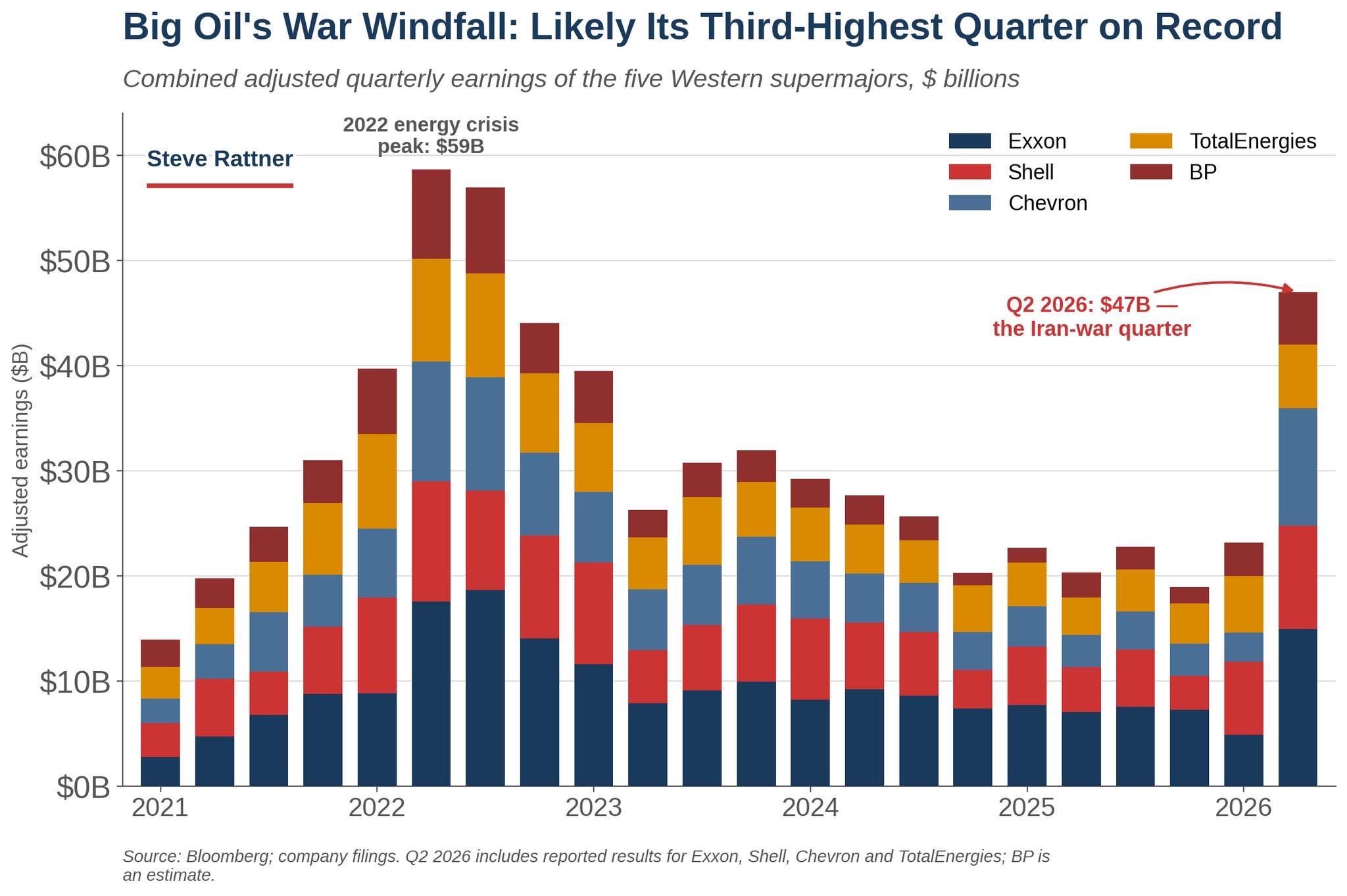
US President Donald Trump has again called on oil companies to lower gasoline prices for American consumers, chiding Chevron Chief Executive Mike Wirth in a television interview for not crediting his administration’s efforts to help the oil industry.
“The only thing he conveniently forgot to mention is that, without the genius, foresight, strength, and stability, of the TRUMP Administration, the Oil Industry, and our Country itself, would be DEAD!” Trump wrote in a social media post.
“Get your consumer (retail!) Oil Prices DOWN, NOW!”
Global oil prices plunged on Monday after Trump held off on a fresh strike against Iran over the weekend, signaling he was pursuing a quick deal.
Tehran, however, said no talks were underway and none are planned for today.
|
|
Meanwhile at the big oil companies:
|
OPEC+ approves 188,000 bpd oil increase from September
The seven member countries of the OPEC+ alliance have decided to increase their oil production quotas by approximately 188,000 barrels per day (bpd) from September.
Saudi Arabia, Russia, Iraq, Kuwait, Kazakhstan, Algeria, and Oman issued a joint statement, saying the decision reflects their collective commitment to supporting stability in the global oil market.
The September increase finishes the phased rollback of a 1.65 million bpd supply cut originally agreed to in 2023, when the group still included the United Arab Emirates, which left OPEC in May.
“OPEC+ has finished unwinding its voluntary cuts. The next challenge is managing the surplus that could emerge as export flows normalize,” said Jorge Leon, an analyst at Rystad Energy.
He warned, however, that the “decision changes little in the near-term because” the Strait of Hormuz “remains constrained”. The real market impact will come when normal export flows resume, he said.
|
|
|
Oil prices close 7% down on Monday
Oil prices settled around seven percent lower at the end of trading on Monday, its lowest closing level since July 13.
Brent crude futures fell $6.35, or seven percent, to settle at $83.77 a barrel. US West Texas Intermediate (WTI) crude declined $4.33, or five percent, to settle at $80.34 a barrel.
The drop in crude prices came as data released by the US Department of Energy showed that crude oil inventories in the US Strategic Petroleum Reserve had fallen to their lowest level since 1983, after the Trump administration approved the release of 172 million barrels from the reserve.
|
|
|
| |
|
|