| Highlights from yesterday |
|
Comments |
- The US bombs Iran for the 12th consecutive night as Iranian media report explosions in the cities of Bushehr, Ahvaz and Sirik.
- Iranian Minister of Foreign Affairs Abbas Araghchi says Tehran’s defense doctrine is an “eye for an eye”, after US President Donald Trump warned that US forces would bomb an Iranian bridge or power plant every time Tehran shoots at a ship in the Strait of Hormuz.
|
|
|
IRGC says tanker on fire after explosion in Strait of Hormuz
Iran’s Islamic Revolutionary Guard Corps (IRGC) says an explosion has set a tanker ablaze in the Strait of Hormuz after it attempted to navigate the southern route off the coast of Oman.
In a statement carried by Iranian media, the IRGC said two other vessels quickly turned back following the explosion.
The IRGC claimed the three ships were acting under US orders and had “intended to pass through the mine-laid route south of the Strait of Hormuz”.
“The powerful IRGC Navy emphasizes that the Strait of Hormuz is under our control and that as long as America’s evil deeds in the region continue, it is completely closed and no oil tanker will enter or exit [the strait],” it warned.
“Any ship that is deceived by America and intends to pass through without coordination with the Islamic Republic of Iran will suffer the same fate.”
|
|
|
Iran warns of wider response after Trump threatens strikes on infrastructure
Iran has responded to Trump’s latest threat that any Iranian attack on ships in the Strait of Hormuz would trigger US strikes on bridges and power plants in Iran, including near Tehran.
Tehran said the threat represents a new escalation and warned that it would respond if Iranian civilian infrastructure is attacked.
|
|
|
US strikes Iran again as Trump threatens civilian infrastructure
President Trump’s threat to hit civilian infrastructure in Iran, such as bridges, has drawn criticism, particularly from Democrats, who are already critics of the conflict and who have pointed out that this would violate the laws of war.
It is important to note that there is some distinction between Trump’s rhetoric and the operational policy of the Pentagon.
So far, there have been 12 consecutive nights of strikes, but these strikes have been somewhat calibrated or measured, and the question is whether or not the US president, who is also commander in chief of the military, will take that further.
What we do know is that Iran has responded in kind with its own rhetoric, arguing that if they cannot sell oil, then they will ensure that US allies and the Gulf also will have difficulty selling oil.
So, this definitely does raise the stakes, not only when it comes to military conflict, but also in terms of the global economy.
|
|
|
Missiles hit Iran’s Shalamcheh, near Iraq border
US missiles have struck the area around a passenger terminal in Shalamcheh, a western city near the Iraqi border, a local official has told the Mehr news agency.
The attack did not result in any injuries, and people are continuing to travel without issues, the agency reported.
|
|
|
Two killed in US attack on Iran-Iraq border crossing
Two people have been killed after US forces attacked the Shalamcheh border crossing with Iraq, the deputy governor of Iran’s Khuzestan province told the IRIB state broadcaster.
The official said the border remained open as relief operations continue on site.
|
|
|
At least 11 wounded in deadly US attack on Iran-Iraq border
The earlier reported US missile attack on the Shalamcheh border crossing, which killed two people, has also wounded 11 others, the deputy governor of Khuzestan province told Iranian media.
|
|
|
Travelers panic as US attacks Iran-Iraq border crossing
A US strike has hit the Shalamcheh border crossing between Iran and Iraq overnight.
Two people were killed and 11 injured, according to Iranian state media.
|
|
|
US attacks target Iran’s Khuzestan, Hormozgan and Bushehr provinces
US continued air attacks. targeting cities across southern Iran overnight.
In the southwestern province of Khuzestan, at least three cities were hit, including Ramshir, where an asphalt facility was said to be targeted. Explosions were also reported in areas adjacent to Ahvaz as well as in Mahshahr, another important port city.
In Hormozgan province, explosions were heard in the city of Sirik, which is very important as it oversees the Strait of Hormuz.
In the city of Bushehr, the governor confirmed an attack overnight and said that on Wednesday, a power substation near Bushehr nuclear power plant was also targeted, resulting in a few hours of power outage in the city.
Meanwhile, the Iranian side is also talking about retaliatory strikes, and we’ve got reports from different countries across the region, including Kuwait, where attacks were reported targeting US military assets.
|
|
|
US strikes Bushehr military site
US forces have launched a second missile attack on Bushehr province, the Fars news agency reports, citing the deputy governor.
The official said the strike hit a military site at about 4am local time (00:30 GMT).
|
|
|
US missile attack hits near Andimeshk
A US missile attack has hit a location on the outskirts of the city of Andimeshk, Iran’s semi-official Tasnim news agency reports, citing the deputy governor of Khuzestan province.
|
|
|
Explosions heard in Iran’s Jask
Explosions have been heard in Jask, Iran’s state broadcaster IRIB reports.
The port city is in the Hormozgan province of southern Iran.
|
|
|
Oil prices climb to $96 a barrel
Oil prices are extending their gains, with Brent crude futures rising $1.93 as of 00:11 GMT, or 2 percent, to reach $96 a barrel, marking their highest level since June 8.
US West Texas Intermediate (WTI) crude went up $1.44, or 1.7 percent, to trade at $88.27.
The increases came after US forces launched a new round of strikes on Iran and Yemen’s Houthis attacked oil tankers in the Red Sea. In the previous session, Brent had settled more than $3 higher at $94.07 a barrel, while WTI rose nearly 3 percent on Wednesday.
|
|
|
Hormuz closure creating ‘serious risks’ for food production in Bangladesh, WFP says
Bangladesh is at “severe risk” of a “potential fertilizer crisis” due to rising urea prices following the closure of the Strait of Hormuz, the UN’s World Food Program (WFP) has said.
Bangladesh relies on imports from Saudi Arabia, Qatar, and the UAE for about 80 percent of urea fertilizer supply and currently only has enough in storage to last until October, the WFP said in a new report.
The price of urea has now risen by approximately 50 percent, while three of Bangladesh’s five state-owned urea fertilizer factories have been forced to shut down production due to gas shortages, the WFP added.
The ongoing crisis is contributing to estimates that as many as 18.1 million people will experience acute food shortages, the WFP added.
|
|
|
Less than 30% of Americans support war on Iran
Most polls show that less than 30 percent of Americans are in support of the war in Iran, and that number is continuing to decline.
This has to do with a number of things.
Not only did Donald Trump campaign on ending foreign entanglements and bringing the US out of “forever wars”, but the cost of goods and services has also risen alongside a spike in the price of oil and energy.
We also know that – as the US president visited Dover Air Force Base on Wednesday – the rising casualty numbers are also impacting Americans.
But the bottom line in all of this is that Americans feel this is just too expensive.
All week on Capitol Hill, officials including the defence secretary and the chair of the Joint Chiefs said they need more money for the war in Iran, a conflict the president had suggested would be short.
Now, the US House has passed a resolution authorising up to $73bn more for a war that most Americans say the country cannot afford.
|
|
|
US-Israel war on Iran risks leaving everyone ‘a loser’
Joey Hood, a former US ambassador to Tunisia, says the US and Israel’s war on Iran risks leaving everybody a “loser” unless all parties turn to a negotiated settlement to end the conflict.
Hood told Al Jazeera that while Trump had erred in joining Israel’s assault on Iran, Tehran’s retaliation, including against neighbours, was proving counterproductive.
“Donald Trump made a huge strategic mistake in attacking [Iran] along with Israel without consulting the Gulf countries or taking into account what Iran’s responses were likely to be,” Hood said.
Iran, meanwhile, has lashed out “at absolutely everyone that it can reach” without “really affecting the US”, he said. Iran has managed to take “out a handful of aircraft” and killed 18 US troops, but “strategically, they haven’t been able to really land a punch against the” US, he argued.
When “Trump pokes them in the eye, they turn around and slap the Kuwaitis or the Qataris, and that’s not going to be a winning strategy for them”.
“So, I think you have a situation right now where everybody turns out to be a loser unless there is a negotiated solution to this,” he added.
|
|
|
Iranian missiles show deadly precision amid US-Iran war escalation
An Iranian attack on a US military site in Jordan that killed three US soldiers has shown the IRGC’s ability to inflict a deadly toll five months into the US-Israel war on Iran.
The strikes on Friday were the first time US soldiers have been killed by Iranian attacks on US military installations since March 1, just hours after the US and Israel launched the war.
While the Pentagon has not released full details of the attack, analysts say the deadly incident underscores an uncomfortable reality for Washington: Despite barrage after barrage of US air strikes, Iran maintains the military capability it needs to continue a prolonged asymmetric war.
|
|
|
US completes 12th consecutive night of strikes on Iran
US Central Command (CENTCOM) says it has completed another round of strikes to “further degrade Iran’s ability to attack civilian mariners and commercial vessels”.
In a statement, CENTCOM said its forces struck “Iranian military targets including maritime capabilities, missile and drone storage facilities, coastal surveillance sites, and air defense assets” in the latest wave.
It added that US forces have targeted dozens of land-based Iranian military sites this month while also enforcing a maritime blockade. “As of today, CENTCOM has redirected nine commercial vessels and disabled one to prevent ships from entering or departing Iranian ports,” it said.
“More than 50,000 US service members are operating across the Middle East and remain highly vigilant, focused, lethal, and ready,” the statement added.
|
|
|
US advises ‘Americans worldwide to exercise increased caution’
The US State Department has renewed a security alert advising Americans “worldwide to exercise increased caution” due to “heightened tensions in the Middle East”.
“The security environment remains complex with the potential for unforeseen escalation,” the department said in its latest update.
The alert noted that “US diplomatic facilities, including outside the Middle East, have been targeted”, and warned that “Iran and groups supportive of Iran may target other US interests overseas or at locations associated with the United States and Americans throughout the world, including US businesses and other institutions”.
In particular, the alert advised Americans currently in the Middle East to be aware of potential flight and other travel disruptions, and said: “Americans outside the Middle East should reconsider travel to and through the region.”
|
|
There are no reports from around the world which confirms that there is a developing threat towards American people anywhere in the world.
The message is a behavior of exaggeration self-inflicted by the US as a result of their illegal war on Iran.
The situation co-created by the US since February 28th remains a regional military issue and affects only American people who remain in that region. It is the US who exposed them to danger since that date, not Iran.
|
Two killed, 11 wounded in Iran as explosions rock southwestern provinces
Explosions have been heard in different Iranian provinces in recent hours, particularly the southwestern province of Khuzestan.
In several cities, explosions were reported, including in Ramshir, where an asphalt storage facility was targeted, and also in Ahvaz, in Mahshahr and Andimeshk.
Most importantly, explosions were reported in an area close to a passenger station in Shalamcheh, a border area close to Iraq. As a result of this, according to local authorities, at least two people were killed and 11 injured.
At least eight people have been killed over the past few weeks, and at least 10 people have been killed as a result of the US’s air strikes since the beginning of this new round of confrontation.
In Hormozgan province, explosions were also reported in Sirik and, most recently, in Jask. These cities are critically important as they oversee the Strait of Hormuz amid Iran’s claims of control and authority over the waterway.
Two explosions were reported in Bushehr as well: one earlier in the night, and another more recently.
|
|
|
US agencies warn of Iranian-affiliated cyber security threats
US government agencies, including the Cyber security and Infrastructure Security Agency and the FBI, have issued an advisory, warning US organizations of “ongoing Iranian-affiliated cyber activity targeting” internet-connected devices.
“Iranian cyber actors continue to target US critical infrastructure, and the FBI is committed to identifying, disrupting, and imposing costs on those responsible,” assistant director of the FBI’s cyber division, Brett Leatherman, said in a statement.
“This advisory provides network defenders with the information they need to identify malicious activity, strengthen their defenses, and reduce opportunities for Iranian cyber actors to disrupt the essential services Americans rely on,” Leatherman added.
|
|
|
Iranian actors pose ‘genuine risk’ to US critical infrastructure
Jody Westby, chief executive of cyber security firm Global Cyber Risk, has told Al Jazeera that the US government’s advisory warning of Iran-affiliated cyber-threats reflects a “genuine risk”.
Westby said US authorities have observed attacks “targeting US critical infrastructure” that they believe are “clearly” being conducted “with the Iranian Revolutionary Guard’s Electronic Cyber Command group”.
“So these are skilled, smart people conducting cyber attacks,” she said.
The potential systems that could be at risk include those at hospitals, as well as at water, waste management and electricity facilities.
Westby said the targets, as well as conditions in the US, which is currently experiencing a “very hot summer”, mean that the attacks “could have a significant impact”.
The “very fractured and fragmented private sector network structure” in the US “doesn’t allow for rapid or large government response, and so they [Iran] are going to take advantage of that”, she said.
“Five months ago, we went to war with Iran, [and] this is what we get with asymmetrical warfare. This is Iran striking back,” she added.
|
|
On the left, cited statements are marked with quotes, which suggest that they are claims while evidence are missing.
|
Hegseth wants $70bn more to keep fighting
Iran activated air defense systems across Tehran on Wednesday as the war edges closer to the capital.
Meanwhile, the Pentagon is seeking nearly $70bn more to sustain the war, on top of the $37.5bn it has already cost.
|
|
|
Two rescue boats damaged in US attack on Iran’s Hormozgan
Two naval search and rescue vessels have been hit and seriously damaged in a US attack on Iran’s Hormozgan, the ISNA news agency has reported, citing the province’s Ports and Maritime Administration.
|
|
|
Trump faces ‘very tall order’ in getting deal on Hormuz and Iran’s nuclear program
Joey Hood, former US envoy to Tunisia said Trump “threw away the possibility of an agreement on the nuclear program in February” and now needs a far more ambitious deal.
“Now he needs not just an agreement on the nuclear program, but also one that gives up Iran’s stated goal of trying to control the Strait of Hormuz, and with it, the economies of Iraq and the Gulf States,” said Hood.
“That’s a very very tall order,” the former envoy said. “But obviously diplomacy is going to be the answer to this, not a military solution. If a military solution was going to work, it probably would have worked by now.”
Hood said the conflict has widened into a regional war, because Iran believes that by drawing in other countries, “somehow, the rest of the world will side with Iran, and will put pressure on Donald Trump”.
But the calculation is mistaken, he argued.
“As much as other governments may not like” Trump, they “have way too much bound up in the United States, politically and economically, and they have absolutely nothing in common with Tehran”.
The only exception, he said is China, which has been Iran’s largest oil customer.
“If China decides to get more involved, that could change the balance of things here. But for now, I think what Trump sees is that the rest of the world does not agree with Tehran, even if they’re not supportive of him.”
|
|
|
IRGC claims attacks on Kuwait
Iran’s Islamic Revolutionary Guard Corps (IRGC) has claimed more attacks on US military assets in Kuwait, saying the strikes are retaliation against Washington and not the Kuwaiti people.
The IRGC said it had “attacked and destroyed a large warehouse of military equipment, a Patriot missile defence system, and a hangar of American MQ9 drones” at Ali al-Salem airbase.
It also claimed attacks on US forces’ accommodation and two helicopter hangars at the Al-Adiri barracks, saying the attacks caused casualties and inflicted heavy damage on helicopters and drones.
The IRGC added that its fighters “targeted a telecommunications tower in response to US attacks on telecommunications towers in Iran”.
|
|
|
IRGC tells Kuwaitis: It is US, not Iran, that violates your sovereignty
More from the IRGC statement.
Addressing the Kuwaiti people directly, the IRGC insisted it is the United States, not Iran, that has “violated your territorial integrity and sovereignty”.
It said its attacks are aimed at US bases, territory it described as beyond the control of Kuwait’s own border guards, and where Americans and anyone they want, including prisoners from other countries, enter and leave freely.
“So it is America that has violated your territorial integrity and sovereignty, not us. We are attacking lands occupied by the American army, an army that knows nothing but crime,” it said.
|
|
"It is US, not Iran, that violates your sovereignty"
Iran is wrong.
The US is not violating Kuwait's sovereignty but Kuwait is violating international law. Here is why:
The United States is a war belligerent since February 28th. It is to their allies in the region to decide how they respond to US changed position from a hosted military guest to a hosted war belligerent.
In all summaries regarding attacks from Kuwait, we notice the use of HIMARS MLRS systems operating on its soil to fire missiles on targets in Iran. This means that Kuwait allows its hosted war belligerent to use its soil for attacks on Iran.
Kuwait is facilitating in a US war that has no authorization from the UNSC; is nuclear political motivated therefore infringing Iran's sovereignty, and disregards civilian casualties and the protection civilian objects and infrastructures have. They all are in violation of the UN Charter.
Kuwait is co-responsible for this all under states responsibility laws.
|
Qatar, Pakistan, Egypt propose truce amid Iranian attacks on Gulf states
It’s been busy nights and days [in the Gulf] in the past 12 consecutive nights of US attacks.
Iran’s formula is pretty straight. They’ve laid it out, saying, “Eye for an eye”, after the US president said that his forces are going to attack an Iranian bridge or a power plant every time a ship gets attacked in the Strait of Hormuz. Iran says they’re going to play it the same way.
These attacks continue across GCC countries, namely Kuwait and Bahrain, in the past 12 days, and also Jordan. On Wednesday, Jordan’s military said that it shot down four missiles, and Kuwait was also attacked.
So, in all these days, the GCC countries come under attack for a war they did not start, for a war they say they do not support, and if at all, are making efforts to bring back the ceasefire.
The latest on that is we’ve had Qatar, Pakistan and Egypt propose a 10-day ceasefire between Washington and Tehran, so that this does not widen into a regional conflict.
|
|
|
Top Jordanian and Saudi diplomats discuss efforts to de-escalate tensions
Foreign Minister Ayman Safadi has held a phone call with Prince Faisal bin Farhan Al Saud and exchanged views on regional developments, according to a statement by the Jordanian Foreign Ministry.
“The two ministers discussed regional developments, the efforts being made to de-escalate tensions and ensure freedom of maritime navigation in the Arabian Gulf and the Red Sea,” the statement said.
They also discussed “coordination and consultation regarding diplomatic efforts aimed at enhancing security and stability in the region”.
|
|
|
Iran claims more attacks on Jordan
Iran’s Islamic Revolutionary Guard Corps (IRGC) claimed attacks on US assets in Jordan, saying it has “destroyed a radar of the American THAAD missile defense system with lightning strikes”.
It said a “Patriot system and a C-RAM radar were also targeted and destroyed, and the fuel tanks of the American base were set on fire”.
It added that “a large helicopter equipment warehouse and a helicopter repair and maintenance shed were also set on fire and destroyed”.
The IRGC, addressing the Jordanian people, insisted that its actions do not violate Jordanian sovereignty, arguing that US military presence infringes on local authority and that targeting American forces is a legal and necessary response.
There was no immediate comment from Jordan.
Earlier, the IRGC also claimed attacks on US military assets in Kuwait.
|
|
|
Iran warns of ‘new strategies’ if US attacks on southern infrastructure continue
Brigadier General Amir Mohammad Akraminia, a spokesperson for Iran’s army, has warned that the country’s security forces will “implement new strategies and scenarios to make the war impossible for the aggressors to continue” should US attacks on Iran’s southern infrastructure persist.
“Following the American side’s violation of the memorandum of understanding, we are now witnessing a new phase in the war,” he told Iran’s Defense Press news agency in an interview.
Akraminia said Iran’s armed forces were carrying out retaliatory strikes in response to what he described as US aggression, adding that such operations “will continue as long as US attacks against the country’s infrastructure and coastal areas persist”.
More from the Brigadier General’s interview with the Defense Press news agency:
- “We took full advantage of the ceasefire opportunity to improve our situation and combat capability.
- “Today, we are better prepared than in the past.
- “We do not consider any action by the enemy to be impossible or unlikely; for this reason, we have enhanced our preparations for any scenario.
- “If the enemy invades via land routes, its vulnerability will certainly be much greater than air and missile attacks.
- “Ground operations provide many opportunities to damage and inflict more casualties on the enemy, and our effectiveness and efficiency will certainly be much higher in this area.”
|
|
|
Thai survivors of ship attack in Hormuz sue owners for ignoring Iranian warnings
Three sailors who survived an attack on the Thai cargo ship Mayuree Naree are suing the vessel’s owners, alleging that Iranian warnings were ignored ahead of the strike.
The ship was hit on March 11 in an attack that killed three crew members.
“The moment I heard the explosion, I thought that was it. I knew something serious had happened. No ordinary explosion would have been that loud – so loud that it completely shocked me,” said Panithi Tumkaew, one of the three sailors.
He said he can no longer face returning to sea and has been forced to leave his job, receiving just $5,000 in back pay.
The case has drawn attention to the risks facing seafarers amid the Hormuz crisis, an aspect of the conflict that has been overshadowed by its impact on energy and fertiliser markets. Tens of thousands of sailors, many stranded for more than six months, have borne the brunt of the disruption.
Southeast Asian crews, from countries including the Philippines, Indonesia, Myanmar and Thailand, form the backbone of global shipping, though many remain reluctant to speak out for fear of losing their jobs.
|
|
|
‘Iran is begging for a deal’: Rubio
US Secretary of State Marco Rubio is speaking now on the sidelines of the ASEAN conference in Manila.
“Iran is begging for a deal,” he said. “It looks like Iran is not ready to make a deal, they will pay the price,” he added.
“Every time they make a deal, they either break it or change it.”
|
|
|
‘Price on Iran is getting higher every night until they come to their senses’: Rubio
“The price on Iran will get higher every night until they come to their senses,” he said.
He also commented on the situation in Yemen, saying that he hopes the Houthis will de-escalate. “They got snookered by Iran.”
|
|
|
Rubio says Iran ‘is not serious about making a deal’
The US secretary of state made the remarks as he gave a news conference in Manila.
“I just don’t think they’re serious about making a deal,” he told reporters.
“The problem with them is you can’t make a deal with people unless they’re going to keep it,” the US top diplomat said, claiming that Tehran “breaks” or tries to “change the deal” after entering into them.
He concluded: “So now they’re paying the price for it, and maybe they’ll change.”
|
|
The only person who was and is still not serious, is Trump, notably behind the scene of the Islamabad talks, and during attempts to implement the MoU, by constantly issuing threats to force Iran to follow the line that is not outlined in the MoU; by arbitrary interpretations of the MoU, and by ending ceasefire with Iran unilaterally.
|
A head for an eye’: Rubio defends Trump’s hard line stance on Iran policies
When asked about Iranian officials referring to an “eye for an eye” policy, Rubio said Trump’s approach was “a head for an eye”.
“They will pay a very heavy price for the things they are doing. They are already paying a heavy price,” Rubio said, claiming the country’s industrial infrastructure was being “decimated,” resulting in “billions” of dollars of damage.
|
|
|
Iran ‘can be the richest country in the Middle East’: Rubio
The US secretary of state says Iran “is a country run by radical clerics,” calling them “oblivious” to economic issues.
“They are destroying their country,” he said, adding: “Iran can be the richest country in the Middle East if they wanted to be.
“But instead they take their money, and they use it and they give it to Hezbollah, they give it to Hamas, they give it to the Houthis. They give it to Shia militias. They give it to sponsored terrorism all over the world.”
Rubio concluded that the primary focus of the US is “a denuclearised Iran”.
“They cannot have nuclear weapons; I mean, imagine what they would do to the world.”
|
|
|
US attacks on Iran’s infrastructure, military targets persist for 12th consecutive night
Iran has witnessed daily US attacks on civilian infrastructure and military targets for a 12th consecutive night.
The latest attacks hit the passenger terminal of the Shalamcheh border crossing, killing two people and injuring others.
This is a critical border crossing not just for religious reasons, but it is also a major trade gateway connecting Iran and Iraq.
There was also an attack on a storage facility in Ahvaz. Iranians say the US has attacked this site to prevent the repair of civilian infrastructure.
In the past 12 days, we have seen the US targeting civilian infrastructure; roads and bridges have been hit in Iran.
Also, for the second time, the northwestern region of Kermanshah was attacked. This is an important area as it borders Iraq and hosts some important IRGC military installations.
|
|
|
Jordanian army says its air defenses intercept multiple missiles, drones
Four Iranian missiles and six drones have been shot down in the past 24 hours, according to a report by the official Petra News Agency that quotes a military official.
The source “confirmed that the operation did not result in any human casualties or material losses”.
|
|
|
Sirens sound in Bahrain
Hostile aircraft sirens have sounded in Bahrain once again.
The Ministry of the Interior has urged citizens and residents to remain calm and “head to the nearest safe location”.
|
|
|
Nuclear enrichment on Saudi soil might lead to a nuclear race: Former Israel PM Bennett
A deal between the United States and Saudi Arabia allowing the kingdom to build nuclear reactors using American technology and to enrich uranium “could lead to a regional nuclear race,” according to former Israeli Prime Minister Naftali Bennett.
“The nuclear agreement that is coming together with Saudi Arabia, over Israel’s head, is a serious strategic failure that endangers our security,” said Bennett, who is seeking to unseat Netanyahu in an October 27 election.
“Nuclear enrichment on Saudi soil could lead to a regional nuclear race and a dangerous loss of control.”
The Trump administration plans to submit to the US Congress in the coming days the pact with Saudi Arabia, according to reports.
The two sides signed a preliminary agreement in Riyadh last year.
|
|
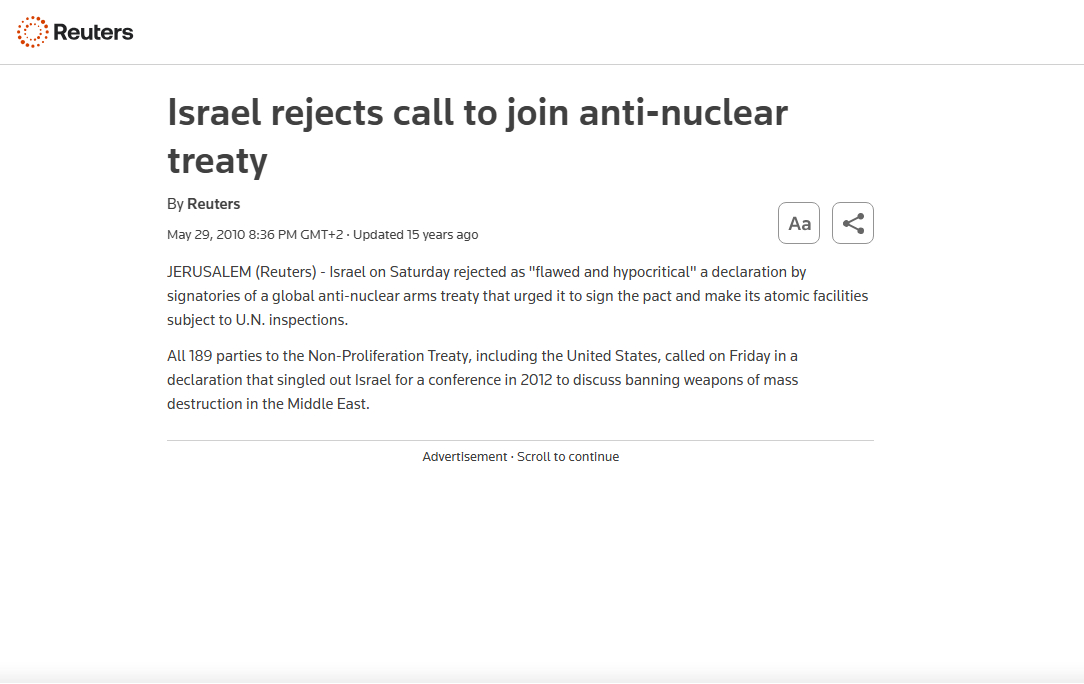
With the launch of the secret Nuclear Manhattan Project in 1942, so not the Nazis as Hitler showed no interest in the created nuclear fission by German scientist, the United States became the inventor of the nuclear militarization, and triggered the rise of nuclear powers in the world. Among them the Israelis in 1956.
In 1968, the Israelis started their own sort of nuclear arms race, in particular between the 1970s and 1980s, but to prevent Arab countries from starting their own nuclear program. Iraq and Syria where preemptively attack under the pretext of "Make sure that no enemy has a nuclear reactor." This, while no country in the world saw in another country a nuclear enemy.
In 2010, the pretext became "Make sure that Iran has no nuclear program/weapons," as the Israelis began to launch a campaign of assassinations of Iranian nuclear scientists and cyber attacks and sabotage on Iran's nuclear program.
So, there has been a some sort of nuclear race in the Middle East for decades by the Israelis only to make sure that they are the only nuclear power in the region. The war on Iran is just part of that race, now fought by Trump.
|
Trump says US-Saudi nuclear deal conditional on country joining Abraham Accords
President Donald Trump says any civil nuclear deal with Riyadh is conditional on Saudi Arabia joining the Abraham Accords.
He added in a post on social media that there will be no enrichment of material under such a deal between the US and Saudi Arabia.
“The Civil Nuclear Deal (There will be no enrichment of material!) being made between the United States Department of Energy and Saudi Arabia, which pertains only to non-military use such as the ones that Iran and UAE (and others) already have, will be approved, but is totally subject to Saudi Arabia joining the very respected and successful Abraham Accords,” he said.
|
|
|
Trump’s claims on Saudi nuclear deal raise confusion
There is a little of confusion concerning Trump’s latest post on Truth Social as he mentioned that Saudi Arabia will not be allowed to produce or enrich its own nuclear fuel.
The agreement signed between the two countries’ energy secretaries does indicate that Saudi Arabia will be allowed to produce its own nuclear fuel though it specified that it won’t be allowed to reach weapon grade.
Secondly, Trump said that this is subject to Saudi Arabia agreeing to the Abraham Accord with Israel. This does not appear to be part of the original agreement either.
This is a 123 deal as it is called. The US has more than 20 such deals with more than 50 countries and institutions, including the UAE, and that deal is different because the UAE is now allowed to enrich its fuel and it has to be subject to inspections by the International Atomic Energy Agency (IAEA). The deal between Washington and Riyadh does provide for inspections but does not mention the IAEA.
So there are many questions that arise and no doubt there will be many questions in Congress.
|
|
|
Netanyahu hails prospect of Saudi Arabia joining Abraham Accords over nuclear deal
Israeli Prime Minister Benjamin Netanyahu says that if Saudi Arabia joins the Abraham Accords, it would be “an historic leap forward for peace in the Middle East”.
Earlier on Thursday, Trump said in a post on Truth Social that a landmark deal with Saudi Arabia allowing Riyadh to develop a civilian nuclear program was conditional on the Gulf kingdom joining the Abraham Accords.
Riyadh has not publicly responded to Trump’s comments. However, Saudi Arabia has maintained that it will not recognize Israel until a viable pathway to an independent Palestinian state is established.
Trump did not suggest the deal was conditional on Riyadh joining the Abraham Accords when it was announced on Wednesday.
Currently, the UAE, Bahrain, Sudan, Morocco and Kazakhstan are signatories to the accords.
|
|
|
The security implications of the US-Saudi nuclear deal
United States President Donald Trump agreed to a 30-year nuclear deal with Saudi Arabia on Wednesday that would see Washington transfer nuclear technology to the Gulf kingdom.
This has drawn concerns that if the deal comes to fruition, it could spark a nuclear arms race across the Middle East amid reports that Riyadh would be able to enrich its own uranium, a necessary step in acquiring nuclear weapons.
US officials have stressed the proposed deal would serve civilian nuclear purposes, although exact details of the agreement have not been made public.
|
|
|
Iran slams US policy of ‘collective punishment’
The US government “intends to sacrifice whatever remains of international humanitarian law and the foundations of human ethics and civilization to its insatiable appetite for war and slaughter,” the Iranian Foreign Ministry spokesman says.
Esmaeil Baghaei claimed that Washington follows “a policy that calls for the destruction of bridges and power plants, which is manifestly unlawful and criminal”.
“It constitutes reprisal and collective punishment – both of which are explicitly prohibited as war crimes under international humanitarian law,” the Iranian official added.
He urged military personnel to refuse unlawful orders and said Iran would stand firmly “against lawlessness”.
|
|
|
UAE slams new attacks on Bahrain, Kuwait and Jordan
The UAE’s Foreign Ministry has “strongly condemned the renewed Iranian aggression” on the three Middle East countries.
In a statement, the minister affirmed that these attacks “constitute a blatant violation of the sovereignty of these brotherly nations and a threat to their security and stability”.
It reiterated the UAE’s “full solidarity” with the three nations.
|
|
|
Abdali border crossing targeted in drone attack: Kuwait Defense Ministry
Kuwait’s Ministry of Defense says the Abdali border crossing was targeted by drones this afternoon. The attack caused material damage but no casualties, the ministry’s spokesperson, Saud Abdulaziz al-Atwan, said in a statement.
Specialized teams have taken all necessary measures to secure the site in coordination with the relevant authorities, he said. Drone debris is being cleared, he added.
Located in Kuwait’s northern al-Jahra province, Abdali is the country’s main land border crossing for passenger and commercial traffic with Iraq.
|
|
|
Kuwait says fire at Abdali border crossing brought under control
Kuwait says firefighters have brought a blaze at the Abdali border crossing under control after the facility was targeted by drones earlier today.
Kuwait Fire Force spokesperson Brigadier General Mohammed al-Gharib said crews from the al-Subiya and Abdali fire stations successfully contained the fire at the northern border crossing.
Earlier, we reported that Kuwait’s Ministry of Defence said the drone attack caused some damage but left no casualties.
|
|
|
Kuwaiti border crossing ‘becoming a flashpoint’, suggesting wider escalation
The Al-Abdali border crossing is in the north of Kuwait, along the border with Iraq. A statement from the Kuwaiti Ministry of Defense says that it was attacked by numerous drones over the course of today. They say there have been no casualties, but there has been material damage.
This is not the first time this border crossing has been attacked. Last Friday, there was an attack involving an unknown projectile that landed and caused a fire. That was on the same day that Kuwait said it had been targeted by 32 drones.
Then back in April, this area was once again attacked, and back then the authorities in Kuwait felt the attack was coming from Iran-backed groups in Iraq. We don’t know if that is the case this time, but if it is, that would suggest that this border crossing is becoming a flashpoint, and it points to a wider escalation in this war.
|
|
|
Kuwaiti army says it is protecting the ‘homeland’s borders’ following attack
The Kuwaiti army says authorities are taking the necessary measures after the Abdali border crossing with Iraq was repeatedly attacked by “hostile drones”.
“The Armed Forces affirm their continued execution of their missions and duties with high efficiency, and their adoption of all necessary measures to protect the homeland’s borders and preserve its security and stability,” Saud Abdulaziz al-Otaibi, the spokesman for the Ministry of Defense, said in a statement posted on X.
Officials say the attack caused material damage but no casualties. The ministry is yet to apportion responsibility for the strike.
The crossing is Kuwait’s main land border crossing with Iraq and was targeted last week and also in April. Officials believe April’s attack was carried out by Iran-backed groups in Iraq.
|
|
|
Iran’s Araghchi says US should change its ‘hegemonic approach’
The Iranian foreign minister has spoken to the national media on the sidelines of the meeting between Iranian President Masoud Pezeshkian and Iraqi Prime Minister Ali al-Zaidi in Tehran.
“[The Iraqi PM] had a trip to Washington, and it is natural for him to convey his own views and impressions from that trip to us, which is a normal matter,” he said regarding al-Zaidi’s recent trip to the US.
“Moreover, we do not currently have a problem with the issue of mediators with the United States – there are enough mediators between us who are carrying out this role,” Araghchi added.
He said that the problem is not the issue of the exchange of messages between the sides.
“The problem is the nature of the US approach – its irrational, excessive and hegemonic approach – which has been met with a firm response from our side,” Araghchi said.
“As long as they do not understand that there is no way forward other than respecting the Iranian people and respecting their interests, it will not be effective,” the top diplomat concluded.
|
|
|
Iran’s Foreign Ministry condemns UK over use of British bases in US strikes
Iran’s Foreign Ministry, in a statement carried by Mehr News Agency condemned the UK’s decision to let the US use British bases and facilities for military strikes against Iran, calling it a violation of the UN Charter and international law.
“Such action could constitute participation in an act of aggression against Iran,” the ministry said, adding that assisting US-Israeli attacks amounts to complicity in aggression and war crimes.
The ministry accused the UK of siding with the aggressors rather than condemning them, and cited past UK actions against Iran, including the 1953 coup.
Iran said it will defend its sovereignty, and warned any country aiding attacks will bear the consequences.
|
|
International law considers parties who facilitate a war belligerent by assisting in the preparation of attacks during a war on a third party country, they are contributing to the violation of the UN Charter and therefore also responsible under states responsibility laws.
Britain cannot claim that the US is using its territory for defensive attacks on Iran because the Americans are waging a war across borders, meaning that they are not attacking from their own territory. This is a violation of international law.
So, Iran has a point.
|
Trump says he is considering a ‘massive attack’ on Iran
US President Donald Trump has told Axios that he is seriously considering restarting major combat operations against Iran, saying Tehran “haven’t received enough pain yet”.
“I am considering a massive attack. Bigger than ever before. I am close to making a decision. We are all set for it,” Trump was quoted as saying on Thursday.
Trump acknowledged that such a decision would have consequences but said he had not yet made a final determination or set a deadline. He said Israel “would join in two minutes if I ask them to”, before adding: “We don’t need anybody.”
Trump also said there would be “consequences” if Israel joined the attacks, appearing to refer to possible Iranian retaliation against it. The US president went on to claim that Iranian officials “want to negotiate” but were not currently ready to reach a deal.
|
|
|
Oman’s sultan, France’s Macron discuss regional tensions in phone call
Sultan Haitham bin Tariq Al Said of Oman and French President Emmanuel Macron discussed the latest regional developments during a phone call, Oman’s Foreign Ministry says.
The two sides addressed “regional and international efforts” to contain the escalating tensions “in a way that contributes to preserving the region’s security and stability” and the importance of maintaining “the safety of navigation in accordance with the provisions of international law”, according to the ministry’s statement on X.
|
|
|
US State Department tells citizens in Middle East to prepare for potential flight cancellations due to Iran war
The US State Department has issued an advisory urging US citizens in West Asia to be prepared for emergency travel situations due to potential flight cancellations and disruptions to air travel as a result of the Iran war.
This warning comes amid President Trump’s latest threat to carry out a “massive attack” on Iran.
|
|
|
Gulf states, Jordan condemn Iranian attacks
The Gulf Cooperation Council and Jordan have condemned Iran’s continued attacks, calling them “a clear act of aggression that violates the United Nations Charter and international law”, according to a joint statement.
“The seven countries affirm their inherent right to self-defense, individually or collectively, in accordance with Article 51 of the Charter of the United Nations”, the statement reads, calling on the UN Security Council “to recognize the right of countries affected by Iran’s attacks to defend themselves, and to issue an urgent resolution demanding an immediate halt to Iran’s attacks”.
It also affirmed “the commitment to freedom of navigation in the Strait of Hormuz and Bab al-Mandeb and to maintaining regional security”.
|
|
Article 51 of the Charter of the United Nations
Nothing in the present Charter shall impair the inherent right of individual or collective self-defense if an armed attack occurs against a Member of the United Nations, until the Security Council has taken measures necessary to maintain international peace and security. Measures taken by Members in the exercise of this right of self-defense shall be immediately reported to the Security Council and shall not in any way affect the authority and responsibility of the Security Council under the present Charter to take at any time such action as it deems necessary in order to maintain or restore international peace and security.
Jordan and the GCC countries are misusing Article 51, as we commented earlier that Donald Trump is waging a war across borders, meaning that he is not attacking from his country but from the mentioned countries without having a UNSC mandate.
Article 51 does not protect countries when they are at least assisting in the preparation of attacks on Iran by the United States.
Then, as a member of the United Nations, the US began attacking Iran on February 28th, which is also a member of the United Nations. Trump didn't wait for any measure to be taken by the UNSC.
|
UN chief warns situation in Middle East ‘getting out of control’
UN Secretary-General Antonio Guterres warned Thursday that an “alarming disregard for international law” is driving worsening crises across the Middle East, telling the UN Security Council that conflicts are “increasing in number, complexity, length and scope”, while “impunity is spreading”.
“The situation is getting out of control,” he said. “It is teetering on the edge of the unimaginable.”
Guterres called for navigational rights around the Strait of Hormuz and Bab al-Mandeb to be “fully restored,” stressing “diplomacy is the only way forward.”
On Gaza, he said civilians still pay a heavy price despite the ceasefire, with killings continuing “as Israel increases its control of Gaza” and conditions remaining “intolerable”.
In the occupied West Bank, he warned of “creeping annexation”, violence and “large-scale displacement”, adding: “The region is being pulled into an ever-widening circle of confrontation.”
|
|
|
Omani and UK FMs discuss Iran war
Oman’s foreign minister has discussed the US-Israeli war on Iran with his UK counterpart on the sidelines of the ASEAN Summit in the Philippines’ capital, Manila.
The Omani Foreign Ministry said that Badr Albusaidi and Ed Miliband discussed efforts to stop the fighting and compel both sides to return to negotiations, as well as restoring free and safe navigation in the Strait of Hormuz.
They also spoke about bilateral ties between Oman and the UK.
|
|
|
US investigates possible Russian role in Iran’s targeting of CIA sites in Gulf
US intelligence is investigating whether Russia helped Iran locate and strike CIA facilities in the Gulf, including the US embassy in Saudi Arabia, Reuters reported Wednesday, citing the precision of recent Iranian drone attacks as a possible sign of outside support.
Reports of Iran targeting CIA sites first emerged early in the US-Israel war, with The Washington Post and CNN both citing sources describing Russian help in locating US personnel and assets in the Gulf.
Nicole Grajewski of Sciences Po’s Centre of International Research called Russian involvement a “realistic” theory, noting Iran lacks Russia’s satellite capability. Russia has also been accused of supplying Iran’s drones with an anti-jamming system, though Moscow denies it.
Grajewski said Russian support gives Iran “an edge” but isn’t the main driver of the war, pointing to Iran’s own drone and missile capabilities.
The report comes as US Secretary of State Marco Rubio met Russian FM Sergey Lavrov in Manila Thursday, officially to discuss Ukraine.
|
|
|
US Senate votes down War Powers Resolution to end US involvement in Iran war
Support for the war with Iran is eroding even among President Trump’s staunchest supporters, according to a new poll, as the US Senate [voted down] a War Powers Resolution to end America’s involvement…
The poll found the share of self-identified MAGA [pro-Trump] Republicans who say the war has been “worth” the financial cost has fallen from about 50 percent in May to roughly a third now, with one in five saying the war should end.
Despite the shift, that pressure has not changed outcomes so far. The House passed its own version of the resolution hours earlier, but by one vote fewer than in June. The Senate passed a similar resolution in June — during a ceasefire, with no active conflict or additional American casualties — by 50-48, with only four Republicans joining Democrats.
No president since the War Powers Resolution became law in 1973 has treated it as binding, and it has never been tested in court, meaning even passage would be unlikely to have a practical effect on the war.
|
|
|
Iran’s Araghchi heads to Kyrgyzstan for Shanghai Cooperation Organization meeting
Iranian Foreign Minister Abbas Araghchi has departed for a meeting of the Council of Foreign Ministers of the Shanghai Cooperation Organization (SCO) in Kyrgyzstan.
The meeting is due to take place on Thursday and Friday in the resort city of Cholpon-Ata.
The SCO has strongly criticised the US-Israeli war on Iran and has called for the conflict to be resolved through diplomacy.
Russian Foreign Minister Sergey Lavrov is also set to attend the meeting.
The SCO comprises 10 countries, including China, Russia, Pakistan and Iran.
|
|
|
UK says armed forces ‘stand ready 24/7 to defend’ the country after Iran warning over US bombers
Britain said its armed forces are ready to protect the country from any attack, after Iran’s Revolutionary Guards issued a warning over the use of UK bases by US bombers.
“Our Armed Forces are ready to keep the United Kingdom safe from any kind of attacks, whether it’s on our soil or from abroad. The UK stands ready 24/7 to defend itself,” a government spokesperson said.
“This includes through operating a layered approach to air and missile defense, provided by Royal Navy, British Army and Royal Air Force assets equipped with a range of advanced capabilities, working closely with our NATO allies,” they added.
|
|
International law considers parties who facilitate a war belligerent by assisting in the preparation of attacks during a war on a third party country, they are contributing to the violation of the UN Charter and therefore also responsible under states responsibility laws.
Britain cannot claim that the US is using its territory for defensive attacks on Iran because the Americans are waging a war across borders, meaning that they are not attacking from their own territory. This is a violation of international law.
So, Iran has a point.
|
CENTCOM says it has redirected 12 commercial vessels
The US military says it has “disabled” one ship and redirected 12 commercial vessels since resuming its naval blockade against Iran nine days ago.
In a statement, US Central Command (CENTCOM) said the measures were taken “to prevent ships from entering or leaving Iranian ports or coastal areas”.
CENTCOM did not provide further details about the disabled vessel or the circumstances surrounding the action.
|
|
|
Iran’s Ghalibaf mocks US military strategy in sarcastic post
Iran’s chief negotiator and parliament speaker has mocked the US military strategy aimed at degrading Tehran’s ability to control the Strait of Hormuz, suggesting it has backfired.
“They wanted to punish Iran. Punished themselves with triple-digit oil instead. 10/10 strategy,” Mohammad Bagher Ghalibaf said in a post on X.
Brent crude, the global benchmark for oil prices, temporarily exceeded $100 a barrel on Thursday after the Houthis attacked two Saudi oil tankers.
The US-Israeli war on Iran has triggered a global energy crisis.
Earlier this month, the International Monetary Fund (IMF) downgraded its global growth forecast as a result of the conflict, describing it as a “modest slowdown”. It cut its projected growth rate from 3.1 percent to three percent.
|
|
|
Kuwait’s army says air defenses are intercepting hostile Iranian missile and drone attacks
Kuwait’s army says air defenses are currently confronting hostile missile and drone attacks from Iran, adding that any explosion sounds are from interceptions.
The army urged the public to follow safety instructions from authorities.
|
|
|
Senior Iranian official says Trump’s threats are a sign of desperation
An adviser to Iran’s supreme leader says Trump’s threats to strike Iranian civilian infrastructure show that he is becoming desperate as Tehran continues to absorb military strikes and retaliate by attacking Gulf countries.
“The delusional President of the United States has gone from the ‘Madman Game’ to the ‘Desperate Man Game’ with his deadly mistakes. The attack on pilgrims in Shalamcheh and threats of infrastructure attacks are nothing but desperation and helplessness. Iran’s response to infrastructure attacks will be escalating and severe,” Mohsen Rezaei said in a post on X.
On Wednesday, Trump threatened to bomb an Iranian bridge or power plant every time Tehran targets a ship in the Strait of Hormuz.
Attacking civilian infrastructure is illegal under international law and constitutes a war crime. In exceptional circumstances, civilian infrastructure can be attacked, but only when it contributes to military action and offers a definite military advantage.
|
|
|
IMO chief condemns Red Sea shipping attacks as ‘indefensible’
International Maritime Organization Secretary-General Arsenio Dominguez condemned the latest attacks on Red Sea shipping, calling them “indefensible” and warning they endanger seafarers and threaten global supply chains.
The statement follows Houthi attacks on two Saudi oil tankers, with a Saudi news agency confirming one vessel was ablaze.
“Seafarers must never be placed in harm’s way or targeted in situations of conflict or instability,” Dominguez said, renewing calls for the release of seafarers held captive in the Red Sea and Gulf of Aden.
“De-escalation is the only solution,” Dominguez said, adding that he is also concerned about potential pollution in the Red Sea and Strait of Hormuz.
|
|
|
Iran’s FM Araghchi: ‘Mindless aggression’ will make Trump ‘pay heavier price’ for deal
Iranian Foreign Minister Seyed Abbas Araghchi said officials in the ruling US administration are ignoring “realities on the ground” and are focused only on the 2028 election, in a post on X.
“Compromised individuals in the U.S. administration are burying their heads in the sand,” Araghchi said. “They ignore the realities on the ground and seem focused only on 2028.”
He warned the approach would backfire on President Trump: “The mindless aggression they advocate will only ensure that POTUS [Trump] pays heavier price for deal he’s trying to achieve.”
|
|
|
Iranian media reports explosions on Qeshm Island, possible resumption of US attacks
Iran’s semi-official Tasnim news agency is reporting two explosions near the village of Mosan on Qeshm Island, located in the Strait of Hormuz.
Tasnim is attributing these explosions to US missile strikes, however these reports are unconfirmed.
|
|
|