| Highlights from yesterday |
|
Comments |
- US Defense Secretary Pete Hegseth says the cost of the war on Iran has reached $37.5bn and tells Congress the Pentagon needs $90bn in additional funding.
- US President Donald Trump says he plans to attack a suspected Iranian nuclear site called Pickaxe Mountain “pretty soon, and very heavily”.
- Iran’s Khatam al-Anbiya Central Headquarters says if the US attacks the country’s nuclear sites, there will be an expansion of war in the region.
- Mediators step up efforts to end the hostilities as Iranian Interior Minister Eskandar Momeni holds talks with senior Pakistani officials, including Army Chief Asim Munir, in Islamabad.
|
|
|
US launches attacks on Iran for 11th consecutive night
The US military’s Central Command says forces “began striking military targets in Iran” at 7pm Eastern Time (23:00 GMT) “for the 11th consecutive night”.
“The strikes are designed to continue degrading Iran’s ability to threaten commercial shipping in the Strait of Hormuz,” it said in a post on X.
|
|
|
US attacks target areas near Iran’s Behbahan and Omidiyeh
US missile attacks have targeted areas near the cities of Behbahan and Omidiyeh in Iran’s southwestern Khuzestan province, the province’s deputy governor has told the Fars news agency.
|
|
|
Congress questions Hegseth over Iran war costs
The line of questioning largely fell along party lines.
Democrats were critical. Republicans tried to give Secretary Pete Hegseth the space to make the case for the war.
The view was that both parties would be critical, given how unpopular this war is. But Democrats really pinned Secretary Hegseth on having imprecise language in describing this war effort.
At one point, he said that Iran was destroyed and made combat-ineffective.
Senator Jon Ossoff of Georgia, who’s up for re-election, asked how that could be the case if the secretary is coming before Congress to ask for billions more dollars if America is, in fact, winning this war.
Democrats also point out that this money could be used for a whole host of domestic policy priorities: addressing childcare, healthcare, and energy costs among them.
Hegseth was also interrupted several times by protesters during his testimony. It speaks to the frustration in the US, because when President Trump ran for office, he said he would do the opposite of this.
He said that he would end the forever wars and that he wasn’t interested in these types of military campaigns.
Well, now he is governing in a much different way, and it is coming at a significant financial and human cost to American citizens.
|
|
|
US air strike hits military site near Iran’s Tabriz
The Fars news agency reports that US forces have attacked a military site on the outskirts of Tabriz in northwestern Iran.
Citing local crisis management officials, Fars said the strike occurred at about 2:40am local time (23:00 GMT) and hit a military zone near the city.
It said there have been no attacks inside the city.
|
|
|
Qatar urges all parties to commit to diplomacy and execute MoU
Qatari Prime Minister and Minister of Foreign Affairs Sheikh Mohammed bin Abdulrahman bin Jassim Al Thani has held a telephone conversation with Saudi Arabia’s top diplomat, Prince Faisal bin Farhan Al Saud.
During the call, the ministers discussed “enhanced diplomatic efforts and closer coordination for de-escalation and strengthening security and stability in the region,” according to a statement from Qatar’s Ministry of Foreign Affairs.
Sheikh Mohammed “underlined the importance of all parties committing to diplomacy and executing what had been concurred on in the Memorandum of Understanding between the United States of America and the Islamic Republic of Iran”.
He pointed out that this includes “ensuring freedom of traffic in the Strait of Hormuz to protect the region’s security, preserve the recent diplomatic gains and promote regional stability”.
Qatar “fully backs all endeavors to de-escalate tensions and reach a comprehensive agreement that achieves enduring peace in the region”, Sheikh Mohammed said, according to the statement.
|
|
|
Air defenses activated across Tehran
The IRIB state broadcaster is reporting that “air defense activity was heard in the west, east, and northeast of Tehran”.
|
|
|
US completes 11th consecutive evening of air strikes on Iran
US Central Command (CENTCOM) says it has completed its 11th consecutive evening of air strikes against Iran to further degrade the country’s “ability to threaten commercial shipping in the Strait of Hormuz”.
In a statement, CENTCOM said that US forces targeted “Iranian military operations centers, maritime capabilities, aircraft hangars, drone storage facilities, and military logistics infrastructure”.
It added that over the past three months, Iran “has attacked more than 30 commercial vessels transiting the international waterway vital for regional and global trade”.
“The unwarranted attacks have endangered hundreds of innocent mariners and undermined freedom of navigation,” it said.
Despite the hostilities, the Strait of Hormuz “remains open for commercial vessel transit”, CENTCOM claimed, adding that since early May, US forces “have helped facilitate the transit of approximately 900 commercial vessels and 450 million barrels of crude oil”.
|
|
“The unwarranted attacks have endangered hundreds of innocent mariners and undermined freedom of navigation,” it said."
The US shouldn't have been remained in the Middle East after the 2003 invasion of Iraq. It wanted to be in the Middle East since then for own interest. Its service people could also have made different choices but choose to put their own lives at risk.
|
IRGC says operation to punish the aggressor continues
Iran’s Revolutionary Guard says “the operation to punish the aggressor continues” in a statement carried by the IRIB state broadcaster.
This comes after the US launched an 11th consecutive night of attacks against Iran.
|
|
|
Explosions heard in Iran’s Tabriz and cities along southern coast
This is yet another night of exchange of fire as the Iranian side also launches retaliatory strikes targeting US military assets across the region, including in Kuwait.
Speaking of the US attacks, southern coastal cities of Iran have been witnessing a sustained campaign of air strikes. The Tasnim news agency reports explosion sounds near the city of Bushehr, and this is critically important, given that Bushehr is home to the country’s nuclear power plant. That raising the risk of potential environmental damage, though there is no confirmed information yet of an attack targeting the plant itself.
Air strikes are also reported in other cities, including Behbahan and Omidiyeh in the Khuzestan province. The latter is significant as it is home to some of the country’s energy infrastructure.
There are reports of attacks as well in the city of Mahshahr. In Hormozgan province, there were initial reports of strikes, but local authorities have since denied that any attacks have taken place so far.
Similar incidents are also reported in Tabriz, in the northwestern part of Iranian territory, far from the southern coast.
|
|
|
Oil prices climb as US strikes Iran for 11th night
Oil prices have inched up in early trading as concerns over potential supply shocks grow amid the continued US attacks on Iran.
Brent crude futures rose by 0.55 percent, or 50 cents, to $91.51 per barrel after trading opened today, according to Reuters, while US West Texas Intermediate (WTI) crude gained 0.36 percent, or 30 cents, to $84.64 amid light trading volumes.
|
|
|
US forces attacked Chabahar and Konarak, official says
The IRIB state broadcaster says the deputy governor of Iran’s Sistan and Baluchestan province has confirmed attacks on the southeastern cities.
“The attacks occurred this morning in the Chabahar and Konarak areas, and the situation is under control,” it cited the official as saying.
|
|
|
US attacks hit central Iran’s Kabudarahang County
US forces launched air strikes on Kabudarahang County in west-central Hamadan province in the latest round of attacks, the IRIB state broadcaster says, citing the deputy governor of Hamadan province.
|
|
|
Air defenses activated in Tehran due to ‘hostile threats’
It’s not the first time we are witnessing the activation of the air defense system over the skies of the Iranian capital, Tehran.
Here in northwestern Tehran, I have been able to see and hear the sounds and the lights related to the activation of the air defense system.
We’ve got reports about the activation of the air defense system in eastern and northeastern parts of the capital as well.
So far, there’s no official, detailed account of what took place. But no attacks are reported, and no casualties are reported. The only official line that we have from the state news agency and other state-affiliated outlets is that air defense has been activated due to the interceptions of micro drones or hostile threats over the skies of the Iranian capital.
But we also know that the domain of the attacks, the domain of this recent development, is not limited to the Iranian capital.
|
|
|
Iran holds funerals for 32 children killed in Minab school strike
Iran has held funerals for 32 children killed in a US strike on a school in Minab, Iran, on February 28th.
Ongoing search and excavation operations have recovered the remains of more victims of the attack, which killed at least 170 people.
|
|
|
Two blasts heard in Bushehr, city housing Iran’s only nuclear plant
Outside the capital, Tehran, it was another night of escalation – I would say an exchange of fire between Iran and the United States, as we’ve got different cities, specifically in the southern areas of the country, being targeted.
In the city of Bushehr, at least two explosions are reported, and that is critically important, because the city hosts the nuclear power plant, but so far, no damages are reported to the plant itself. But we know that the other day, another nuclear facility of the country in Darkhovin, which was under construction, was targeted.
Tonight, we’ve got the joint military headquarters of Khatam al-Anbiya saying that attacking the nuclear facilities of the country is going to extend the scope of the war.
In Tabriz, local authorities are saying that a military site has been targeted, but no casualties were reported.
Air strikes are also reported in Kabudarahang in Hamadan province, and last but not least – and similar to other nights in southeastern parts of Iran– in Sistan province, we had reports of air strikes in Konarak and Chabahar, two important port cities being targeted for yet another night.
|
|
|
US says soldier missing in Jordan believed killed in Iranian attack
A third US soldier is believed to have been killed in action during an Iranian strike on Muwaffaq Salti airbase in Jordan on July 17, the US Defense Department says in a statement.
The department said the 28-year-old had previously been reported missing, but that the soldier’s status has now been updated to “Duty Status–Whereabouts Unknown, believed deceased”.
Two other soldiers were killed in the attack on the Jordan base. The latest death brings the total number of US soldiers killed since the war on Iran began on February 28 to 18.
|
|
|
Trump approves Saudi nuclear deal that may allow uranium enrichment: Reports
Reuters and the Associated Press are reporting that Trump has approved a pact with Saudi Arabia to share nuclear power technology that could potentially give the kingdom uranium enrichment capability.
AP, citing two sources, said the deal is expected to last 30 years and would involve US firms in developing the program. It could pave the way for a uranium enrichment facility in Saudi Arabia following a joint US-Saudi study.
Reuters, citing two sources, said the administration plans to submit the deal to Congress in the coming days as a so-called “123 Agreement”, signed by US Energy Secretary Chris Wright and Saudi Energy Minister Prince Abdulaziz bin Salman Al Saud.
The report said the agreement does not include the safeguards Washington had previously said were necessary to ensure nuclear material could not be diverted to a weapons program.
The White House has not publicly confirmed the agreement.
|
|
|
Iran’s Kurdistan hit in US attacks
The IRIB state broadcaster reports that “a point outside the city limits” of Baneh in the western Kurdistan province “has been targeted by enemy attacks”.
|
|
|
Air strikes hit Iran’s western Ilam province
Air attacks have hit Iran’s western Ilam province, on the border with Iraq, the IRIB state broadcaster says.
It said the attacks struck the Chavar and Abdanan regions of Ilam province, and that the governor of Abdanan confirmed an air strike on the Dinarkoh region.
|
|
|
Rubio says US open-minded on war on Iran
US Secretary of State Marco Rubio says Washington is open-minded on the war on Iran and willing to engage, negotiate, and settle differences.
“If they’re serious, we’re serious. If they’re not, then we will do what’s necessary to protect our interests, and also the interests of our allies,” Rubio said in a meeting with Southeast Asian counterparts in Manila.
|
|
|
US, Iran ‘trapped in a mechanical ratcheting of escalation’
David de Roches, a former Pentagon director of Arabian Peninsula affairs, says both Washington and Tehran are widening their target lists in an attempt to force the other side to change course.
“We’re kind of trapped in a mechanical ratcheting of escalation that is typical of relying only on air power,” de Roches said, adding that air campaigns rarely achieve their objectives quickly.
“Unless you achieve your ends very quickly with air power – which usually can only happen if you have a big state against a very, very small state – what you get is the campaign usually goes on and on, and the target list expands, the region expands, the type of targets you hit expands,” he said.
De Roches argued that Trump was “trying to inflict damage on Iran to force them into good faith negotiations”. Tehran, meanwhile, appears to be “trying to inflict damage on US forces and on other Arab states – not Israel, oddly enough – to try to get them to force the United States to leave the region.”
The analyst was skeptical of the US’s claim that the war has so far cost $37.5bn, calling the figure “a lowball estimate”.
“The Department of Defense’s normal peacetime [expense] is roughly $2bn a day. The question you have to ask is what you consider to be an expense. For example, buildings destroyed on bases. Will those be rebuilt by the United States?” he said.
“I’d say that a good ballpark estimate when you consider the cost of replacing weapons depleted is probably about four times that,” he added.
|
|
|
Iran claims drone attacks on Kuwait
Iran’s military claims to have launched drones at US military facilities at Camp Doha in western Kuwait.
In a statement carried by the semi-official Tasnim news agency, the Iranian military said its forces struck “ammunition depots” and “ground forces command logistics equipment” at the base in response to the US’s “repeated aggression”.
“The Armed Forces of the Islamic Republic of Iran – with sacred unity – stand ready to decisively counter any new conspiracy and adventurism by the enemy,” the statement added, describing Camp Doha as a major support hub for US personnel and equipment in the region.
|
|
|
Qatar’s Sheikh Mohammed urges diplomacy in calls with Bahrain, Omani ministers
Qatari Prime Minister and Minister of Foreign Affairs Sheikh Mohammed bin Abdulrahman bin Jassim Al Thani has received telephone calls from the top diplomats of Bahrain and Oman, according to a statement from his office.
In separate calls with Bahrain’s Abdullatif bin Rashid Al Zayani and Oman’s Badr bin Hamad bin Hamood Albusaidi, Sheikh Mohammed “underlined the importance of all parties committing to diplomacy”, the statement said.
He called for the implementation of what has been agreed in the memorandum of understanding between the US and Iran, including “ensuring freedom of traffic in the Strait of Hormuz”.
Sheikh Mohammed earlier spoke with Saudi Arabia’s foreign minister and made the same points.
|
|
|
Rubio at ASEAN says Iranians ‘not serious about talks’
- “The United States is always committed to diplomacy. We are open-minded and always willing to engage in negotiated settlements of differences. And that remains true in the case of Iran.”
- “Unfortunately, so far, even though we have reached agreements, they have not kept their commitments… The problem we’re having right now is that they’re not serious about talks. If they’re serious, we’re serious. If they’re not, then we will do what is necessary to protect our interests and also the interests of our allies.
- “If we create a precedent in the Middle East where a nation-state can decide that they are going to control an international waterway, charge a toll, and if you don’t pay them, blow up your ships, we have created a very dangerous precedent which will repeat itself in other parts of the world, including in this region.”
- “So what is at stake here is not simply the issue of what’s happening in the Straits of Hormuz. There’s a very fundamental principle about freedom of navigation. And if that is threatened, then I think the global economy is threatened, and the rules which have underpinned 150 years of international trade and commerce are also threatened. And that cannot be allowed to happen.”
|
|
The only person who was and is still not serious, is Trump, notably behind the scene of the Islamabad talks, and during attempts to implement the MoU, by constantly issuing threats to force Iran to follow the line that is not outlined in the MoU; by arbitrary interpretations of the MoU, and by ending ceasefire with Iran unilaterally.
|
Oil prices climb to $92 a barrel
Oil prices are continuing their upward trajectory, with Brent crude futures gaining $1, or 1.1 percent, to $92.01 per barrel as of 03:30 GMT.
US West Texas Intermediate (WTI) crude went up 82 cents, or 1.0 percent, to trade at $85.16.
The gains came after oil settled at a five-week high on Tuesday, according to Reuters, in the wake of US forces attacking targets in southern and western Iran, and Iran striking US facilities in Bahrain, Kuwait and Jordan.
Brent futures closed at $91.01 per barrel on Tuesday, while WTI settled at $84.91.
|
|
|
Vessel traffic in Strait of Hormuz falls further
Only three commodity vessels crossed the Strait of Hormuz on Tuesday, down from four on Monday, according to data from shipping analytics firm Kpler cited by Reuters.
No very large crude carriers (VLCC) or liquefied natural gas (LNG) tankers were visibly recorded passing through the strait, it said.
The decline came as the US military said it had carried out another round of attacks on Iran, marking the 11th consecutive night of US attacks.
|
|
|
Democrats slam Trump administration over funding for the war on Iran
There is more on the heated questions the US defense secretary has faced from Democratic senators over the Trump administration’s request for billions of dollars in additional military funding.
Speaking at the Senate Appropriations Committee hearing, Senator Patty Murray questioned the Trump administration’s war strategy, saying: “The president is threatening escalation and war crimes, and suggesting this could be another forever war. He has told us over 40 times now that a deal is near and the war will be over soon. But now, he is asking for $70bn more. And for us to just trust him, it’ll work out fine.”
Senator Kirsten Gillibrand meanwhile criticized Hegseth over his call for Congress to approve a proposed $1.5 trillion Pentagon budget for 2027, accusing the administration of seeking “unlimited money for bombs” while neglecting healthcare, food, housing and farmers.
In another tense exchange, Senator Gary Peters accused Hegseth of lacking a strategy or long-term plan to win the war.
Hegseth called that characterization “reckless” and “irresponsible” and accused Democrats of refusing to fund US troops.
“It’s not a question of money,” Peters replied. “It’s a question of leadership.”
|
|
|
US strikes multiple Iranian cities in ‘yet another night of escalation’
It was yet another night of escalation and exchange of fire between Iran and the US, as we witnessed the continuation of air strikes targeting cities across Iran.
Sounds related to the activation of the air defense system in Tehran were heard. In Tabriz, located in the northwest of the country, attacks were reported targeting a military base. We also know that, in Khuzestan province, in the three cities of Omidiyeh, Mahshahr and Behbahan, explosions were reported.
Explosions were heard in the city of Sirik, which is very important as it oversees the Strait of Hormuz. Further strikes were also reported in Chabahar and Konarak in the southeastern Sistan province.
Similarly, air strikes were reported in the cities of Bushehr, Kangavar, Kabudarahang and in areas in the vicinity of the city of Baneh in Kurdistan province for the very first time.
In response, the Iranian side is warning about the possibility of the war being extended beyond the region. Most recently, we’ve got two statements – one from the IRGC saying that they are going to continue their operations to “punish the aggressor”; the army also issued a statement confirming a retaliatory strike on US military assets, specifically in Kuwait.
|
|
|
US attacks hit electrical substation near Bushehr nuclear plant
The US have attacked the Iranian city that hosts the country’s only nuclear power plant.
The deputy governor for security affairs of Bushehr province told Fars news agency that two explosions occurred in the city of Bushehr and a third took place near Khormoj. He said the attack resulted in no loss of life or injuries.
He said power was temporarily knocked out in Bandar-e Gah village after missiles struck an electrical substation near the Bushehr Nuclear Power Plant but was restored within two hours.
|
|
|
Funeral procession held for newly identified Minab primary school strike victims
A funeral procession is under way in Minab as residents gather to honor the newly identified victims of the Shajareh Tayyebeh Elementary School attack, according to Iran’s semi-official Tasnim news agency.
The school was destroyed on February 28 by a missile strike on the opening day of the war, killing more than 170 children and teachers.
According to Tasnim, large crowds assembled for the mourning ceremony, carrying portraits of the victims and offering prayers as the procession moved through the streets.
|
|
|
Iran’s military says it attacks US bases in Jordan and Bahrain
A statement from Iran’s military says Jordan’s Muwaffaq Salti Air Base in Azraq and Bahrain’s Isa Air Base have been targeted with drones.
“The army targeted the ‘housing and welfare buildings’ and ‘equipment warehouses’ of the terrorist US army at the Azraq base in Jordan with drones in the morning,” the statement, cited by the Mehr News Agency, said.
“[Drones] also targeted the ‘large equipment warehouses and sheds’ and the ‘heavy aircraft maintenance and repair sheds’ of the child-killing and criminal US army at the Sheikh Isa Air Base in Bahrain.”
|
|
|
French shipping company CMA CGM to impose emergency surcharge due to Hormuz tensions
The shipping and logistics company says the decision, which will be effective on August 1, follows the renewed escalation of hostilities in the Strait of Hormuz.
“Following the renewed escalation of hostilities in the Strait of Hormuz over the past days, fuel prices have surged sharply again, reversing the easing observed in recent weeks. As a result, bunker costs have significantly increased across all regions and trades, impacting the overall cost of ocean transportation,” the firm said on its website.
The surcharge, which will range from $65 to $165 per container, will be in place until further notice.
|
|
|
Hegseth called a ‘failure’ as he reveals $37.5bn cost of war
The war on Iran has cost the US $37.5bn so far, the defence secretary says, an increase of nearly $8bn since the last public estimate.
Pete Hegseth told lawmakers that the figure also included anticipated costs through to September 30.
This is the first time that Hegseth, who appeared before the Senate Appropriations Committee along with Chairman of the Joint Chiefs of Staff General Dan Caine, has publicly faced questions from lawmakers since the US military started attacking Iran again earlier this month.
|
|
|
Top diplomats from Egypt and the UAE discuss regional developments
Egyptian Foreign Minister Badr Abdelatty has met his Emirati counterpart, Abdullah bin Zayed Al Nahyan, during a visit to the United Arab Emirates, according to a statement by his office.
It said they discussed the evolving situation in the Middle East and avenues for reinforcing regional and international efforts to end the escalation and ensure freedom of navigation in the Strait of Hormuz based on international law.
The ministers also renewed their condemnation of repeated Iranian attacks against several Arab countries.
Abdelatty said “Egypt’s full solidarity [is] with the United Arab Emirates and all Arab Gulf countries, confirming that these attacks represent a blatant violation of their sovereignty and a serious threat to the security and stability of the region.”
The diplomats also stressed the importance of working to achieve enduring security and stability in the region to meet the people’s aspirations for development and prosperity, the statement added.
|
|
|
Air defense systems activated, but no US attacks on Tehran ‘as of now’
Air defense systems where heard in the eastern part of Tehran being activated. However, officials are saying that there were no attacks last night, while no sound of explosions throughout the night were reported. So defense systems are activated, but no attacks on the Iranian capital as of now.
This is the second time since the Memorandum of Understanding was signed that the air defense systems are being activated in the capital of the country. The closest location that was hit by the US was the city of Semnan, roughly two hours’ driving from Tehran. A civilian airport was also hit last week, but in Tehran so far there haven’t been any attacks.
|
|
|
Brent crude passes $94 a barrel, highest price since early June
Brent crude has hit its highest price in more than a month, as Iran targeted US bases in the Gulf in retaliation for an 11th consecutive night of attacks on the country.
Brent crude was trading up 1.2 percent at $94.25 a barrel at about 09:00 GMT, its highest intraday price since early June.
Iran stepped up its attacks in the Middle East on Tuesday, after its war with the US resumed.
The country said it had attacked and stopped two “non-compliant oil tankers” attempting to transit the Strait of Hormuz.
|
|
|
Sirens sound in Jordan’s port city of Aqaba
A statement by neighbouring Israel’s military says an Iranian missile attack has targeted the kingdom.
Plumes of smoke could be seen overhead in the Red Sea city of Aqaba in videos filmed by people in nearby Eilat, Israel, according to The Associated Press.
Jordan has been repeatedly targeted by Iran for allowing the deployment of US troops and aircraft on its territory.
Another recent attack on Aqaba saw Israeli officials warn that there could be a spillover of the Iranian attacks into its territory.
|
|
|
US senators ‘angry’ at Hegseth and Pentagon over ‘lack of transparency’
US Defense Secretary Pete Hegseth and the US Defense Department in general are upsetting a lot of people in the Senate over their lack of transparency, Paul Musgrave of Georgetown University in Qatar says.
“When Secretary of Defense Hegseth says that the military needs additional funding, he’s not making this up,” Musgrave said, alluding to the latest request put forward by Hegseth and Chairman of the Joint Chiefs of Staff Dan Caine to the Senate for a $1.5 trillion defense budget, including nearly $70bn for the war with Iran.
“The United States will need to replenish its arsenals, but people are asking why this had to happen, and they’re asking why the Defense Department is being so opaque about its dealings in this war and why it’s so hard to get feedback or transparency from the Defense Department,” Musgrave said after Hegseth’s appearance on Tuesday before the Senate Appropriations Committee.
“When you put all those things together, this is a bipartisan group of people [in the Senate] who are more than a little annoyed – actually angry – and you’re starting to see people who are normally fairly laid-back members of the Senate who are being really forceful in these hearings.”
|
|
|
Jordan says it was targeted by six Iranian missiles
Jordan’s military has intercepted four Iranian missiles targeting the kingdom, while two other missiles fell in remote, uninhabited areas, according to the Petra news agency.
Citing an anonymous military source, the agency said that air defense systems detected six missiles coming from Iranian territory and dealt with them immediately upon entering Jordanian airspace.
It added that there were no casualties or material damage due to the attack.
|
|
|
US Secretary Rubio says ‘Iran is in a lot of trouble’
Speaking at the ASEAN meeting in the Philippines, Marco Rubio says Iran’s economy and military have been battered during the war on Iran.
When a reporter asked him about the rising number of US casualties during the heightened fighting, Rubio said, “All I would say is that, you know, any time you’re in a combat zone there’s danger associated with it.”
On Tehran’s ability to strike, he said, “I mean, at the end, this actually proves the point that this is what Iran has been investing its money in for the last 20 years.
“They’ve suffered a tremendous amount of damage to their military infrastructure, but they’ve also spent 20 years taking every penny they have and not spending it on their country; they spent it on sponsoring terrorist groups and building up their missiles and their drone systems.”
|
|
|
Rubio: ‘We remain open to diplomacy’
Secretary Rubio says the United States has not written off peace negotiations with Iran to halt the war.
“We remain open to diplomacy,” he told reporters, but added Iran cannot be allowed to control the Strait of Hormuz.
“Iran is targeting global shipping and an international waterway and demanding to control which ships can go and which ones cannot. That just is unacceptable. We’re not going to accept that. We’re not going to allow that to be the status quo. But ultimately, there are other countries that should feel just as strongly as we do.”
|
|
|
Iran is the main ‘troublemaker’ in the Middle East: Rubio
The secretary of state says the US is in contact with Saudi officials over the threat by Yemen’s Houthi militia to attack commercial vessels in the crucial Bab al-Mandeb waterway in the Red Sea.
“We’ve been engaged with the Saudis a number of times over the last week in regards to that threat. It’s not a new threat, but it’s one that’s manifested itself in the past,” he told reporters.
“At the gist of that issue is the fact Iran is in the middle of it. Talking about the troublemaker of the region, it’s Iran,” said Rubio.
“It’s just another example: the Houthis, Hezbollah, the militias in Iraq, Hamas – this is what Iran spends its money on, not on its people, on supporting terrorist organizations and destabilizing actors in the region.”
|
|
In Zionism, there is a saying: "Always blame the victim." We, from our side, describe the American nuclear politics against Iran simply as scapegoating, as we look from a historical perspective: who invented the nuclear militarization; what have caused this invention; and who became a nuclear power because of the cause.
The problem making started in 1968, so a year after the Israelis had already nuclear weapons, the then-Israeli prime minister Menachem Begin said during his speech at the UNGA: "Make sure that no enemy has a nuclear reactor." However, at that time no UN member state at the UNGA saw in another member state a nuclear enemy because only the five per.
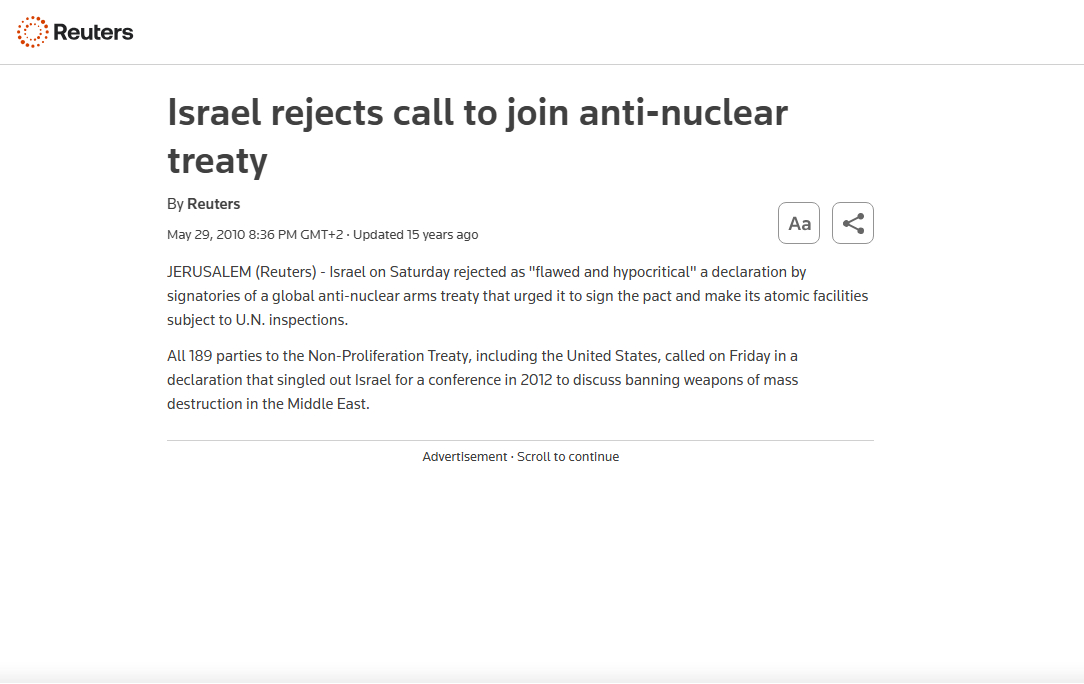
The nuclear problems, better say, nuclear rivalry began in 2010, not with Iran but against Iran and by the Israelis themselves.
When looking at Netanyahu, he himself is making these problems for more than 30 years, including the 12-day war on Iran in June 2025, and his instigated resumption of that war since February 28, 2026.
|
Iran’s Hormuz demands set ‘a very dangerous precedent’: Rubio
The US secretary of state says Iran’s demands to control and collect tolls in the Strait of Hormuz threaten the world’s economy and the principle of freedom of navigation.
Many leaders have expressed serious concern over the US-Israel war on Iran and the ensuing global energy crisis caused by the strait’s closure.
“If we create a precedent in the Middle East where a nation-state can decide that they are going to control an international waterway, charge a toll and if you don’t pay them blow up your ships, we have created a very dangerous precedent which will repeat itself in other parts of the world, including in this region,” Rubio said.
|
|
".. says Iran’s demands to control and collect tolls in the Strait of Hormuz threaten the world’s economy and the principle of freedom of navigation."
Paragraph 5 of the MoU reads:
Upon the signing of this MOU, the Islamic Republic of Iran will make arrangements, using its best efforts, for the safe passage of commercial vessels, with no charge for 60 days only, from the Persian Gulf to the Sea of Oman and vice versa.
The paragraph reads very clear "will make arrangements, using its best efforts" Anything else by the United States is arbitrary therefore 'a very dangerous precedent.' Because what they are spreading is not written in the MoU.
|
| |
|
|
| |
|
|
| |
|
|
| |
|
|
| |
|
|
| |
|
|
| |
|
|