| Highlights from yesterday |
|
Comments |
- US forces strike a bridge, a railway station and other sites across Iran, killing at least two people and injuring several others, Iranian media report, in the sixth consecutive night of strikes on the country.
- An Iranian military spokesman says the Strait of Hormuz will “never return to what it was before the 40-day war”.
- US Vice President JD Vance has accused Israel of funding campaigns aimed at ruining US negotiations with Iran to end the war.
- Tehran says a “barbaric” US attack forced some 200 cancer patients to evacuate a hospital in southwestern Iran.
|
|
|
US launches sixth night of strikes on Iran as tensions escalate across Middle East
The US military says it’s launched a new wave of strikes against Iran despite a ceasefire agreement signed last month.
Washington and Tehran have been attacking each other every day for nearly a week.
The US military’s Central Command says the strikes are aimed at further degrading Tehran’s military capabilities.
Iran’s Health Ministry says recent attacks have killed at least 40 people and injured more than 300.
|
|
|
Power outages reported in southern Iran in wake of latest US attacks
Iran’s Energy Ministry says the latest US attacks have caused damage to power lines in Bandar Abbas and surrounding villages.
The ministry said that electricity has now been restored in some areas, with the situation stabilizing.
A power outage in the Nobonyad 1 area has also been resolved, according to the ministry.
Officials are also calling on people in Iran’s southern regions to manage their electricity use during peak consumption hours.
|
|
July 16, 2026
Iran tells Houthis to close Red Sea gateway if US hits power network
Iran has asked Yemen’s Houthi movement to stand ready to close the Red Sea oil route if the United States strikes Iranian power infrastructure, three sources told Reuters on Thursday, posing a potent new threat to global energy supplies.
The idea has been discussed within the Islamic Republic's leadership, and the message has been conveyed to Iran's Houthi allies, two senior Iranian sources and a regional source familiar with the matter said, speaking on condition of anonymity.
|
Air raid sirens activated in Bahrain after Iran army claims attack
The Interior Ministry has told people to “remain calm and head to the nearest safe place”.
According to Iran’s semi-official Tasnim news agency, the country’s army says it targeted US helicopters and reconnaissance aircraft at the Sakhir airbase in Bahrain.
|
|
|
Attacks continue on infrastructure in Iran
Sirik – a city that is critically important because it oversees the Strait of Hormuz – is witnessing continued air strikes by the Americans for another night.
Bushehr has similar reports while also reporting that two bridges near Khamir port have been targeted as a result of which local authorities are saying that two people were killed and four injured.
Allaho Akbar – a neighborhood in Bandar Abbas – is experiencing continued attacks by the Americans.
There are reports of attacks on a residential area in which eight people were injured and one killed, according to local authorities.
The railway infrastructure is reportedly being targeted near Bandar Abbas, as a result of which two people were injured.
And the airport in Iranshahr was also attacked. Damage was reported.
|
|
|
Death toll in US attack on Bandar-e Khamir bridge rises to 7, with 9 injured
Iran’s Fars news agency reports that the death toll from the US attack on the Bandar-e Khamir bridge in Hormozgan province has risen to seven.
The attack injured nine people, who are receiving treatment from emergency services and medical staff, it added.
|
|
|
US continues attacks on Iran for sixth night, though not many details provided by military
The US military’s Central Command said earlier that it had started this latest round of air strikes, the sixth day in a row, at 2pm Eastern Time (19:00 GMT).
The statement did not specify the targets. It did not specify whether any people had been injured or killed, and it didn’t say specifically which parts of the US military were taking part in these attacks.
But we do expect there will be an update on what CENTCOM says its mission for this sixth night of air strikes would have been.
It should be noted that in relation to the enforcement of the US naval blockade on traffic in and out of Iranian ports, the US Navy is not providing escort assistance to commercial vessels through the Strait of Hormuz.
This operation is strictly focused on traffic in and out of Iranian ports.
They are basically trying to keep their efforts very much focused on that part of the operation, based on the orders from the White House.
|
|
|
Qatar raises security threat level, urges residents to stay home
The country’s Interior Ministry reports an ongoing security threat.
“Everyone must adhere to staying in homes and safe places,” the ministry said.
|
|
|
Qatar says security threat has ended, situation back to normal
Qatar’s Ministry of Interior has announced that the security threat has ended and the situation in the country has returned to normal, according to the Qatar News Agency.
The ministry urged the public to continue following any official instructions and guidance issued by the relevant authorities.
|
|
|
IEA chief warns of risk to global energy security if Strait of Hormuz remains shut
The executive director of the International Energy Agency (IEA) has warned that global energy security is at risk without an increase in oil shipments through the Strait of Hormuz.
“Oil security is still a critical issue,” Fatih Birol told a Council on Foreign Relations event. “We should be worried, and I am worried, if the situation does not improve in the next few weeks.”
The Strait of Hormuz, a narrow waterway between Iran and Oman through which about one-fifth of the world’s energy shipments transited before the war, has been mostly blocked since the conflict began on February 28.
The subsequent oil and gas supply crisis has hurt economies around the world, but disproportionately, Birol said.
“It is mainly Asia, because Asia was getting 80 to 90 percent of this energy from the Strait of Hormuz,” he said.
Japan and South Korea have suffered, but developing countries, including Pakistan, Bangladesh and India, have been hit hardest, he said.
|
|
|
US is ‘winning big in Iran’, Trump claims
The US president is saying that the US has the upper hand in its joint conflict with Israel against Iran.
“You will see the fruits of that labor very, very shortly,” Trump added.
|
|
|
Qatar’s Defense Ministry says military intercepted missile attack
In a statement shared on X, the Ministry of Defense said its armed forces intercepted a missile attack that had targeted Qatar.
|
|
|
US Republicans push forward with spending plan that includes billions for Iran war
Republicans on the budget committee in the US House of Representatives have pushed forward a $95bn spending package that includes billions of dollars of funding related to the war on Iran.
The $95bn budget plan includes $60bn for defense, $13bn for intelligence, and $12bn for agriculture, as US farmers face higher fuel and fertilizer costs during the war.
Republican lawmakers have said that the defense spending includes funding for the Iran war, money to replenish US weapons stockpiles depleted by the war, and funding to boost military readiness.
“We’re not going to get any help from our Democrat colleagues to do what I believe are … critical things,” the budget committee chair, Jodey Arrington, a Texas Republican, told his fellow panel members as they voted to send the package to the Republican-controlled House for approval.
|
|
|
Oil prices jump on intensifying US-Iran hostilities
Oil prices have continued to climb after another night of attacks from both the US and Iran.
Brent crude futures rose more than 1 percent to more than $85 a barrel, with US oil futures also climbing to just under $80 a barrel, erasing losses from the previous session.
Both benchmark contracts have climbed nearly 12 percent this week, with Brent on track for a third consecutive weekly gain, and WTI for a second weekly gain.
Some stock markets in Asia opened lower on Friday morning, with Japan’s benchmark Nikkei 225 index down more than 3 percent.
|
|
|
US military completes major wave of strikes against Iran, CENTCOM says
The US military says it has “successfully” completed its latest major wave of strikes against Iran, according to US Central Command (CENTCOM).
“US forces, including fighter jets, aerial drones, and warships, launched precision munitions that hit dozens of Iranian military targets such as coastal surveillance and air defense sites, military logistics infrastructure, and maritime capabilities,” CENTCOM said.
It added that “this was the sixth consecutive night of US strikes against Iran”.
“At the Commander in Chief’s [Trump’s] direction, CENTCOM is further degrading Iranian military capabilities and holding Iran accountable for recent attacks on commercial shipping,” the statement continued.
“More than 50,000 US service members are operating across the Middle East and remain vigilant, lethal, and ready,” it added.
|
|
|
Where US targeted in tonight’s strikes on Iran
Iranian southern coastal cities and islands have come under fire for yet another night as the United States continues to carry out air strikes.
The reported targets:
- Ahvaz, Qeshm, Bushehr, Dashti, Bostan, Sirik and Bandar-e Lengeh: Explosions were reported across these southern coastal cities and islands, causing more extensive damage to infrastructure than in previous nights.
- Bandar e-Khamir: Two bridges near the city were struck.
- Bandar Abbas: The Tapeh Allah Akbar neighborhood was hit, alongside several other explosions reported across the city.
- Hormozgan province: Road and railway infrastructure was targeted.
- Iranshahr: The airport in the southeastern city was attacked, causing damage to the facility and leading to power outages.
- Kish Island: Air strikes were reported on the island, resulting in temporary power outages in some areas.
|
|
|
Child injured by shrapnel following Iranian attack on Qatar, Interior Ministry says
Qatar’s Interior Ministry says that a child was injured by falling shrapnel following the Iranian attack this morning.
“Based on received reports and field findings, the Ministry confirms that one child was injured by falling shrapnel resulting from the interception operations; the child is currently receiving the necessary medical care,” it said.
The statement also stressed “the need to obtain information solely from official sources and to refrain from circulating rumors or publishing any unverified information, photos, or video clips, to avoid legal accountability”.
“The specialized security agencies at the Ministry of Interior continue their operations with full readiness around the clock to enhance response times, guarantee community security and safety, and ensure that services continue to run normally,” it added.
|
|
|
US air strike hits Iran’s Chabahar maritime control tower for third time
Iran’s Mehr news agency reports that a US missile strike has hit the Chabahar maritime control tower.
The attack marks the third time a US strike has hit the facility over the past week, it added.
|
|
|
Qatar intercepting a number of air attacks: Defense ministry
Qatar’s Ministry of Defense says the country’s armed forces are currently intercepting a number of air attacks.
|
|
|
US forces hit five bridges in Hormozgan province, local authorities say
Iran’s semi-official Fars news agency is reporting on comments from the Hormozgan Province Governorate, saying that US air strikes have hit five bridges in the southern Hormozgan province.
They include:
- The Gariveh Bridge connecting Bandar Abbas to Khmeir and Lar.
- A bridge near the village of Latidan
- Two bridges on the Kahoorestan–Lar route.
- A partially constructed bridge connecting Bandar e Khamir, Keshar and Bandar Abbas.
- A bridge in the village of Maru, Khmeir district.
The governorate advised people to avoid traveling on these routes and in the adjacent areas to ensure rescue teams could access the sites, Fars reported.
|
|
|
Iranian army claims drone strikes on US military sites in Kuwait
The Iranian army says it targeted US military deployment sites and logistical support centers in Kuwait with drones.
According to a statement carried by the Fars news agency, the military said, “Relying on history, popular support, experience, and combat readiness, we stand with vigilance and authority against any pressure or threat.”
|
|
|
‘Nightmare scenarios’ unfolding as diplomacy evades US, Iran
The latest fighting between the US and Iran suggests that the “appetite for diplomacy” has been lost, Trita Parsi from the Quincy Institute for Responsible Statecraft says.
“We are quickly going towards nightmare scenarios that were earlier avoided,” Parsi said.
“Even if de-escalation can’t be achieved in the short run, AVOIDING FURTHER escalation can,” Parsi added. “And it must.”
|
|
|
JD Vance says claims Kushner, Witkoff benefited financially as Iran negotiators ‘completely bogus’
US Vice President JD Vance has taken to X to deny claims that top White House advisers Jared Kushner and Steve Witkoff attempted to benefit financially from their roles as Iran negotiators.
“This is completely bogus”, Vance said, describing Kushner and Witkoff as “trusted members of the president’s team”.
“The idea they’re trading on insider information is absurd,” said Vance, responding to a post from an X account called The Hormuz Letter.
The post came after Drop Site News reported on Thursday that Iran had written to Vance during negotiations in Switzerland to say Kushner and Witkoff were “abusing” their access as negotiators.
“I never received a message like this,” Vance said, adding that “no one has done more than the two of them [Kushner and Witkoff] to work towards peace and prosperity in the region”.
The US vice president’s remarks came hours after he accused some members of Israel’s government of trying to “derail” US efforts to end the war through a “foreign influence campaign”.
|
|
"... claims Kushner, Witkoff benefited financially as Iran negotiators ‘completely bogus’ "
In May 2024, Jared Kushner, an Orthodox-Zionist, was caught on video talking about a "Gaza waterfront" development project, which his father-in-law Donald Trump picked up to and changed the name into "Gaza Riviera."
The ideas, originally from Tony Blair's Gaza plan, were worked out even by the Israelis.
Kushner and Witkoff, the latter is a Zionist migrant from Russia, are realtors, so businessmen without diplomatic skills and background. Kushner has also close ties with Netanyahu. For instance:
The Abraham Accord was initially drafted to isolate the Palestinian Authority from the Arab world then changed into normalization, which merely brought fruit on business level as reports about alleged contracts with signatories in the Gulf region revealed.
|
IRGC targets US command centre in Syria
Iran’s Islamic Revolutionary Guard Corps (IRGC) says it has attacked a US special operations command centre at the al-Tanf military base in Syria, the Tasnim news agency reports.
The IRGC also said the attack was in retaliation for the killing of Iranian soldiers in Iranshahr.
The Guard also said Iran retained full control of the Strait of Hormuz and that no oil or gas would be exported through the waterway for as long as the renewed US attacks continued.
|
|
|
Iranian sources say US strikes hit civilian infrastructure
Iranian official and semi-official news outlets report that US strikes overnight caused casualties and hit civilian infrastructure, including an airport and a key bridge.
|
|
|
Jordan says it shot down 3 Iranian missiles
The Jordanian army has said that it shot down three Iranian missiles targeting the country after its air defence systems intercepted the projectiles.
The army said that the incident did not cause any human casualties, as Jordan’s Royal Engineering Corps teams dealt with falling shrapnel.
|
|
|
IRGC claims retaliatory strike on US military base in Kuwait
Iran’s Islamic Revolutionary Guard Corps (IRGC) says it has targeted a US military base in Kuwait, striking a missile defense radar, several key weapons depots and two HIMARS surface-to-surface missile launchers, Mehr news agency reports.
The IRGC also said the attack was carried out in retaliation for recent US strikes on Iranian civilian infrastructure, including telecommunications and railway networks.
It also said that US actions in the region had led to a “severe drop in production and a complete halt of oil and gas exports through the Strait of Hormuz,” warning that its “retaliatory operations would continue”.
|
|
|
Iran says it hit US maritime surveillance radars in Oman
Iran’s IRGC has claimed to have destroyed a US air control radar in Oman’s Ghanem region and a maritime control radar on rocks in the Strait of Hormuz, in waters dividing Iran and Oman.
The IRGC said that in the 13th wave of ongoing Iranian attacks, the military said in a statement that “the retaliatory operation continues with determination,” and the critical waterway “remains in the hands of the IRGC Navy’s admirals.”
|
|
|
Oil prices rise on intensifying US-Iran hostilities
Oil prices have risen after the US and Iran stepped up attacks across the Gulf and with Tehran asking Yemen’s Houthis to stand ready to shut the Red Sea export route.
On Friday, Brent crude, the primary international benchmark, rose by 70 cents or about 0.83 percent, to $84.93 a barrel at 03:12 GMT.
On Thursday, International Energy Agency Executive Director Fatih Birol said “oil security is still a critical issue.”
Speaking at a Council on Foreign Relations event in Washington, Birol expressed concern, saying the world should be worried “if the situation does not improve in the next few weeks.
|
|
With the announcement on July 8, 2026 by Trump to end the ceasefire with Iran due to his impatience and frustration, then resumes and escalates his part of the resumption of Netanyahu's preemptive 12-day war on Iran, Trump is solely responsible for the effects prices on the energy markets are causing to economies in countries around the world.
|
How would the closure of the Bab al-Mandeb affect world trade
Iran has threatened it could prod its Houthi allies in Yemen to close the Bab al-Mandeb Strait at the mouth of the Red Sea if the US continues attacking Tehran’s infrastructure.
The Bab al-Mandeb Strait connects the Red Sea to the Gulf of Aden and is a crucial waterway for global oil trade. Its importance has increased since Iran’s closure of the Strait of Hormuz, through which 20 percent of the world’s oil and gas is shipped in peacetime.
If the Bab al-Mandeb were also to be closed, it would impact more than the ongoing war – it could compound the global energy supply crisis caused by the conflict, deepening the economic turmoil being felt in factories, kitchens and at petrol stations around the world.
|
|
It's not the world trade but European trade that would be affect, as shipping via Bab al-Mandeb goes through the Suez Canal with destinations to European ports.
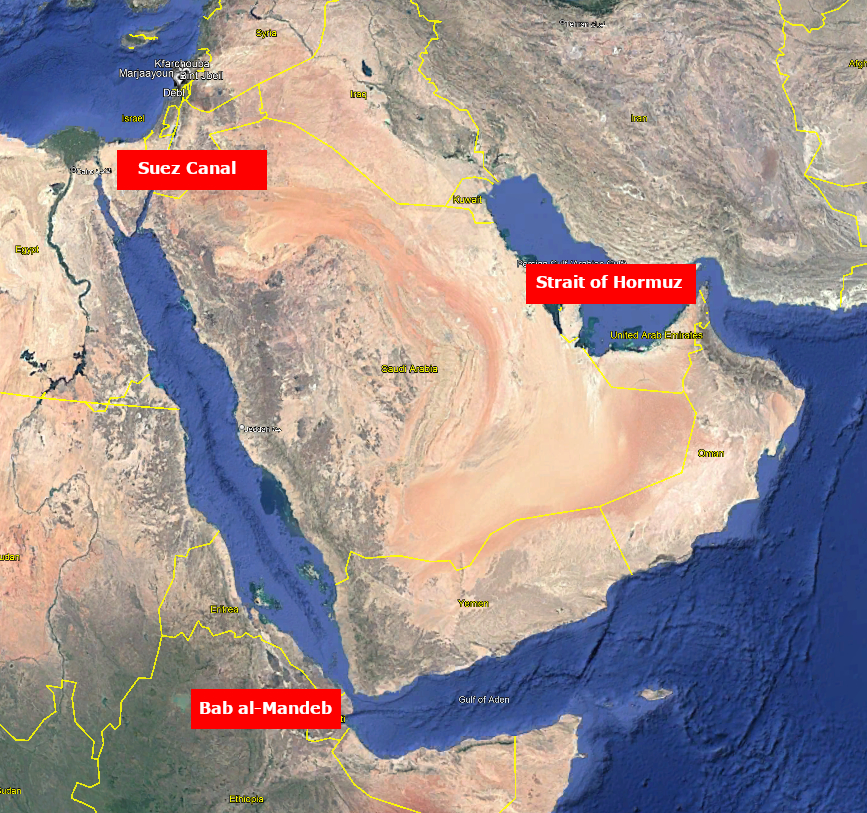
Shipping from China, South Korea and Japan to Canada and the United States goes through the Pacific Ocean.
|
Closure of Bab al-Mandeb could have ‘tremendous impact’ on the global economy
So far, the Iranians have not confirmed that the Houthis will shut the Bab al-Mandeb Strait.
However, there is a line of communication between the Houthis and Iranians. They are allies, and the Iranians are saying any decision regarding the strait is going to be made by the Houthis.
But the Iranians are also saying that “if our critical infrastructure, civilian infrastructure, energy and power plants are attacked, then we are also going to respond in kind.” Iran and its non-state allies in the region are going to be more involved in that.
In this equation, the role of the Houthis is critical, because, especially now that the Strait of Hormuz is closed, any closure of Bab al-Mandeb is going to have a tremendous impact on the global economy.
|
|
See previous comment.
|
Tanker hit by unknown projectile off Oman’s coast, UKMTO says
A tanker was hit by an unknown projectile on Thursday while sailing about 19 nautical miles (equivalent to about 35km) east of Khasab, Oman, the United Kingdom Maritime Trade Operations (UKMTO) agency has said.
The crew is reported safe, with no environmental impact, UKMTO added.
|
|
|
Iran says 38 killed, 400 injured in US attacks since ceasefire deal
Iran has said 38 people have been killed, and more than 400 injured, in the US attacks since the two sides met in Switzerland on June 22 for talks to end the war through a 60-day negotiation period, the AFP news agency reported.
The ceasefire unravelled in the last week, with both sides continuing their tit-for-tat attacks, as the Strait of Hormuz remains closed for maritime traffic.
|
|
|
Death toll from overnight US air attacks on Iran rises to eight
Iran’s state-run IRNA news agency reports that the death toll from overnight US air attacks has risen to eight.
The US military attacks on infrastructure across several provinces occurred late Thursday night and in the early hours of Friday morning, leaving 20 other people injured, it added.
|
|
|
Just three vessels crossed Strait of Hormuz amid closure
Only three commodity vessels crossed the Strait of Hormuz on Thursday, the fewest daily transits since May, according to shipping data.
Most ships halted or made U-turns after recent Iranian attacks on vessels and the resumption of a US blockade on Iran-related shipping.
Miraan, a sanctioned product tanker carrying fuel oil, and Norita, a small vessel carrying liquefied petroleum gas, exited the strait on Thursday via the Iranian route but stopped at the Gulf of Oman, where the US blockade is, Kpler data showed as of 05:13 GMT on Friday.
Arolia, a bunkering tanker laden with Iraqi fuel oil that is used to refuel vessels at sea, made a U-turn to head back into the Gulf hours after it exited earlier on Friday, LSEG data showed.
|
|
|
Bahrain says intercepted several Iranian air attacks
Bahrain’s armed forces say its air defence systems have intercepted and destroyed “a number of hostile Iranian aerial attacks” today.
“Iran has continued its aggressive approach by carrying out cowardly attacks targeting civilians in the Kingdom of Bahrain,” the military said in a statement.
It also urged everyone to exercise caution, avoid approaching any strange or suspicious objects that may have resulted from the Iranian attack, and report them immediately.
“The General Command stresses that the deliberate use of missiles and drones to target civilians and private property constitutes a blatant violation of international humanitarian law,” the statement further noted.
|
|
|
IRGC says it targeted US jets in Jordan
Iran’s Revolutionary Guard Corps say they have targeted US fighter jets stationed in Jordan, Iranian State TV reports.
Earlier, the Jordanian army had said that it shot down three Iranian missiles targeting the country.
|
|
|
US attacks on civilian areas reveal its hypocrisy: Iran official
Ebrahim Azizi, the head of the Iranian Parliament’s National Security Committee, says the US attacks in southern Iran on residential and civilian zones “reveal the hypocrisy of those who preach ‘human rights’”.
“The proud South has always been Iran’s fortress of defense, and every Iranian’s heart beats there,” he said in a post on X.
“To the enemies of this resistant and victorious nation: The Armed Forces will not let the blood of the innocent go [unavenged],” he added.
|
|
|
Names and importance of some Iranian sites hit by US
- Bandar Khamir Bridges, located in the Hormozgan province, is a key transportation route connecting local communities. Damage to such bridges can disrupt mobility, logistics and access between coastal areas and internal parts of the country.
- Railway Infrastructure near Bandar Abbas is a critical logistics route linking the country’s main southern port gateway with inland transportation networks. It is also important for cargo movement, trade and supply chains.
- Iranshahr Airport located in the Sistan and Baluchestan province is a major regional aviation facility, supporting transportation, emergency services and connectivity in southeastern Iran.
- Chabahar Maritime Traffic Control Radar is a key aviation monitoring system responsible for airspace surveillance, flight coordination, maritime traffic and aviation safety in a strategically located coastal region.
- Sirik located in the Hormozgan province is a strategically located coastal area near the Strait of Hormuz.
- Qeshm Island, also in Hormozgan province, is strategically important and the largest island near the Strait of Hormuz with significance in maritime trade, commercial activity and overseeing the Strait of Hormuz.
- Ahvaz in Khuzestan province is one of Iran’s most important industrial centres, with major significance due to its oil, energy and economic infrastructure.
- Bushehr in Bushehr province is a key Persian Gulf coastal location with importance in maritime activity, energy infrastructure and regional connectivity.
|
|
|
Iran restricts trains from Bandar Abbas after US attacks
Iran has been restricting passenger train departures from Bandar Abbas station due to the US attacks on a railway point in the Hormozgan region, the country’s Tasnim news agency reports.
The Hormozgan Railways Administration has directed passengers to take an intercity bus to the Fin station and catch their trains there.
|
|
|
Mother killed, child critical after US attack on Bandar Abbas
A woman has been killed in the US attacks on southern Iran’s Bandar Abbas, leaving her one-year-old child critically injured from shrapnel wounds.
Iran’s Tasnim news agency reports that the US strike in the Tappeh Allah Akbar neighborhood of Bandar Abbas killed the mother and left eight others injured.
|
|
|
Iran claims attacks on several locations in Kuwait
Iran has claimed to have destroyed High Mobility Artillery Rocket System (HIMARS) platforms and missiles in attacks on Kuwait at several locations, where Tehran said American forces and Israeli-backed fighters are stationed.
Iranian attacks eliminated “a large number of anti-revolutionaries and American special forces [and] the tit-for-tat operations are ongoing,” the IRGC said in a statement.
|
|
|
Kuwait says water desalination plant damaged in Iranian attacks
Kuwait’s Ministry of Electricity, Water and Renewable Energy says one of its electricity generation and water desalination plants was targeted by Iran in the latest attack, resulting in fire and damage to the site.
The ministry said in a statement that firefighting teams have brought the fire under control, while technical teams continue to carry out repair work and restoring the affected units to service, alongside continued monitoring of the stability of the electricity grid.
The ministry also called on the citizens and residents to “rationalise” their electricity consumption.
|
|
|
US attacks southern Iran, Tehran hits Gulf nations
For a sixth night in a row, the US has hit Iran in a wave of major attacks. Iran hit back, launching missiles and drones at multiple countries in the Gulf and at US bases in other regional countries.
Iran says at least 38 people have been killed and more than 400 injured in US attacks since the two sides met in Switzerland on June 22 for talks to end the war through a 60-day negotiation period. That includes at least eight people killed in overnight attacks.
|
|
|
Time for diplomacy between US, Iran ‘suspended’
Alexandru Hudisteanu, a military and diplomatic analyst, has said that the time for diplomacy has been suspended.
“It [diplomacy] is not necessarily lost, but suspended. In the end, the US and Iran need to get out of this war. It is not beneficial for either side. So they will look towards a conclusion,” he said.
But Hudisteanu noted that from the beginning of this war, both sides have had different objectives and different understandings on what diplomatic discussions to end the war should entail.
“So now we’re back to this type of smaller military trap in which the strait [of Hormuz] becomes the focal point,” he said.
“I’m not sure we are going back to all out war but it is this sort of brinksmanship which increases the tension. We are at the riskiest point in the past two months.”
|
|
|
‘US targets civilian infrastructure, aims to cut-off southern Iran’
There was a systemic attack on the Iranian civilian infrastructure this time. It's about bridges, railways, and airports.
Seven bridges were hit, and six of them are in Bandar Khamir. Most of these bridges connect the ports, and Bandar Abbas also, to nearly 200 miles inland, meaning these are quite important.
Bandar Khamir is a small town, pretty much close to Qeshm Island, the biggest island in the Gulf. These bridges are quite important for the movement of people, for fuel, and, of course, for military ammunition as well.
And then the Bandar Abbas railway was also hit. It is quite an important one, because that is simply connecting the country’s largest port to central Iran, particularly to cities such as Shiraz.
These attacks are aiming to cut off the southern part of the country from the mainland, and that is quite a huge concern for Iranians.
Another target that was hit is a railway and airport facility close to the Pakistani border. There are some separatist groups there fighting against the Iranian army for decades. So, degrading the IRGC’s capacity there could lead to insurgency.
|
|
|
Hormozgan MP says US attacks ‘disregard civilian lives’
Ahmad Moradi, a member of parliament from Iran’s Hormozgan, has said that the targeting of civilian infrastructure and the killing of civilians are “a sign of the criminal nature of these attacks.”
Moradi is visiting the bridges destroyed during the latest US attacks in Bandar Khamir, reported Iran’s Mehr news agency.
Moradi, referring to the damage to the city’s communication infrastructure, said: “The destruction of bridges and public infrastructure once again revealed the nature of these attacks and the disregard for the lives of civilians.”
He added, “[Iran’s] armed forces will defend the country’s security with authority and will respond to aggression at the appropriate time.”
|
|
|
Iran claims attack on US air base at Qatar’s Al Udeid
Iran says its forces have targeted the US air base in Al Udeid, Qatar, in the 15th wave of attacks.
The IRGC said in a statement that the Iranian attacks destroyed a long-range radar system and several US strategic refueling aircraft, according to the country’s IRIB news agency.
“The American enemy and the hosts of its bases in the region should know that crossing red lines and attacking people and civilian infrastructure will have a very severe and miserable price. If the enemy continues this trend, more crushing responses are on the way; responses that will remain in the history of battles,” it said.
|
|
|
Iran urges citizens to cut electricity use after US strikes
Iran’s energy ministry has called on citizens to reduce electricity use after the power grid came under strain following US strikes on energy infrastructure in the south.
In a statement on Friday, the ministry said those areas in the south “are currently experiencing extreme heat and attacks on power infrastructure.”
The ministry however did not elaborate on whether it was power plants, transmission lines or other equipment that had been attacked.
|
|
What does international law say, when the US targets Iran electricity supply which affects civilian and medical use the most?
Under international humanitarian law (IHL), deliberately targeting civilian power grids—which are deemed objects indispensable to the survival of the civilian population—is generally prohibited. Such strikes, which cause devastating, disproportionate harm to civilian infrastructure like hospitals and water systems, are widely considered by human rights experts and international legal scholars to be potential war crimes.
Iran targeted desalination plants in Kuwait but in equal response to attacks by the US. It is also a war crime committed in a 'involuntarily situation' as it didn't start the war and confronted with the Israeli initiated war without warning.
|
‘Israel using US taxpayer dollars to silence US critics’: Araghchi
Iran’s Foreign Minister Abbas Araghchi has taken a dig at the US government, reiterating the warning of Israeli interference in Washington’s foreign policy and domestic politics.
“Americans are being warned of Foreign Influence. How about the extensive Israeli Campaign to bamboozle the US Administration into an unwinnable war of choice?” Araghchi wrote in a post on X.
The Iranian official was referring to an article in Time magazine that reported Trump’s former presidential campaign manager, Brad Parscale, running an Israeli influence operation targeting the MAGA base.
“Even worse: Israel is using US taxpayer dollars to silence any US critics,” he wrote. “It will all soon unravel.”
|
|
|
US attack destroys maritime surveillance tower in Chabahar Port
Tehran has said that the latest US attacks have destroyed a maritime traffic control tower on the Chabahar port, in Iran’s Makran, in a “heinous attack” targeting the livelihoods of fishermen and the safety of civilian maritime navigation in the region.
Iran said in a statement, reported by Tasnim news agency, that the US forces destroyed “a completely civilian structure” by the launch of three missiles.
The US attacks on “vital infrastructure once again highlight the West’s double standards and Washington’s disregard for its own self-imposed international treaties,” the statement noted.
|
|
|
Tehran imam calls for revenge to ‘punish perpetrators’
Mohammad Javad Haj Ali Akbari, who leads Friday prayers in Tehran, has said that the first step for Iran in seeking revenge is to “punish the perpetrators” of the killing of the late Supreme Leader Ali Khamenei.
Akbari said, “pursuing America’s withdrawal from the region, removing the Zionist regime from the map of West Asia, and ending America’s hegemonic position in the world will be the other steps on this path”.
“The demand for revenge is not merely an emotion, but a demand based on rationality, Sharia and rights,” Akbari said in his Friday sermon in Tehran.
“The supreme leader of the revolution confirmed this general demand of the nation in his message, and now this demand has become one of the main demands of the Islamic nation.”
|
|
|
UKMTO investigating incident on merchant vessel east of Oman
The United Kingdom Maritime Trade Operations (UKMTO) has received a report of an incident involving a merchant vessel and military forces approximately 100 nautical miles east of Duqm in Oman.
Reports indicate that the tanker was subject to interaction as part of ongoing military activity in the region. Authorities have said they are aware, and relevant investigations remain ongoing.
Earlier, UKMTO said a tanker was involved in an incident with military forces about 100 nautical miles east of Oman’s Duqm on Thursday.
The tanker was subject to interactions as part of military activity in the region, it added.
|
|
|
Oil prices climb with Hormuz closure, uncertainty in Red Sea
Oil prices have risen by about 2 percent as the US and Iran exchange tit-for-tat attacks across the Gulf, with shipping threatened by a potential Red Sea closure on top of the restricted traffic through the Strait of Hormuz.
Brent crude futures rose by $1.53, or 1.82 percent, to $85.76 a barrel by 09:51 GMT. US West Texas Intermediate futures gained $1.69, or 2.14 percent, to $80.64.
Both benchmarks have climbed nearly 13 percent this week, with Brent on track for a third consecutive weekly gain and WTI set for its second.
|
|
|
Who controls the Strait of Hormuz?
Ali Vaez, the International Crisis Group’s Iran Project director, has said that the loss of lives on vessels in the Strait of Hormuz is a result of both the US and Iran wanting to control the strait.
“The Iranians believe that … to open its southern corridor, the US was violating the memorandum of understanding’s Article 5, which allows Iran to come up with arrangements to reopen the strait,” he said.
“They [Iran] also believe that this is a deliberate US policy to erode their leverage by establishing a southern corridor so that if the war resumes, Iran will basically have less leverage to bring the war to an end or to come to a deal that would be beneficial to the negotiating table,” Vaez added.
“So this really has turned into a war which is just about one question and that is the control over the strait.”
|
|
|
Kuwait says Iranian attacks are an ‘extremely dangerous escalation’
Kuwait’s Foreign Ministry has condemned “the heinous Iranian aggression using missiles and drones” that struck one of its power stations and water desalination plants.
The ministry called the Iranian attacks a “flagrant violation of the sovereignty of the State of Kuwait and its security and the safety of its territories, and a grave breach of international law and international humanitarian law”.
“The ministry affirms that the continuation of this aggressive approach constitutes an extremely dangerous escalation that threatens regional security and stability, a brazen challenge to international legitimacy, and undermines efforts aimed at de-escalation and reaching peaceful solutions,” according to a statement.
“The ministry emphasizes the inherent right of the State of Kuwait to take the necessary measures to preserve its sovereignty, maintain its security and stability, in accordance with the provisions of international law.”
|
|
“The ministry emphasizes the inherent right of the State of Kuwait to take the necessary measures to preserve its sovereignty, maintain its security and stability, in accordance with the provisions of international law.”
If any of the Gulf states and Jordan engages in military agreements with a alien military power from another continent, knowing that this power wants to be on their soil for its own interest, and because of their own regional policies, like the UAE and Saudi Arabia, these countries contribute to insecurity and instability in their own region.
When the guest, the alien military power, is a war belligerent, and the host country Kuwait allow the guest to carry out attacks on Iran, the country has made itself co-belligerent of its 'guest,' the United States.
The war on Iran has no approval or mandate from the UN therefore illegal.
Kuwait has international law not on its side because it contributes to the violation of the UN Charter by its guest, the US.
As the attacked country, Iran has the right to consider the host countries in the region, including Kuwait, as military objectives.
Kuwait bears full responsibility for its actions under states responsibility laws.
|
Iranian attacks to continue until calm returns to Hormuz, says commander
Iranian attacks will continue “until calm returns to the southern coastline and the Strait of Hormuz”, according to Seyed Majid Mousavi, the commander of the Aerospace Force of the IRGC.
“In the system of calculations, the entire territory of Iran – from Tehran to the south – is one and the same. Effective and targeted strikes from across Iran against the enemy will continue until calm returns to the southern coastline and the Strait of Hormuz,” according to a report on Iranian state TV.
|
|
|
Several Kuwaiti military personnel injured in Iranian attacks
Kuwait’s military says several personnel were injured in Iranian attacks that targeted “several facilities and camps affiliated with the Kuwaiti Army”.
Lieutenant General Khaled Dirj Saad Al-Shreian, the Chief of Staff of the Army, visited the injured personnel “to check on their health conditions and follow up on the progress of the medical care provided to them,” the army said in a statement.
|
|
|
UK formally designates IRGC ‘threat to national security’
The UK has formally designated the IRGC and another Iran-linked group, the Islamic Movement of Companions of the Right (IMCR), as threats to national security, effectively outlawing any support for them.
“It is now a criminal offence to express support for these bodies – meaning anyone who glorifies or encourages their activity which threatens the safety of the UK can be prosecuted. It is also now a criminal offence to assist or to accept or obtain a material benefit, such as payment, from any of these bodies,” the government said in a statement.
Anyone found guilty of these offences could face up to 14 years of imprisonment, it said.
The British government also designated Russia’s GRU Volunteer Corps under the National Security (State Threats) Act 2026 alongside Iranian bodies after the parliament approved an order laid by the Home Secretary on Monday.
|
|
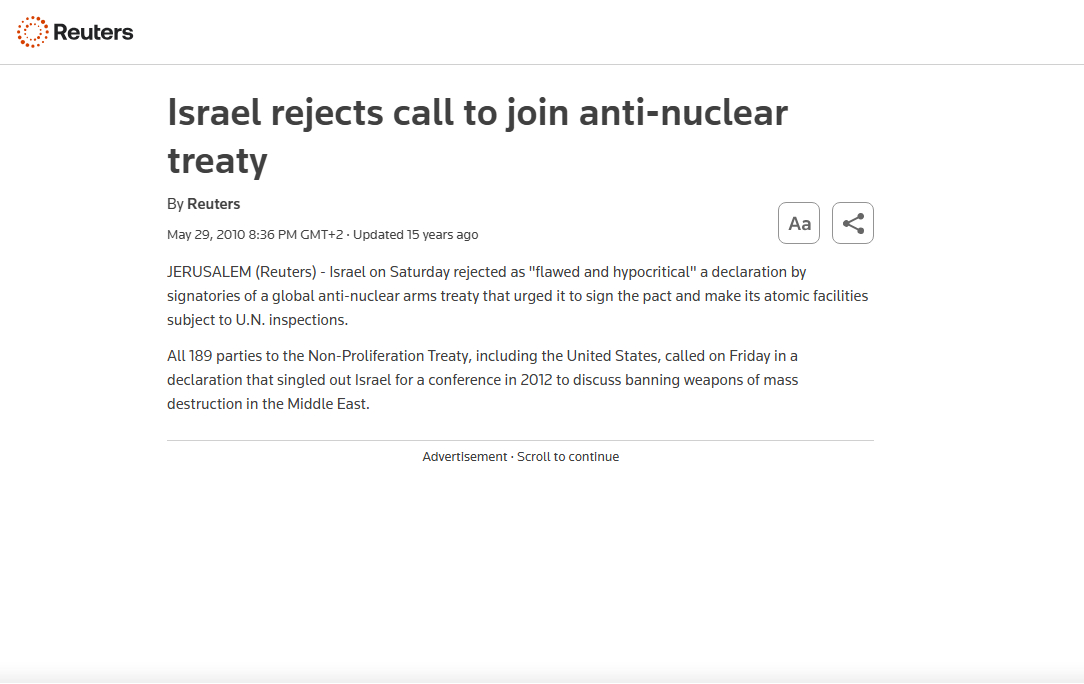
The war on Iran is nuclear political motivated and therefore in violation of the UN Charter.
There is a multiple page document on our website showing that Britain was involved in the secret preparation of the Israeli production of nuclear weapons.
So, from a nuclear historical perspective, the British action has no value to us.
|
US, Iran locked in a ‘high-risk gamble’
“We are currently at a point where, day by day … these strikes are escalating, the ability of the parties to go back to the MoU is becoming more difficult, and more regional players are being dragged into the conflict,” Ellie Geranmayeh, deputy program director and senior policy fellow for MENA at the European Council on Foreign Relations, says.
“Right now, my sense is that both Iran and the US feel they have this under control; that they are managing this escalation in order to inevitably escalate and strike a deal over the Strait of Hormuz, but whether they’ll be able to do so is a really high-risk gamble”, she said via video link from London.
The accusations from both sides that the other is now hitting civilian infrastructure means the conflict “enters a much more ruthless, more violent phase that we saw during the so-called 40-day war at the earlier start of this year, where both Israel and the US began targeting Iranian critical infrastructure like energy installations, ports, bridges, factories, and each time Iran took the policy of an eye for an eye and hit back” she said.
|
|
|
Almost all Hormuz transits through Iranian territorial waters, says agency
Iran’s semi-official Tasnim news agency has released data purporting to show that eight vessels have transited the Strait of Hormuz in the past 24 hours.
Seven of them, which were evenly split between commercial and non-commercial vessels, passed through Iran’s territorial waters. None passed through Omani waters, the agency added.
Half of all marine transits involved vessels flying the Iranian flag, according to Tasnim, despite US forces asserting that they were blockading vessels leaving and entering Iranian ports.
|
|
|
IRGC Navy says approaching ‘zero hour’ for operation against US naval units
In a statement carried by Iranian state television, the IRGC Navy Command said the movements and military equipment of US forces are “under the surveillance” of Iran’s naval units.
“The Americans are drawing closer by the moment to the zero hour of an operation by Iran’s Armed Forces against CENTCOM naval units in the region’s waters,” it said.
The command concluded its statement with the warning: “Wait and see.”
|
|
|
Iran’s Chahbahar port surveillance tower destroyed: CENTCOM
US forces destroyed a surveillance tower at Chahbahar port in eastern Iran during attacks yesterday, according to a US Central Command (CENTCOM) post on X.
The tower was part of a maritime surveillance network used to track and target commercial vessels transiting the Strait of Hormuz, CENTCOM said.
|
|
|
Qatar condemns Iran’s attacks on its territory, Gulf states, Jordan
In a statement posted on X, Qatar’s Foreign Ministry says the attacks were a “flagrant violation of the sovereignty and territorial integrity of the targeted states, and a blatant breach of international law, the Charter of the United Nations, and the principles of good neighborliness”.
Qatar holds Iran fully legally responsible for the attacks and their consequences, the statement said, and asserts its right to respond under international law and Article 51 of the UN Charter to protect its sovereignty and citizens.
Qatar also expressed solidarity with fellow nations defending their territorial integrity and called for an immediate halt to all military actions, restraint from further escalation, a serious return to dialogue and negotiations, and adherence to previously reached diplomatic understandings.
|
|
|
Germany, France urge Iran to return to talks
German Chancellor Merz and French President Macron have called on Iran to de-escalate and return to negotiations with the US in a joint statement, which came after a defense and security council meeting.
“We urge Iran to refrain from endangering further negotiations through military escalations or activities,” the two countries said in the statement on Friday.
The leaders also stressed the need to urgently reopen the Strait of Hormuz.
|
|
With the announcement on July 8, 2026, Trump ended the ceasefire with Iran due to his impatience and frustration despite the inclusion of the ceasefire in the Memorandum of Understanding.
|
‘Iran claims to have hit Al Udeid Air Base, but no confirmation yet’
Al Udeid is a huge US base on the outskirts of the capital, Doha, which normally hosts about 10,000 US military personnel and is the forward headquarters of US Central Command.
There is no official confirmation from the US or the Qataris that that base was hit.
What Qatar has consistently reiterated through the course of this entire conflict is that the base has not been used by US forces to target Iran.
There were two waves of attacks in Qatar in the early hours of this morning.
The timing of these attacks was significant.
They came just hours after the official end of the mourning period for the late emir of Qatar, and just 48 hours after Iranian Foreign Minister Abbas Araghchi had been in Doha to pay his condolences to the family.
|
|
|
IRGC claims shooting down US drone in Khuzestan
Iran’s Revolutionary Guard says it has shot down a US RQ-11 drone in Khuzestan province, according to a statement carried by state media.
The drone was intercepted and shot down by light weaponry used by Basij Corps, in the city of Ramshir in Khuzestan.
The AeroVironment RQ-11 Raven, is a small hand-launched remote-controlled drone, operated by the US military.
|
|
|
Iran attacks Thai-flagged ship in Hormuz, semi-official Iranian media reports
The Iranian Navy attacked a vessel flying the Thai flag in the Strait of Hormuz, says Iran’s semi-official Tasnim News Agency, quoting an unnamed official.
The ship was attempting to transit without permission from the Iranian Navy, despite being warned, according to the official.
|
|
|
US again attacks Iranian oil tanker near Kharg Island, official says
US forces have attacked an Iranian oil tanker docked near Iran’s Kharg Island for the second time in two days, according to an Iranian official speaking to the Fars news agency.
“The empty, Belma N.I.22 oil tanker, which was hit two days ago, was attacked again today by two US missiles”, the deputy governor of Bushehr told Fars.
|
|
|
UN chief condemns attacks on civilian infrastructure in Iran, Gulf states
UN Secretary-General Antonio Guterres has called attacks on civilian infrastructure in Iran and elsewhere in the Gulf “unacceptable”, according to his spokesman.
|
|
|
Kuwait says fires caused by Iranian attacks brought under control
Kuwait’s state news agency reports that two fires in southern Kuwait were brought under control after sites were targeted in Iranian attacks.
No casualties were reported.
|
|
|
Iranian FM mourns three killed in US strike on bridge in Bandar Khamir
Iran’s foreign minister says the three people killed while crossing the bridge were “completely innocent”.
“We will never allow their pure blood to be trampled upon”, Abbas Araghchi said on his official Telegram account.
“We will defend every inch of this land until our last breath.”
|
|
|
MoU dead after US violations: IRGC commander
IRGC Commander Mohsen Rezaei has told state television that Iran’s MoU with the US is all but dead.
“The failure of the Israeli regime to withdraw from southern Lebanon, the creation of an illegal alternative route in the Strait of Hormuz despite the existence of a legal Iranian route, the lack of respect for Iran’s sovereignty with attacks on Iranian territory, and the failure to release Iran’s assets are all US violations of the MoU,” Rezaei said.
The US had signed the framework agreement, he continued, “with the aim of exerting maximum pressure and forcing Iran to back down”.
“After the Islamabad talks, the United States adopted a policy of war and negotiation simultaneously. Iran’s acceptance of a two-week ceasefire provided the United States with an opportunity to complete its naval blockade while negotiations were under way,” Rezaei added.
|
|
|
Can mediator Pakistan afford to take sides in escalating US – Iran war?
Major international actors might be forced to intervene, “sooner rather than later”, to stem the current escalation between the US and Iran, says scholar and historian Ayesha Siddiqa.
“The question is, at what point will other power players, like China and Russia, intervene more directly in pushing for negotiations between Iran and the US?”, Siddiqa, author of, Military Inc., said.
“As the MoU seems to have ended, all concerned players are increasing their weight in the conflict to extract more ground and concessions; however, a positive result is unlikely in the foreseeable future, which will have threatening consequences for the Middle East and the global economy”, she said.
This would particularly affect weaker regional players, including the MoU’s mediator, Pakistan, which might be forced to take sides, despite not being in any position to do so, given the limited options that it has.
“Pakistan has far more to lose if it becomes directly involved in defending Saudi Arabia against Iran, but then the issue is how it addresses its economic problems, which makes it increasingly dependent on Saudi Arabia”, Siddiqa said.
“Tensions between the UAE and Saudis will also affect Pakistan’s internal situation, for example violence in the country’s Balochistan province, bordering Iran”, she said.
|
|
|
Seventh consecutive night of attacks on Iran: CENTCOM
CENTCOM launched the seventh consecutive night of attacks against Iran, according to a post on its X account.
It said it started attacking Iran again at 3pm ET (19:00 GMT) on Friday.
|
|
|
US attacks on southern Iran
The latest wave of US attacks has been less intense, relatively speaking, compared to previous nights.
But still, it’s yet another night, continuing with the Americans targeting the southern coast of the country.
In several cities explosions are reported.
Sirik is one of them, and the city is very important. It has been witnessing continued assaults by the Americans, and we have to keep in mind that it oversees the Strait of Hormuz.
Explosions are also reported in Qeshm Island, the largest island in the vicinity of the Strait of Hormuz.
In Bushehr, explosions where being heard, and obviously that is coming in the context that Iranians are talking about their retaliatory strikes.
First, it was the Iranian army coming out to say that they have attacked a US vessel in the region.
The Revolutionary Guard and also the army are talking about their retaliatory strikes on the US military assets across the region.
|
|
|
Iran carried out a number of attacks or strikes across the region
Kuwait was one of the countries that witnessed a number of attacks from Iran in the early hours of this morning.
There were also reported attacks in Jordan.
Amman said they’ve intercepted several missiles in their airspace, but there were no injuries, and there was no damage that was reported.
Similar instances where in Bahrain, and in Qatar, in the early hours of Friday, people received text alerts and messages warning of an imminent threat for people to take shelter.
Loud explosions have been heared. Authorities say there had been interceptions.
One child was injured by the falling debris following those interceptions.
|
|
|
ISNA says US military has attacked area around Sirik in southern Iran
The Iranian Students’ News Agency (ISNA) is reporting that the area around Sirik in southern Iran has been targeted in what it claims was an attack by the US military.
|
|
|
More from CENTCOM on its Iran blockade
The US military’s Central Command says it has redirected four commercial vessels, disabled one and boarded another during the first three days of its latest naval blockade of Iran.
US forces renewed their blockade on vessels leaving and entering Iranian ports at 20:00 GMT on Tuesday.
|
|
|
US committed another blatant war crime: Iran Foreign Ministry
Iran’s foreign ministry spokesman, has shared a post on his X account, calling out “another blatant war crime”, committed by the US.
Esmaeil Baghaei said the US attempts to showcase its so-called strength, “by attacking civilian infrastructure and killing civilians.”.
|
|
|
IRGC claims to destroy US drone depot in Bahrain
Iran’s Islamic Revolutionary Guard Corps says in a statement that it attacked and destroyed a US drone depot in Bahrain in an attack early this morning.
It also said it destroyed “the main artificial intelligence center in Bahrain”, claiming it was used by the US to identify targets in Iran and commit “war crimes”.
“We will henceforth destroy the most important industrial, information technology, and artificial intelligence assets of companies with American shareholders in the region, regardless of the country they are in, and we will obliterate the most valuable assets of American companies in all countries hosting American bases”, the IRGC’s statement concludes.
|
|
|
Iranian media reports more explosions, including in central Yazd province
Iranian media are continuing to report explosions across the country.
- Iran’s Tasnim news agency reported five explosions in the city of Yazd, in the central Yazd province.
- Iran’s Mehr news agency reported an explosion was heard on the outskirts of Las, in the southwest Fars province.
- Local officials reported a US missile attack on the city of Ahvaz, in the southwestern Khuzestan province, according to Mehr.
|
|
|
Two oil tankers catch fire after passing through minefields in Strait of Hormuz, Tasnim reports
Iran’s semi-official Tasnim news agency is reporting that two oil tankers have caught fire following explosions that took place after they tried to pass through minefields in the southern Strait of Hormuz.
Tasnim reported the IRGC Navy as saying that the strait is “extremely unsafe and completely closed” due to US aggressions.
|
|
|
US attacks shifting further into Iran’s interior
On July 8th, Trump announced that the ceasefire was over while insisting dialogue was continuing.
So he was involved in dialogue and in conflict at exactly the same time, but those first days of strikes being carried out by the US in the wake of the end of the ceasefire were limited in scope.
They were mainly related to the Iranian control of the Strait of Hormuz.
But from today, there is a shift in strategy, and that is seeking targets further in the Iranian interior, escalating the intensity of the US military attack and its scope.
Earlier this week, President Trump had a meeting in the situation room with his senior security staff to discuss presented wide range of targets that would make a greater spread for US operations within Iran, moving away from the coastline into the interior.
Now, President Trump has directed a widening of US operations.
Why was he reluctant to do this? Because once the conflict intensifies, it gets more and more difficult to step back from it and create that dialogue that he so desperately needs to get his off-ramp and put this war behind him.
But now it is looming very, very strongly and large in his rearview mirror.
|
|
|
IRGC says it shot down US drone over Bushehr
Iran’s Islamic Revolutionary Guard Corps Navy says it has shot down a US drone over the Iranian port city of Bushehr.
The IRGC navy says the MQ-9 drone was intercepted and destroyed using a new advanced air system operating under the control of Iran’s integrated air defense network.
|
|
|
Yemen’s government condemns ‘unjustified’ Iranian attacks on Gulf countries
Yemen’s government has issued a statement strongly condemning “unjustified” Iranian missile and drone attacks on Kuwait, Bahrain, Qatar, and Jordan.
Yemen “considers these attacks a blatant violation of their sovereignty and territorial integrity, a threat to security and stability in the region, and a flagrant breach of international law”, the statement added.
|
|
".. a blatant violation of their sovereignty and territorial integrity, a threat to security and stability in the region, and a flagrant breach of international law,..”
The narrative has been used by the GGC, its member states, and Jordan on the regular basis, and shows that Arab countries lack knowledge about the UN Charter and international law.
Blatant violation of sovereignty and territorial integrity, and a flagrant breach of international law have already been committed on February 28th by Netanyahu and Trump by going again for war on nuclear political grounds with no approval or mandate from the UNSC.
A threat to security and stability in the region has been existing since countries in the region have engaged in military agreements with alien military powers from other continents, who wanted to be on the soil of engaging countries for their own interest.
|
Iran’s Mehr says US projectile landed outside Yazd, no casualties
Iran’s Mehr news agency says projectiles fired by the US have landed outside the Iranian central city of Yazd.
No casualties were reported in the attack.
|
|
|
Iran’s Revolutionary Guards block four US-escorted tankers in Strait of Hormuz
Iran’s Revolutionary Guards Navy command have blocked four tankers attempting to pass through the Strait of Hormuz with US support.
The IRGC navy command says the tankers were “stopped in place” in a combined missile and drone operation.
In a statement, the IRGC naval command warned vessel owners to listen to its warnings and announcements, after the US reimposed a blockade on Iran.
It said “vessel owners should not be fooled by the baseless support of the US terrorist army, like the leaders of some countries in the southern Persian Gulf”.
|
|
|
| |
|
|
| |
|
|
| |
|
|