| Highlights from yesterday |
|
Comments |
- The US military launches attacks on southern Iran again, as the standoff over the Strait of Hormuz intensifies.
- Iranian state media report explosions in the port cities of Bandar Abbas, Sirik and Jask, as well as Qeshm Island.
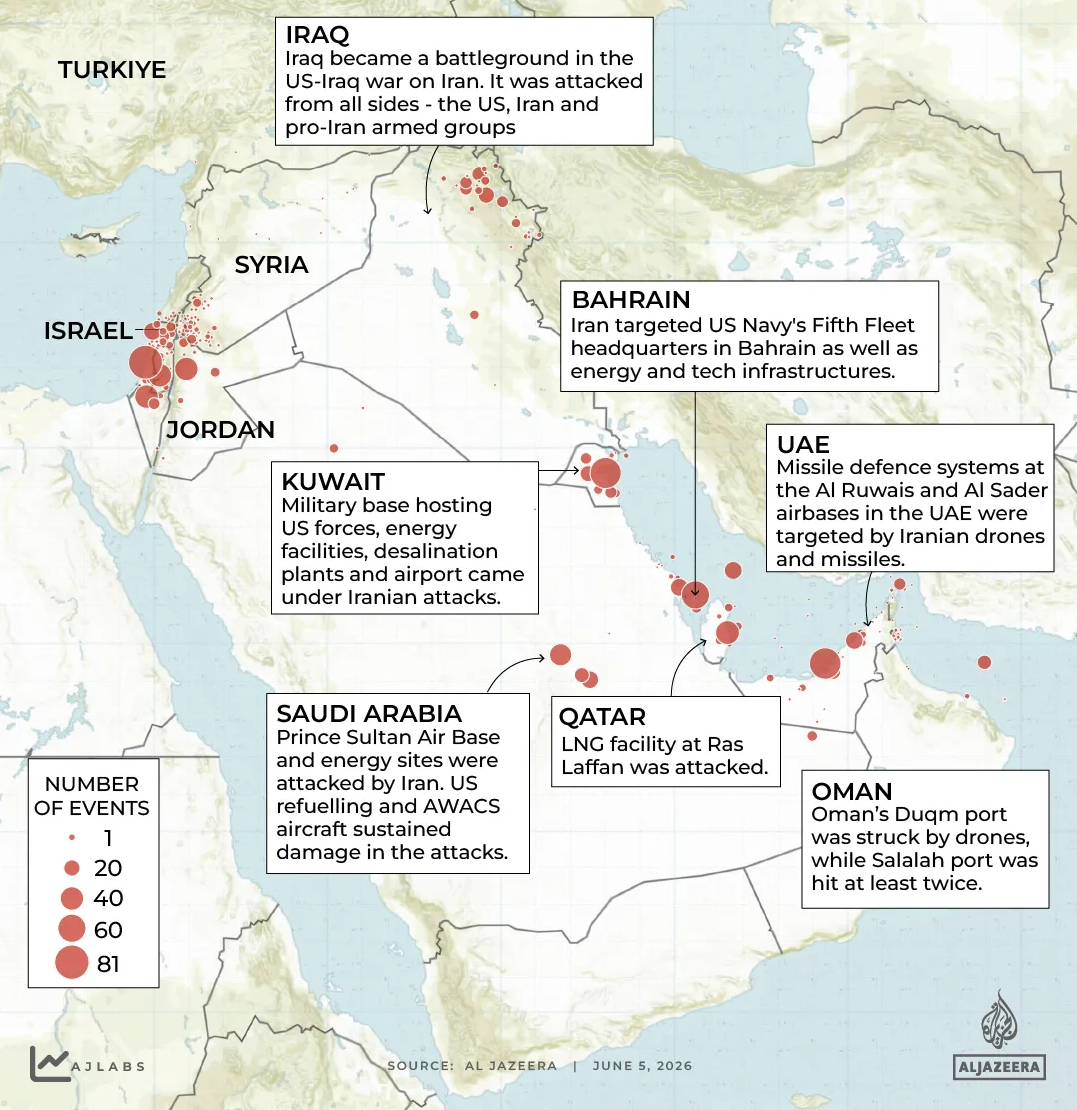
- The strikes come a day after the US military said it hit at least 140 targets in Iran, killing at least two people, and Tehran launched retaliatory attacks on Bahrain, Kuwait, Oman, Qatar and Jordan.
- US President Donald Trump claims the Strait of Hormuz is “open”, while Iran’s Persian Gulf Strait Authority insists no travel is allowed until “stability and calm are restored”.
- Qatar says shrapnel from Iranian attacks wounded three people, including a child, while Kuwait says Iranian attacks hit three border centres and an offshore drilling platform, wounding one person and causing material damage.
- India says 23 Indian sailors were rescued and another remains missing after an attack on the container ship GFS Galaxy off the coast of Oman.
|
|
|
Iran says almost dozen ‘enemy projectiles’ targeted Qeshm Island
New explosions have been heard in Bandar Abbas and Qeshm Island as the US carries out a fifth wave of strikes since a ceasefire agreement was signed three weeks ago.
Iranian state media say military sites were targeted in Hormozgan province, with Tehran saying it has retaliated against US military assets in the region.
|
|
|
US targets geostrategically important cities along Strait of Hormuz
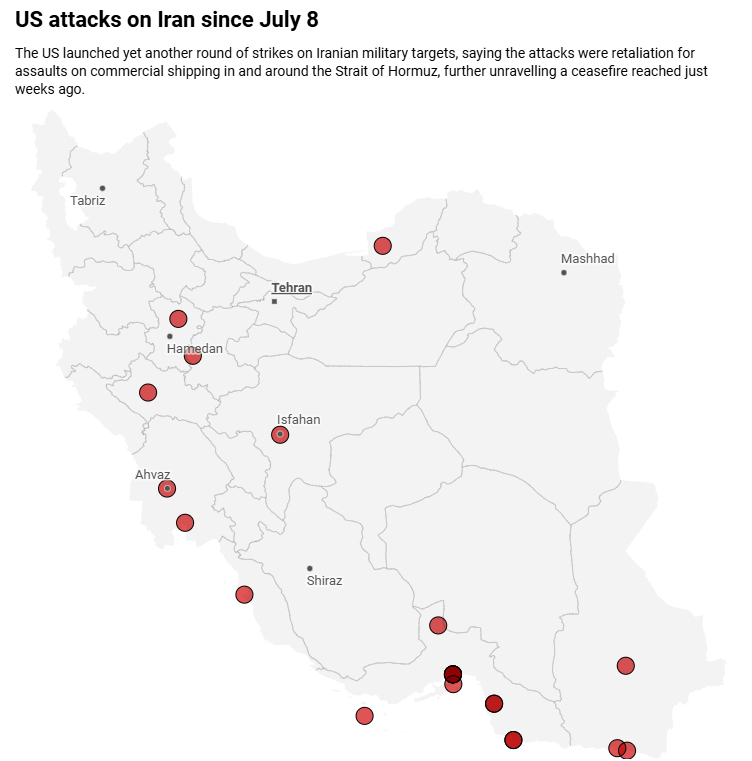
There is a longer list of cities targeted in Khuzestan province, Hormozgan province, and Sistan-Baluchestan province.
Initial reports say that attacks have taken place in at least four locations in Hormozgan province – Jask, Sirik, Qeshm Island, and Bandar Abbas – with explosions reported.
These places are critically important for their geostrategic role when it comes to the authority Iran is trying to exercise over the Strait of Hormuz. They also host radar sites and military facilities.
Qeshm Island, for instance, is the largest island in the vicinity of the Strait of Hormuz.
In Khuzestan province, located in the southwest of the country, we have several cities where attacks have been reported, including in Omidiyeh, Mahshar, Behbahan, Dezful, as well as areas in the vicinity of Ahvaz.
In Sistan-Baluchestan, we’ve got reports of continued air attacks in the vicinity of Chabahar, but one important location struck by the US is in Markazi province, outside the city of Khondab. That is significant because it hosts the country’s heavy water facilities.
|
|
|
US say IRGC continuing to fire at ships in Hormuz
A spokesperson for US Central Command has told Al Jazeera that Iran’s Islamic Revolutionary Guard Corps, or IRGC, has fired at commercial shipping transiting the Strait of Hormuz over the past hour.
Captain Tim Hawkins said US aircraft have so far shot down an Iranian cruise missile and a one-way attack drone.
That comes after CENTCOM announced a fresh wave of US attacks on Iranian military targets, which began about two hours ago. The US says those strikes are aimed at degrading Iran’s ability to target commercial shipping… in the waterway.
So we are still seeing two very different versions of what is happening in the Strait of Hormuz. US President Donald Trump has said the strait is open, while Iran says it is trying to close it until the US stops interfering in the waterway.
But with both sides trading fire in and around the strait, the practical question is: how many ships are actually able to cross?
Brent crude has already risen to about $79 a barrel, and the latest figures from Kpler show traffic through the strait had fallen to about 22 ships a day last Thursday, compared with about 130 a day before the start of the war.
That is also becoming a political problem for Trump at home, as rising fuel prices add pressure on his administration and the Republican Party ahead of upcoming congressional elections.
|
|
|
US attack on water pumping station in Iran’s Mahshar kills 1, wounds 4
A senior official in Iran’s Khuzestan province says one person has been killed and four others injured after a projectile hit an agricultural water pumping station in Mahshahr, according to the IRNA news agency.
Valiollah Hayati, the deputy governor for security and law enforcement, said the attack took place in the early hours of today, adding that the person killed was a guard at the facility.
He said emergency and medical teams were following up on the condition of the wounded.
|
|
|
Iran accuses US of ‘overt and covert pressure’ on Oman
The Iranian Foreign Ministry issued a statement, condemning the US’s “aggressive” attacks against the country.
The statement also addressed the talks between Iran and Oman on Saturday in Muscat.
It said the talks focused on arrangements for managing the Strait of Hormuz and that, “unfortunately, the US prevented a result on this issue through overt and covert pressure on Oman”. It also rejected Trump’s claims about the outcome of the talks as “pure falsehoods born of desperation”.
Trump had told US media that Iran had agreed to a deal on Saturday, where “they were giving up everything”, but “then, all of a sudden, two hours after that, they hit a ship with a drone”.
Earlier, sources told Al Jazeera that during Iranian Foreign Minister Abbas Araghchi’s meeting with his Omani counterpart, Badr Albusaidi, on Saturday, Muscat had proposed two separately-controlled routes in the Strait of Hormuz, one through Iranian territorial waters and one through Omani waters.
|
|
|
Oil prices surge as US, Iran exchange tit-for-tat attacks
Oil prices have spiked again after the US renewed strikes on Iran over the standoff on the Strait of Hormuz.
Brent crude climbed 3.3 percent in early trade to reach $78.50 a barrel, up from the recent trough of $70.14, while US crude added 3.4 percent to $73.83 a barrel.
|
|
|
Oil prices could rise above $80 a barrel if violence persists
Omid Shokri, an energy expert and senior visiting fellow at George Mason University, said that Brent crude, the main benchmark for oil prices, could rise above $80 if the violence persists, “as traders add a larger geopolitical risk premium”.
“The much greater upside risk would emerge if the fighting restricts tanker traffic through the Strait of Hormuz, or damages Gulf production and export infrastructure,” he added.
Shokri said prices are likely to remain elevated for as long as traders perceive the agreements underpinning the truce between Iran and the US as fragile.
“As a result, price volatility is likely to remain elevated even during periods of relative calm,” he said. “Ultimately, the duration of elevated oil prices will be determined by the extent of actual supply disruptions, not by fragile agreements alone.”
|
|
|
US strikes hit eight towns across Iran’s Khuzestan province, official says
More about the US attacks on Iran’s southwestern Khuzestan province:
Valiollah Hayati, the province’s deputy governor for security and law enforcement, told the semi-official ISNA news agency that US forces attacked at least eight locations across Khuzestan in recent hours.
The strikes landed in a series of waves between 1:35am and 2:20am local time.
He said officials were still assessing the damage in each area and denied that Ahvaz airport had been struck, saying the two impact points near the city were on its outskirts.
Earlier, Hayati had said that one person was killed and four others wounded after a projectile hit an agricultural water pumping station in Mahshahr.
|
|
|
Sirens blare in Bahrain
Bahrain’s Ministry of Interior has said air raid sirens have been activated.
The ministry also advised people to avoid using or obstructing main roads unless necessary and said that further safety instructions would follow.
|
|
|
Trump claims he has 59 percent approval rating
The US president has said in a Truth Social post that he has a 59 percent approval rating, while also claiming that prices are falling, alongside oil and gas costs.
“59% Approval Rating. Prices coming down along with the lowering of oil and gas,” Trump wrote in the brief post.
He did not specify the source for the approval rating figure, but the latest polls, including from HarrisX and Quantus Insights this month, show that some 43 percent of Americans approve of Trump’s performance, while some 54-55 percent disapprove.
Meanwhile, global oil prices are also surging amid the renewed tensions in the Gulf, with Brent crude climbing about 3.3 percent to about $78.50 a barrel.
|
|
|
US strikes cannot ‘sufficiently degrade’ Iran’s ability to disrupt Hormuz shipping
Alan Eyre, a distinguished diplomatic fellow at the Middle East Institute, says Iran views control of the Strait of Hormuz as its primary strategic deterrent and is not yet prepared to relinquish it.
But “this is something that the US is not yet willing to accept”, said Eyre, who served on the US team that negotiated the 2015 nuclear deal with Iran, which Trump later withdrew from.
“So, forget about talking about the nuclear issue. This is the main speed bump that has to be negotiated and navigated if we want a resolution for the nuclear issue. And right now, I don’t see that happening,” Eyre said.
He added that the US’s ongoing strikes would not “sufficiently degrade” Iran’s ability to threaten shipping through the strait.
“The US is, again, doing what it does best: attacking Iran militarily, because we do have military supremacy. But the unfortunate reality is that no matter how much we strike the coastal areas, we cannot sufficiently degrade Iran’s potential to threaten shipping through this strait,” Eyre said.
And that’s “because Iran has so many missiles, so many drones, so many smaller attack craft that can threaten vessels”, he added.
|
|
|
Iran launches missile, drone attacks on ‘enemy bases’, state media report
Iran’s Nour News Agency reports that the Iranian Army and the IRGC have launched “large-scale missile and drone attacks” on “enemy bases in the region”.
Citing an Iranian military official, the agency said the operation was launched in response to the US’s continuing attacks on Iran and targeted sites identified following “enemy movements” over the past 48 hours.
|
|
|
Iran claims attacks on Jordan’s Prince Hassan airbase
The Islamic Revolutionary Guard Corps says it targeted the Prince Hassan airbase in Jordan with missiles and drones, setting fire to several fuel depots and ammunition storage facilities.
In a statement, the IRGC said the attack was the first phase of its response to US strikes on Iranian coastal military bases.
It said the US attacks followed an operation by the IRGC Navy to stop two ships in the Strait of Hormuz, which it accused of “switching off their tracking systems, travelling illegally and endangering navigation”.
The IRGC said its retaliatory operations are continuing and that the results would be announced in subsequent statements.
|
|
|
US military says latest wave of attacks against Iran now over
US Central Command says it has “completed a new wave of offensive strikes against Iran”.
|
|
|
US military says ‘dozens of targets’ hit in Iran, including air defense systems
The CENTCOM said it hit “dozens of targets at multiple locations with precision munitions to degrade Iran’s ability to continue attacking international shipping flowing through the Strait of Hormuz”.
These targets include “Iranian military air-defense systems, coastal radar sites, missile and drone capabilities, and small boats”.
CENTCOM said it deployed “US fighter aircraft, naval vessels, one-way attack aerial drones, and one-way attack sea drones for the first time”.
|
|
|
Iran claims attack on Bahrain’s Sheikh Isa airbase
The IRGC says it targeted several facilities at the Sheikh Isa airbase in Bahrain in the second phase of its retaliatory operation.
In a statement, the IRGC said its aerospace forces struck helicopter maintenance facilities, a hangar housing a P-8 aircraft and a US military drone command-and-control centre.
The IRGC said the attacks were carried out in response to continued US military action against Iran. It added that its retaliatory attacks were continuing.
|
|
|
Explosions heard in Iran’s Bandar Abbas
The IRNA news agency reports that at least two powerful explosions have been heard in Bandar Abbas, in Iran’s southern Hormozgan province, in the past hour.
The report came moments before US Central Command announced that its latest wave of attacks on Iran was over.
|
|
|
Iran claims attacks on Kuwait airbases
The IRGC says it has “completely destroyed” fuel tanks and Patriot air defense systems at the Ali Al-Salem airbase, as well as a strategic FPS radar system at the Ahmed Al-Jaber airbase.
In a statement, the IRGC said the attacks were carried out by its aerospace forces during the third phase of its “eye-for-an-eye” operation in response to US military action against Iran.
The IRGC said the operation was continuing.
It also warned against further US involvement in the Strait of Hormuz, saying that Iran would not allow continued foreign military interference in the waterway.
|
|
|
With war on Iran, Trump took a ‘complex system and broke it’
Alan Eyre, the former senior US diplomat and member of the US negotiating team for the 2015 Iran nuclear agreement, said the US and Israel’s war on Iran has disrupted the region’s strategic balance.
“With the war in June, and to a lesser extent last year as well, President Trump took the complex system and broke it,” Eyre told Al Jazeera. “It’s going to take time for this complex system in the Persian Gulf area to find a new balance, a new homeostasis. I don’t know how long it will take; I don’t know what it’ll be. But we do know it won’t be like it was before.”
And “that’s unfortunate, because the new region is going to be far less stable, and Iran will be far more dangerous”, he said.
Eyre suggested that the US may have to “accept increased Iranian control” of the Strait of Hormuz to reach a nuclear deal. He also pointed to a growing divergence between the US and Israel over how to proceed.
“The US and Israel, at this point, have differing strategic goals,” Eyre said. “The US just wants to cut its losses, get the strait open, and move away, because it’s a quagmire. Israel thinks this is unfinished business – it wants to resume attacks, and wants the US to resume attacks against Iran and against Hezbollah.”
“So it’s an incredibly dynamic situation”, he added, “with a lot of different variables in play”.
|
|
|
Sirens sound again in Bahrain
Bahrain’s Interior Ministry says that sirens have been sounded again, warning people to remain calm and head to the nearest safe place.
|
|
|
US, Iran ‘almost back to war’ over ‘misunderstandings’ about Hormuz
The MoU was signed several weeks ago and is close to the end of the first month of the 60-day period given for a final deal. So that’s not a very hopeful situation, but countries in the region are continuing their [diplomatic] efforts.
Qatar sent a delegation just a couple of days ago to Iran, and there has been negotiations between Iranians and Omanis to try to come to a deal regarding how to manage the Strait of Hormuz.
Of course, that misunderstanding between the Americans and the Iranians is the cause.
The Iranians think that they have the prerogative, according to the MoU, to organize traffic in the Strait of Hormuz, which means they can give or deny permissions to ships, and [they believe that] any ships that cross the strait without advance Iranian permission have violated the MoU.
But according to the American understanding, the Iranians have to step aside and allow free, unhindered traffic in the Strait of Hormuz. So that’s the subject of this conflict right now, and we are almost back to war because of this particular point and the misunderstanding about it.
So that’s something that is hindering the peace efforts, and regional countries are still continuing to try to overcome this particular obstacle, including Pakistanis, Qataris and Omanis.
|
|
|
Iran’s army says ‘drone attacks continue against US bases in the region’
A new statement from Iran has been issued on the attacks on Kuwait. This time, it’s from the Iranian Army.
The statement, carried by the IRNA news agency, said drone attacks were continuing on US bases in the region and that the army launched “destructive drone” assaults on US forces in Kuwait, including defense and missile systems, bunkers and support shelters.
The army went on to condemn what it described as repeated US attacks on military sites, civilian infrastructure and civilians in Iran, calling them a “blatant violation” of the fundamental principles of the United Nations Charter.
The army said Iran’s armed forces would use their full capabilities to defend the country’s sovereignty, territorial integrity, independence, and population against any further aggression.
As we’ve been reporting, Iran’s IRGC earlier claimed attacks on Kuwait’s Ali Salem and Ahmad Al-Jaber bases.
|
|
“..blatant violation of the fundamental principles of the United Nations Charter."
The US is a war belligerent since Trump's declaration of war on Iran on February 28th. Their attacks have been regularly reported by Iran as (also) from GCC countries, which means that each member state has been contributing to aggression and violence by the US in their acts of war on Iran. This involvement makes GCC state a co-belligerent of the United States, and is therefore also responsible under states responsibility laws.
Iran has therefore the right to consider facilitating GCC countries as military objectives.
The war on Iran is supposed to have approval by mandate from the UN Security Council, which Trump hasn't.
Then, Trump is participating on nuclear political grounds in a war initiated by Netanyahu before Trump declared war on Iran, while the latter is not attacking the country of the United States.
The war already violates the UN Charter as even Netanyahu started the war on nuclear political grounds. So, GCC's facilitation is by the given political grounds thus also in violation of the UN Charter thus infringing the sovereignty of Iran.
|
Neither US nor Iran ‘can change facts on the ground’ with military action
Trita Parsi, a leading expert on Iran, says misunderstandings between the US and Iran over the governance of the Strait of Hormuz during the interim period are driving the current tensions.
“There were obviously some ambiguities in that memorandum [signed on June 16]. It was necessary in order to get to an agreement within a timely fashion,” said Parsi, executive director of the Quincy Institute for Responsible Statecraft, a US-based think tank.
“But some of those have proven crucial in the sense that the two sides have very different ideas of what it should actually mean.”
Parsi said he did not believe military action “can change the fundamentals of the situation” in favor of either of the sides.
“At best, I think it can lead to scenario in which – after this round of fighting, which seems to be much more intense than the previous ones – they will return to the table, realizing that neither one of them can really change the facts on the ground, and as a result, [realize that] some form of a compromise is necessary,” he said.
“I do not see military action by either side really being able to change the fundamentals of the situation, differently from what it did in the previous war,” he added.
|
|
|
Depleted oil inventories make a longer US-Iran war ‘very unattractive’
Trita Parsi, the executive vice president of the Quincy Institute for Responsible Statecraft, said while confidence in diplomacy remains low in both Tehran and Washington, “there’s an even greater confidence that neither side can afford another long war”.
As a result, “that force will keep them away from a completely uncontrolled level of escalation”.
Parsi pointed to depleted oil inventories as a key factor that “makes a longer war very unattractive”.
“All inventories have not been able to be replenished. We are at a much lower level globally. We’re at a much lower level with the US strategic petroleum reserve,” he said. “The Iranians have less oil on the waters, compared to what they did in February. So the runway before any oil crisis really would become serious is much shorter than it was back in February.”
Paris added that given sufficient time, the US can degrade Iran’s ability to disrupt shipping in the Strait of Hormuz.
But “the question is, how long will that take, and how much will the oil market suffer in the meantime – that it ends up becoming a political disaster and nightmare for the Trump administration,” he said. “That’s where I think the problem lies for the US.”
|
|
|
Kuwait says air defenses engaging ‘hostile aerial targets’
The General Staff of Kuwait’s Army says air defense systems are engaging “hostile aerial targets” inside the country’s airspace.
It said any explosions heard were the result of air defense systems intercepting the attacks, and urged the public to follow safety and security instructions.
|
|
|
Oil prices jump as US and Iran trade attacks over Strait of Hormuz
Brent crude, the main international benchmark, has risen more than 4 percent as US and Iran continue to exchange fire amid their escalating standoff over control of the Strait of Hormuz
Brent futures for September delivery stood at $79.17 a barrel as of 03:00 GMT, the highest since June 22.
|
|
|
Jordan claims intercepting 4 missiles fired from Iran
Jordan’s military says it has intercepted and downed “four missiles that entered Jordanian airspace” and came from Iranian territory.
Earlier, the IRGC said it targeted Jordan’s Prince Hassan airbase with missiles and drones, and set fire to several fuel depots and ammunition storage facilities.
|
|
|
Sirens and alerts sound across Gulf states
Shortly after those US strikes across Iran, sirens went off in several countries in the region.
In Bahrain, the Interior Ministry called on people to take shelter. They also advised people not to be in open spaces. After that warning, a statement from the Iranian army was released saying that they targeted the Sheikh Isa airbase in Bahrain.
They said the targets were maintenance facilities and the command-and-control centre for US military drones.
We also heard sirens in Jordan. There, the Iranians are claiming the targets of those strikes were fuel depots and ammunition storage facilities.
In Kuwait, there was a warning a short while ago from the army, saying that they were engaging hostile aerial targets and telling people not to panic if they heard any loud noises, as that is their air defense systems engaging those projectiles.
The Iranians are saying they targeted radar systems and air defense systems at Ali Al Salem airbase.
|
|
|
Concern for renewed war in Iran as US attacks military, civilian targets
Several days of military attacks by the US across Iran have marked the most intense rounds of bombardment since the two sides reached a vague memorandum of understanding last month.
US fighter jets and warships have hit hundreds of military targets and a number of civilian ones in nearly a week of strikes with Iranian authorities reporting attacks in at least 10 provinces, mainly in southern Iran near the strategically important Strait of Hormuz.
In Tehran, life for more than 10 million people has carried on mostly as usual since the capital has not been recently attacked. But the economy is in the doldrums, and the outlook is increasingly uncertain, more than four months after the US and Israel began their aerial campaign.
|
|
|
Iran claims attacks on HIMARS launchers in Kuwait
The IRGC says it has launched attacks on Kuwait in the fourth phase of its retaliatory operations this morning.
It said it targeted a US surface-to-surface missile base in Kuwait, “setting fire to two HIMARS missile launchers and missile-packed warehouses, completely destroying them”.
|
|
|
Iran claims attacks on Oman, Bahrain
The IRGC has announced details of what it called its fifth phase of retaliation.
It said it launched missile and drone strikes targeting “installations and infrastructure of the aggressive US army” in Juffair, Bahrain, and “the FPS long-range aerial radar and the vessel detection radar in Oman”.
It claimed the radars in Oman were destroyed.
The IRGC warned that “the only way to open the Strait of Hormuz to vessel traffic is to end the interventions of the aggressive US military in this strait and respect the sovereignty of countries over their own coastal waters”.
“Continuing these interventions will lead to greater incidents in the world’s oil and gas sector,” it added.
|
|
|
US-Iran MoU ‘now largely undermined’
The United States has conducted one of its largest military campaigns against Iran since the memorandum of understanding was signed over three weeks ago. This is now the sixth time that both parties are attacking one another.
The locations of the strikes are becoming a pattern. The majority are around the Gulf and the Strait of Hormuz. The Americans believe by hitting these locations they are going to degrade the capabilities of the IRGC, and the Iranian armed forces, but Iran also is not giving up.
They say they hit a fuel depot in Jordan and also a helicopter maintenance facility in Bahrain, and have destroyed fuel tanks and a Patriot air defence system in Kuwait.
On top of that, once again, the IRGC is saying that the Strait of Hormuz is closed. Two ships that tried to pass through the Strait of Hormuz were intercepted and stopped by IRGC.
Iran believes that Article 5 of the MOU states it has on full control over international maritime traffic in the Strait of Hormuz.
The MoU is now largely undermined. Article 1 is about both sides not attacking each other, which has simply collapsed. Article 10 is about lifting sanctions, but a couple of days ago the US imposed new sanctions.
So the prospect of future diplomacy is not that promising.
|
|
|
Sirens activated in Bahrain again
The Ministry of Interior in Bahrain says the air raid alarm siren has been activated.
“Citizens and residents are requested to remain calm, head to the nearest safe location, and follow updates through official channels,” it said.
Bahrain has issued several alerts in the past few hours amid Iranian attacks on the country.
|
|
|
Iran says US drone shot down in Bandar Abbas
The Tasnim news agency is reporting that the drone was a US-manufactured “Lucas” suicide drone, and it was “accurately hit and shot down”.
|
|
|
GCC oil exports suffer amid standoff over Strait of Hormuz
The economies of the countries in this region are based on oil and gas exports that pass through the Strait of Hormuz to reach global markets.
If the Strait of Hormuz is restricted or closed, their economies are hit hard.
But they’re not the only countries that are affected. Globally, about 20 percent of energy supplies of gas and oil pass through this waterway to reach markets in Europe, Asia and Africa. Any time the Strait of Hormuz is closed or restricted, global energy markets are therefore affected.
And what you see happening now is that countries mediating between the US and Iran have also been targeted. I’m talking about Qatar and Oman.
Yesterday, both countries were targeted by Iranian strikes. Oman has even summoned the Iranian ambassador to complain about those attacks. Qatar’s Foreign Ministry said those strikes and escalations do not help mediation efforts.
|
|
|
Strait of Hormuz traffic slows to multi-week low
The number of vessels transiting the Strait of Hormuz has fallen to its lowest in five weeks, according to shipping data, amid renewed strikes between the US and Iran.
Six ships crossed the strait on Sunday, according to Kpler data, including the Very Large Crude Carrier Humanity and the Capetan Andreas, transporting two million barrels of Iranian oil and 500,000 barrels of Kuwaiti petroleum products, respectively.
Three empty tankers also entered the Gulf to load oil, according to the data.
On Sunday, President Trump said the waterway was open to commercial vessels, though Iran earlier declared that it had shut the strait after a ship attempted to pass using an unapproved route.
Iran’s Revolutionary Guards said on Monday that it had stopped two vessels in the strait, without naming the ships involved.
|
|
|
How did the US-Iran conflict reignite?
- It began on July 6 when the IRGC struck three commercial vessels, including a Qatari liquefied natural gas tanker, off the coast of Oman.
- The following day, the US said it carried out retaliatory strikes on Iranian military targets, and Tehran responded with missile and drone attacks on US bases across the Gulf.
- On July 8, Trump told reporters the ceasefire was over, rattling markets and increasing oil prices.
- On Saturday, Iran’s IRGC announced the closure of the Strait of Hormuz until further notice after attacking a container ship using what it called an unapproved route.
- The assault triggered renewed tit-for-tat strikes between the US and Iran, with US forces carrying out deadly strikes on multiple Iranian cities, most of them along the Strait of Hormuz. Iran retaliated with attacks on Bahrain, Kuwait, Oman, Jordan and Qatar and claimed more strikes on ships in the Strait of Hormuz.
|
|
|
GCC and Jordanian air defenses busy engaging ‘hostile aerial targets’
It’s been a quite a busy night and morning for the air defense systems in some of the Gulf Cooperation Council countries, like Kuwait and Bahrain, but also in Jordan.
Since those US attacks on Iran, we’ve had three rounds of strikes on Bahrain. The Ministry of Interior has advised people to stay indoors to take precautions and not to come out in open spaces.
In Kuwait, the military is in the process of intercepting “hostile aerial targets”. People were told if they hear loud explosions they should not panic – that it’s the air defense systems of Kuwait engaged with those projectiles.
In Jordan, we’ve also had warning sirens and the government saying it intercepted at least four missiles fired from Iran. The debris from those interceptions fell in several locations, but the government said there have been no casualties.
|
|
|
Iran to ‘pursue justice’ for slain supreme leader, every citizen killed
Foreign Ministry spokesman Esmaeil Baghaei says pursuing justice for the assassination of Supreme Leader Ali Khamenei is “a serious principle” for the Iranian government.
“The government has a clear duty. The Ministry of Foreign Affairs is part of this process,” he said at a news conference in Tehran.
“We will use all legal and international tools and opportunities at the international level to document their [US-Israeli] crimes and to pursue the implementation of justice,” Baghaei added.
Iran is trying to agree a joint mechanism with Oman for shipping through the Strait of Hormuz, but US pressure on Muscat has hindered efforts, he said.
|
|
|
No Iran sanctions relief without clear nuclear renunciation: France
France’s foreign minister, Jean-Noel Barrot, has told French media there would be “no lifting of sanctions” on Iran as long as it hasn’t “renounced its nuclear program”.
Last month, Barrot said Paris wanted to play a role in talks dealing with Iran’s nuclear efforts and would not approve the lifting of UN sanctions unless it’s satisfied by the terms of a final peace agreement in the US-Israeli war on Iran.
France is a veto-wielding member of the United Nations Security Council.
|
|
|
Iran calls on US to meet its obligations under interim deal
Iran has entered “every negotiation with meticulousness and seriousness, keeping in mind the interests and concerns of the Iranian nation”, Iran’s Foreign Ministry spokesman says.
“Once an understanding has been reached, it has acted in good faith and seriousness in fulfilling its commitments,” Baghaei told reporters in Tehran.
“The Islamic Republic of Iran has never been the first to violate its commitments.”
Iran will no longer abide by the memorandum of understanding signed with the US if Washington fails to uphold its commitments to end the war, he added.
“Each time the other party has failed to meet its obligations, we did not uphold ours. … We will continue to act in this manner,” Baghaei said.
|
|
|
At least 1 killed, 7 wounded in US strike on central Iran
The deputy governor of Isfahan province says one person has been killed in a US attack on a military base in the city of Nain.
Seven people were injured and are receiving treatment “following an attack by the terrorist American army”, the official told Mehr news agency.
It’s the second death reported in Iran today. Iranian media said earlier one person was killed and four others wounded in a US strike on an agricultural water pumping station in Mahshahr.
|
|
|
‘No one can accuse Iran of violating its promises’
The foreign ministry spokesperson says Iran has carried out its pledges under the memorandum of understanding with the United States.
“No one can accuse the Islamic Republic of Iran of violating its promises,” Esmail Baghaei said.
“In all cases, our obligations and those of the other party are clear, and it can be proven in a documented manner that the other party has violated various parts of this memorandum of understanding under various pretexts.”
|
|
|
EU’s Kallas says Strait of Hormuz must return to status quo
European Commission Vice President Kaja Kallas says officials will meet Gulf nations to discuss security in the region.
Noting the Iran-US interim deal is “not really holding”, she said EU foreign ministers will discuss “what kind of messages we can send that the Strait of Hormuz has to be opened, freedom of navigation has to be respected, there cannot be no tolls, no fees for navigation there”.
Iran has warned against any “foreign” interference in the Gulf after some European countries suggested deploying naval forces to get commercial shipping flowing through the critical strait.
|
|
|
Oil prices surge on deadly US-Iran attacks; Hormuz uncertainty
Oil prices jumped more than 4 percent after the latest flare-up between the United States and Iran that threatened their already fragile truce.
Both main oil contracts, which have tumbled since the announcement of an interim agreement, spiked as much as 4.5 percent, fanning concerns that inflation – already elevated because of the war – could force central banks to hike interest rates.
Fawad Razaqzada, a market analyst at Forex.com, said: “One can easily imagine the situation spiraling quite rapidly. Of course rhetoric can soften. We’ve seen that movie before. But for now traders are forced to assume the worst.
While the resumption of hostilities has led to another spike in crude prices, IG analyst Fabien Yip said they are unlikely to hit the lofty levels that followed the launch of the US-Israel war on Iran on February 28.
“Oil’s return towards pre-war levels in June reflected markets pricing in a best-case outcome for the fragile US-Iran arrangement,” she wrote. “Re-escalation exposes how fragile that assumption was.”
|
|
|
Tit-for-tat attacks show Iran and US navigating ‘red lines’
Despite attacks between Iran and the US, it is still likely diplomacy is continuing, says Paul Musgrave, associate professor of government at Georgetown University in Qatar.
“When you have two sides engaged in a conflict like this, they’re going to communicate in many ways, sometimes through mediators or back channels. Sometimes they’re going to do it on, for example, the battlefield,” Musgrave said.
Right now, both are trying to figure out where the other’s “red lines” stand, he added.
“The Iranians have said they have to have control over the Strait of Hormuz, but what does that really mean? Are they going to insist on a mandatory tolling? Are they ever going to allow Oman to have the same rights over its territorial waters that they claim for their own?”
Iran’s objectives seem to have grown over the course of the conflict while the US’s have “amazingly” shrunk, Musgrave said.
“The US is no longer talking about regime change, but people in Tehran are starting to talk about something that looks like hegemony over the Arabian Gulf,” he noted.
That means it’s going to be extremely difficult to get back to diplomacy, Musgrave said.
|
|
|
China calls for ‘free’ and ‘safe’ Hormuz passage
Beijing says the Strait of Hormuz is a waterway for international navigation resuming free and safe passage serves the interests of all nations.
Speaking to reporters in Beijing, Foreign Ministry spokesperson Lin Jian said passage through the strait should be “properly handled”.
Lin’s remarks come after the US and Iran engaged in days of reciprocal attacks over disagreements on navigation routes in Hormuz.
Earlier this Iran’s ambassador to Beijing said ships transiting the Strait of Hormuz will be charged new fees but added China and other “friendly” countries will be granted “special considerations”.
|
|
|
Explosions heard around Iran’s Bandar Abbas and Qeshm Island
New blasts have been heard around Iran’s southern Bandar Abbas city and Qeshm Island.
|
|
|
New Iran strikes on Gulf as US attacks escalate
Iran’s Islamic Revolutionary Guard Corps (IRGC) has targeted Bahrain, Oman and Kuwait in retaliatory attacks in response to escalating US strikes.
In the wake of this third round of military escalation, GLOSM-IRIS recaps where the latest strikes occurred, the responses from both sides, and what this means for vessels transiting the Strait of Hormuz.
|
|
|
Bahrain says it thwarted ‘treacherous’ Iranian attacks
Bahrain’s military says its air defense systems intercepted Iranian missile and drone attacks and accused Tehran of systematically targeting civilians and private property.
All military units have been placed on high alert to protect the kingdom, while the public has been warned not to approach suspicious debris and to report it immediately, a statement said.
The army denounced “several treacherous Iranian aerial attacks this morning” on the Gulf state.
Bahraini forces are at “advanced combat readiness”, it said, praising the “high vigilance demonstrated by its valiant personnel in performing their sacred national duty of defending the homeland”.
|
|
|
Pezeshkian will be scapegoated for failure of Iran-US deal
Over the past few days, the US-Israel war on Iran has seen yet another deadly escalation that threatens to derail peace talks.
The fate of the memorandum of understanding, which the US and Iran signed as a framework for negotiations, is now increasingly in question.
As anger grows among the Iranian regime’s own base, official rhetoric is increasingly pointing to one individual responsible for the perceived failure: President Masoud Pezeshkian.
Blaming the president is not only an attempt to offer the Iranian public a scapegoat but also to cover up internal divisions within the ruling elite.
|
|
|
US attacks on Iran since July 8
The US launched yet another round of strikes on Iranian military targets, saying the attacks were retaliation for assaults on commercial shipping in and around the Strait of Hormuz, further unravelling a ceasefire reached just weeks ago.
|
|
|
US attempted to neutralize Iran’s leverage over Hormuz during truce
Ali Akbar Dareini, a researcher at the Center for Strategic Studies in Tehran, says Iran closed the Strait of Hormuz in self-defence at the height of the war.
“It was a defensive measure because Israel and the United States launched a war of aggression against Iran,” Dareini said.
“Then Iran established protocols to make sure that ships passing through the Strait of Hormuz will not endanger Iran’s national security – that there will not be any hazardous passage, but only innocent passages.”
Under Article 5 of the memorandum of understanding, “Iran will make arrangements for the passage of ships, not the United States or other parties”, he added.
“The same article says Iran and Oman will hold discussions about the future administration and maritime services at the Strait of Hormuz.”
Dareini said diplomatic efforts were paused to hold the funeral for slain Supreme Leader Ali Khamenei.
“Americans looked at that as an opportunity to take away Iran’s leverage in the Strait of Hormuz by establishing an alternative corridor, and Iran could not tolerate that.”
|
|
“Iran will make arrangements for the passage of ships,.."
Latterly:
Upon the signing of this MOU, the Islamic Republic of Iran will make arrangements, using its best efforts, for the safe passage of commercial vessels, with no charge for 60 days only, from the Persian Gulf to the Sea of Oman and vice versa.
"..using its best efforts,.."
This latterly means that Iran should look for these efforts to use. But Oman took that position by offering the IMO unilaterally an alternative route without Iran's consent.
|
At least 2 killed in US strikes on Iran’s Abadan
US missiles hit three locations in the city of Abadan in the western province of Khuzestan.
Mehr news agency, quoting the deputy governor, reported the attack took place at 1:45pm (09:45 GMT).
At least two unidentified people were killed and three wounded in the attack, it said.
|
|
|
Iran fires ‘warning shots’ at 2 ships in Hormuz
State TV reports the IRGC opened fire on two ships attempting to cross the Strait of Hormuz as Iran and the US battle for control of the strategic waterway.
“This morning, two ships that were attempting to cross the Strait of Hormuz illegally were targeted and stopped by warning shots fired by the navy of the Revolutionary Guards,” said a correspondent based near the strait.
Iran-US strikes continue to escalate as both vie for authority over the trade route, through which about one-fifth of the world’s energy resources flow.
|
|
|
UK to designate Revolutionary Guard as "foreign power threat"
The United Kingdom will designate Iran’s Islamic Revolutionary Guard Corps (IRGC) as a threat to its national security with its members facing up to life imprisonment.
Britain says a second Iran linked-group, the Islamic Movement of Companions of the Right, has claimed seven attacks linked to Jewish and Israeli communities and will also be designated.
A new act – using proscription-like powers designed to tackle state-backed threats – gives the home secretary authority to designate organisations involved with foreign nations. The law makes it a criminal offence to express support for, assist, or receive material benefit from a designated organization.
|
|
|
Trump claims US to become ‘guardian’ of Hormuz and get paid for it
President Trump is claiming the United States will take over the Strait of Hormuz and should be reimbursed for controlling the vital waterway.
“We’re going to keep the strait and we’ll probably run it. We’ll become the guardian of the strait. Maybe we’ll call it the guardian angel of the strait, and we should be reimbursed for that,” he said in a phone interview with Fox News.
Attacks between the US military and Iran’s Revolutionary Guard have surged in recent days as both aim to seize control over Hormuz, where 20 percent of oil-and-gas shipments traversed prior to the start of the February war.
|
|
If the US as a war belligerent designates itself a "guardian" over the Strait of Hormuz and expects to be paid for, is that an international violation?
Designating oneself a "guardian" of the Strait of Hormuz and expecting payment for transit is widely considered a violation of international law. Under the UN Convention on the Law of the Sea (UNCLOS), straits used for international navigation are governed by the right of transit passage.
This legal framework strictly prohibits the US as a belligerent from impeding, suspending, or charging tolls for the passage of foreign vessels. Imposing mandatory tolls or forcing commercial ships to pay for military escorts fundamentally breaches UNCLOS and established customary international law.
|
More ships sailing Iran’s Hormuz route than southern path
Dimitris Maniatis, a maritime security analyst, says there’s been a “drastic decline” in the number of commercial vessels transiting the Strait of Hormuz following a “tremendous increase” when the Iran-US deal was signed last month.
Over the past three days, 26 vessels transited the Iranian route, 26 “went dark” with electronic tracking systems turned off, and only five vessels chose the US-military backed southern route, he noted.
“It’s obvious that the Strait of Hormuz is operating under a parallel and competing transit system, rather than a unified international maritime regime,” Maniatis said.
“Commercial operators are adapting by selecting routes, which basically depend on individual political, commercial, and security appetites rather than following a universally accepted transit framework.”
Maniatis noted the Japanese government managed to come to an agreement with Iran and secure the exit of seven Japanese vessels that were trapped in the strait.
|
|
|
Germany, France and UK condemn Iran’s Gulf attacks
The foreign ministers of Germany, France, and Britain have denounced Iran’s attacks on commercial shipping in the Strait of Hormuz and on regional nations.
“We condemn Iran’s heinous attacks on merchant shipping in the Strait of Hormuz and on countries in the region including Qatar, Kuwait, Oman and Jordan,” they said in a joint statement.
The group, which is known as the E-3, called for the restoration of the ceasefire and the resumption of negotiations between the warring parties.
|
|
|
Trump threatens to hit Iran ‘very hard’ as escalation rises
President Trump has accused Iran of violating the interim agreement and vowed more powerful attacks against the country.
“It was a done deal and then they broke it. They always break it. We’ve had 10 deals with these people – and so we’re just going to hit them very hard,” a White House statement quoted the president as saying.
“They’re a bad group of people. They’ve been this way for a long time,” Trump added.
|
|
|
Iran’s armed forces say ‘will not allow the US to interfere’ in Hormuz
The unified command of Iran’s armed forces has warned the US against trying to intervene in the Strait of Hormuz and threatened attacks against those who collaborate with Washington.
“We do not and will not allow the United States to interfere in the management of the Strait of Hormuz,” said Ebrahim Zolfaghari, spokesman for the Khatam al-Anbiya Central Headquarters, in comments carried by state broadcaster IRIB.
Iranian forces will “deal severely with any disruption and insecurity” outside Tehran’s designated route.
“Any cooperation with the United States and logistical support for that country’s aggressor army will be considered a war against Iran’s sovereignty and national security,” Zolfaghari said, adding the war could “engulf all the countries in the region”.
|
|
|
View from Tehran: ‘MoU severely weakened but not completely collapsed’
Military confrontation between Iran and the United States continues to intensify beyond the strait of Hormuz despite neither side seemingly engaging in full-scale war. Overnight and into Monday morning, the US carried out multiple strikes targeting several military as well as civilian locations in central and southern Iran, killing and wounding many people according to Iran’s state media.
Iran’s foreign ministry has condemned US air strikes and said it’s a violation of the UN charter, a violation of articles, 1, 5 and 10 the Pakistan-brokered MoU.
The IRGC has expanded its retaliation operations beyond the region targeting US military facilities in Jordan, Bahrain, Kuwait and in Oman.
Despite the violence there are signs that diplomatic efforts are still underway. Iran says it is engaging in technical talks with Oman, pertaining to guaranteeing the safe passage of vessels through the Strait of Hormuz.
But the escalation indicates that the MoU is rapidly, severely weakening but has not completely collapsed.
|
|
|
Iran repairs tens of thousands of war-damaged housing units
Reconstruction is under way on tens of thousands of homes that sustained damaged from US-Israel attacks on Iran’s capital.
More than 95 percent of the nearly 50,000 units with minor or moderate damage have received repairs, Tehran’s Disaster Prevention and Management Organization told ISNA news agency.
Progress was also made on the roughly two-thirds of 2,135 units that require demolition, ISNA reported, with about 200 families staying in hotels and another 1,800 having received housing deposits.
|
|
|
US has threatened global oil-and-gas supplies, says Iran
The United States has “seriously jeopardized” the security of energy supplies by interfering in the Strait of Hormuz, Iran’s military says.
Ebrahim Zolfaghari, spokesman for the Khatam al-Anbiya Central Headquarters, says Tehran continues to assert its authority and control over the strait.
“Regrettably, the cooperation of certain countries in the region has also increased the risk of the conflict spreading throughout the region,” Zolfaghari warned.
|
|
|
‘Asymmetry of war costs favor Iran’
The reason why the US-Iran agreement has failed is down to the economics of war, says Patrick Bury, a senior lecturer in security studies at the University of Bath.
“As long as the Iranian regime has these low-cost weapons such as cheap drones there is an asymmetry between the costs it can impose on global oil traffic versus the price of the US retaliatory cost on the Iranian regime,” Bury said.
“Whenever the Iranians don’t like some development or what they consider to be a violation of the MoU – for example this new shipping route that most of the ships were trying to sail through closer to the Gulf and Oman, rather than the Iranian coastline – Tehran can impose costs by attacking vessels,” he said.
|
|
|
Trump says Hormuz blockade against Iran reinstated
Trump says the US is “reinstating” a blockade on Iran in the Strait of Hormuz and will charge ships for safe passage.
The US will be known as “THE GUARDIAN OF THE HORMUZ STRAIT”, Trump wrote on Truth Social.
“As such, and as a matter of FAIRNESS, will be reimbursed, at the rate of 20% on all cargo shipped, for any and all costs necessary to do the job of providing safety and security to this very volatile section of the World. The process and formation will begin immediately,” he added.
|
|
If the US as a war belligerent designates itself a "guardian" over the Strait of Hormuz and expects to be paid for, is that an international violation?
Designating oneself a "guardian" of the Strait of Hormuz and expecting payment for transit is widely considered a violation of international law. Under the UN Convention on the Law of the Sea (UNCLOS), straits used for international navigation are governed by the right of transit passage.
This legal framework strictly prohibits the US as a belligerent from impeding, suspending, or charging tolls for the passage of foreign vessels. Imposing mandatory tolls or forcing commercial ships to pay for military escorts fundamentally breaches UNCLOS and established customary international law.
|
Iran won’t retreat from controlling Hormuz, official says
Mohammed Mokhber, a senior adviser to Iran’s Supreme Leader Mojtaba Khamenei, says Tehran will continue to fight for the Strait of Hormuz after the US president pledged to take full control of the crucial trade route.
“We defend it so that in the future – for the passage of our ships – we are not forced to pay tribute to the enemy,” he wrote on X. “Retreating from this vital matter has no place in the mind of any friend of Iran.”
Trump said on Monday “we’re taking over the Strait of Hormuz” a day after announcing “we bombed the hell out of them”.
Iran asserted control of the formerly freely navigable waterway in retaliation for the US-Israeli war launched on February 28.
|
|
|
No details yet on how, or if, the US Navy will resume its blockade
Trump ordered the US Navy to impose a blockade on all Iranian shipping through the strait but there are no details on how it should be worked out.
It is unclear whether the US military is currently configured in order to be able to carry out a blockade.
It has been providing some escort work for commercial ships going through the Strait of Hormuz because there are mines at the bottom of the strait and clearly there is no desire to have these commercial vessels blown up by these mines.
But, again, Trump is announcing that this US blockade of Iranian shipping traffic through the Strait of Hormuz is going to resume.
|
|
|
People killed in the latest US strikes on Iran
At least 24 people have been reported killed in Iran since the latest round of US strikes began, including four so far today:
- US missiles hit three locations in the city of Abadan in the western province of Khuzestan, killing two people and wounding three, Mehr news agency reports.
- One person died in a US attack on a military base in the city of Nain, says the deputy governor of Isfahan province.
- A US strike on an agricultural water pumping station in Mahshahr, killed one person and wounded four, Iranian media report.
|
|
|
Hormuz traffic slows to two-month low after latest US-Iran attacks
The number of tankers transiting the Strait of Hormuz fell in the past 24 hours to the lowest level in two months, as renewed fighting between the US and Iran and attacks on vessels heightened safety concerns.
Shipping industry sources said vessels are increasingly switching off their public AIS tracking transponders making it difficult to determine how many ships are at moving.
But according to tracking analysis from Kpler, oil and gas tanker traffic fell to its lowest level since May 25.
“Should the renewed escalation in the strait lead to another prolonged closure of Hormuz, the world will find itself in a much tougher spot,” ship broker Gibson said in a report. “With global inventories rapidly depleted in recent months this is a recipe for much tighter supply, higher prices and significant downside risk for tanker markets.”
The oil products tanker Sea Faith was among the few visible vessels sailing towards the entrance to the strait near the Iranian side, according to LSEG and MarineTraffic ship-tracking data.
|
|
|
Trump’s latest statements call the status of the MoU into question
As part of the MoU, there was not supposed to be any more blockade carried out by the US Navy, and that apparently stopped the minute the two countries agreed to this MoU.
That said, the US military has been providing some escort services to commercial vessels because the strait has not been fully cleared of mines.
But, in terms of preventing Iranian vessels or vessels doing business with Iran, whether it’s the government or businesses, that was not being carried out because that was a part of the MoU.
Does that mean, with the president’s latest announcement, that the MoU is now null and void or is the US violating the MoU?
All of these questions need to be sorted out because this is only creating more confusion on the status of the MoU.
There’s also this question about whether the US can legally impose any tariffs on countries that it is assisting throughout this process because another part of the MoU was, the Iranians would not charge any vessels for transiting the strait for the 60 days of the MoU, implying that the Iranians would then be able to charge tolls or tariffs after that 60-day period.
These are questions that need to be sorted out that both governments need to try to explain and renegotiate, if they are willing to renegotiate at this point.
|
|
"As part of the MoU, there was not supposed to be any more blockade carried out by the US Navy,.."
MoU Paragraph 4
Immediately upon the signing of this MOU, the United States of America will begin the removal of its naval blockade, and any disturbances or impediments against the Islamic Republic of Iran, and will fully end the naval blockade within 30 days.
|
IMO calls for Strait of Hormuz to remain toll free
The International Maritime Organization (IMO) has called for the Strait of Hormuz to “remain free of any tolls and charges, in accordance with international law”.
“We have always been consistent on our stance on fees – IMO stands firmly against charging fees for passage through straits used for international navigation,” an IMO spokesperson said.
“There is no legal basis through which to introduce mandatory tolls simply to transit through a strait.
|
|
|
Trump’s latest comments on Hormuz fee just ‘bluster’
Trump’s latest comments about reimposing a blockade in the Strait of Hormuz are likely “bluster”, Dania Thafer, the executive director of Gulf International Forum, said.
“I think we’re in the bluster category,” she said about whether Trump’s statement was all talk or would be followed up by action.
“I think it’s Trump’s way of having a strategic reciprocity, if you will, with Iran. For example, Iran blockaded the Gulf states in so the US turned around and blockaded Iran. Iran wants to charge fees and perhaps tolls, so the US is saying, well we can do the same thing.”
However, Trump’s latest statements are likely to draw concern from the international community, Thafer said.
“I think, not only the leaders of [the Gulf region] would have an issue with it, the international community would have an issue with it too. The whole discourse around the Strait of Hormuz is about that it’s an international waterway and no one has real control over it.”
|
|
|
Iran ‘guardian of the Strait and will remain so forever’: FM Araghchi
Iran’s FM says the country has “always been the guardian of the Strait and will remain so forever”.
This comes after Trump announced the US will levy a charge on vessels transiting through the Strait of Hormuz
“POTUS is absolutely right. Whoever provides secure and safe passage of commercial vessels through the Strait of Hormuz should be compensated for this service,” added Araghchi in a post on X, adding that “20% is of course too much. We will be fair.”
|
|
|
US military says reinstated naval blockade of Iran to begin on Tuesday
The US Navy-led Joint Maritime Information Centre (JMIC) has issued a statement saying the blockade of Iranian ports and coastal areas that was announced by Trump earlier today will begin at 20:00 GMT on July 14.
“US Central Command will begin enforcement of a naval blockade of all Iranian ports and Iranian coastal areas. All neutral vessels are hereby warned and have the period until enforcement begins to depart the blockaded area,” said JMIC.
The blockade will encompass the entirety of Iran’s southern coast, including ports and oil terminals. JMIC said the measure will not impede neutral transit through the Strait of Hormuz travelling to or from non-Iranian destinations and humanitarian shipments will be permitted, pending inspections.
“Ships aiding vessels circumventing the blockade by conducting ship-to-ship transfers with them are suspected of working with or for Iran and will be subject to boarding. Enforcement actions include disabling and destructive fires upon vessels who do not demonstrate immediate compliance with blockading/boarding forces,” it added.
|
|
|
Oil prices rise, gold drops as US-Iran fighting continues
The price of Brent crude has jumped above three percent while gold prices slumped further as fighting between the US and Iran continues.
Brent was just under $78 a barrel in midday trading after Trump announced the resumption of the blockade on Iran.
Gold prices dropped almost three percent to $4,005 per ounce at 15:00 GMT.
|
|
|
Inflated fuel prices to play pivotal role in US midterms
One of the fundamental issues in US politics is the cost of necessities – and the cost of petrol is one of those pivotal issues that captures the voters’ imagination.
Politicians know that if people can’t afford to put fuel in their cars, and if they can’t afford to heat and cool their homes, there will be payback at the polls.
The question is: Will this hurt Republicans more, or will it hurt Democrats more in the upcoming midterm elections?
It’s perhaps a little too early to tell, but there are a couple points people should know.
Americans overwhelmingly are not in support of the US war on Iran, partly because of the inflation that’s resulted from it. And they will punish any politician who doesn’t do enough to bring down the price of gas.
|
|
|
Iran’s president meets Russia’s energy minister over plan to connect grids
Iran’s President Pezeshkian is discussing a “limited capacity of electricity from southern Russia” to Iran with Russia’s energy minister, Fars news agency reports.
The pair conferred about several projects, including a plan to connect the Iranian and Russian electricity grids.
Iran’s electricity system has incurred heavy damage in the latest round of US strikes, with hits reported at more than 2,000 points on the grid, according to state-run power company Tavanir.
The utility reported a 4,200MW drop in capacity yesterday, citing the summer heat as an additional burden.
|
|
|
Outgoing British PM Starmer pushes IRGC terror label
This isn’t the first government that has tried to designate the IRGC as a terrorist organization.
Successive governments in the past have also attempted to list it as such but stopped short of doing so. This is because the IRGC is still an arm of the Iranian state and that has presented some legal challenges.
Outgoing PM Starmer did table a bill in parliament in April as he wanted it to be a part of his legacy package and he seems to be fast-tracking it through. The trigger this time appears to be new evidence, what government ministers describe as an escalation of Iranian state activity on British soil, specifically arson attacks on several Jewish and Israeli-linked sites in Britain.
|
|
|
Trump has ‘boxed America in’ with ‘spiralling incompetence’: Senator Murphy
Trump has “no path to a deal” and is approaching the latest round of strikes with “lunacy”, US Senator Chris Murphy has said.
“Trump has no way out. Iran is emboldened. Their hardliners have control, and they likely aren’t going to do a meaningful nuclear deal or give up control of the Strait,” Murphy wrote on X. “A total disaster.”
Murphy, a Democrat from Connecticut, has emerged as one of the fiercest critics of the US-Israel war on Iran.
|
|
|
Explosions reported in Bandar Abbas
Iran’s state news agency IRNA is reporting new explosions in eastern Bandar Abbas.
The cause of the explosions remains unknown.
A new round of US strikes targeted Bandar Abbas, Qeshm Island and Hajjiabad in the southern Hormozgan province near the Strait of Hormuz yesterday, with US CENTCOM saying it struck a submarine and ship maintenance facility at Iran’s Bandar Abbas Naval Base along the strait.
|
|
|
Iranian media says air defenses activated in Bandar Abbas
Iran’s Tasnim news agency is reporting air defenses have been activated in Bandar Abbas, where sounds of explosions were reported.
- Explosions have been heard in Hormozgan province’s eastern Bandar Abbas, where, it added, air defences have been activated.
- Residents in Chabahar and Konarak in Sistan and Baluchestan province also reported six separate explosions, with the exact locations and cause unknown.
|
|
|
US military confirms blockade of Iranian ports to begin tomorrow
US Central Command (CENTCOM) has confirmed its forces will be enforcing the reimposed US blockade, set to begin Thursday at 20:00 GMT.
“CENTCOM forces will enforce the blockade against vessels transiting to or from Iranian ports and coastal areas,” it said in a statement on social media.
“The US military continues to support traffic flow through regional waters for all vessels not violating the blockade.
“The resumption of the U.S. blockade against Iran follows the initial implementation from April 13 to June 18. CENTCOM forces redirected more than 140 compliant vessels, disabled nine non-compliant ships, and allowed over 50 commercial vessels supporting humanitarian aid to pass through the blockade during the two-month period.”
|
|
|
Several ‘violating’ vessels were targeted in the Strait of Hormuz
Iran’s Tasnim news agency is reporting several “violating” vessels were targeted in the Strait of Hormuz.
Iranian FM Abbas said earlier on Monday that Iran “has always been the guardian of the strait and will remain so forever” following comments from Trump that the US will reinstate a naval blockade on Iranian ports and “become the guardian” of the critical waterway.
|
|
|
New US blockade set to begin on the anniversary of ill-fated JCPOA
The US has said it will reimpose its naval blockade of Iran on Tuesday, on what would have been the 11th anniversary of the signing of the Joint Comprehensive Plan of Action (JCPOA).
The landmark nuclear was finalized in Vienna on July 14, 2015 after being agreed by Iran, Britain, China, France, Germany, Russia and the United States.
Under the terms of the deal, Iran scaled back its uranium enrichment program and promised not to pursue nuclear weapons.
In exchange, international sanctions were lifted, allowing it to sell its oil and gas worldwide. However, secondary US sanctions remained.
Trump withdrew the US from the deal during his first term in 2018, calling it “defective at its core”. His administration also reimposed sanctions on Iran that had been lifted under the terms of the JCPOA.
|
|
This is another proof that Trump's part of Netanyahu's war is nuclear political motivated, therefore a violation of the UN Charter.
|
UN chief wants ‘freedom of navigation’ in Strait of Hormuz
The UN chief “wants to see freedom of navigation in the Strait of Hormuz”, his spokesperson has told Al Jazeera when asked about Trump’s announcement that US plans to impose a 20 percent tariff on all commercial shipping passing through the strait.
|
|
|
Oil prices jump almost 9 percent
Global oil prices have jumped by nearly nine percent as fighting has intensified between the US and Iran.
Earlier on Monday, Brent crude was trading three percent above last week’s rate, but increased by 8.92 percent at closing to reach $82.79 per barrel.
|
|
|
Trump says US going to strike Iran tonight and tomorrow
The US is going to hit Iran hard on Monday night and Tuesday, Trump has told conservative radio host Hugh Hewitt.
When asked about the MoU, Trump said it was a test for Iran, which they did not honor.
|
|
|
Trump’s desire to charge toll could prove problematic with Oman
The Joint Maritime Information Centre, a joint US-UK body that basically oversees passage through the Strait of Hormuz, says that the blockade will come into effect tomorrow and that ships will be protected by the US Navy and others should that be necessary.
The issue here is that what’s being talked about is the southern route through the Strait of Hormuz that borders Oman.
Complicating the situation further is President Trump saying the US intends to take 20 percent of the value of cargo as payment for its escort.
This is something that was incredibly controversial in the MoU. The US insisted that passage has to be free, and that Iran, on the northern route, has no right to take tolls.
There is now a situation coming right back to the MoU indicating how flawed it is – and also raising the possibility of what the reaction is going to be in Oman over the US president charging tolls on cargo passing through what is, in part, Omani territorial waters.
|
|
|
Trump has ‘no right’ to impose any tariffs on Hormuz passage
Trump has no right to impose any tariffs for the safe passage of vessels through the Strait of Hormuz, the head of the International Law Program at Chatham House says.
“The US has no right to appoint itself the guardian of the world or some such term,” said Marc Weller, adding that the announcement sounded like all such ships will pay a 20 percent tariff, which is “extraordinarily high, in relation to the cargoes for the passage”.
Weller said that international law applied equally to all states, and that “even a state through whose territory or territorial waters a strait used for international shipping runs is not entitled in any way to inhibit shipping or to charge a toll”.
He said the US Navy was walking back from Trump’s statement, and that it was unclear if the US was in any position to secure safe passage through the Hormuz.
“We saw with the missile attacks which did occur while the US was attempting to secure passage through an alternative route,” he said.
|
|
|
Six vessels crossed Hormuz on Monday: Maritime tracker
Tanker traffic through the Strait of Hormuz has dropped to its lowest level in five weeks, according to data from maritime tracking service Kpler.
The group said six vessels passed through the strait on Monday, down from 14 that crossed on Sunday.
|
|
|
Iran’s army says it targeted US Patriot missile system in Kuwait
The Iranian army says it has carried out a drone attack on US military targets in Kuwait.
In a statement posted by state broadcaster IRIB, the army said it launched drones at a US Patriot missile system, fuel tanks, a watchtower, an ammunition depot and communication systems.
|
|
|
Iran says it fired cruise missiles at ‘hostile’ US vessel
Iran’s Navy fired cruise missiles at a “hostile vessel of the American enemy”, according to Iran’s state broadcaster IRIB, quoting an unnamed military source.
IRIB reported Iranian attacks across the region, including on Gulf states, as the US said it will start blockading Iranian ports from 20:00 GMT on Tuesday.
|
|
|
Trump threatens to ‘take out’ Iran’s Pickaxe Mountain
Trump says US military operations against Iran could continue for two to three weeks.
In a conversation with conservative radio host Hugh Hewitt, Trump also threatened to strike Iran’s Kuh-e Kolang Gaz La, also known as Pickaxe Mountain, calling it “a possible target for a nice, big, fat shot right in the front door”.
Pickaxe Mountain is a highly fortified tunnel complex in the Zagros Mountains in central Iran, near the Natanz nuclear site.
“We’re going to take out Pickaxe Mountain. Tell the Iranians to be ready, OK? There’s nothing they can do about it,” Trump said.
|
|
".. Iran’s Kuh-e Kolang Gaz La, also known as Pickaxe Mountain.."
According to analysts who monitor the site's development, its depth may exceed that of the Natanz Site, at 260-330 feet, and is potentially intended for the secure storage of Iran's stockpile of near-weapons-grade uranium or for covert uranium enrichment.
|
US military announces new round of strikes on Iran
The US military’s Central Command says it has carried out the latest wave of attacks on Trump’s orders.
“These strikes will continue imposing a heavy cost on Iranian forces and degrade their ability to attack innocent civilians and commercial shipping in the Strait of Hormuz,” CENTCOM said on X.
|
|
|
Explosions reported in Bandar Abbas and Kish Island
Iranian media reports explosions in Bandar Abbas and on Kish Island.
|
|
|
Explosions reported in Jam and Qeshm Island
Iran’s Fars news agency reports that several explosions have been heard in Jam, a southern city in Iran’s Bushehr province, as well as on Qeshm Island.
Earlier, Iranian media reported explosions in Bandar Abbas and Kish Island after US Central Command said its forces had started launching a new wave of attacks on Iran.
|
|
|
Trump says US ‘hitting’ Iran ‘very heavy tonight’
“We’re hitting them very heavy tonight,” the US president said in response to a question from a reporter at the White House.
“We have tremendous amounts of ammunition… and it’ll continue, and we’ll see what happens. But we’re knocking out all of their offensive capability, and we’re controlling the strait,” Trump said.
“We’re putting the blockade back, and it’s a blockade not for anybody but Iran.”
|
|
|
Ceasefire is over but negotiations still taking place
President Trump has been repeating things that he said for many weeks now about how there has been a complete degradation of the Iranian military power.
But there is also an important point in that he was asked specifically whether he’s come to the conclusion that there will be no more negotiation, and he was very specific and actually quite strong in saying he will never come to that conclusion.
So for President Trump, the idea of negotiation remains on the table, despite the fact that there’s a whole series of new strikes.
The ceasefire is over, but the negotiations are still there. Whether or not negotiations are taking place is beside the point, as far as the US is concerned. What they want is for the concept of negotiation to remain in place, because the US administration desperately wants those negotiations to go forward and to come up with a deal at the end.
|
|
|
Trump says Iran wanted further negotiations after deal reached
The US president has claimed that Washington had a “deal with [Iran] two days ago” but that Tehran wanted “to negotiate it further”.
Asked by a reporter if he has decided that a negotiated settlement with Iran is no longer possible, Trump said: “I never reached that conclusion.”
He added that he believed the “most effective” way to put pressure on Iran was through a combination of a blockade and “hitting them”.
|
|
|
Iran’s military warns US against Strait of Hormuz ‘interference’
Iran’s military has warned that it will not allow the US to “interfere” in the management of the Strait of Hormuz – after Trump said the US would reinstate its naval blockade on Iranian ports and become the “guardian” of the strategically vital waterway.
|
|
|
UAE says Iran targeted 2 tankers, Indian crew member killed
The UAE’s Defense Ministry says Iranian cruise missiles targeted two of its oil tankers in Omani waters in the Strait of Hormuz.
An Indian national crew member was killed in the attack on the Mombasa tanker, with eight people wounded, it added.
|
|
|
Attack on UAE tankers caused ‘material damage’
The UAE’s Defense Ministry added that the attack on its oil tankers, which it blamed on Iran, “also caused material damage… as a result of fires breaking out on board”.
“The fires have been brought under control on both tankers,” it said.
|
|
|
UAE condemns ‘brazen’ attack on its oil tankers
The UAE’s Defense Ministry says the attack that killed a crew member and injured eight others is a “serious violation and a clear breach of international law”.
The UAE reserves its full right to respond to this escalation and to take all necessary measures to protect its territories, people, and residents, the ministry said in a statement.
|
|
|
US missions in UAE suspend consular appointments over ‘security situation’
The US embassy in Abu Dhabi and the US consulate in Dubai have cancelled consular appointments through Wednesday due to the regional “security situation”.
People with appointments scheduled for the next two days “should not come to the embassy or consulate”, the US mission said.
|
|
|
Air raid sirens activated in Bahrain
Warning sirens are blaring in Bahrain, with authorities urging residents to seek shelter immediately.
The Interior Ministry has instructed the public to “remain calm and head to the nearest safe place”.
|
|
|