| Highlights from yesterday |
|
Comments |
- The US is carrying out more attacks on Iran, with Iranian media reporting explosions in Kish Island, Jam Island, Qeshm Island, Bushehr and Bandar Abbas.
- Iran’s army says it attacked US military sites in Kuwait and a “hostile vessel of the American enemy”.
- US President Donald Trump says a US blockade will be reinstated on Iranian ports in the coming hours and Washington will “become the guardian” of the Strait of Hormuz for a 20 percent fee.
- The United Arab Emirates says two of its national tankers have been targeted by Iranian cruise missiles, with one crew member killed and several wounded.
|
|
|
Iran military warns US against Strait of Hormuz ‘interference’
Iran’s military has warned it will not allow the US to “interfere” in the management of the Strait of Hormuz, after Trump said Washington would reinstate a naval blockade on Iranian ports and become the “guardian” of the strategic waterway.
|
|
|
US forces attack Iran’s Omidiyeh, wounding 4
Iran’s Mehr news agency reports that US projectiles have hit the city of Omidiyeh in Iran’s southwestern Khuzestan province.
Citing a local official, the agency said at least four people were wounded in the attack.
|
|
|
Explosion heard in Bushehr
Iran’s Mehr news agency reports that the blast was heard in the southern city of Bushehr at 3:10am local time (23:40 GMT on Monday).
It said there has been no comment from official sources yet.
|
|
|
US strikes Iran for third night as Trump eyes attack on nuclear site
CENTCOM issued a statement saying that strikes were under way for the third consecutive night.
They said the targets were all associated with Iran’s attempts to control the Strait of Hormuz, similar to targets hit in recent days, including coastal guard stations, air raid shelters, and other elements of the Iranian military apparatus involved in targeting shipping in the strait or attempting to block vessels from passing through it.
That has been typical of the military’s activity in recent days.
President Trump confirmed that these strikes were under way and added that he was considering striking another target inside Iran itself – a nuclear facility. Carrying out that threat would mark the first time since the ceasefire that the conflict moved back inland into Iran.
|
|
|
Iran says will continue retaliation, claims attack on Kuwait
It’s another night of continued air strikes by the Americans, targeting the southern coast of Iran, including several cities and islands. There where explosions on Abu Musa and Qeshm Islands tonight – very similar to past nights – as well as on Kish Island, which is something new.
There are reports of explosions in Bandar Abbas, which is an important commercial hub on Iran’s southern coast.
Explosions have also been reported in the southwest and southeast of the country. There are reports of explosions in Konarak and Chabahar, similar to past nights, and there are also reports from Bushehr and Khuzestan provinces, which are critically important, given that they host key energy infrastructure.
Attacks have been reported in Omidiyeh, Jam, and Kangan.
In response, the Iranian side, all in all, is talking about the continuation of the retaliatory strikes. The latest comes from the country’s army, which first reported attacks on a US vessel, and later on a US military base and assets in Kuwait, saying communication centers, fuel depots, and Patriot systems were targeted.
They also said an MQ-1 drone was shot down over the Strait of Hormuz. And they also are promising further retaliatory strikes, and we’re receiving reports of potential attacks on other US military bases across the region.
|
|
|
Bahrain’s air defenses ‘intercept and destroy Iranian aerial attacks’
Nabeel Alhamer, a media adviser to Bahrain’s king, says the kingdom’s air defense systems have intercepted and destroyed Iranian aerial attacks in the country’s skies in recent hours.
He made the announcement in a post on X.
|
|
|
Democrats slam Trump’s ‘unauthorized war’ on Iran
US Senate Democratic Leader Chuck Schumer has criticized the renewed attacks on Iran, saying Trump “must comply” with votes in the House and Senate “to remove our forces from harm’s way and end this war now”.
He was referring to a War Powers Resolution passed by both houses of Congress in June, directing the president to withdraw US forces from hostilities with Iran.
Senator Adam Schiff, also a Democrat, said that recent events “prove why Congress must reassert its war powers authority”.
“We were promised the war would be over for months. And now in a matter of days we’ve gone from a bad US-Iran deal to more strikes, another blockade, and added turmoil that will only drive prices higher,” Schiff said on X.
Meanwhile, US Representative Joe Morelle said on X that Trump’s renewed strikes on Iran represent “another escalation” in his “unauthorized war”.
|
|
|
Places in Iran where explosions have been reported
- The cities of Jam, Bushehr and Kangan in the southern Bushehr province
- The port city of Bandar Abbas in the southern Hormozgan province
- The city of Omidiyeh in the southwestern Khuzestan province, where four people were injured, according to Iran’s Mehr news agency
- The islands of Qeshm, Abu Musa and Kish in the Strait of Hormuz
- The cities of Konarak and Chabahar in the southeastern Sistan-Baluchestan province.
|
|
|
Trump wants to charge 20 percent toll on cargo ships in Strait of Hormuz
Should Trump’s threat to impose tolls be carried out, a fully laden tanker paying that 20 percent fee would be paying some $30m when it passes through the strait.
However, it is believed that Iran has been charging those ships that wanted to pay in the region of $2m. So this would be a massive increase in energy costs within the United States as well as, of course, globally.
And one must remember as well that Trump’s own secretary of state said only recently that to charge tolls on public waterways to vessels passing through was against international law.
However, Trump insists that this fee, or this toll, is justified because he says many rich nations use this route through the Strait of Hormuz, and the US should be compensated for its expense – as he put it – in protecting those vessels.
The route connected to this plan is the Omani route. And we haven’t heard from the Omanis about what they feel about the US president charging tolls on vessels passing in the vicinity of that country.
|
|
If the US as a war belligerent designates itself a "guardian" over the Strait of Hormuz and expects to be paid for, is that an international violation?
Designating oneself a "guardian" of the Strait of Hormuz and expecting payment for transit is widely considered a violation of international law. Under the UN Convention on the Law of the Sea (UNCLOS), straits used for international navigation are governed by the right of transit passage.
This legal framework strictly prohibits the US as a belligerent from impeding, suspending, or charging tolls for the passage of foreign vessels. Imposing mandatory tolls or forcing commercial ships to pay for military escorts fundamentally breaches UNCLOS and established customary international law.
|
US strikes Iranian ship with drone boats in first-of-its-kind attack
US Central Command has published a video it says shows three Corsair unmanned surface vessels striking an Iranian ship maintenance facility and submarine, marking the US military’s first combat use of sea drones.
The strike comes despite Trump’s claim that Iran’s Navy has been “destroyed”.
|
|
|
Iran claims attacks on two oil supertankers
The Tasnim news agency says Iran’s Revolutionary Guard has hit two “offending” oil supertankers.
It cited a statement by the IRGC.
The report comes hours after the UAE said Iran targeted two of its oil tankers in the Strait of Hormuz in Omani waters, killing at least one Indian crew member.
The Revolutionary Guard said the “rogue” tankers had been “deceived by the US” into taking the southern route in Omani waters “by turning off their navigation systems”.
It said the tankers ignored repeated warnings and “were hit and disabled”.
|
|
|
Oil prices surge to four-week high
Oil prices have climbed 2 percent to a four-week high amid the continued tit-for-tat attacks by the US and Iran.
Brent crude futures gained $1.68, or 2 percent, to reach $84.98 a barrel, while US West Texas Intermediate (WTI) crude pushed up $1.65, or 2.1 percent, to trade at $79.79 a barrel as of 00:51 GMT.
The increase follows a dramatic session on Monday, when Brent crude soared 9.6 percent, marking its sharpest single-day climb since May 2020.
|
|
|
‘Iran has tightened measures at the Strait of Hormuz’
The blockade by the US is critically important for Iran, and the lifting of sanctions is also key. That’s at least one of the main reasons Tehran engaged in this diplomatic trajectory.
But rhetorically speaking, the two sides seem poles apart.
For instance, US President Donald Trump has spoken of American control and authority over the Strait of Hormuz, while Iran says control and authority rest with Tehran, within a coordinated framework involving Oman.
In that regard, Iranian Foreign Minister Abbas Araghchi posted on X that whoever ensures the safe passage of commercial vessels through the Strait of Hormuz should be compensated for that service, adding that Iran has always been and will remain the strait’s guardian.
When it comes to military rhetoric, Iran says it’s fully prepared to continue its retaliatory strikes, while the US president claims the Iranian military has been partially destroyed.
And practically speaking, we know the Iranian side has tightened measures at the Strait of Hormuz. We are receiving reports of ships and oil tankers being blocked or attacked, and so we are seeing a certain flexing of muscles from the Iranian side.
|
|
|
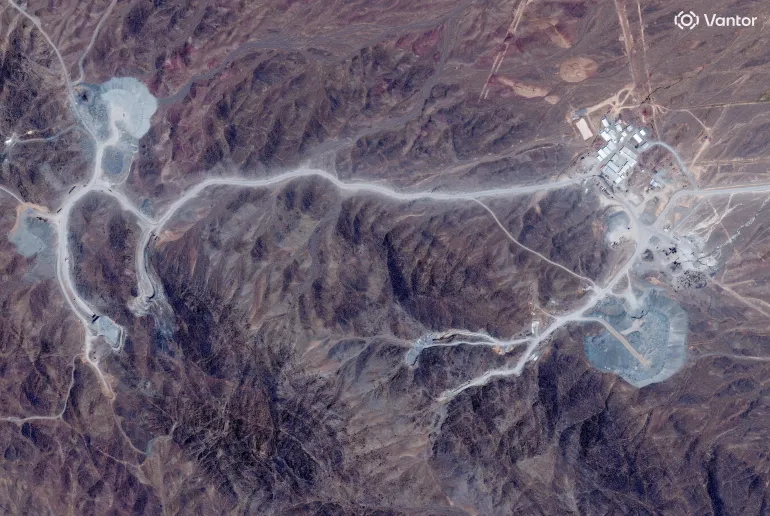
Iran’s Pickaxe Mountain
US president has threatened to “take out” a suspected nuclear site at Pickaxe Mountain in Iran, saying, “Tell the Iranians to be ready”.
- Pickaxe Mountain – known locally as Kuh-e Kolang Gaz La – is located near Iran’s heavily damaged Natanz uranium enrichment facility and hosts two deeply buried tunnel complexes.
- Experts believe the tunnels are constructed too deep to be reached by even the most powerful bunker-buster bombs in the US arsenal.
- Analysts quoted by US media, including The Washington Post, have suggested the site may be part of Tehran’s nuclear program.
- Trump told the Hugh Hewitt Show earlier that the US is watching the site closely. “We see no activity there. They’re not doing well with their nuclear situation. Every time we hear about it, we blow it up. So they don’t like talking about it. But we’ll probably give Pickaxe a shot relatively soon.”
|
|
|
Air raid sirens sound again in Bahrain
Air raid sirens have sounded in Bahrain for the third time this morning, with the Interior Ministry telling residents to take immediate shelter.
|
|
|
Trump claims US strikes have sent Iran ‘back to the Stone Ages to a large extent’
The US president has been speaking to Newsmax about the offensive against Iran.
He told the US outlet that the Iranians’ “power has been largely taken away” and expanded on the alleged damage by saying: “Now, they have something left, but it’s been largely taken away. As an example, their military had 159 ships; 159 ships are under the sea.”
Trump further claimed that “they had 200 aero planes; their aero planes are all gone. Their radars gone, their anti-aircraft is gone, their weapon-making capability is largely gone – about 84 percent – and, you know, it’s largely gone.”
“So they are a much different country than they were four months ago,” he said.
“In four months we’ve brought them back to the Stone Ages to a large extent.
“With that being said, they’ve got some missiles, and they’ve got a little capability, but they’ve been largely brought back into a different period of time.”
“Iran was the bully of the Middle East, and they weren’t going to be bullying me,” he added.
|
|
|
Iran claims attacks on Bahrain
The IRGC says it targeted “several weapons storage depots, a satellite communications centre, and a building housing US forces” at the Al-Juffair base in Bahrain.
It said the missile and drone attacks were part of the second phase of its “retaliation operation” today.
It said the operation, dubbed “Nasr 2”, continues.
|
|
|
Sailors killed in the Strait of Hormuz
The UAE has said that an Indian crew member was killed in an Iranian attack on an oil tanker near Oman, which also wounded eight others. They included six Indian sailors and two Ukrainians.
The UN said last month that at least 14 seafarers had been killed in attacks in and around the Strait of Hormuz since February 28, when the US-Israel war on Iran began. Many of the victims were Indian nationals.
Some of the incidents:
- An Indian crew member was killed in an attack on the Marshall Islands-flagged MKD Vyom oil tanker on March 1. No one claimed responsibility for the attack, although the US military blamed Iranian forces.
- Two Indian crew members were killed in an attack on the Palau-flagged tanker Skylight near Oman’s Musandam Peninsula, also on March 1.
- On May 8, another Indian sailor was killed when a wooden dhow carrying Indian crew members caught fire near the Strait of Hormuz.
- Three Indian crew members were killed in a US attack on the Settebello oil tanker off the coast of Oman on June 9. US forces said the vessel had violated its blockade of Iranian ports.
|
|
|
US military says latest round of attacks on Iran now over
The Central Command says it “completed the latest wave of strikes on Iran” at 02:15 GMT.
|
|
|
US military says it struck Iranian coastal defence systems, missile and drone sites
It said the latest round of attacks on Iran lasted five hours and that US forces “successfully struck military targets across Iran including Bushehr, Chah Bahar, Jask, Konarak, Abu Musa, and Bandar Abbas”.
US forces “employed precision munitions against Iranian coastal defense systems, missile and drone sites, and maritime capabilities”, it said, with the aim of further degrading “Iran’s ability to attack commercial shipping”.
The statement went on to say that more than 50,000 US troops are currently deployed across the Middle East.
|
|
|
UAE vows to defend assets after ‘brazen’ Iranian missile strike on tankers
There is a statement from the UAE Ministry of Defense, giving some details about this attack [on oil tankers], saying that Iran used two cruise missiles to hit them.
Both tankers, the Mombasa and the Bahia, caught fire because of those strikes, and an Indian crew member on the Mombasa was killed, and eight others were injured, including six with serious injuries.
The injured include four Indians and two Ukrainians.
The Ministry of Defense described it as a brazen attack and a violation of international law, saying the UAE has the right to defend its assets and that its goal is to take the necessary measures to counter those actions from the Iranian side.
We know that in Bahrain, sirens were sounded a while ago, but we don’t have details about what happened there or if there is any impact, or an attack.
These are signs of another escalation, and the usual thing that we see, the usual action by the Iranians,… after any American attacks on Iranian soil.
|
|
|
Strait of Hormuz
A US-Iran ceasefire agreed upon in June appears to be collapsing, with tit-for-tat strikes escalating into renewed regional conflict.
Fighting has centered on the Strait of Hormuz, a critical waterway for global oil and gas shipments, after Iran attacked commercial vessels and later declared the route closed.
The US launched retaliatory strikes on some 170 Iranian military targets, prompting missile attacks on US bases across the Gulf.
Shipping traffic through the strait has slowed to a multi-week low, while Brent crude prices have risen amid the uncertainty.
|
|
|
Iran claims strikes on US’s Fifth Fleet in Bahrain
The IRGC says it has launched missile and drone attacks on the US Fifth Fleet in Bahrain.
It said the strikes set fire to fuel depots at the base and hit and destroyed a Patriot radar, as well as the fleet’s air control radar, a C-RAM early warning radar system and the control and monitoring centre for unmanned surface vessels.
“The retaliatory operation continues,” the statement added.
|
|
|
Strait of Hormuz became an issue of sovereignty for Iran after US–Israeli attacks
Alex Vatanka, senior fellow at the Middle East Institute, says the ceasefire reached between the US and Iran on June 16 has always been “fragile”.
“And whenever the two sides are flexing muscle, it has happened in and around the Strait of Hormuz,” Vatanka said, “because that’s basically Iran’s ace card today”.
As for the US, the analyst argued that Trump appears to be betting “that if the Iranians are punished enough, that’s gonna make them change their mind and go back to negotiations”. But that’s “a gamble”, he said, warning this approach could lead to escalation, as Iran has consistently signaled it will respond to pressure with retaliation rather than concession.
Vatanka also cautioned against framing the dispute over the Strait of Hormuz as a matter of sovereignty.
“It wasn’t a question of sovereignty before the US and Israel attacked Iran, and it became an issue of sovereignty [for Iran] simply because that was the only card left,” he said.
“Once its nuclear program was devastated, then what was left for Iran to play in terms of its negotiations with the Americans?” he asked. But “thanks to” the US-Israel war this year, Tehran discovered it holds significant leverage in the Strait of Hormuz, one that matters for the “rest of the region, not to mention the rest of the world”, Vatanka said.
“And I think they will continue to play this card as long as the diplomatic process still has any chance of succeeding.”
|
|
|
Trump notifies Congress of renewed strikes on Iran
The US president has formally notified lawmakers that the Pentagon has resumed strikes against Iran, according to multiple media outlets.
In a letter to Congress on July 10, Trump said the strikes began on July 7 and represent “military action consistent with my responsibility to protect Americans and United States’ interests both at home and abroad”, according to CBS and Politico.
The letter described the most recent strikes as “limited, measured, planned, and executed in a manner designed to minimize civilian casualties”.
Under the 1973 War Powers Resolution, the president must report to Congress within 48 hours of starting any military action. The law also states that any military action begun without Congress’s approval must be terminated within 60 days.
The US began attacking Iran on February 28, and the two sides agreed to a ceasefire in April. But tit-for-tat attacks continued, with the US blockading Iranian ports.
The first 60-day deadline under the War Powers Resolution was on May 1, but Trump did not seek congressional approval, claiming it did not apply because of the ceasefire.
Both houses of Congress have since passed a War Powers Resolution directing Trump to withdraw US forces from hostilities with Iran.
|
|
|
Jordan intercepts 4 missiles from Iran
Jordan’s armed forces have shot down four missiles in Jordanian airspace that were fired from Iran, according to the official Petra news agency.
|
|
|
Iran claims attack on Jordan airbase
The IRGC says it launched ballistic missiles at US forces and key facilities at an airbase in Jordan.
This comes after Jordan announced intercepting four Iranian missiles.
|
|
|
IRGC tells Jordanians: ‘We hold no animosity towards your country’
More from the IRGC statement that claimed the attack on Jordan.
In a message addressed directly to Jordanians, the IRGC insisted that the operation was aimed at the US military presence, rather than Jordan or its citizens.
“You know that we hold no animosity towards your country. On the contrary, we deeply love you, the noble people. You understand the pain and suffering of the Palestinian people better than any other nation, and you are aware of the crimes of the Zionist regime in the massacre of 70,000 Palestinians, including 20,000 children in Gaza, carried out with the direct involvement of the United States,” it said.
“Your firm demand for the dismantling of American occupation bases in the region would greatly help save the Palestinian people and restore security to the region. We wish Jordan success,” it added.
|
|
|
Most Americans expect US attacks on Iran to continue for extended period, poll finds
Some 79 percent of Americans, nearly eight in 10 people, expect US military involvement to “go on for an extended period of time”, a new Reuters/ Ipsos poll suggests.
The figure is up by 14 percentage points since late March, when 65 percent of respondents said so, Ipsos said in a statement.
The poll also suggests that most Americans continue to disapprove of the war, with 58 percent of respondents saying they oppose the war, while 37 percent say they approve of the strikes.
Far more people say it has not been worth the US taking military action in Iran than those who say it has been worth it, with 51 percent saying it is not worth it, versus 24 percent saying it is. Some 23 percent say they are not sure.
|
|
|
Iranian lawmaker says bill on Hormuz security introduced
The head of the Iranian Parliament’s National Security Committee has warned that Iran remains steadfast in defending its red lines, following the formal introduction of a bill to manage the Strait of Hormuz.
In a post on X, Ebrahim Azizi wrote, “Last night, coinciding with the downing of US drones, the ‘Strategic Action for the Security and Sustainable Progress of the Strait of Hormuz and the Persian Gulf’ bill was formally introduced in Iran’s Parliament.
“We remain steadfast in defending our red lines, particularly regarding the management of the Strait of Hormuz,” Azizi said.
“This is the first step; subsequent measures are forthcoming,” he added.
|
|
|
Trump’s proposal for tolls in Hormuz ‘will upset’ US allies in Gulf
Alex Vatanka, a senior fellow at the Middle East Institute, said Trump’s proposed 20-percent fee on ships transiting the Strait of Hormuz appears to have no basis in international law and could upset US allies in the Gulf.
“President Trump likes to engage in those dramatic statements. I don’t know how much hard thinking has happened in his team around this 20-percent fee,” Vatanka said.
“Some of his comments, I’m sure, will upset some of America’s friends in the region, who he said are rich, therefore can afford to pay. That’s not the deal the Gulf states signed up for when they looked at the United States as their provider of security,” he said.
“So if they feel they’re being exploited in this situation, they will let that be known, and that maybe will also have an impact on how President Trump decides to proceed with this idea.”
The proposal remains an “idea for now”, Vatanka added, noting: “We haven’t really heard specifics in terms of how he intends to go about it.”
|
|
If the US as a war belligerent designates itself a "guardian" over the Strait of Hormuz and expects to be paid for, is that an international violation?
Designating oneself a "guardian" of the Strait of Hormuz and expecting payment for transit is widely considered a violation of international law. Under the UN Convention on the Law of the Sea (UNCLOS), straits used for international navigation are governed by the right of transit passage.
This legal framework strictly prohibits the US as a belligerent from impeding, suspending, or charging tolls for the passage of foreign vessels. Imposing mandatory tolls or forcing commercial ships to pay for military escorts fundamentally breaches UNCLOS and established customary international law.
|
Hormuz cargo fee ‘would be fundamentally wrong’: Hapag-Lloyd
Charging fees for passage through international waters “would be fundamentally wrong”, German shipping company Hapag-Lloyd says.
The company told the Reuters news agency that it could not reliably quantify the financial impact of tensions in the Gulf region on its business.
The statement comes after US President Donald Trump said he would reinstate a naval blockade on Iran and charge 20 percent on all cargo shipped through the Strait of Hormuz.
|
|
|
Toll bidding war over strait exposes lack of coherent US strategy
The US threat to impose tolls on ships in the Strait of Hormuz “is really indicative of how the US went into this conflict without any coherent or clear strategy”, according to Rob Geist Pinfold of King’s College London.
Washington and its allies have maintained that the Strait of Hormuz must remain a free, open international waterway. But in recent days, Trump has responded to Tehran’s aggression with threats of charging a 20 percent toll for cargo moving through the strait.
“It’s a really strange dynamic,” Geist Pinfold says, noting that the US has consistently underestimated Iran’s capacity to set the regional agenda. “And as a result, we see the US floundering and coming up with some of these frankly strange and illogical declarations from President Trump.”
Instead of opening the waterway, the US has ended up in a bidding war with Iran, he explains, essentially copying the exact tactics it set out to stop.
|
|
|
Trump goes back on 20 percent tariff announcement for Strait of Hormuz
In a social media post, Trump reiterated the US blockade of Iranian ports and has made a U-turn on his 20 percent tariff announcement.
“The Strait of Hormuz is open to ALL Ship traffic except for Iran — and that is because of their lying, violent, malicious leadership, which is taking them down the path of TOTAL DESTRUCTION,” Trump posted.
Trump also said he was replacing the 20 percent tariff with “trade and investment” deals from Gulf countries.
|
|
|
Trump says he does not like ‘concept of a fee’ for Hormuz use
No one should be able to charge a fee for transiting the Strait of Hormuz, Trump says during a news conference with Iraqi Prime Minister Ali al-Zaidi at the White House.
Trump said on Monday that the US would charge a 20 percent toll on ships transiting through the strait. However, the US president told reporters today that he was then contacted by Gulf countries that said they’d rather invest in the US.
“They said, ‘We’d love to do it a different way. We’d love to invest in the US with billions and billions of dollars,'” Trump said.
“I don’t like the concept of a fee.”
|
|
|
We welcome investments in US in exchange for providing protection for Hormuz: Trump
“We welcome investments in the US in exchange for providing protection for the Strait of Hormuz,” Donald Trump says.
|
|
|
Ambiguity over how much Gulf countries will invest in the US over Hormuz crisis
Trump’s announcement on the Strait of Hormuz came as a bit of a shock to people in the region, financial markets and probably members of his own administration.
They had been on TV for weeks and months, saying that Iran cannot profit off letting any ships through the Strait of Hormuz, which is an international waterway.
The president said that he simply got a call from Gulf rulers who promised to make a huge investment in the US that would be better for the American people. Exactly how much, who, where, what, none of that has been specified.
But when it comes to this Trump administration, he often talks about numbers of foreign investments with very little detail, and outside groups say the numbers tend to be exaggerated.
|
|
|
Trump says Iran ‘shot first’, calls it ‘big mistake’
“I wanted to give them a chance at making a deal,” he told reporters, referring to Iran.
“And they shot first, and that was a big mistake that they shot first because we have been knocking the hell out of them. They’re very difficult people,” Trump said.
|
|
|
Trump claims US has taken away majority of Iran’s military capabilities
The US has taken the majority of Iran’s military capabilities, Trump claimed at the press briefing.
|
|
Trump has made several of such claims, and they all appeared to be false.
|
Trump: Iran, Hezbollah might be added to sanctions bill
Iran and Hezbollah might be added to the Russia sanctions bill currently under consideration by Congress, Trump said at a press conference at the White House.
|
|
|
Bahrain air sirens sound again
Air sirens are heard again in Bahrain, the fourth time this morning. The interior ministry urged citizens to remain calm and find a nearby safe place.
Earlier, Iran’s IRGC said it had launched missile and drone attacks on the US’s Fifth Fleet in Bahrain.
|
|
|
Lebanese president condemns attacks on Gulf states and Jordan
Lebanese President Joseph Aoun has condemned “the repeated attacks targeting brotherly Arab Gulf states, the latest of which was the sinful attack on the sisterly Kingdom of Saudi Arabia, as well as the targeting of the brotherly Kingdom of Jordan”.
In a statement, Aoun said: “We view these hostile acts as blatant attempts from multiple sources that target not only the security and sovereignty of the Kingdom and the affected nations, but also systematically seek to undermine the stability of the Arabian Gulf and keep the entire region in a permanent state of tension and anxiety, serving agendas that do not wish well for our Arab peoples.
“Out of the close historical and brotherly ties that unite us with our brothers, we reaffirm today broad and complete Lebanese solidarity – both officially and popularly – with the Kingdom of Saudi Arabia, all Arab Gulf states and the Hashemite Kingdom of Jordan,” the statement added.
|
|
|
Iran rescues vessel crew after collision in Hormuz: Fars agency
Twenty-three foreign crew members have been rescued after a bulk carrier collided with another vessel north of Qeshm Island, in the Strait of Hormuz, according to the semi-official Fars news agency.
The bulk carrier suffered serious damage to its hull and began taking on water, prompting the captain to order an emergency evacuation, Fars said, adding that all crew members were safely transferred to Qeshm Island.
|
|
|
India summons Iran’s deputy ambassador over killing of national in Oman waters
India has summoned Iran’s deputy ambassador, Mohammad Javad Hosseini, over the killing of an Indian national in Oman waters, an Indian government official said.
Indian news channel NDTV reported the diplomat was summoned to protest against attacks on oil tankers by Iran. The meeting has been concluded, as social media videos circulating showed the Iranian diplomat apparently leaving the Indian Ministry of External Affairs.
The Indian seafarer was a crew member of a tanker hit by Iranian cruise missiles in Omani waters. Eight other people were wounded, with six of them being Indian nationals.
|
|
|
US attacks meant to degrade IRGC capacity, control over Hormuz
Practically speaking, the memorandum of understanding has collapsed. We saw attacks on Konarak, Chabahar, Qeshm, Abu Musa island, and Kish island. Kish island is a tourist destination in Iran, quite popular, particularly during the summer. And then Omidiyeh, Bushehr, and Bandar Abbas were hit as well.
So Kish island and Bandar Abbas have been the constant targets of the United States because these two locations are quite strategic for Iranians. They oversee the Strait of Hormuz. And for Iran to keep control over the Strait of Hormuz, they are important. The US, by attacking these two locations constantly, believes it is degrading the capacity of the IRGC.
And then in response, the IRGC say they have hit US military assets in Jordan, Bahrain, and Kuwait – fuel tankers, fuel depots, several Patriot air defense missile systems, and satellite radars. They’ve also hit a number of areas where US armed forces personnel are staying. In addition, they are confirming that two supertankers were stopped by the IRGC as they were trying to pass through the Strait of Hormuz.
Meanwhile, the US blockade over the Strait of Hormuz will definitely have a huge impact on Iran’s economy.
|
|
|
Iran says oil exports continue despite US revoking waivers
Iran’s oil exports are continuing as usual despite the cancellation last week of a 60-day waiver of US oil sanctions, according to oil minister Mohsen Paknejad.
In remarks released on his Telegram channel, Paknejad said the oil ministry had maintained mechanisms for years to neutralize the impact of US sanctions and that Iran’s oil exports would face no problems despite the removal of the waivers.
“The Americans, as usual, broke their promise and violated Article 10 of the memorandum of understanding related to the 60-day waivers,” he said.
“Given that the structures foreseen for the continuation of oil exports have been maintained, the country’s oil export process continues as before,” the minister added.
Last week, the US Treasury Department revoked the authorization of Iranian oil sales after tensions heated up at the Strait of Hormuz with a series of attacks on tankers.
|
|
|
Bahrain says it foiled multiple Iranian attacks today
Bahraini forces thwarted several Iranian attacks this morning, they said in a statement.
“The General Command of the Bahrain Defense Force announces that Iran continues its systematic aggression through its heinous attacks targeting civilians in the Kingdom of Bahrain,” the statement said.
“The General Command emphasizes that the deliberate use of missiles and drones to target civilians and private property constitutes a flagrant violation of international humanitarian law.”
It urged its citizens to continue exercising caution and to avoid approaching any suspicious objects.
|
|
|
Iran has shipped 80 million barrels of oil in past 26 days, monitor says
TankerTrackers, a maritime traffic monitor, says Iran has shipped out more than 80 million barrels of crude oil and refined products, which are currently worth $6bn, in the past four-week period.
But millions more barrels are still awaiting departure, it said.
“Now that the US Navy blockade is being reinstated more than a month ahead of schedule, it appears that around 30 million barrels of Iranian crude oil have yet to depart,” the tracking group said.
“However, there are also more than 60 million barrels of floating storage capacity available within the blockade perimeter should Iran be forced to scale back its oil production.”
|
|
|
Tanker struck by missile near Oman’s Limah on Monday: UKMTO
A tanker is reported as having been hit by a missile yesterday while transiting southeast of Oman’s Limah area, says the United Kingdom Maritime Trade Operations (UKMTO).
Authorities are investigating the incident, UKMTO said, in their report which was issued today.
|
|
|
US launches more attacks on Iran as Trump reimposes Hormuz blockade
The US says it has completed another wave of strikes on Iranian military targets, marking a third consecutive night of attacks.
State media say explosions were heard in Bushehr, Bandar Abbas, Kish island, Qeshm island and several other areas.
US Central Command (CENTCOM) says the attacks hit Iran’s coastal defence systems, as well as missile and drone sites, while President Donald Trump says the campaign is aimed at further weakening Iran’s ability to disrupt shipping in the Strait of Hormuz.
|
|
|
Kuwait condemns Iran’s attack on UAE tankers
Kuwait has denounced Iran’s attacks on two Emirati oil tankers passing through the Strait of Hormuz, which killed an Indian crew member and injured several others, calling it “reprehensible”.
The country’s foreign ministry described the act as a “flagrant violation of international law” and a “direct threat to the security and safety of maritime navigation and global energy supplies”.
It also expressed its solidarity with the UAE and urged an end to fighting in the region.
|
|
|
Iran’s critical Aqqala bridge reopens after US bombing
Train services have resumed along a critical international transit route in Iran days after a US air strike damaged a key railway bridge.
According to local news outlet SNN, the Aqqala bridge in Golestan province is fully operational again following rapid repair. Iranian officials have frequently described it as the country’s “most important transit corridor”, serving as a central link between Tehran and the northeastern border towards China and Turkmenistan.
The Iranian daily Kayhan reported the route is used for the movement of Russian cargo and the railway line has also seen a significant surge in traffic from Chinese freight operators. It noted Beijing is increasingly relying on this overland route to bypass volatile shipping lanes since the US-Israel war on Iran.
US attacks on Iran have repeatedly targeted military assets and civilian infrastructure, including key transport networks, railway lines and bridges.
|
|
|
Iran leaders likely to walk away from US deal after deadly attacks
Rob Geist Pinfold, from King’s College London, says that after the recent surge in attacks by the US, Iran’s leadership will decide that dealing with the Americans is pointless, as past negotiations have proven.
“Tehran will conclude what it always thought – that basically you shouldn’t do a deal with the Americans, they’re duplicitous and that they will stab you in the back,” Geist Pinfold said.
The interim deal with the US is not serving Iran’s interests with no sanctions relief and Israel still occupying Lebanon, he noted.
For the United States, the Islamabad memorandum of understanding (MoU) is in reality “a worse deal than the Joint Comprehensive Plan of Action” signed in 2015 by the Obama administration, Geist Pinfold said, “which, of course, Trump called ‘the worst deal ever’ and then withdrew from”.
The new MoU has not “alleviated pressure points, and both sides feel the other has not lived up to their obligations”, Geist Pinfold added.
|
|
|
Tanker struck on Monday by unidentified projectile near Qalhat, Oman: UKMTO
UKMTO is reporting that another tanker was struck in Oman’s waterway yesterday.
In its report from today, UKMTO says the vessel was hit by an unknown projectile on the starboard side engine room, as it passed northeast of Qalhat, Oman.
“All crew are safe and accounted for with no environmental impact reported,” UKMTO says, as authorities continue to investigate.
Earlier, it said a tanker had been hit near Oman’s Limah on Monday.
|
|
|
China urges US and Iran to restore safe passage through Hormuz
China called on the United States and Iran to restore safe passage through the crucial Strait of Hormuz after fighting reignited over how the strategic waterway should be managed.
“Restoring normal and safe passage through the strait as soon as possible is a shared aspiration of the international community,” the foreign ministry’s spokesperson, Lin Jian, told a news briefing.
Beijing will “make unremitting efforts to help de-escalate” the situation, he added.
The US reimposed its naval blockade on Iran after its attacks on “unauthorised” vessels passing through the Strait of Hormuz, heightening uncertainty about global energy flows.
|
|
|
GCC slams attacks on UAE tankers in Hormuz
The Gulf Cooperation Council (GCC) has denounced Iranian attacks on two Emirati oil tankers in the Strait of Hormuz, with Secretary-General Jasem Mohamed Albudaiwi calling it “an explicit violation of United Nations (UN) Security Council Resolution 2817, which stresses the necessity of protecting international navigation and refraining from targeting commercial vessels or endangering maritime lanes”.
Albudaiwi said the GCC stands firmly with the UAE and supports all measures taken to protect its security, sovereignty and vital interests.
He called on the international community, particularly the UN Security Council, to fulfill its legal and moral responsibilities by taking decisive action to halt repeated Iranian attacks, hold those responsible accountable and safeguard international navigation.
The latest incident comes amid heightened tensions around the Strait of Hormuz, and attacks exchanged between the US and Iran around the Gulf region.
|
|
|
Hormuz will never open by US ‘aggression’: Iran’s army
The Strait of Hormuz will never be opened by “war, evil, and American aggression”, the Iranian army’s spokesperson, Brigadier General Mohammad Akraminia, was cited as saying by the Tasnim news agency.
The country’s armed forces will not relent over the key waterway, Akraminia added. Respecting the rights of the Iranian people is the only way to open the Strait of Hormuz, he added.
“We are obligated to avenge the blood of the martyrs, especially the martyred leader of the Islamic Revolution,” Akraminia said.
|
|
|
Explosions heard in western Bandar Abbas, Ira
Five explosions were just heard in the western area of the Iranian city of Bandar Abbas, state TV is reporting.
|
|
|
‘Complex talks have begun to shape a lasting framework’ for Hormuz: Omani FM
In an opinion article published in the French daily Le Monde, Badr bin Hamad Al Busaidi, Oman’s foreign minister, writes that his country bears “a particular responsibility” because its territorial waters border the strategically important Strait of Hormuz.
“Complex talks have begun to shape a lasting framework guaranteeing freedom of navigation in the Strait of Hormuz,” he wrote in Le Monde on Sunday.
The top diplomat added: “It is incumbent upon Oman to work with Iran – the other coastal state – as well as with the entire international community, which depends on this maritime route, to develop a system that is realistic, sustainable, and compliant with international law, thus safeguarding freedom of navigation.”
|
|
|
Three members of same family killed in US attacks on Iran earlier today, state media says
Three members of the same family were killed in US attacks on the Iranian province of Hormozgan, state media are reporting.
Ranger Hassanzadeh was working outside his house, but his two sons and a daughter-in-law were killed, the report said.
|
|
|
More explosions reported in southern Iran
Four locations in Bushehr – in southwestern Iran and home to nuclear facilities – have been hit by US missiles, Iran’s official news agency IRNA reports.
Iranian state television earlier reported at least five blasts were heard near the southern city of Bandar Abbas.
|
|
|
The latest on the retaliatory strikes in the Gulf
The US carried out attacks against Iran for a third consecutive night late on Monday.
Iran has continued to hit targets in the Gulf in waves of retaliatory strikes, including two UAE‑flagged oil tankers in the Strait of Hormuz and US military facilities in Bahrain and Kuwait.
|
|
|
Iran strikes halt Hormuz traffic, impacting global energy supplies
It’s been an active night and morning for air defense systems in several countries in this region because of missiles and projectiles fired from Iran.
This has affected the ship traffic passing through the Strait of Hormuz. Yesterday, we saw the lowest number of ships passing in five weeks. There were only six ships. The day before that, there were 14.
This is really affecting the global energy market, where we are seeing a spike. About 20 percent of the fuel that goes into the energy markets across the world passes through this waterway.
And with ships avoiding the risk of being targeted, it’s affecting the global market, with prices at petrol stations around the globe rising.
|
|
|
Iran condemns UK’s designation of IRGC as security threat
Iran’s Foreign Ministry has condemned the decision, calling the move “unjustified” and “irresponsible”.
The ministry said the Islamic Revolutionary Guard Corps (IRGC) was an official part of Iran’s armed forces and accused the UK of violating international law by targeting a state institution.
The UK on Monday banned support for the IRGC and a linked group, under new powers aimed at preventing foreign states from using proxies for activities such as surveillance and sabotage.
Iran, which is at war with the United States and Israel, has previously denied using proxies.
|
|
|
Low-intensity Iran-US fighting may ‘return to full-scale war’
This is one of the largest military campaigns since the memorandum of understanding was signed.
At least three people have been killed, according to Iranian officials, and there are also reports of injuries. There are more than 20 people killed and 100 wounded since hostilities restarted.
When looking at the pattern of these US attacks, Qeshm Island and Bushehr are particularly targeted almost on a daily basis. They are strategically located with significant military equipment that enables the Islamic Revolutionary Guard Corps to enforce control over the Strait of Hormuz.
The Iranians are responding with strikes on Kuwait, Bahrain and Jordan, saying they hit American military bases and assets.
The Hormuz blockade is back. The strait is closed. Sanctions on Iran are back, and there is no ceasefire any more. This is a low-intensity war that is becoming persistent. And, of course, there are concerns if things escalate further, there might be a return to a full-scale war.
|
|
|
‘This war is a disaster,’ Omani foreign minister says
Badr bin Hamad Al Busaidi says the war on Iran “has achieved none of its officially assigned objectives” and lacks a UN mandate.
“This war is a disaster,” he wrote in an opinion piece published in the French newspaper Le Monde.
The minister added: “Nevertheless, if it finally buries the myth of containment in the Gulf, then there is reason for hope: the emergence of a fairer, more realistic and more effective system, thus correcting nearly half a century of strategic errors.”
For him, the most serious threats to the region do not come from Tehran but from Tel Aviv, he said.
|
|
|
US strikes hit western Iran’s Mahshahr and Abadan
News US strikes have hit in an Iranian border area near Iraq and Kuwait as fighting rages.
The city of Abadan, which hosts the oldest oil refinery in the Middle East, as well as the port city of Mahshahr were targeted, deputy governor of Khuzestan province Valiollah Hayati said, as cited by state news agency IRNA.
The strike on Mahshahr took place at about 1:30pm local time (09:30 GMT), according to the Fars news agency. At 1:25pm local time, Abadan city was hit.
|
|
|
European airlines warned against flying over Gulf airspace
The European Aviation Safety Agency (EASA) says airlines should not operate over Bahrain, Kuwait, Qatar, UAE and near the waters of the Gulf of Oman.
“Unpredictable military developments, combined with the possible use of missiles, drones, combat aircraft and air-defense systems, create a high risk to civil flights at all altitudes and flight levels within the concerned airspace,” EASA said in a statement.
The agency advised airlines last week not to operate within the airspace of Iran, Iraq, and Lebanon.
|
|
|
Tanker Stolt Magnesium hit by explosion off Omani coast overnight
The tanker Stolt Magnesium has caught fire after the “explosion of an unidentified external device” as it was sailing in the Arabian Sea off Oman, its manager, Stolt Tankers, says.
The incident occurred at 12:40am (20:40 GMT on Monday) and caused a fire in the vessel’s engine room, the company said in a statement.
All of the vessel’s seafarers were safe and accounted for, it added, and the crew had begun fighting the fire.
The UKMTO had reported an incident 40 nautical miles (75km) northeast of Oman’s Qalhat, which we reported earlier and matches the location of the Stolt Magnesium on LSEG shipping data.
|
|
|
Iranian embassy says 55 fishermen detained in UAE are being repatriated
Iran’s embassy in Abu Dhabi says 55 Iranian fishermen detained in the UAE are being repatriated.
Fourteen have already returned by sea, while others are expected to travel home by air, the embassy said. The fishermen were detained in March and April after navigation system disruptions reportedly led to their arrest by the UAE coastguard.
“These 55 fishermen, mainly from the provinces of Sistan and Baluchestan and Hormozgan, were arrested by the UAE Coast Guard in March and April due to the specific conditions in the region and disruptions in tracking systems, and spent more than two months in the Sweihan detention centre and prisons in Ras al-Khaimah and Sharjah,” the embassy said in a statement.
|
|
|
Iran hacked Middle East mobile networks to track US personnel: Financial Times
Iran has hacked mobile networks throughout the Middle East to track the locations of US personnel and contractors throughout the war, London’s Financial Times (FT) newspaper reports, citing telecommunications data from the Mobile Surveillance Monitor research project and quoting people familiar with the matter.
US lawmakers were alarmed by the information, the newspaper said, as they warned that roaming systems and smart phone advertising technology have left the military vulnerable to attack.
Officials in the Gulf suspected Iran or its allies of exploiting roaming agreements with local phone providers to try to locate US personnel, one person familiar with the matter told the FT. A US official speaking on the condition of anonymity told the newspaper that actors linked to Iran had abused commercially available advertising databases to track phones in northern Iraq’s semiautonomous Kurdish region.
“Iran absolutely has capabilities to get real-time, immediate and continuous location information,” Gary Miller, a senior research fellow at the cyber security watchdog Citizen Lab who reviewed the data, was quoted as saying by the FT.
“It would surprise me very much if Iran were not using SS7, or mobile network access in the region, to track US users.”
|
|
|
‘It’s the Americans who caused what’s happening now’
Escalating turmoil in the Gulf was caused by President Trump and Israeli Prime Minister Netanyahu’s decision to launch the “war of choice” on Iran, a Tehran-based analyst says.
“Right now the Iranians are doing actual self-defense,” Mohammad Eslami from the University of Tehran said.
He said the recent Revolutionary Guard attack on a UAE oil tanker came after Trump declared the ceasefire is over.
“Right now the Strait of Hormuz is a battlefield. The Iranians declared no ships, no vessels are permitted to go through. I think if any neighbor who wants to challenge the Iranians’ intention, they’ll show they’re very serious regarding their intention during the war,” said Eslami.
“What the Iranians want to convey to their neighbors is ‘we should come together and have a collaborative development in the region’, and it’s the Americans who caused what’s happening now in the Persian Gulf.”
|
|
|
Oman continues ‘transparent cooperation with all parties’ over Hormuz
Oman has called on all parties involved to respect international law regarding navigation in the Strait of Hormuz, according to a statement by the country’s foreign ministry.
It also said that Muscat “continues its transparent and neutral cooperation with all parties to restore freedom of navigation in the strait fully in line with international law”.
“The Sultanate of Oman reaffirms its full commitment to its obligations as a State Party to the United Nations Convention on the Law of the Sea, and calls on all parties to respect international law and act in accordance with it.”
The ministry also condemned the Houthi rocket threats to which the Kingdom of Saudi Arabia was exposed and stated its solidarity with the measures the kingdom is taking “to safeguard its sovereignty, security, and stability”.
Earlier, Qatar’s foreign ministry also sent out a statement condemning the ballistic missile attack on the southern region of Saudi Arabia.
|
|
|
Qatar slams attack on UAE tankers in Hormuz
A statement by the foreign ministry condemns the attack targeting two UAE oil tankers as they transited the Strait of Hormuz, describing it as “a serious violation of the safety of international navigation, a direct threat to global energy supplies, and a clear breach of international law”.
“The continuation of such unacceptable attacks represents a dangerous escalation that threatens regional security and stability and undermines efforts to promote regional peace and stability,” the ministry said.
It reiterated Qatar’s call on Iran to “immediately cease any practices that undermine regional security, refrain from jeopardizing the security of international navigation and global energy supplies, fully comply with international law and United Nations Security Council Resolution 2817, and take urgent measures to prevent the recurrence of such attacks”.
One Indian crew member was killed, and eight others were wounded, when two Emirati oil tankers were struck by Iranian cruise missiles in the Strait of Hormuz, the Emirati Ministry of Defense said earlier.
|
|
|
Oil extends major price gains following fresh US strikes
Oil prices have risen again today, with Brent crude futures gaining 5 percent to hit $87.49 per barrel – the highest since June 12 but still well below the peak since the war began.
Prices had already shot up more than 9 percent on Monday.
The surge comes after new US strikes against Iran, fuelling fears over their already fragile truce and the risk of another spike in inflation.
|
|
|
Netanyahu warns Iran’s leaders Israel will hit back if attacked
Netanyahu has vowed to strike powerfully against Iran if it launches new attacks on his country.
“I will say it to the leaders of Iran: do not count on things remaining quiet if you attack us,” Netanyahu said at a conference, according to a video released by his office.
“The days are over when someone strikes us and we don’t hit back with a decisive blow.”
|
|
Netanyahu is the initiator of the war on Iran while the motive, which is nuclear political and in violation of the UN Charter, dates back in 2010 when the Israelis began to target Iran's nuclear program. Read more.
|
US Senator Schumer slams Trump over war on Iran
Senate Minority Leader Chuck Schumer Chuck Schumer has condemned President Trump’s handling of the US-Israeli war on Iran.
Schumer accused Trump of repeating past mistakes without a clear strategy.
|
|
|
Control of Hormuz necessary to keep Iran’s enemies from using it ‘to make problems for Iranians’
Iran has been compelled to attack its neighbors because the US is mounting attacks from these countries, the University of Tehran’s Mohammad Eslami says.
“The Iranians are defending themselves against US attacks. Some of our neighbors have allowed US military bases on their land,” he said.
Eslami said Iran wants the Strait of Hormuz to be open but will set the conditions for how it is used. “Iran sees the waterway as an instrument to re-establish relations with its neighbors and with European and Asian countries to end the illegal sanctions regime imposed on Tehran.”
As such, he added: “Iran cannot be isolated from Hormuz, and the Iranian position in the waterway can’t be ignored. Iran will not allow any other adversary to use this strait in order to make problems for the Iranians.”
|
|
|
Oil inventories near critical levels warns analyst
Markets are reacting to every “little skirmish” in the conflict between the US and Iran, says oil and gas specialist Cornelia Meyer.
“Within the next few months or few weeks, we need to see things getting back to normal,” Meyer said, speaking from Bern, Switzerland.
Markets have not reacted more, however, because “we had people with inventories that they could draw from [even though] they’re close to tank bottom,” she said.
China – the new swing consumer – has imported so much less than it did before, Meyer added.
But markets are not predicting escalation because the US has midterms coming up, so they may not want a full-fledged war, said Meyer. Meanwhile, Iran has economic problems, so they may also not want a full-fledged war, she said.
“But what markets are not factoring in, is that we are close to tank bottom in the inventories, and what they’re also not factoring in, is this open and closed state of the Strait of Hormuz makes it very difficult for insurers to insure cargoes and ships,” said the analyst.
While many ships have left the strait, not many have entered, said Meyer.
The developed countries of the OECD will be able to manage another hit as they have still some inventories, but for developing countries, it will be “very bad”.
|
|
|
Hardliners appear to have upper hand in Iran as war spreads
A military analyst says powerful hardliners in Iran’s government are determined to get revenge for the US-Israel war on the country and the killing of Ayatollah Ali Khamenei.
“Some of the leadership wanted to find a diplomatic way through this conflict because they saw the potential lifting of sanctions and the unfreezing of assets as something that could be constructive in helping rebuild the country,” Alex Alfirraz Scheers said.
“The other side – especially those linked to the IRGC and to current ayatollah – were much more intransigent because they felt as though there was vengeance to be had, and felt that by controlling the Strait of Hormuz they had won strategically.”
The hardliners felt it wasn’t in Iran’s interests to negotiate with the US “because in their minds the war had been won and the US had in fact embarrassed and humiliated itself in waging this conflict in the first place”, said Alfirraz Scheers.
However, both camps are aligned on one issue: they believe Hormuz is a spoil of the war and the Iranians need to keep control of it for economic and military reasons, he added.
“It is their biggest leverage going forward as far as negotiations are concerned. And even if these talks don’t succeed, for the Iranians control of Hormuz is essential for economic activity and trade moving forward.”
|
|
|
Hormuz sees lowest ship passage since US-Iran deal in June
The Strait of Hormuz recorded the lowest navigational passage of ships since the signing of the MoU on June 17, as only four ships have passed since this morning.
According to the Marine Traffic platform data, the passage included an oil tanker and three container ships.
The navigational data also showed the four ships departed ports in Oman and the UAE before crossing the strait, but upon their return, they hid their final destination and ownership registration data.
|
|
|
Difficult 24 hours for Gulf countries and Jordan
It’s been another difficult 24 hours for countries in the Gulf and in Jordan as these Iranian attacks continue across this region.
In Bahrain, their defense forces say they have intercepted several aerial attacks, and they have accused the Iranians of deliberately targeting both civilians and private property.
So while the Iranians continue to maintain that they are only targeting US military assets in the Gulf region and Jordan, that’s not how countries in this region are seeing it or experiencing it.
In Jordan, air defenses have intercepted four Iranian missiles, and their royal engineering corps are now dealing with the debris, which they say has fallen over several regions.
Two Emirati vessels have also been hit by cruise missiles from Iran in the southern part of the Strait of Hormuz in Omani territorial waters. Those attacks caused huge fires on those vessels, and the United Emirates say it has caused the death of one Indian national and also injured at least eight others, some seriously.
Omani Foreign Minister Badr bin Hamad Albusaidi has written an opinion piece in the French newspaper Le Monde, in which he says that the war against Iran has revealed how much of a myth the policy of containment was. He refers to the Gulf region as being wounded, and he says that people in Oman and across the Gulf have been dragged into a conflict that should never have started.
Nevertheless, states such as Qatar recognize that this conflict will end with some kind of diplomatic agreement.
|
|
|
Majority of Iran lawmakers want an end to US interim deal
One hundred eighty members of Iran’s 290-strong parliament have issued a statement declaring the end of the memorandum of understanding with the United States.
The lawmakers emphasized the necessity of “pursuing revenge”. They also called for the passing of new legislation to manage the Strait of Hormuz on Iran’s terms.
The statement added:
- We will swear an oath in the path of bloodlust and revenge; let us not neglect any moment of effort, planning, and operational action.
- The parliament will place legal measures on its agenda, including upgrading the defense doctrine and passing the law on the management and governance of the Strait of Hormuz.
- Now that the president of the United States declared this agreement over, it is expected the heads of the branches of government announce their firm and revolutionary stance in this regard.
- We firmly support the performance of the armed forces, especially in exercising Iran’s sovereignty over the Strait of Hormuz, and we will not fail to provide any support to meet their needs.
|
|
|
Russia’s Lavrov says US attacks on Iran ‘close the door’ interim deal
Russian Foreign Minister Sergey Lavrov says the US resumption of fighting with Iran “does not lead to a resolution” and “closes the door” to peace negotiations.
“It’s sad because civilian infrastructure is getting damaged in Iran and in the Gulf Cooperation Council states. It’s not leading to anything good,” Iran’s semi-official Fars news agency reported.
Lavrov criticized the failure by the United States to implement foreign agreements and raised questions about Washington’s credibility when making commitments, Iran’s IRIB news agency cited him as saying.
|
|
|
Kuwait says ‘confronting hostile aerial targets’
Kuwait’s armed forces are currently “confronting hostile aerial targets within Kuwaiti airspace”, the army posted on social media.
|
|
|
Explosion reported on Iran’s Qeshm Island
Iran’s Fars news agency is reporting that explosions have been heard on Iran’s Qeshm Island.
The report said the cause of the blast remains unknown.
|
|
|
MoU appears to be no longer in effect
There hasn’t been any official confirmation, but it appears that the MoU is no longer in effect.
The reason why there is this growing perception that the MoU may be on its last legs is because of a letter that Trump sent to Congress last week.
The letter indicates that under the War Powers Resolution, the president has notified Congress that the US military has once again started military actions against Iranian targets and that the US is doing so because the Iranian government has carried out attacks on civilian vessels in the Strait of Hormuz and the Gulf, violations of this MoU.
Trump has also said that there were going to be strikes launched against Iranian targets, both on Monday and again on Tuesday. We don’t know whether that’s going to continue, but certainly there is this growing concern that efforts to try to bring the war may actually be restarted.
|
|
|
Projectile explodes on Iran’s Kish Island
Iran’s Tasnim news agency is reporting that a projectile has exploded near a water and electricity facility on Iran’s Kish Island.
|
|
|
Iran-US conflict shifts gears from military to economic warfare
Today’s developments point to a widening confrontation between Iran and the US with the conflict shifting from military to economic warfare after Trump imposed a new blockade on Iranian ports.
That comes after he revoked a waiver on Iranian exports for petrochemicals and oil.
Iran’s oil minister responded defiantly to Trump’s decision, saying it has other ways to export its oil. This coupled with the Revolutionary Guard’s announcement of closing the Strait of Hormuz will have an economic impact on the global economy.
The US conducted air strikes into Tuesday targeting the southern coast of Iran. These included military, naval and coastal authority assets in order to eliminate Iran’s control over the strait.
Meanwhile, the IRGC carried out retaliatory strikes targeting US military assets in the United Arab Emirates, Jordan, Kuwait and Bahrain with ballistic missiles and drones.
|
|
|
Kuwait says confronting drone and missile attacks
Kuwait’s army says the hostile aerial targets being confronted are missiles and drones targeting its airspace.
|
|
|
Oil gains on new attacks; dollar slides as inflation slows
Oil prices are up more than 3 percent as equity markets in New York opened. International benchmark Brent North Sea crude rose as much as 5 percent to trade about $87 a barrel.
Prices had already shot up 9 percent on Monday.
“The prospect of more fighting and a fresh blockade has meant that traffic through the strait has slowed to a near halt,” said Kathleen Brooks, research director at the trading group XTB. “When the supply chain gets gummed up, this is what keeps upward pressure on the oil price.”
The US launched a third round of strikes on Iran in a week as Trump reimposed a blockade on Iranian ports and proposed that ships pay the US to pass through the Strait of Hormuz.
|
|
|
Iranian media says Qeshm Island hit by a projectile
Iran’s local media is reporting the Qeshm Island has been hit by a US projectile, citing the island’s governor’s office.
|
|
|
Iranian media reporting explosion in Andimeshk
Iran’s state broadcaster IRIB is reporting an explosion in Andimeshk in Iran’s Khuzestan province.
The news outlet did not elaborate on the cause of the explosion.
|
|
|
Explosions in Andimeshk not from an attack: State media
Explosions previously reported in Andimeshk, Iran were the result of “controlled explosions” and there is “no enemy attack”, state media reported.
|
|
|
Kuwait latest Gulf country to come under renewed Iranian fire
Kuwait says its armed forces are engaging with a number of aerial targets. This has been the case for the last few days for Kuwait and other Gulf countries.
Iran is saying that it’s targeting US assets in the region, and that’s fully rejected by Gulf countries, which say their territories are not being used by US forces to attack Iran.
|
|
|
Two Liberia-flagged oil tankers targeted off Oman
Oman says it has evacuated crews from two Liberia-flagged oil tankers targeted off its Musandam and Ash Sharqiyah South governorates.
In a separate statement, Oman’s Maritime Security Centre said it rescued eight crew members from the oil tanker Al Bahyah after it was targeted near the country’s coast.
Three crew members remain missing, it said.
|
|
|
Rising oil and gas prices could impact US midterm elections
Anything that happens in the Strait of Hormuz is sort of a whiplash (for Trump).
Earlier today, there was word that inflation in the US was down a bit lower than what economists expected and that gas prices were going down a bit as well, giving US consumers a bit of financial relief.
But amid this good news, there is this looming reimposition of the US military blockade of the Strait of Hormuz, targeting Iranian vessels entering and leaving Iranian ports.
Now economists say this will have a direct impact on global energy prices. We have seen oil prices going up several dollars per barrel… and economists suggest that we’re also going to see a rise in fuel prices.
This ultimately could have an impact on the midterm elections. Americans tend to vote based on their pocket, and if the price of gas and related products keeps going up, they’re going to punish the politicians who they think are responsible for those price hikes.
|
|
|
Jordanian, Kuwaiti FMs discuss latest Iran escalation
Jordan’s foreign minister has discussed Iran’s latest escalation in the region with his Kuwaiti counterpart over the phone, according to a statement released on X.
The two diplomats called for the necessity of returning to negotiations to reach a comprehensive solution and implementing the ceasefire agreement between the US and Iran.
They also condemned the latest Houthi attacks on Saudi Arabia.
|
|
|
Pezeshkian vows to defend ‘every inch’ of Iran
Iranian President Masoud Pezeshkian has responded to Trump’s recent comments, in which the US president claimed to have taken the majority of Iran’s military capabilities.
“Their rhetoric continues but the question is – have they reached their goals on the battlefield?”, Pezeshkian said in televised remarks.
“The people who decided to try and tear apart our country – what have their actions ultimately achieved?”, he added.
“We will defend every inch of our homeland with our actions.”
|
|
|
Return to ‘US-Iran hostilities’ huge setback for civilians: UN rights chief
The UN Human Rights chief Volker Turk says the resumption of hostilities between the US and Iran was a huge setback for civilians in the region as he urged restraint.
“The return to wider hostilities in the Middle East between the US and Iran is a huge setback for civilians in the region and beyond. It undermines peace efforts and deepens instability, with grave risks for human rights across the entire region,” Turk said in a statement.
|
|
|
US ‘threatening’ ICC members: Iranian official
Iran’s Deputy Foreign Minister Gharibabadi has accused the US of “threatening” ICC member states in an effort to undermine the global tribunal before it investigates the US and Israel for their attack on Iran.
Gharibabadi said the US was using “sanctions, visa cancellations, and political pressure to halt their cooperation with the court”.
The comments come a day after the US government said it would work to “systematically disable” the Hague-based court.
Eleven ICC officials, including the chief prosecutor, have so far been placed under US sanctions and travel bans.
|
|
|
Explosions reported in southern Iran’s Ahvaz
Iran’s Fars news agency is now reporting explosions being heard in Ahvaz, southern Iran.
|
|
|
Iran’s deputy FM says country will exert full control over Strait of Hormuz
In televised remarks, Iran’s deputy foreign minister commented on the Strait of Hormuz, a key point of contention between the US and Iran.
“In wartime, we will fully manage the Strait of Hormuz,” Gharibabadi said, according to state broadcaster IRIB.
The official argued that Iran’s actions did not violate the sovereignty of Oman, which shares the strait with Iran, but claimed security reasons for seeking to establish control over the waterway.
“We cannot allow it to be used for actions contrary to national security.”
|
|
|
Kuwait says one Navy vessel targeted, 4 personnel wounded
Kuwait’s Defense Ministry says Iranian attacks targeted one vessel belonging to the Kuwaiti Naval Force, wounding four personnel.
It added that Iran launched one ballistic missile, five cruise missiles and 33 drones towards Kuwait on Tuesday, all of which were intercepted.
It said the attacks also targeted civilian infrastructure and that shrapnel fell in various locations across the country, causing material damage.
|
|
|
Iranian media report three explosions in Bandar Abbas
Iran’s state news agency IRNA is reporting three explosions in Bandar Abbas.
|
|
|
US risks falling into ‘escalation trap’ if it deploys troops in Iran
Military and defense analyst Alex Alfirraz Scheers says the US risks falling into an “escalation trap” if it launches a ground assault in Iran because Tehran still retains a large number of ballistic missiles.
|
|
|
US military launches more strikes against Iran
The US Central Command has said the military has been launching more strikes against Iran.
In a post on X, CENTCOM said at 15:00 ET (20:00 GMT) today, its forces “began launching an additional round of strikes against Iran to continue degrading Iranian capabilities used to attack commercial shipping in the Strait of Hormuz.”
CENTCOM added that the strikes are taking place as US forces “prepare to resume the naval blockade against Iranian ports and coastal areas.”
The blockade will begin at 16:00 ET (21:00 GMT)
|
|
|
US to impose a naval blockade on Iran
It seems like the US are going to just what they did before the MoU.
That means ships that are trying to get through [Iranian ports], the US navy will flag them and say, “Stop, turn around,” and if they don’t, what we’ve seen in the past is a fighter pilot, or helicopter, or drone tends to shoot a missile at their propulsion system, disabling the ship.
So, it’s likely we’re going to see that again.
The Trump administration really believes that what brought out Iran to the negotiating table to get to that MoU was because their ships couldn’t get in or out.
That said, there was an internal intelligence briefing that said Iran could last months with the blockade as it was.
So obviously, this is pretty much going back to where we were before we had that temporary ceasefire.
|
|
|