| Highlights from yesterday |
|
Comments |
- A two-day public farewell ceremony for Iran’s slain Supreme Leader Ali Khamenei has come to a close, with millions expected to attend a funeral procession scheduled in Tehran today.
- Khamenei’s sons made a rare public appearance for their father’s funeral prayers, but there has still been no sign of his son and successor, Mojtaba.
|
|
|
Saudi and Bahraini FMs discuss US-Iran talks during Riyadh meeting
Saudi Arabia’s foreign minister has met his Bahraini counterpart in Riyadh and “discussed the latest regional developments, including the US-Iran negotiation path”, according to a statement from his office.
Saudi Arabia’s Prince Faisal bin Farhan Al Saud and Bahrain’s Abdullatif bin Rashid Al Zayani also discussed “the ongoing efforts of both countries to enhance security and stability”, the statement said.
They “reaffirmed the importance of safeguarding freedom of navigation” in the Strait of Hormuz, it added.
Iran attacked Gulf states, including Saudi Arabia and Bahrain, after the US and Israel bombed Iran on February 28. Tehran insists it has only targeted US interests in the Gulf, but regional leaders say civilian infrastructure was also struck.
|
|
|
Iran’s Ghalibaf calls MoU an ‘achievement for the axis of resistance’
Iran’s Parliament speaker, Mohammad Bagher Ghalibaf, has met the vice chairman of the Houthi Supreme Political Council, Mohammed Al-Nuaimi, and hailed the MoU signed with the US as an achievement for Tehran’s “axis of resistance”.
“The United States and Israel were forced to practically recognize Iran’s allies in the axis of resistance, and this is one of the achievements of this memorandum,” Ghalibaf said, according to Iranian media.
Iran’s regional network of armed groups, known as the “axis of resistance”, includes Hezbollah in Lebanon, the Houthis in Yemen, Hamas in Gaza, and armed groups in Iraq.
Ghalibaf described the MoU as a “defeat for the United States and an achievement for the axis of resistance, both militarily and politically”. He also stressed that strong diplomacy depends on full military preparedness, warning that the US and Israel would “resort to war” if they perceived any weakness by Iran.
|
|
|
The religious and political message behind Khamenei’s funeral
A week of ceremonies for the funeral of former Supreme Leader Ayatollah Ali Khamenei has adopted heavy symbolism to promote pro-government religious and political messages.
From carefully curated state rhetoric to organized demonstrations, a barrage of messaging is being used to create a narrative of unity among supporters of the Iranian government, which has been in power since the 1979 revolution.
Khamenei’s funeral began with three days of mourning in Tehran, before a procession weaves between cities in Iran and Iraq, embedded with heavy symbolism about the former supreme leader’s life and Shia Islam in general.
Khamenei was supreme leader from 1989 until his death in a US-Israeli air strike on February 28, with his son, Mojtaba Khamenei, taking over as head of state in March.
Iranian authorities have emphasized the “martyrdom” of Khamenei in official messaging and promoted the idea that grief for his death is a national duty.
“We must rise”, the official slogan being used for ceremonies, can be seen on banners and images displayed by mourners in Iran. For Arabic-language and international audiences, the authorities have selected the Arabic equivalent of “Rise for God”. Both phrases are based on a Quranic verse that calls on Muslims to stand up for a divine cause.
|
|
|
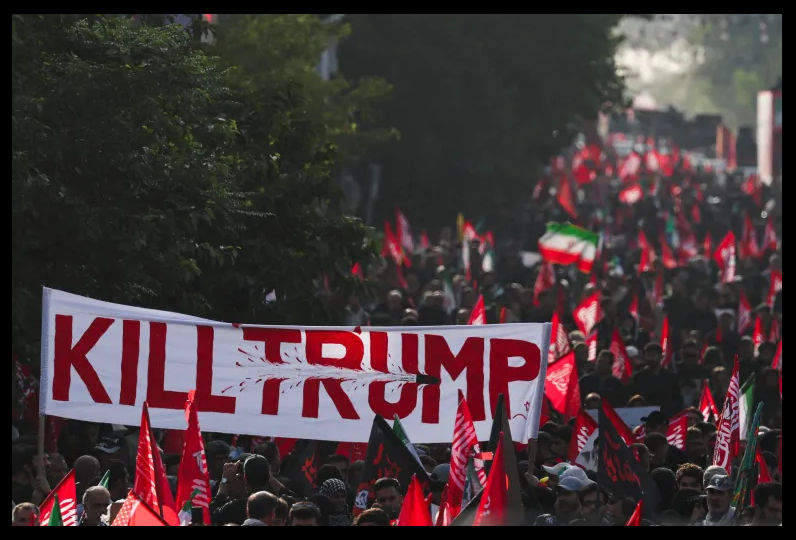
Mourners in Tehran carry banners calling for Trump’s death
Images from Khamenei’s funeral procession in Tehran shows mourners carrying a banner with the words “Kill Trump”. The banner also shows a bullet running through the word Trump.
Other mourners also carried placards of images of US Vice President JD Vance, US Defense Secretary Pete Hegseth and Israeli Prime Minister Benjamin Netanyahu with the words, “There will be blood”.
|
|
|
Mohseni-Ejei reappointed as Iran’s judiciary chief
Iran’s supreme leader has reappointed Gholam-Hossein Mohseni-Ejei as head of the country’s judiciary.
In a decree, Mojtaba Khamenei praised Mohseni-Ejei’s “valuable and sincere efforts” as judiciary chief.
In January, Mohseni-Ejei pledged to fast-track trials for those arrested during weeks of antigovernment protests that began in December and continued into the new year.
He has accused the protesters of working with Israel and the US.
|
|
|
OPEC+ countries say they will expand monthly oil production
OPEC+ members have announced plans to boost oil production as energy markets show tentative signs of recovery amid the fallout of the US-Israel war on Iran.
OPEC+ said on Sunday that seven member countries – Saudi Arabia, Russia, Iraq, Kuwait, Kazakhstan, Algeria and Oman – would raise output by 188,000 barrels per day from August after officials held a virtual meeting to “review global market conditions and outlook”.
The production boost is the fifth consecutive increase announced by the seven OPEC+ members in as many months, continuing a gradual unwinding of production cuts announced in 2023.
|
|
|
Iranian army chief says Tehran will not abandon quest for justice
Iranian officials and mourners at the weeklong funeral procession for Khamenei have been calling for revenge over the supreme leader’s assassination by the US and Israel.
The Iranian army chief, Major General Amir Hatami, who pledged to never abandon the quest for justice, said:
“Those who committed this crime must know that the nation of Iran and all of us will never cease in our pursuit of and demand for justice,” according to Press TV.
“We will not let go of them, and this is a definitive decision that we will follow through until we achieve results,” he added.
|
|
|
Iran has changed after the US-Israel war
Following the assassination of Iran’s supreme leader, the country is entering a new political phase. Analysts say the US-Israel war on Iran has accelerated internal shifts, with Tehran adopting a more confrontational stance across the region.
|
|
" .. US-Israel war.. "
Putting "US" first then "Israel" is inaccurate, as it is Netanyahu who started in June 2025 by claiming without evidence that Iran was accelerating its nuclear program. In December of that year, he vowed to attack Iran again in 2026, which he did on February 28, 2026, by bombing the building where Khamenei, his family, and senior figures were.
Netanyahu was already at war before Trump chose to decide to take part by declaring war on Iran.
So, it is "Israel-US war"
Why did Trump declare war on Iran, not Netanyahu who started it all?
The Israelis have been a war belligerent since 1967 and never lifted the declaration of war (on Arab countries), which was issued by the then-Israeli prime minister Levy Eshkol. You can't declare war twice when you're already a war belligerent.
Netanyahu had made an statement on October 7, 2023, by saying "We're at war (with Gaza)," while he can't say that when he's occupying the enclave, which in return is part of Palestine that was first partially seized and colonized since 1948, and the remaining part, the West Bank, occupied since 1967.
|
Iran’s Ghalibaf says US memorandum is ‘difficult but possible’ to enforce
The Iranian parliament speaker and top negotiator says Iran remains deeply at odds with the US despite the recently signed memorandum of understanding, describing its implementation as “difficult, but possible”.
Ghalibaf made the comments during a meeting in Tehran with Mohammad Darwish, head of Hamas’s leadership council, who traveled to Iran to attend Khamenei’s funeral ceremonies.
- “We have no peace with the United States, and we will not recognize Israel.”
Iran will continue supporting Muslims and the “axis of resistance” under Khamenei’s guidelines," if needed with missiles and if political pressure is required, pressure through negotiations”.
- Iran must avoid “negotiation for the sake of negotiation”.
“We told the American side that the territorial integrity of regional countries and the cessation of war against Iran’s allies in the resistance groups must be part of the memorandum, and it was added to the text.”
- “Today, this memorandum is being implemented, and its enforcement is difficult, but possible.”
- Muslim countries have an important role to play, adding, “They have now realized that cooperation with the US and Israel will not bring them security.”
|
|
|
Ghalibaf says peace in Lebanon cannot happen without Tehran
Ghalibaf says peace in Lebanon cannot hold unless Iran plays what he describes as its stabilizing role in the region.
Iran’s top negotiator made the remarks during a meeting in Tehran with Muhammad Fneish, a senior Hezbollah official who traveled to Iran to attend Khamenei’s funeral ceremonies.
He said Tehran had made Lebanon a central issue in negotiations that led to the signing of the Iran-US MoU, according to Iranian media.
Here are some of his other comments:
- “We had a special emphasis on Lebanon’s territorial integrity and sovereignty.”
- He also praised Hezbollah’s fight against Israel in support of Iran during the US-Israeli war, describing it as a “turning point in history” that showed the “unbreakable bond” between Iran and the groups in the “axis of resistance”
|
|
Paragraph 1 of the Memorandum of Understanding
The United States of America and the Islamic Republic of Iran and their allies in the current war, by signing this MOU, declare the immediate and permanent termination of military operations on all fronts, including in Lebanon, and undertake from now on not to initiate any war or any military operations against each other, and to refrain from the threat or use of force against each other, and ensuring the territorial integrity and sovereignty of Lebanon. The final deal will confirm the permanent termination of the war on all fronts, including in Lebanon, and other provisions of this paragraph.
However, the US and the Israelis "drafted" a agreement, which is called "framework," which clearly sidelines the MoU.
The rival agreement, which the framework is, has been written in a language of ambiguity, allowing the Israelis to uphold an open-end-occupation in Lebanon because both the US and the Israelis, if not the siding Lebanese government, know that Hezbollah would reject.
|
The US could prepare to drop Israel
For many Israelis, it appears inevitable that Trump will re-evaluate US ties with Israel, an alliance that has helped sustain the Israeli war belligerent since its formation in 1948 from Zionist terrorist groups like Irgun Tzvai Leumi, Lehi (the Stern Gang), and Haganah.
Netanyahu has embarked on a hazardous course for his political survival, potentially facing prison due to his ongoing corruption charges and a general election that could throw him out of office this year.
Between Washington’s need to secure an agreement with Tehran that includes Lebanon – which Israel has been bombing since 2023 – and the Israeli public’s desire to see that war continue, Netanyahu is faced with one of the most challenging periods in his four-decade political career.
After reports of friction between the US and Iran during the previous war on Iran in June 2025, relations a year later appear to have deteriorated further due to disagreements on how to proceed with Tehran.
|
|
|
Israeli Defense Minister Katz threatens Iranian leaders
Israel’s defense minister has claimed that his country assassinated Khamenei for allegedly leading a “plan to destroy” Israel and again threatened to “eliminate” any Iranian leader who tries to promote such actions, according to Israel’s Channel 13.
Israel Katz made the comments in response to the ongoing funeral procession in Tehran, the Israeli broadcaster reported.
Katz added that Israel remains prepared to defend itself at any time and against any threat.
Earlier, Katz said Khamenei’s son and successor, Mojtaba, was “marked for death”, spurring an angry protest from Tehran. Iranian Foreign Minister Abbas Araghchi said Trump “has committed the US to muzzling its pets in Tel Aviv”, adding, “Any threat against our people and leadership will receive an immediate, powerful response.”
|
|
"... for allegedly leading a plan to destroy Israel"
This is not the first time that Katz threatened Iran's leaders. Last week, he said Iran's supreme leader Mojtaba Khamenei had been “marked for death.” The threat prompted Tehran to keep Mojtaba away from his father's funeral.
On February 27, 2026, and amid Oman's efforts in its mediation between Iran and the US, Trump's son-in-law Jared Kushner told his father-in-law Donald Trump, that Iran was going to attack. Kushner was in contact with the Israelis during Oman's mediation. The Pentagon dismissed the claim by saying that Iran wasn't preparing before Netanyahu started his resumption of the June 2025 war on Iran on February 28th.
Israel Katz, who is an German Ashkenazi, resorts to a obsession similar to the one which emerged after a statement made by Mahmoud Ahmedinedjad, who was Iran's president in 2005. He was mistranslated by Western media, as the statement wasn't about wiping Israel from the map but in the face of time. It took seven years
Still, the Israelis
|
Japan-linked tankers leave Hormuz after months stuck in Gulf
Ten Japan-linked vessels have begun leaving the Strait of Hormuz after spending months stranded in the Gulf because of the US-Israeli war on Iran.
The ships include six oil tankers carrying 12 million barrels of Middle Eastern crude as well as two chemical tankers, a vehicle carrier, and a container ship.
The oil cargo – loaded between late February and early March – include crude from Saudi Arabia, the United Arab Emirates, and Qatar, according to shipping data from LSEG.
Most of the vessels are managed by Japanese shipping company Mitsui OSK Lines, which said it would put the safety of its crew, cargo, and ships first when crossing the strait.
In a separate development, South Korean refiner S-Oil said the VLCC Long Wind, carrying crude for its refinery, left Hormuz on Saturday.
The tanker loaded two million barrels of Saudi crude in early March and is expected to reach Onsan, South Korea, on July 26, according to LSEG data.
|
|
|
Indonesia, Singapore pledge to keep Malacca Strait open
Indonesia and Singapore say the Strait of Malacca will remain “safe, open and accessible to all” as Iran moves to impose fees on ships passing through the Strait of Hormuz.
Indonesian President Prabowo Subianto said after talks with Singaporean Prime Minister Lawrence Wong in Jakarta that both countries have an interest in keeping Malacca a free passageway.
“We will continue to coordinate with Malaysia and Thailand,” Prabowo said, adding the strait should remain open.
Wong said Singapore and Indonesia are committed to freedom of navigation under the UN Convention on the Law of the Sea.
The statement comes after Iran’s ambassador to China said ships crossing the Strait of Hormuz would be charged fees with “friendly” countries receiving special treatment. The Hormuz route normally carries about one-fifth of the world’s crude oil and liquefied natural gas flows.
|
|
|
Iran leader unable to attend his father’s funeral over security fears
Mohammad Eslami, a research fellow at Tehran University, says Iran’s Supreme Leader Mojtaba Khamenei is unable to attend his father’s funeral procession because “the war is not over”.
“There is a very fragile ceasefire between Iran and the United States and Israel. Right now they are talking about very hard topics to negotiate. With their security arrangements, there’s not really a chance for him to appear in public,” said Eslami.
Iranian leaders are mapping out a new strategy for the Middle East that encompasses the Strait of Hormuz and Bab al-Mandeb Strait, he said.
“The Iranian system is thinking about ‘dominance’ instead of ‘resistance’. Right now we are witnessing a new self-confidence.”
Supporting Hezbollah and defending Lebanon during Israeli attacks also top Iran’s priorities, according to Eslami.
|
|
|
Iranian economy ‘resilient’ despite Hormuz closure pressure
Mohammad Eslami of the Tehran University said that although the Strait of Hormuz’s closure may not be good for Iranians, they are already “victims of two decades of sanctions” and “maximum pressure on the Iranian economy and society”, referring to the harsh economic measures imposed by Western countries.
Therefore, the government “is feeling confident regarding the resilience of the economy”, he added.
Eslami also said the Iranian government does not want the Strait of Hormuz “to be closed”. Rather, he added, it would like “a new framework” with countries in Europe and Asia to regulate passage through the vital waterway.
|
|
|
Russia’s Rosatom to send staff back to Iran nuclear plant
Russian state nuclear company Rosatom is planning to send personnel back to Iran’s Bushehr nuclear power plant starting in mid-July, Interfax news agency reports.
Rosatom is building two new units at Bushehr, which sustained multiple attacks by the US and Israel following their February attack on Iran.
Nearly 200 Rosatom employees were evacuated from the plant in April.
|
|
|
| |
|
|
| |
|
|