| Highlights from yesterday |
|
Comments |
- Huge crowds have poured into Tehran for funeral ceremonies for Iran’s late Supreme Leader Ali Khamenei, who was killed in a US-Israeli strike on his compound on February 28.
- US President Donald Trump says “neither side will shoot the other during the funeral proceedings” and that talks with Iran will continue after the ceremonies.
- Trump also hints that Israeli Prime Minister Benjamin Netanyahu could visit the White House as early as next week, in what would be his first trip to the US since the start of the war on Iran.
- Turkish President Erdogan accused Israel of undermining the recent memorandum of understanding (MoU) between the US and Iran, adding that Turkey “stands ready to support any effort to achieve peace in the region”.
|
|
|
Iran chooses a new posture of deterrence after Khamenei’s assassination
The system in Iran has survived the assassination of its Supreme Leader Ayatollah Ali Khamenei and several high-ranking officials, but it did not emerge unchanged.
Mojtaba Khamenei, the son and successor of the late supreme leader, has moved to assert himself. Unlike his father, he has chosen direct confrontation, outside and inside Iran, attacking neighboring countries and pushing the conflict with the US and Israel to the edge.
Washington didn’t achieve regime change, but it may have driven change within the system itself.
At the heart of the new posture is deterrence: Iran is signaling that another war against it would be expanded beyond its borders.
Control over Hormuz has been the clearest expression of that doctrine. For Tehran, the message is simple: If Iran cannot have stability, others will not buy and sell oil as usual.
The confrontation with the US, and talks to end the war, have also become a tit-for-tat contest, with each side testing the other without knowing where the red line lies.
The shift is also visible in the wider region.
Iran has linked the war in Lebanon to any truce and retaliated after the Israeli attack on Beirut’s southern suburbs. Lebanon is no longer treated as a separate front. It is part of Iran’s wider security equation.
Then there’s the funeral of Khamenei in Iraq.
By taking the ceremony through the holy cities of Najaf and Karbala, Iran is declaring that its influence across the Shia world would continue.
|
|
|
‘The post-Khamenei era is taking shape under fire’
The new Iran is not without internal tension.
There are differences inside the state over whether talks with Washington can still produce results. The decision-making circle has also changed, and power appears more concentrated and less cautious.
Yet the country still faces sanctions, economic pressure and public fatigue that could reignite mass protests, as well as the aftermath of the war.
The post-Khamenei era is taking shape under fire.
Iran is more assertive, more regional, more willing to escalate, but also more exposed.
What is visible now may be less a settled doctrine than a series of acts of defiance by a new leader trying to prove authority.
The real test will come when the war ends, the crowds disperse, and Iran has to decide whether this era is built on confrontation alone, or something more durable.
|
|
|
Four ships alter course in Strait of Hormuz
Ship-tracking firm Windward says four vessels attempting to transit the Strait of Hormuz via the southern route along Oman’s coast have altered course, with two turning back and two diverting to a central corridor.
Iran opposes ships using the southern route through Oman’s territorial waters and has previously attacked at least two vessels traveling that corridor. The route was announced by Oman, the US and the United Nations in late June.
Tehran claims sole responsibility for managing traffic in the Strait of Hormuz during the 60-day period specified in its MoU with the US, and is seeking, in coordination with Oman, to impose fees for services in the waterway once that period ends.
Ship-tracking firms have been reporting a modest recovery in maritime traffic through the Strait in recent days but still well below pre-war levels.
|
|
|
The latest on the Iran-US talks
- Iranian and US delegations wrapped up indirect technical talks in Doha last week, following days of tit-for-tat attacks amid a dispute over shipping routes in the Strait of Hormuz.
- US Middle East envoy Steve Witkoff and Trump’s son-in-law, Jared Kushner, attended, but Iran’s top negotiators – Foreign Minister Abbas Araghchi and Speaker Mohammad Bagher Ghalibaf – did not. Iran’s Deputy Foreign Minister Kazem Gharibabadi, who heads the country’s technical team, attended instead.
- US Vice President JD Vance said discussions were held on the Strait of Hormuz, while informed sources are saying that Tehran’s nuclear program, its frozen funds and the conflict in Lebanon were also on the agenda.
- Gharibabadi told Iranian media that two meetings were held in Doha. The first one addressed the US’s “violations of its obligations”, and the sides decided to establish a communication channel to resolve disputes. The second meeting addressed the release of $6bn in frozen Iranian funds.
- Qatar has hailed “positive progress” in the talks and said the next meeting will follow funeral processions for the late Iranian Supreme Leader Ali Khamenei.
|
|
|
Iranian embassy to Trump: ‘People can be killed, but ideals cannot’
Iran’s embassy in Armenia has responded to Trump’s comments to the Axios news outlet, in which he said no shots would be fired during the multiday funeral for Khamenei.
The US president told Axios he could “eliminate everyone” attending the event but said that then “there will be no one left to negotiate”. He also expressed surprise at Iranians crying at the funeral, saying he thought people hated Khamenei.
In response, Iran’s embassy in Yerevan said on X:
“People can be killed, but ideals cannot. You killed Ayatollah Khamenei, but in reality, you broke a perfume bottle whose scent spread everyplace. You don’t understand these things because you have neither civilization, nor history, nor honor.”
|
|
|
Trump says Netanyahu ‘knows who the boss is’
Trump’s comments about a possible visit by Netanyahu to the White House.
The US president told Axios the visit could take place after he returns from the NATO summit in Turkey on July 7-8.
“We get along very good. [Netanyahu] knows who the boss is,” Trump told the outlet, referring to himself.
An Israeli official, however, told Axios the visit might take place the week after. The Israeli prime minister’s office had said earlier that the two leaders had spoken by phone and that they “agreed to meet soon” in the US.
The visit will be Netanyahu’s first to the US since February, when he reportedly presented the plan for launching the war on Iran. A US official told Axios, “many of Trump’s closest advisers think that Bibi [Netanyahu] was wrong about everything”.
|
|
|
Medvedev says Iran has ‘backup weapon’ in Bab al-Mandeb
Medvedev, the deputy chairman of the Russian Security Council, said earlier that the Strait of Hormuz was a strategic asset for Iran, comparable to a nuclear weapon.
In the same comments, Medvedev said Iran also possessed a “backup weapon” in the Bab al-Mandeb, a strait that sits between Yemen, Djibouti and Eritrea and connects the Gulf of Aden to the Red Sea and the Suez Canal.
He warned that shipping through the key maritime chokepoint could be disrupted in the event of a broader regional conflict and said, “I hope it does not come to that, but all countries seeking conflict in the region should remember this.”
The Iran-aligned Houthi rebels in Yemen have previously threatened to close Bab al-Mandeb and on June 8 declared a ban on Israeli ships in the Red Sea.
|
|
|
Qatar says maritime navigation can resume normally
Qatar’s Ministry of Transport says maritime navigation activities can now resume normally for all types of maritime vessels and ships.
In a statement, it urged operators to abide by maritime regulations and instructions currently in force.
The ministry also called on sailors to ensure all necessary equipment is on board before sailing. The measures are aimed at ensuring “the highest levels of safety and security” for all trips, it added.
The move reverses a June 29 advisory that temporarily suspended travel by sailing and fishing boats until further notice, though commercial shipping was exempted.
Qatar did not provide a reason behind the June 29 measure, but it came a day after it said one of its nationals had been killed after sustaining injuries from shrapnel because of “military operations in the region”.
|
|
|
Ayatollah’s Khamenei’s funeral carries messages of defiance
Mourners chanting slogans against the United States and Israel calling for revenge – some calling for the killing of Donald Trump.
These commemoration ceremonies, these processions, carry several messages including to the international community, to the West, that despite the fact the supreme leader was killed, state institutions are still intact and functioning. The establishment and the armed forces are all standing behind their leaders, functioning and intact.
There are also messages to the region, to Iran’s allies, that the transition, the succession, is going smoothly and normally.
This also carries a message internally that despite years of sanctions, economic hardship and war, Iran now has a mood of unity and consolidation, rather than a mood of crisis. An underlying message is: “You managed to kill the leader, but you have not been able to break the establishment.”
|
|
|
Iran’s military says ceasefire being used to heighten combat readiness
Brigadier-General Mohammad Akraminia says the army is using the ceasefire period to strengthen its combat capabilities, warning any “enemy mistake” would be met with a “decisive response”.
Akraminia said Iran is using the halt to hostilities to strengthen its armed forces. “We will not waste a single moment or neglect this,” he said.
“If the enemies make a mistake, they will definitely face a crushing and decisive response from the Iranian armed forces,” he said.
Thousands of US and Israeli air attacks hit a range of military targets, energy and civilian infrastructure during weeks of war that began with the killing of Ayatollah Ali Khamenei on February 28. The attacks killed more than 3,000 people in Iran, according to state media.
|
|
|
UKMTO says cargo ship under attack off Yemen’s Red Sea coast
A cargo vessel is under attack by unknown armed assailants off Yemen’s Red Sea coast, according to the United Kingdom Maritime Trade Operations.
UKMTO said it received a distress alert from the vessel 56km (30 nautical miles) southwest of Yemen’s port city of Hodeidah.
Authorities are investigating the incident, the agency said, advising vessels in the area to transit with caution and report any suspicious activity.
No group immediately claimed responsibility for the attack.
|
|
|
Iranians call for President Trump’s death at Khamenei funeral
Calls have rung out for the killing of US President Donald Trump in the crowd of hundreds of thousands of mourners in Iran’s capital.
Ziba Naderi, 42, a nurse attending Khamenei’s funeral, said Iranians need to follow whatever new Supreme Leader Mojtaba Khamenei commands.
“I heard the call for revenge, but our leader should say what we need to do, and we must listen to him,” she said.
Posters and graffiti at the Grand Mosalla called for the killing of Trump and Israeli Prime Minister Benjamin Netanyahu.
Mohammad Rasouli, a poet who emceed the event before the funeral prayers, drew out calls of “Death to America” and “Death to Israel”.
Speaking to the crowd over loudspeakers, Rasouli asked, referring to Trump: “Why is the most bastard man in the world still alive?” The question drew cheers from the crowd.
|
|
|
Turkey's Erdogan says world ‘breathed sigh of relief’ after Iran-US deal
Turkish President Recep Tayyip Erdogan has hailed Pakistan’s mediation between Iran and the US after meeting Pakistani Prime Minister Shehbaz Sharif in Istanbul.
“The entire world has breathed a sigh of relief,” Erdogan said, according to a statement by the Turkish presidency, in reference to the memorandum of understanding that was signed last month by Tehran and Washington.
Erdogan said Turkey would continue to support initiatives aimed at reducing regional tensions, adding that it was also closely monitoring what he called Israeli provocations.
“The current Israeli government, which has become addicted to war, should never be allowed to once again plunge our region into the smell of gunpowder and blood,” Erdogan said.
|
|
|
IRGC vessels divert 6 ships from Omani route in Strait of Hormuz
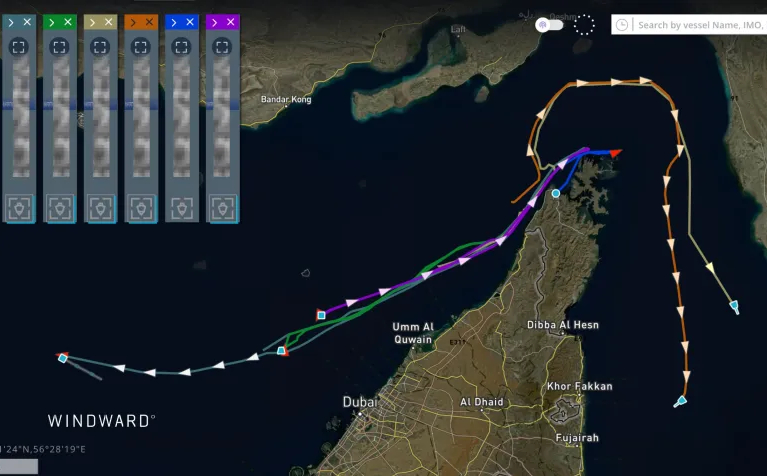
Maritime intelligence firm Windward says six ships have changed course from the Omani corridor while Islamic Revolutionary Guard Corps boats patrolled the area.
Since Saturday, two of the ships diverted from the route that runs closer to Oman than Iran have sailed towards Iran while the four others have returned to the Gulf, Windward said.
The IRGC navy has been issuing radio warnings to ships using routes other than what Iran describes as its “safe route”, it added.
|
|
|
Iran will not be ‘fooled’ by talks as US-Israel hostility continues
Mostafa Khoshcheshm, a professor at the University of Applied Science and Technology in Tehran, says the message from Iranians attending the supreme leader’s funeral is unambiguous.
“I believe the message is very much clear: Iranians are not going to be fooled by talks or some kind of [memorandum of understanding]. They are awake. They know that the United States and Israeli animosity is not over,” Khoshcheshm said.
Iranians expect “hostile” actions against the country to continue regardless of whether a nuclear deal is reached, he said.
“They know that no matter what happens in the next few weeks or months, if a deal is signed or not, the Israeli and US hostile moves against Iran will continue through hybrid warfare in various areas of the economy and sanctions, as well as cyber attacks, soft warfare, assassination, sabotage attacks and probably military attacks as well.”
The scale of people’s participation in the funeral reflects public resolve to support the government, Khoshcheshm said.
“The Iranian people are showing they are there to stand to the end, and they are steadfast in pursuing the supreme leader’s goals and targets.”
|
|
|
Iran claims ‘monolithic control’ over Strait of Hormuz in ‘new normal’
Alexandru Hudisteanu, a military and maritime analyst, says Iran is trying to assert itself as the main overseer of traffic through the Strait of Hormuz but the rest of the world will not agree to it.
“The region also wants to move past this conflict, past this war as soon as possible, and obviously, there’s a gap in the market, and that’s why we saw the oil price increase, and that’s why we see now that there is trust this memorandum of understanding will go through and we’ll reach, let’s say, more or less a permanent deal in the best case scenario, which will mean some form of return to whatever will be the new normal after this,” he said.
“Obviously, the region pushes for free flow of trade, and also the world wants that. But in the end, we have to see exactly how that will basically end up,” Hudisteanu says.
Iran is portraying its “monolithic control” over Hormuz. “If Iran can claim after this war is finished … that it maintains customary control of the trade, then it will become their legal argument to continue to do so.”
|
|
|
Iran-Qatar shipping route reopens after five-month suspension
A maritime cargo route between Iran’s Dayyer port and Qatar’s Al-Ruwais port has resumed operations, after a five-month suspension because of the US-Israeli war.
Abbas Abdolkhani, Iran’s commercial attaché in Doha, told state media shipping resumed following coordination between the Iranian embassy in Doha and Qatari authorities.
The two geographically opposite ports mainly cater to regional trade. Dayyer port was hit several times during the war.
Al-Ruwais port is one of the main gateways for Iranian exports to Qatar, and its reopening is expected to reduce transportation costs and speed up the supply of goods.
Qatar has served as one of the key mediators between Iran and the United States to end the war.
|
|
|
Third US-Iran war would be ‘catastrophic’ if deal collapses
A breakdown of the US-Iran memorandum of understanding (MoU) could trigger a third round of conflict following a 12-day war in 2025 and a 40-day war this year, a Tehran-based analyst says.
“If the United States doesn’t abide by the terms of this MoU, we are going to witness a third war which will be more devastating, more ravaging than the first two,” said Mostafa Khoshcheshm, a professor at the University of Applied Science and Technology.
“This one was stronger than last year’s war and the next one will be more ravaging not just for Iran or the United States but for the entire region.”
Khoshcheshm said Tehran is committed to ending the conflict. “Iran is doing its best to make sure that diplomacy works, because a third round will be a catastrophic war for everyone – not just the region, but even beyond the region.”
|
|
|
Iran’s Bandar Abbas airport resumes operations after four-month halt
Bandar Abbas International Airport in southern Iran has resumed commercial flights after a four-month suspension.
The first passenger flight from Mashhad landed on Saturday afternoon, Fars news agency reported.
Bandar Abbas is the capital of Hormozgan province, about 1,000km (621 miles) south of Tehran on the Strait of Hormuz.
The airport was closed for reconstruction and repairs following damage sustained during the US-Israeli bombardment. Authorities expect a gradual return of flights to Tehran, Shiraz and Yazd in the coming days.
|
|
|
Demands grow at Khamenei funeral for ‘serious response’
A far larger crowd attended the funeral ceremony on Sunday than on Saturday. Mourners dressed in black walked to the site carrying banners and flags honoring Ayatollah Ali Khamenei, while also calling for President Trump’s killing.
“I came here to shout and seek revenge,” said Gholamreza Sabooni, 29, who works in a grocery store. “They killed our imam, we should kill their leader, Trump.”
US authorities have been tracking Iranian threats against Trump and other administration officials for years. That stems from Trump ordering the 2020 killing of General Qassem Soleimani who led the Revolutionary Guard’s Quds Force.
“Our foreign policy should not be shaped in a way that allows our martyred leader’s blood to be dishonored and other countries can afford to do such things, without any serious response from our government and diplomatic system,” mourner Mohammad Reza Sharifi said.
|
|
|
US Navy suspends search for sailor missing in Arabian Sea
The US Navy says it has suspended its search for a sailor who was reported missing on July 1.
- The Navy’s 5th Fleet said the Navy and Air Force searched for a sailor who was reported missing last week after an MH-60S Seahawk helicopter went down in the Arabian Sea.
- Three others were wounded when the MH-60S Seahawk made an emergency landing.
- Search-and-rescue efforts lasted more than 102 hours and covered 14,000 square miles (36,260 square kilometers), the fleet said.
- The sailor’s name is being withheld until at least 24 hours after the next of kin is notified.
|
|
|
OPEC+ approves further oil output increase as Hormuz exports begin to recover
OPEC+ has agreed to a further increase in output targets from August, adding to global supply at a time when oil prices are falling due to the gradual reopening of the Strait of Hormuz for oil exports.
“In their collective commitment to support oil market stability, the seven participating countries decided to implement a production adjustment of 188 thousand barrels per day from the additional voluntary adjustments announced in April 2023,” read an OPEC+ statement.
|
|
|
| |
|
|
| |
|
|
| |
|
|
| |
|
|
| |
|
|
| |
|
|
| |
|
|
| |
|
|