| Highlights from yesterday |
|
Comments |
- The US and Iran have agreed to stop attacking each other and plan to meet in the Qatari capital, Doha, on Tuesday to work out their dispute over the Strait of Hormuz, according to Axios.
- The report comes after the US bombed Iran’s Qeshm Island and the cities of Sirik and Bandar-e Lengeh over attacks on shipping in the strait, and Tehran retaliated by firing missiles and drones at US forces in Bahrain and Kuwait.
- Iran’s Foreign Minister Abbas Araghchi says responsibility for the Strait of Hormuz lies solely with Tehran and warns that any attempts to bypass its preferred route in the waterway will lead to “tension and escalation”.
- Iranian Supreme Leader Mojtaba Khamenei has called for US and Israeli leaders to be prosecuted for war crimes committed against the country last year and this year.
|
|
|
New Jersey governor says ‘deeply troubled by Trump’s handling of war’
Mikie Sherrill, the Democratic governor of the US state of New Jersey, is demanding answers from the Trump administration about what the war on Iran has accomplished.
“The administration’s objectives have shifted repeatedly. The costs have soared. And we all deserve a clear explanation of what the Trump Administration thinks it is actually achieving to make America safer,” Sherrill wrote in a series of social media posts.
She noted that Trump’s justifications for the war have shifted since the conflict began, from eradicating Iran’s missile program to ending its nuclear program to enacting regime change.
“To date, he has accomplished none of these goals,” Sherrill wrote. “At one point, he even claimed he was at war to open the Strait of Hormuz, which had been open before he began his war.”
|
|
|
US and Iran to resume talks after days of tit-for-tat attacks
Late on Sunday, Washington, DC, time, a US official told the Axios news site that technical talks between the US and Iran will resume on Tuesday in Doha.
It follows several days of tit-for-tat military strikes between the US and Iran around the Strait of Hormuz, mainly because of disputes about how commercial ships can transit that waterway.
Trump has been criticizing Iranian officials on social media, threatening a resumption of military strikes if the Iranians do not allow commercial vessels to move through the Strait of Hormuz without any impediment, financial, physical, or otherwise.
The Iranians have accused the US of violating the terms of the MoU by interfering with their ability to control traffic in the waterway, as well as trying to interfere with their right, eventually, to collect tolls from vessels transiting the waterway.
According to reports, including from Axios, US officials said the strikes by both sides will stop for the time being, and a new round of technical talks, focused specifically on commercial shipping traffic through the Strait of Hormuz, will take place.
It’s not clear how long those discussions will take place, but it certainly sends the signal that the 60-day period for negotiations, aimed at permanently ending the war, will be continuing.
|
|
|
US-Iran to ‘stand down’ in Hormuz and renew talks, media reports say
Reuters now reports that Iran and the US have agreed to halt hostilities and renew talks over their dispute in the Strait of Hormuz. It cited an unnamed US official, confirming an earlier report by Axios.
Here’s what the outlets said:
- “Technical talks are slated to continue on all areas of the MoU. Both sides will stand down for now, and vessels can move freely,” a US official told Reuters.
- One official told Axios that the US has “decided to stop all the kinetic activity”.
- Both officials said the US and Iran plan to meet in the Qatari capital, Doha, on Tuesday.
- While Reuters reported that the talks will span all areas of the MoU, Axios said they will focus on the Strait of Hormuz.
- Nick Stewart, who heads the US technical team, is expected to participate in the talks, Axios added.
There has been no comment from Tehran or Washington on the reports so far.
|
|
|
Strait of Hormuz remains under Iranian control for 30 days, Araghchi says
Iran’s foreign minister has urged “all parties not to interfere” in the management of the Strait of Hormuz after the US bombed Iran for a second day following a drone attack on a vessel.
During a news conference with his Iraqi counterpart in Baghdad, Abbas Araghchi said the MoU gives Tehran control of the waterway.
|
|
|
48 vessels passed through Hormuz after US-Iran attacks, data shows
Several maritime websites have been tracking traffic through the Strait of Hormuz since the US and Iran traded strikes, accusing each other of violating the ceasefire agreement:
- From Friday, June 26, to Sunday, June 28, a total of 48 vessels transited the strait during two separate timeframes.
- That includes 23 oil and gas tankers and seven bulk carriers, which are specialized ships designed to transport commodities such as iron, coal, grain, fertilizer and cement.
- Some 19 cargo or container ships also transited the waterway.
- The number marks a drop compared with the 70 transits recorded by Marine
- Traffic in the strait on Wednesday, and 54 on Thursday, before the latest escalation of violence.
|
|
|
Iran issues ‘serious warning’ to Bahrain
An adviser to Iran’s supreme leader has warned Bahrain that Tehran would strike the country with greater force if provoked.
“A serious warning is being given to the Bahrainis to know their limits and not play such games with their own fate, and not force Iran to adopt harsh decisions,” Ali Akbar Velayati was quoted as saying by the semi-official Tasnim News.
Iran targeted a US Navy base in Bahrain on Saturday and Friday in response to US attacks. Tehran claims the US uses military bases in the region to launch attacks on its territory. Gulf nations deny the claim, and Manama has condemned the latest attacks, saying they violated its sovereignty and undermined “opportunities for de-escalation and stability in the region”.
Bahrain, which is home to a large Shia population, has arrested dozens of people in recent months on accusations of having military ties to Tehran.
|
|
As it is for all Gulf states, Bahrain had engaged in military agreements with a alien military power from another continent, knowing that this power wants to be on its soil merely for own interest. Its engagement in these agreements contribute to instability in the region, in particular concerning Iran.
International law prohibits neutral states from actively facilitating one belligerent’s combat operations against another. If a state grants the use of its soil to launch direct attacks, it crosses the line from a neutral to a co-belligerent, making its own and or US military facilities lawful targets for the opposing state.
|
US congresswoman slams Trump’s ‘unhinged’ threats against Iran
Yassamin Ansari, an Iranian-American lawmaker, has condemned Trump’s recent social media post threatening Iran.
In a post on his Truth Social platform yesterday, confirming US attacks on Iran, the US president said Washington may “be forced to militarily complete the job” if Tehran does not abide by the deal that was signed by both countries.
“If that happens, the Islamic Republic of Iran will no longer exist!” he wrote.
Ansari, a Democrat from Arizona, wrote on X that Trump’s rhetoric is “dangerous” and “unhinged”.
“Thousands of innocent people are dead, the region is in chaos, and our economy is devastated. This war must end now,” she said.
|
|
|
Oil prices climb
Oil prices have risen following days of tit-for-tat strikes by the US and Iran that again disrupted shipping through the Strait of Hormuz.
Brent crude futures climbed 58 cents, or 0.8 percent, to $72.57 a barrel at 02:07 GMT, while US West Texas Intermediate crude was at $70.11 a barrel, up 88 cents, or 1.3 percent.
This comes after Brent crude fell 10.6 percent last week, in its third weekly decline, after crude shipments through the strait rose to their highest level since the US-Israel war on Iran began in late February.
|
|
|
US, Iran ready for talks after ‘military action to underscore their interpretation’ of MoU
Richard Schmierer, a former US ambassador to Oman, says mediation by Qatar and Pakistan has succeeded in bringing Washington and Tehran back to the table, and that the exchange of military strikes appears to be over for now.
“I think we’ve probably had some good mediation from Qatar and Pakistan to try to get the two sides to stand down,” he told Al Jazeera, adding that “both sides now feel they have made their point”.
Each party has “used military action to underscore their interpretation” of the MoU, and both sides seem to think they can now “return to diplomatic engagement”.
Schmierer said he expected Qatar and Pakistan to participate in Tuesday’s talks to try to help keep the tensions down.
“Maybe now, for the time being, we are past the back and forth, tit-for-tat, military activity, and on Tuesday, we’ll see what I hope will be successful diplomatic engagement, and to clarify the situation in the Strait of Hormuz,” he added.
He said the 60-day window outlined in the US-Iran MoU offers room for the two parties to solve their dispute on Tehran’s claim over the Strait of Hormuz, including its push to charge fees.
“These negotiations [in the 60-day period] will try to clarify that the status of shipping through the strait, and it [the MoU] does prohibit Iran, or, frankly, anyone, from impeding shipping through the strait,” the former diplomat said.
“So, there should be 60 days in which that issue really doesn’t arise. There should be free shipping.”
But for the period after, Iran and Oman, along with Gulf countries, will have to hold talks to address the question of security for shipping, Schmierer said.
“I’m sure the US position, and I think the international community position, will be that there cannot be prohibitions, there cannot be insurance requirements, there cannot be fees, but there should be some kind of security arrangement. We’ll see whether Iran can agree with that.”.
|
|
|
Rise in oil prices reflects a market that ran ‘too quickly on ceasefire optimism’
Brent crude prices have been climbing today after falling 10.6 percent last week.
As of 03:30 GMT, Brent futures for August delivery stood at $73.21, 127 cents higher than the day before the US and Israel launched their war on Iran on February 28.
“Brent’s partial rebound this morning reflects a market that had perhaps run too quickly on ceasefire optimism,” Fabien Yip, a market analyst at IG in Sydney, Australia, says.
“Oil had nearly unwound its entire war premium, despite an MoU with no enforcement details and ongoing strikes. Thursday’s attack on a commercial vessel was a reality check, and this weekend’s tit-for-tat exchanges have compounded that,” Yip said.
|
|
|
Saudi crown prince, French president discuss regional developments
Mohammed bin Salman bin Abdulaziz Al Saud and Emmanuel Macron had a conversation over the phone, according to the official Saudi Press Agency (SPA).
The agency said that the two leaders reviewed regional and international issues while emphasizing the importance of ensuring freedom of navigation in the region and supporting diplomatic efforts to reduce escalation.
They also discussed recent developments regarding the memorandum signed between the US and Iran, as well as efforts to reach comprehensive solutions aimed at achieving security and stability in the region, according to the agency.
The talks come amid renewed tensions and exchange of fire in the Gulf between the US and Iran despite ongoing negotiations to implement a broader agreement aimed at ending the war.
|
|
|
Israeli cyber chief says Iranian cyber attacks have surged since war
Yossi Karadi, director-general of Israel’s National Cyber Directorate, says Iranian cyber attacks against Israel have surged since the launch of the US-Israeli war on Iran.
He told German newspaper Die Welt that hostile incidents rose from about 1,600 in June 2025 to roughly 4,800 in June 2026.
“Some groups are very skilled,” Karadi said. “We can handle them, but we have to take them seriously. Unlike in the kinetic realm, there’s no ceasefire in cyberspace.”
The attacks targeted critical infrastructure, large organisations and smaller businesses such as law firms and accounting practices. Companies that were easier to penetrate often had their systems wiped entirely, he said.
There was no immediate comment from Iran.
Tehran has previously denied carrying out hacking campaigns against other countries and has also reported attacks on its own cyber infrastructure.
|
|
With the Menachem Begin doctrine in the background, Israeli cyber attacks on Iran began in 2010 with an increase in 2020 as part of a wider campaign aimed to make sure that Iran has no nuclear program.
The Israelis are known to us for their claims with providing no evidence. He doesn't say where in the world the cyber attacks took place, who the alleged firms are (names), and whether and what data has been compromised.
|
US envoy to UN says Iran’s leverage over Hormuz ‘diminishing day by day’
Mike Waltz says Iran stands “completely isolated” over its push to charge fees in the Strait of Hormuz and its leverage over the waterway is “diminishing by the day”.
Speaking after the US and Iran traded strikes following attacks on two ships in the strait, Waltz told Fox News that Gulf Arab states were already building alternatives with the UAE and Saudi Arabia both expanding oil pipelines that bypass the waterway.
He added that the US will “create alternatives to our [military] basing posture” in the Middle East by “hardening some” and possibly moving others underground. “So this leverage that Iran thinks it has now is diminishing faster and faster, literally every week as we speak,” he said.
Waltz said even China had opposed fees or tolls in the strait and claimed that Oman had rejected Iran’s proposal to help set up the necessary infrastructure. “So they’re completely isolated here,” he said.
The diplomat warned Iran that it risks a “path to absolute ruin” and said Trump’s patience “isn’t going to last forever”.
|
|
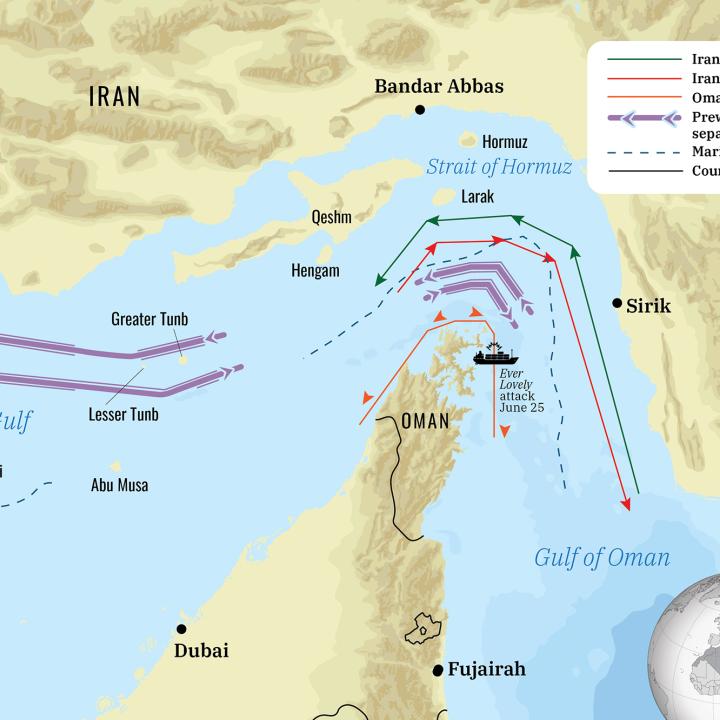
The interim agreement between Iran and the US calls for the opening of the strait, but Tehran has pushed back against Washington’s attempt to create alternative routes closer to the Omani side of the waterway.
The latter refers to Oman that offered on June 23, 2026, the IMO an alternative route, which the UN announced as their initiative.
The development prompted us to suspect the US of having enforced a move via Oman and the United Nation, where the IMO is a maritime body.
The US made its own arrangement. This is a violation of MoU paragraph 5 where it is stated "Iran will make arrangements, using its best efforts, for the safe passage of commercial vessels"
|
Rival Hormuz routes likely prompted latest US-Iran flare-up
Sultan Barakat, a professor at Hamad Bin Khalifa University in Qatar, says the weekend escalation between Iran and the US wasn’t as bad as it could have been, but was designed to show both are serious about using military force.
Because of the ambiguous nature of their memorandum of understanding (MoU), disputes can happen, Barakat said.
Trouble at the weekend apparently started after both Iran and Oman established separate travel routes for commercial vessels through the Strait of Hormuz.
“Now the Iranians must have understood this as a signal for authority as well as responsibility. So they declared a route which, as far as they’re concerned, they have cleared it. They can guarantee that it is safe for ships,” he said.
“But, unfortunately, it seems that Oman has come up with another plan with the United Nations maritime organization to evacuate ships using a different route. And this is what I think caused tension and left the US in a very difficult position.”
|
|
|
Iranian and Omani diplomats hold talks in Muscat on control of the Strait of Hormuz
Iran’s Deputy Foreign Minister Kazem Gharibabadi held the first meeting of the Hormuz Joint Committee with Oman’s ambassador-at-large Abdulaziz Al-Hanaei in the capital Muscat.
“While reviewing current issues related to the strait, we exchanged views on the future management of the strait within the framework of paragraph five of the Islamabad Memorandum of Understanding and the sovereign rights of the coastal states,” Gharibabadi said in a post on X.
Iran and Oman are hammering out details on how the strategic waterway will be governed, including whether international freight carriers will have to pay for secure passage through the Strait of Hormuz.
The negotiations are based on the interim deal signed this month by Tehran and Washington.
|
|
|
Bandar Abbas: War shoots up prices as Iranians struggle to cope
Residents of the Iranian port city of Bandar Abbas say the war has hit their livelihoods hard, as the city itself remains relatively intact despite repeated US attacks on military facilities.
Bandar Abbas sits on the northern shore of the Strait of Hormuz, through which about 20 percent of the world’s oil and liquefied natural gas pass daily, making it one of the most consequential energy corridors on the planet.
Fishermen are too afraid to go to sea. Auto repair shop owners say prices are jumping daily. A bread seller told Al Jazeera she could not afford medicine for her daughter.
“You sleep at night and wake up in the morning and find prices have risen,” one shop owner said.
|
|
|
Iran president says country will receive $6bn of frozen funds held in Qatar
During a visit to the holy city of Qom, Iranian President Masoud Pezeshkian delivered the following remarks:
- The recent agreement with the US was a significant achievement and a major victory for the Iranian people. Within the framework, sanctions on the oil and petrochemical sectors were lifted.
- According to the established plan, $6bn of the $12bn of our frozen funds in Qatar will be released and returned to the country.
- Our efforts will continue to recover the remaining frozen Iranian funds.
- The late Supreme Leader Ayatollah Ali Khamenei declared we are not seeking to acquire nuclear weapons, and we continue to emphasise this position.
- We assure the international community that our nuclear activity will be proportionate to the country’s needs and within the framework of our declared policies.
|
|
|
Ending Israeli ‘aggression’ key to Middle East peace: Turkish official
Numan Kurtulmus, Turkey's parliament speaker, says halting the far-right Israeli government’s expansionist policies would not only allow Palestinians to live in peace but also help stabilize the region.
Speaking at the opening of a NATO summit in Istanbul, Kurtulmus said there can be no lasting Middle East peace without the Palestinian people receiving justice after decades of Israel’s incursions.
“The end of these acts of aggression by the Israeli government would not only allow Palestinians to attain peace and tranquility, but would also mean securing world peace,” he said.
Kurtulmus reiterated Turkey's support for the establishment of an independent and sovereign Palestinian state, with East Jerusalem as its capital, adding “there is no other way forward than a two-state solution.”
He also highlighted the recent Iran-US interim deal. “We hope that they will ultimately lead to a lasting and just peace, not merely a ceasefire but a genuine peace settlement.”
|
|
|
Saudi foreign minister to visit China amid renewed US-Iran tensions
Prince Faisal bin Farhan Al Saud will pay a two-day official visit to China this week.
Saudi Arabia’s top diplomat will visit Beijing from Tuesday to Wednesday at the invitation of his Chinese counterpart, Wang Yi, according to the Chinese Foreign Ministry.
The visit comes after tit-for-tat attacks between the US and Iran at the weekend over the Strait of Hormuz following the signing of a memorandum of understanding and subsequent technical talks in Switzerland to end the US-Israel war on Iran.
After the war began in February, Tehran responded by striking neighboring Gulf states with US military bases, including Saudi Arabia. Repeated attacks and the closure of the Strait of Hormuz also severely affected Saudi oil exports.
|
|
|
Oil prices rise due to renewed US-Iran tensions over Hormuz
Oil prices have climbed following the latest flare-up in hostilities between the United States and Iran.
Brent crude, the primary international benchmark, rose after reciprocal US and Iranian attacks over the weekend renewed doubts about a return to normal shipping in the Strait of Hormuz.
Brent crude futures were up four cents at $72.03 a barrel by 08:03 GMT. US West Texas Intermediate crude gained 44 cents to $69.67.
“There’s still plenty of risk facing the oil market. Even so, participants appear to be … focusing on what a continued recovery in oil flows would mean for the global balance,” ING analysts said in a note.
“This complacency is odd and clearly leaves significant upside risk if the supply recovery proves slow.”
|
|
|
Source: Iran-US talks set for Doha ‘in the coming days’
A source with knowledge of planned US-Iran negotiations tells Al Jazeera they will take place in Qatar’s capital “in the coming days”.
“Technical teams working on the implementation of the MoU are scheduled to meet in Doha in the coming days. Communication channels created to de-escalate any incidents are in place and technical talks are set to continue,” said the source, on condition of anonymity.
|
|
|
Iran official says ‘no plan’ for direct US talks this week
Iran’s Deputy Foreign Minister Kazem Gharibabadi says there are currently no intentions of holding meetings with US officials from the “technical teams” in Qatar this week.
“Although consultations with Qatar – including on following up on the implementation of the other party’s commitments – are ongoing as usual the news from some media outlets that technical talks by the working groups will be held in Doha cannot be confirmed,” Gharibabadi was quoted by the Tasnim news agency as saying.
“The first round of technical talks within the framework of the designated working groups will be held when conditions are met, and after an agreement is reached on the date and location. Consultations in this regard are continuing through intermediary countries,” he added.
Earlier, several media outlets including Al Jazeera reported the US-Iran talks are expected to take place in the Qatari capital Doha on Tuesday.
|
|
|
Multiple diplomatic tracks rolling for US-Iran negotiations
The talks were initially scheduled to take place on Sunday but were cancelled because of the ongoing clashes between the Americans and Iranians in and around the Strait of Hormuz.
The Iranians are saying they agree that ships can pass freely through the strait on condition they fully coordinate with Iran. Tehran says any ships that do not get clearance from authorities are not going to be allowed, so whether they go through Iranian territorial waters or Oman’s, any ships attempting to pass through have to get permission.
The Iranians say talks are going to take place, but they are not confirming whether they will take place on Tuesday or not. But if the talks do take place, they will focus on the Strait of Hormuz not the nuclear file.
|
|
|
‘Tit-for-tat US-Iran attacks appear to be over’
A former US ambassador to Oman, Richard Schmierer, says recent US-Iran military exchanges appear to have run their course, with Qatar and Pakistan helping to bring both sides back to diplomacy.
|
|
|
Hormuz tensions ‘cloud atmosphere’ of Iran-US talks
The Strait of Hormuz has quickly emerged as a key flashpoint threatening to derail Iran-US peace negotiations, an analyst says.
“In the past few days the two sides have been flexing their muscles on this strategic issue – meaning the Strait of Hormuz, which is a leverage for Iran that can create a balance in the negotiations with the United States,” said Abbas Aslani from the Center for Middle East Strategic Studies.
“This has been clouding the atmosphere of the talks. The Iranian senior negotiator said they are not expecting those technical talks to be held this week.”
He said the latest developments indicate the US, “which was perhaps not happy with the terms of the MoU in relation to the Strait of Hormuz, now in the implementation phase wants to resort to a different solution or an alternative method”.
|
|
|
Trump announces Iran talks in Doha on Tuesday after Iran said none planned
Trump says a meeting with Iran will be held in Qatar’s capital on Tuesday after Tehran asked for talks.
“Iran has requested a meeting. It will take place tomorrow in Doha,” Trump wrote on his social media platform Truth Social in all caps.
Earlier, Iran’s Deputy Foreign Minister Kazem Gharibabadi said there are no planned meetings with US officials from “technical teams” in Qatar this week.
|
|
|
Trump claims credit for falling oil prices; links drop to Iran deal
Trump has claimed credit for falling oil prices linking it to the interim deal with Iran.
“This is less than it was prior to the start of the denuclearisation of Iran,” Trump wrote on social media, before adding in a separate post, “Gas prices coming down, fast.”
Trump also highlighted his rising approval ratings. “Highest poll numbers ever.”
Brent crude futures traded at $73 a barrel on Monday while US West Texas Intermediate stood at $69, reflecting a decline of roughly 15 percent from levels seen before the US-Israeli war was launched on Iran.
|
|
|
Witkoff, Kushner to attend meeting with Iranians: White House
Trump’s envoys will attend a meeting with Iranian officials in Qatar on Tuesday, White House spokeswoman Karoline Leavitt says.
“Special Envoy Witkoff and Jared Kushner will be flying to Doha for high-level meetings this week as we continue to discuss the memorandum of understanding,” she said in an interview with Fox News.
“On the sidelines of those high-level talks, there will be the technical talks,” Leavitt added.
Trump announced the meeting in a social media post earlier. Iran’s Deputy Foreign Minister Kazem Gharibabadi said there are no planned meetings with US officials in Qatar.
|
|
|
Trump wants to put US war on Iran ‘in the rearview mirror’
Trump said on social media a meeting will take place in Doha, Qatar, on Tuesday, confirming some US media reporting that this was going to happen.
He has been belligerent. He has continued to threaten extreme action should a deal not be settled, should the negotiations not be completed, should the skirmishes continue. But at the same time, there has been an air of restraint.
Trump wants the ceasefire to continue, he wants the negotiations to go ahead, he wants a settlement to be reached.
The reason for this may be political – midterm elections are coming up and he wants to put this war in the rearview mirror.
It has been politically damaging to him within the United States, being a deeply unpopular war. So as far as Trump appears to be concerned, the quicker this is over the better, the closer a deal comes the better.
|
|
|
Ex-US secretary of state says Iran has ‘new sense of power’
Former US Secretary of State John Kerry has said “Iran has a new sense of power by virtue of having withstood the military assault that has taken place to date”.
Kerry, a Democrat who held the role between 2013 and 2017, was also lead negotiator in a now-moribund nuclear deal that the US and other world powers signed with Iran in 2015.
Speaking to MS Now, Kerry warned US negotiators about their approach in talks with Iran.
“Iran knows and understands and uses asymmetrical warfare as effectively as anyone on the planet and that’s what we’ve seen play out here,” he said.
|
|
|
No confirmation from Iran on meeting in Doha
Iranians are not confirming what the president of the United States has just posted. Kazem Gharibabadi, Deputy Foreign Minister of Iran, says there are no technical meetings with the US side that have been scheduled this week.
But he’s confirmed that consultations with Qatar are continuing. Originally these talks were supposed to focus on the Iranian nuclear file. However, because of the rising tensions related to the Strait of Hormuz, the priority has now shifted to de-escalate the situation there.
The parties have radically different positions. Iranians are saying, no matter what, we are going to keep control over the strait – that this authorisation is given to us by the memorandum of understanding.
The Americans claim Iran is not supposed to be in charge of Hormuz and passage of ships is to be free.
|
|
|
Frozen funds emerge as key incentive to keep Iran-US talks on track
While other tracts of the Iran-US deal remain stalled, Tehran’s access to its $6bn in frozen funds is in play, analyst Abbas Aslani says.
“Part of the deal between Iran and the United States, which has been facilitated by Qatar, is in relation to Iran having access to that money,” Aslani said, adding a further $6bn is also on the table. “The process seems to be beginning.”
In 2023, under the Biden administration, the two sides reached an agreement to release $6bn in Iranian assets that had been frozen in South Korea. The funds were transferred to Qatar as an intermediary with the expectation Tehran would gain access. However, a combination of political pressure on the Biden administration and broader geopolitical complications ultimately prevented the deal, he said.
While broader developments continue to affect the atmosphere of the talks, Aslani said the financial track remains active.
“[Doha] is seeking to somehow salvage the situation by using these issues – like giving Iran access to its money – in order to somehow encourage Iran to continue with the talks with the US,” he says.
|
|
|
Hormuz traffic plummets after weekend tit-for-tat US-Iran attacks
Strait of Hormuz traffic slowed over the weekend after a commercial vessel was struck while transiting the waterway and an exchange of strikes between the US and Iran strained their preliminary deal to end the conflict.
In total, 29 commodity vessels crossed on Saturday and 12 transited on Sunday, according to data from the maritime tracking firm Kpler.
The figures marked a sharp decline from last week when a memorandum of understanding signed by Tehran and Washington boosted traffic through the strait to its highest level since the start of the war, reaching 70 crossings on Wednesday, according to Kpler.
Despite Iran’s warning against using unapproved shipping lanes, vessels continued to take several routes through the waterway over the weekend.
After one vessel was attacked on Saturday morning, ships continued for several hours to use a southern corridor through Omani waters before traffic appeared to slow, according to the Kpler-owned website MarineTraffic.
The website tracks only ships with active transponders meaning additional tankers may have crossed with signals switched off.
|
|
|
Iraq sets September 30 deadline for pro-Iran groups to disarm
Iraq’s government has given pro-Iran militias operating in the country until September 30 to disarm, its spokesman says.
The announcement at a press conference comes ahead of a visit to the United States by new Prime Minister Ali al-Zaidi, with Washington exerting pressure on Baghdad to ensure the factions turn in their weapons.
Some armed groups – many of which operate under the umbrella of the state-sanctioned Popular Mobilization Forces – targeted US facilities in Iraq in the early weeks of the US-Israel war on Iran.
|
|
|
No confirmation from Iran regarding talks in Doha
Iran’s Deputy Foreign Minister for Legal Affairs Kazem Gharibabadi said earlier no confirmation has been given that any “technical talks” will be happening in Doha this week.
The Iranians usually put out their statements at the last minute and confirmation comes from the highest levels in government. So, it possible that they may say something different later in the day, but currently reports that talks will take place in the next few days are being denied.
There are a lot of issues the two sides must discuss before the Iranians agree to return to the negotiating table. They have been unhappy about what they describe as violations of the ceasefire, both in the Strait of Hormuz by the US and in southern Lebanon by Israel.
Iran is demanding the articles of the memorandum of understanding be respected and implemented before any new talks can go ahead.
This includes Article 1 about the ceasefire and Article 5 about allowing Iran to take care of the passage of energy transport through the strait. Iran is vexed the Americans and other countries are trying to create a new corridor near this Omani side. Iran feels that it should, as per Article 5, have the authority to organize that traffic.
|
|
|
Washington, Tehran know ‘least worst option’ is diplomacy
For weeks there appears to have been a cycle of “rapid escalation” between the US and Iran and then pivoting by both sides to a negotiating track, an analysts says.
“On the negative side, this means, particularly from the US perspective, that the most critical issue that they wanted to resolve through this memorandum of understanding, which was essentially the reopening of the Strait of Hormuz, is really facing an uphill battle,” said Ellie Geranmayeh at the European Council on Foreign Relations.
“Every 24 to 48 hours there’s a hiccup in the strait… there is a vessel that comes under targeting; that means there is going to be no normality of passage,” Geranmayeh, who researches Iranian foreign policy and domestic politics, said via video link from London.
“On the more positive side … the fact that the two sides keep coming back to diplomacy and mediators manage to drag them back kicking and screaming to the negotiating table means that both Washington and Tehran know that the least worst option that faces them both is the diplomatic track.”
|
|
|
Technical talks to address ‘the nuts and bolts’ of Iran-US deal
The White House press secretary has said that the talks in Qatar will be attended by Steve Witkoff and Jared Kushner.
These are President Trump’s senior advisers and they’re the ones who’ve been spearheading the negotiations with Iran on the memorandum of understanding in the weeks leading up to its signing, so it is a high-level meeting.
The press secretary added that a “technical meeting” will continue on the sidelines. This technical meeting has been ongoing. It is one discussing the nuts and bolts of how to implement that MoU.
But for the high-level meeting, the focus is going to be the issue that has plagued the relationship in recent days and led to this uptick in violence – and that is the Strait of Hormuz and who controls it.
|
|
|
Trump announces meeting with Iran in Qatar despite trading attacks
Trump says a meeting will take place between Iran and the United States in Qatar on Tuesday, suggesting that diplomacy is still on track despite the recent military skirmishes in the Gulf.
Trump’s announcement on Monday came less than two hours after a top Iranian official said that technical talks over the memorandum of understanding (MoU) between Washington and Tehran “are not planned” for this week.
Iranian Deputy Foreign Minister Kazem Gharibabadi said the meeting would take place after conditions are met, without providing details.
|
|
|
Qatar orders vessels to ‘suspend sailing’
Qatar’s Ministry of Transport has issued a public safety notice urging “owners and users of maritime vessels, including leisure boats, fishing boats, jet skis, and all other maritime vessels” to temporarily suspend sailing and all forms of maritime activities until further notice.
The statement issued on X follows Iranian attacks on Bahrain and Kuwait on Sunday after the US.
On Sunday, Qatar said one of its citizen on a vessel which went missing off the coast was killed after sustaining injuries from shrapnel due to “military operations in the area”. Another man was injured and is in a stable condition in hospital.
|
|
|
| |
|
|
| |
|
|
| |
|
|
| |
|
|
| |
|
|
| |
|
|