


|
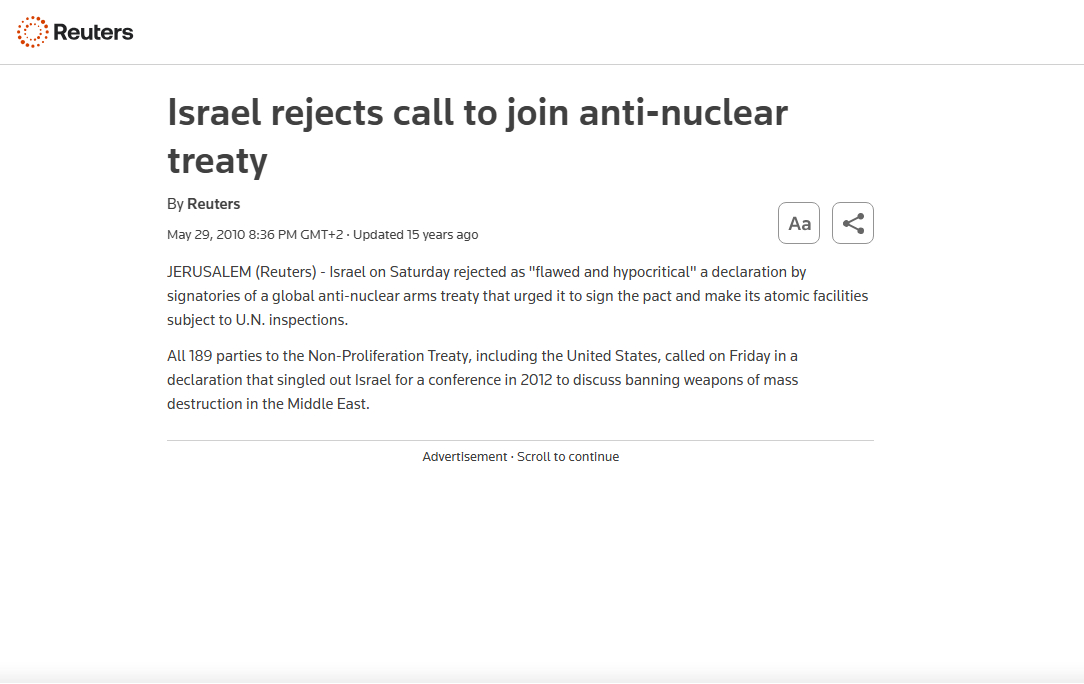
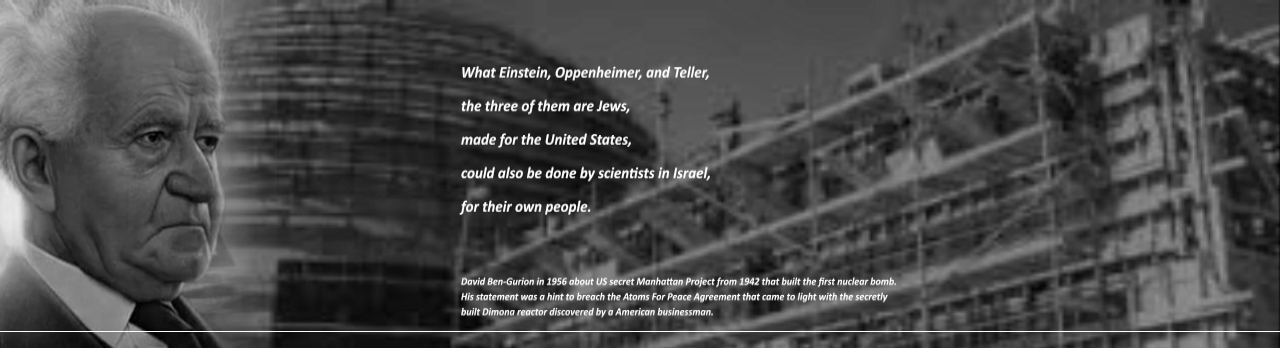
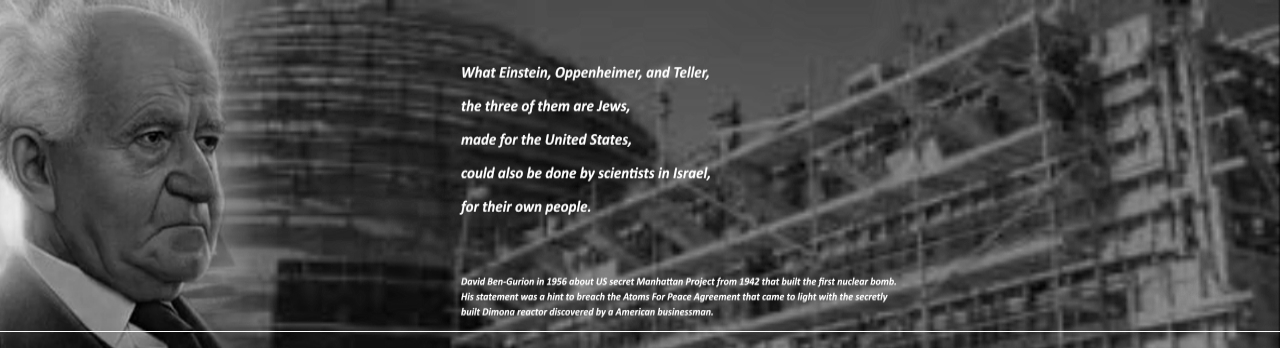
WHERE THE ISRAELI NUCLEAR RIVALRY WITH IRAN HAS ITS ROOT The Israelis were secretly working out their nuclear militarization, including the construction of the Dimona reactor until an American businessman traveling in his car, passed the construction site and became curious. He drove to the American embassy in Tel Aviv then asking if anyone at the embassy was aware that there where construction activities near Dimona. John F. Kennedy, who was the President of the United States at the time of the discovery, ordered a observation flight [with a U-2 spy plane]. The late-President was furious and wanted an explanation from Ben-Gurion, who defended the secret activities by just exploiting the Second World War with the words "to prevent a second holocaust from happening." The Israelis didn't stop after they were caught in violating the Eisenhower Agreement and breaking the promise "not to be the first" but in the Middle East. The Israeli Zalman Mordechai Shaipro, who was the director at the NUMEC site in Apollo, Pennsylvania, started stealing high-enriched uranium, while the Israelis sought help from Britain in obtaining heavy water from Norway. They also needed yellow cake they tried to buy from Argentina to start up the Dimona reactor, that was built with the help of France. By 1967, the year of the six-day war, the Israelis had their first nuclear bomb, which the Israeli general Moshe Dayan wanted to use when he had to see huge losses in the Sinai Desert. Ben-Gurion's successor, Golda Meir refused furiously. In 1968, Menachem Begin said during his speech at the UNGA, that one must make sure that no enemy has a reactor. His wording was harbara to mask that "one" refers to the Israelis themselves, as no country saw in another country an enemy. Countries who became nuclear powers only used their gained position as a deterrence against each other: US against Russia and or China; China and or Russia against the US; India against Pakistan or Pakistan against India. Nevertheless, the Israelis converted his statement into a doctrine carrying his name, the Menachem Begin doctrine, with a political and a military version. The latter translates into preemptive attacks on any country in the region, which attempts to launch its own nuclear weapons program. Iraq became the first country attacked by the Israelis. Syria was attacked twice but one of the attacks was the bombing of a building that was not a nuclear facility but a textile mill. In 1979, Khomeini came to power and ordered the ban of the nuclear energy program that the Shah had launched with the help of Eisenhower's Atoms For Peace program. Khomeini found the nuclear energy program un-Islamic. He later reversed his decision under pressure of the IRG during the ten years long war Iran had with Iraq. Iran's resumption of its nuclear program was in light of that war. But the Israelis sold it as an exaggerated imaginary claim, that Iran is a "existential threat." In 2005, the media in the United States helped the Israelis in seeking authority in their nuclear view by reporting that the then-president of Iran, Mahmoud Ahmedinedjad, said in a speech, that "Israel must be wiped out from the map." Seven years later, an Saudi blogger was found explaining that Ahmedinedjad never used the words "wipe out from the map." Instead, he was saying: "Israel must be erased in the face of time." The Israelis took advantage from the Western refusal to correct the misinterpretation. It here where the Israeli claim, that Iran is an "existential threat," comes from. When in March 2011 the uprising in Syria began and started to spread across the country, Bashar al-Assad sought help from Iran. In response, Tehran contacted Hezbollah, who sent large number of its fighters to Quneitra province then further into Aleppo and Homs provinces to stop the spread of the uprising in Syria. A year later, Tehran decided to send its IRG to assist Hezbollah. Both have been in Syria until the fall of Bashar al-Assad.. Hezbollah emerged in 1981 as a resistance against the Israeli occupation of Southern Lebanon that lasted until 2000. It emerged independently as the group had no contact with Iran during the Israeli occupation, and had already an political orientation, which they later found as similar to those of Iran. However, when Lebanon was under Syrian military control, Hezbollah stood under Syrian influence, not those of Iran. The latter became the issue after Syria was forced to withdraw its troops from Lebanon, and when the group became part of the Lebanese government. But the Israelis erased the periods of their occupation of Southern Lebanon, and those of Syria's presence, to let it look like Hezbollah is created by Iran. In April 2026, the first pro-Israel supporters began to dispute this part of Hezbollah's history on social media. It is important to note, that Lebanon did not sign a peace agreement after the six-day war of 1967, did not recognize that the Israelis have a state, and that the Israelis forced Beirut in 2000 to accept what was then called "a ceasfire," which Syria opposed. On May 5, 2013, we started documenting Israeli attacks on Iran by downloading and describing for archive the air strikes on the Republican Guards 4th division based in Wadi Barada on Mount Qasioun in Damascus governorate. That base was also used by the Iranian Revolutionary Guard. Two years later, on December 2, 2015, Netanyahu announces a "demilitarized buffer zone" stretching from Damascus to Mount Hermon. But "buffer zone" is just a divertive term for taking any piece of someone else's land whether to occupy or annex it. The Israelis branded the Iranian and Hezbollah presence in Syria as "a security threat," while none of them, including the regime under Bashar al-Assad, ever responded with retaliatory attacks on the Israelis. |