| Highlights from yesterday |
|
Comments |
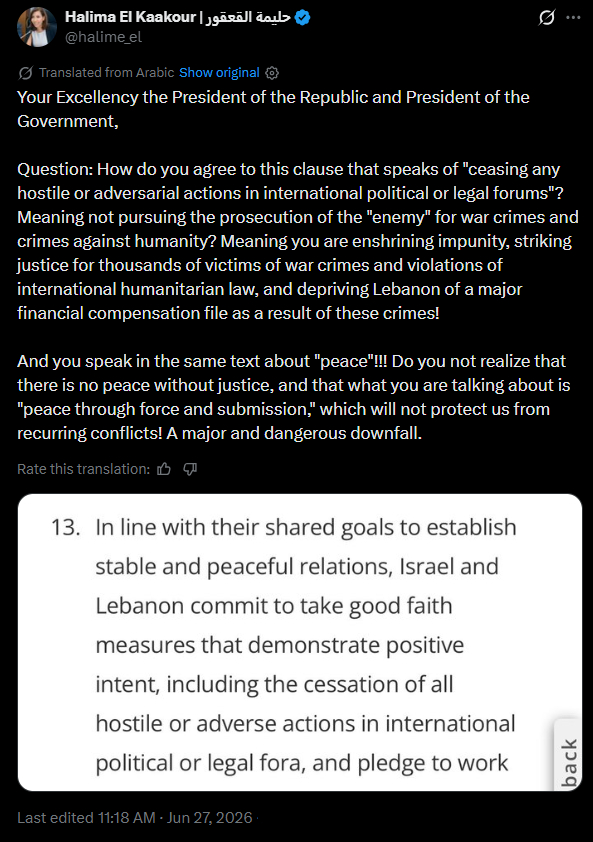
- Lebanese Parliament Speaker Nabih Berri says the trilateral framework agreement between Lebanon, Israel and the US “will not pass” and “will not be implemented” as it does not guarantee Lebanon’s rights.
- Israel kills four Palestinians in Gaza as Syria condemns Israeli incursions into the provinces of Quneitra and Deraa, warning that the continued attacks “risk further escalation and tension across the region”.
|
|
|
Hezbollah says it reserves right to defend Lebanon after Israeli violations
The Lebanese group has accused the Israeli military of breaching the ceasefire in Lebanon by launching several attacks across southern areas on Sunday.
Hezbollah said that Israeli fighter jets targeted residential buildings in the southern city of Nabatieh as well as in the nearby town of Mayfadoun. Among other incidents, an Israeli drone attack was also launched in open areas in the town of Froun and in the Bint Jbeil district, while explosions targeted residential buildings in Taybeh and Haddatha.
“We are monitoring and observing these violations [of the ceasefire agreement] and reserve our right to defend our homeland and people,” the statement added.
The US-Iran memorandum of understanding stipulates that the war should end on all fronts, including in Lebanon, where Israel has been carrying out intensified attacks since early March.
|
|
|
Israel-Lebanon deal ‘does not reflect the justice’ Lebanese people deserve
Some of the harshest critics of the Lebanon-Israel-US framework agreement are those most affected by Israel’s attacks on the country, many of whom say the deal falls short because it does not require the Israeli army to withdraw from the areas it occupies in Lebanon.
Ali Zaytoun, a resident of Dahiyeh, the southern suburbs of Beirut, said he finds it “incredibly difficult” to accept the deal.
“After everything my family, my village, the south, and Dahiyeh have endured – the destruction, the displacement, the grief and the loss – it is incredibly difficult for me to accept an agreement with the same state that carried out the military actions that devastated our communities,” Zaytoun said.
Zaytoun, who runs a popular Instagram account called History of Dahiyeh, told Al Jazeera he had been displaced multiple times due to Israeli attacks.
“Imagine someone destroys your home and your life, and then you’re expected to simply move on as if nothing happened,” he said. “My protest is about remembering those who suffered, standing up for my community, and expressing that this agreement does not reflect the justice or respect that people who lived through this war deserve.”
|
|
|
Has Lebanon recognized Israel?
After months of US-facilitated talks, Israel and Lebanon have signed a framework agreement that the Trump administration says will build “a realistic path out of endless conflict”.
Some critics say the deal effectively amounts to Lebanon recognizing Israel as a state.
But is that correct? In short, no.
In the agreement, Lebanon and Israel do affirm “the right of each state to exist in peace” and declare their intent to “formally conclude any state of war”.
Nevertheless, critics see it as a first step towards normalization.
US Secretary of State Marco Rubio called it “the beginning of the beginning”. But Hezbollah leader Naim Qassem has dismissed it as “null and void”, while Lebanese Parliament Speaker Nabih Berri said it “will not pass” and “will not be implemented” as it does not guarantee the country’s rights.
Lebanon is among several Muslim-majority nations – including Saudi Arabia, Pakistan and Indonesia – that do not recognize Israel.
|
|
While Lebanon and Israel have no formal diplomatic ties, the question of whether Lebanon has recognized Israel involves differing legal interpretations regarding implicit recognition.
Lebanon has not implicitly or explicitly recognized Israel. The two countries have been in a formal state of war since 1948, and Lebanon still upholds the 2002 Arab Peace Initiative, which officially conditions any diplomatic normalization with Israel on the creation of an independent Palestinian state.
While Lebanon signed a US-mediated maritime border agreement with Israel in 2022, the Lebanese government explicitly rejected claims that the deal constituted implicit recognition or normalization, framing it strictly as a technical mechanism to resolve resource disputes.
Similarly, even during US-backed framework talks aimed at establishing security agreements and ceasefires, Lebanese officials have maintained their refusal to engage in direct, normalized bilateral ties without a comprehensive regional peace agreement.
|
Residents return to southwestern Syrian village after Israeli incursion
Calm has returned to the village of Abdeen in the western Deraa countryside a day after Israeli forces entered the area, according to our colleagues on the ground.
Residents who had fled their homes on Sunday began gradually returning by evening after Israeli forces withdrew from Tal al-Maghar hill, where they had been stationed for several hours.
During the night, Israeli forces fired flares over the area and reconnaissance aircraft were observed flying overhead.
Earlier, the Syrian Foreign Ministry said there had been Israeli incursions and artillery shelling in Deraa as well as Quneitra and that the attacks constitute a “flagrant violation of Syria’s sovereignty and territorial integrity”.
The head of Civil Defence operations in the Emergency and Disaster Management Directorate in southern Syria told state news agency SANA that the Israeli attacks had not resulted in any injuries or material damage. However, it caused widespread panic among villagers, leading to a limited displacement to nearby towns.
Civil Defense teams are currently securing the area, he added.
|
|
|
Syrian Civil Defense mobilizes after Israeli helicopter and artillery attacks
Israel’s attacks on the village of Abdeen in the Deraa countryside.
Ahmed al-Hajer, operations commander of the Civil Defense in the Emergency and Disaster Management Directorate in southern Syria, said Israeli forces fired artillery shells and targeted the village and its surroundings with machine guns from a helicopter.
Al-Hajer said the bombardment did not result in casualties or material damage, but caused panic among residents, prompting what he described as “a limited displacement movement to neighboring towns”. Residents have since returned to the village.
The incident is part of a broader pattern of recent Israeli military activity in southern Syria, with Israeli forces conducting repeated strikes and ground incursions into Deraa and Quneitra provinces.
|
|
|
Ex-Lebanese president defends framework agreement with Israel
Michel Suleiman, who served as Lebanon’s president from 2008 to 2014, has defended the agreement with Israel, saying the country must be kept out of military conflicts in “service of foreign interests”.
In a statement carried by Lebanon’s National News Agency, Suleiman said it was “unacceptable” to accept the logic that decisions to launch wars and invite occupation could be taken “unilaterally in service of foreign interests” while efforts to end them required national consensus.
“Those who had the courage to take the decision to proceed with the framework agreement, based on the support of the majority of the Lebanese people, will not lack the same courage to annul this agreement if the other party fails to meet its commitments,” he said.
Suleiman also called for positions on the deal to be based on an objective comparison between what the agreement could achieve and the cost of what he described as “absurd wars” that Lebanon has paid a heavy price for.
|
|
|
Israel attacks what it says are "Hezbollah bases" in southern Lebanon
The Israeli military says it has attacked three "Hezbollah headquarters" in southern Lebanon.
The overnight air strikes targeted Hezbollah facilities in the Nabatieh and Mayfadoun areas, the army said in a statement.
A rocket launcher that Israel said Hezbollah was using to try to target Israeli soldiers was hit in a separate strike on Sunday. “The raids came in response to Hezbollah’s continued targeting of our forces operating in the security zone,” the statement said.
On Saturday, Hezbollah Secretary-General Naim Qassem rejected a “framework agreement” signed between Lebanon and Israel under US sponsorship and called for Israel’s full withdrawal from Lebanese territory in line with the Iranian-US memorandum of understanding.
|
|
|
Ending Israeli ‘aggression’ key to Middle East peace: Turkish official
Numan Kurtulmus, Turkey's parliament speaker, says halting the far-right Israeli government’s expansionist policies would not only allow Palestinians to live in peace but also help stabilize the region.
Speaking at the opening of a NATO summit in Istanbul, Kurtulmus said there can be no lasting Middle East peace without the Palestinian people receiving justice after decades of Israel’s incursions.
“The end of these acts of aggression by the Israeli government would not only allow Palestinians to attain peace and tranquility, but would also mean securing world peace,” he said.
Kurtulmus reiterated Turkey's support for the establishment of an independent and sovereign Palestinian state, with East Jerusalem as its capital, adding “there is no other way forward than a two-state solution.”
He also highlighted the recent Iran-US interim deal. “We hope that they will ultimately lead to a lasting and just peace, not merely a ceasefire but a genuine peace settlement.”
|
|
|
Qatar condemns Israeli incursions in Syria
Qatar condemned an Israeli ground invasion into Syria, describing it as a “flagrant violation” of its sovereignty and international law.
The Israeli army operation included artillery shelling against several areas in Quneitra and Deraa governorates, the Qatari Foreign Ministry said in a statement.
Such attacks only serve to “exacerbate tensions in the region” and undermine efforts towards stability, it said.
The ministry called on the international community to compel Israel to comply with international law.
On Sunday, Israeli forces attacked the village of Abdeen – in the western countryside of Deraa and its surroundings – with artillery fire and helicopter gunships, forcing residents to flee.
|
|
|
Hezbollah slams Israeli army’s ceasefire violations in Lebanon
The Lebanese group says the Israeli army continues to breach the ceasefire in southern Lebanon and it reserves the right to retaliate against these attacks.
Violations include targeting civilian areas in the city of Nabatieh and the town of Mayfadoun with fighter jets and an open area in the town of Froun with drones, it said in a statement.
Homes were also blown up in the towns of Taybeh and Haddatha, the village of Majdal Zoun was targeted, stun grenades were thrown near civilians in the towns of Burj Qalawiyah and Barashit, and suspicious objects were left by soldiers in the towns of Upper Nabatieh and Kfar Tebnit.
The Hezbollah statement said ongoing Israeli attacks constitute a “clear violation” of the Israel-Lebanon agreement.
|
|
|
Egypt minister, Lebanese speaker discuss Israel withdrawal deal
Egyptian Foreign Minister Badr Abdelatty spoke by phone with Parliament Speaker Nabih Berri to discuss the latest developments in Lebanon and Middle East de-escalation efforts.
Abdelatty reiterated Cairo’s support for Lebanese sovereignty, unity, and territorial integrity, and stressed the importance of building on the US-sponsored “framework agreement” to achieve a full Israeli withdrawal from Lebanese territory, Egypt’s Foreign Ministry spokesman Tamim Khalaf said.
Berri expressed appreciation for Egypt’s backing during the current crisis, a statement added.
The call came during deepening divisions in Lebanon over the deal with Israel, which Washington has described as a first step towards ending months of fighting between Israel and Hezbollah.
Hezbollah has rejected the agreement. Berri, who heads the Amal movement and has served as a key intermediary between the government and Hezbollah, has called for calm while criticising the agreement as one-sided.
|
|
|
Gaza Media Office reports 3,465 Israeli ‘ceasefire’ violations
The Israeli military has committed 3,465 “ceasefire” violations since it took effect in October 2025, the Gaza Media Office says.
Since that time, at least 1,045 Palestinians have been killed and 3,380 wounded as a result of ongoing Israeli attacks, it added.
On humanitarian aid access, only 55,539 trucks were allowed by Israel to enter the besieged territory out of 156,000 agreed to under the US-brokered truce.
The Government Media Office condemned Israel’s “systematic policy of extermination” in Gaza and called on mediators to compel Israel to implement all terms of the deal it signed.
|
|
|
Lebanese villagers in Froun wary of ‘pilot zone’ to test Hezbollah
The scale of destruction in Froun is testament to the weeks of destruction and weeks of hostilities in which the Israeli army tried and failed to capture this southern Lebanese town.
Now Israel wants it to be where the agreement that was signed between Israel and Lebanon will be tested. The so-called “pilot zone” where Israel wants the Lebanese army to do what it failed to do – that is to clear the area of Hezbollah’s presence and dismantle its infrastructure.
Now, this town was not occupied and people here say why should the Lebanese authorities give the Israeli army what they failed to capture during the war.
Israel controls up to 6 percent of Lebanese territory. Froun is a strategic location and people here are against this agreement and asking the Lebanese authorities why they agreed to this.
Israel just moments after the agreement was signed, Hezbollah made clear it has no intention to leave southern Lebanon. The defense minister and prime minister instructed the Lebanese army to prepare for a “long stay”.
The Lebanese army has so far been reluctant to confront Hezbollah. Hezbollah has rejected this agreement altogether. It called it “shameful”, it called it “humiliating”, and it said Lebanese authorities will not be able to implement it.
The question here is not whether people trust Hezbollah, it’s that people here do not trust Israel.
|
|
|
Lebanese Sunni groups reject trilateral Washington framework
Two Lebanese Sunni groups have rejected a deal signed in Washington that would link the withdrawal of Israeli forces from Lebanon to the disarmament of Hezbollah calling it a “malicious attempt” to subordinate security to Israeli-American conditions.
The Al-Umma Movement and the Sunni Authority for Supporting the Resistance issued a joint statement after a meeting in Beirut.
It said linking the withdrawal of Israeli troops from occupied territory to the disarmament is “a flagrant violation of all red lines”.
The groups also condemned provisions in the agreement they said grants Israel “a direct role in monitoring the implementation of security commitments and evaluating the performance of the Lebanese army”.
The deal has produced divided reactions inside Lebanon with supporters seeing it as a possible exit from a perpetual state of war, while critics portray it as a surrender to Israeli-American conditions.
|
|
|
Lebanon army chief, US CENTCOM commander meet
General Rodolph Haykal received Admiral Brad Cooper and a military delegation at his office in Yarze town south of Beirut, Lebanon’s state-run National News Agency reports.
The two discussed the latest developments in war-torn Lebanon and the wider Middle East, as well as ways to strengthen future cooperation between the two armies.
Haykal expressed gratitude for US support saying “the necessity of continued cooperation between the two armies in a way that preserves Lebanon’s security and stability”.
The meeting comes as Lebanon moves to implement the trilateral framework agreement signed in Washington last Friday, which sets out a sequenced process for Israeli withdrawal from southern Lebanon tied to the disarmament of Hezbollah.
|
|
|
Lebanon’s president meets CENTCOM commander
Lebanese President Joseph Aoun has hosted Admiral Brad Cooper, commander of the US Central Command, at his official residence in the capital Beirut.
During the meeting, the two men “discussed preparations related to the start of implementing the framework agreement that was approved following the Lebanese-American-Israeli negotiations held in Washington”, according to a statement by Lebanon’s presidency.
Aoun also “thanked Admiral Cooper for the interest shown by US President Donald Trump in helping Lebanon achieve security and stability”, it said.
The president “reaffirmed the Lebanese state’s determination to extend its authority through its armed forces all the way to the internationally recognized southern border”.
Questions remain about the Lebanese military’s ability to disarm Hezbollah and secure the country as demanded by Israel in exchange for its withdrawal.
|
|
|
| |
|
|
| |
|
|
| |
|
|
| |
|
|
| |
|
|
| |
|
|
| |
|
|
| |
|
|
| |
|
|
| |
|
|