| Highlights from yesterday |
|
Comments |
- Iran-backed Houthis in Yemen declare a maritime blockade against Saudi Arabia, threatening to further disrupt global energy supplies.
|
|
|
|
|
|
|
Residents of Yemen’s Sana'a say they don’t want war with Saudi Arabia
The Houthis have declared a naval blockade on Saudi Arabia due to Riyadh’s “unjust and oppressive siege” on Yemen.
The Saudi-led coalition in Yemen has promised to respond to the threat “firmly”.
We’ve been speaking to residents of the Houthi-controlled capital, Sana'a, about the latest developments.
One resident said: “All Yemeni people want to end the Saudi blockade on Yemen in all its forms, to import food items and medicine, and to allow airports to operate again for sick people and other travelers.
“We are neighbours with Saudi Arabia, and we wish them well, but they want war. We are ready for it, but we don’t want war.”
Another man echoed the sentiment.
“We tell Saudi that we are peaceful people, and we don’t want war. End your blockade, and we will end ours. But if you want war, we are for it,” he said.
|
|
|
What does the Houthis’s maritime blockade mean for Saudi Arabia?
For Saudi Arabia, this naval blockade means they will no longer be able to use Bab al-Mandeb to export oil to East Asia.
This will have a tremendous impact on Saudi Arabia’s yearly oil revenue.
It also means that any nation, any shipping company, will not be able to export to Saudi Arabia. If they attempt to export, if they attempt to trade with Saudi Arabia through Bab al-Mandeb, then they will be prevented and turned away at Bab al-Mandeb.
The question now is, however, how will Saudi Arabia decide to respond to the declaration of a naval blockade? Will they engage militarily, or will they perhaps give negotiations a try?
Now, the good news is, there is currently an Ansar Allah Houthi delegation in Oman, and they are engaged in peaceful dialogue with Saudi officials. However, the Ansar Allah Houthi group has made it very clear that if Saudi Arabia decides to engage militarily, then their next set of options will include Saudi Aramco oil facilities as targets.
|
|
|
Houthi supporters back naval blockade of Saudi Arabia
Supporters of Yemen’s Houthis have rallied in the capital, Sanaa, after the group announced a maritime blockade against Saudi Arabia.
In Sanaa’s Sabeen Square, Mujeeb al-Blaihi said the decision was a response to years of Saudi Arabia’s siege on Yemen.
“The decision is wise in response to the Saudi aggression and its blockade. They have blockaded us for 12 years,” he told Reuters. “So we say to them: a blockade for blockade, airports for airports and ports for ports.”
Another Houthi supporter, Abdullah al-Asouli, said the Yemenis had repeatedly called for the reopening of airports and ports.
“After this, the decision of blockade for blockade was taken,” he said, adding that demonstrators supported the Houthi armed forces.
As we’ve been reporting, Saudi Arabia has condemned the Houthis’ decision and denied claims that it has imposed a siege on the Yemeni people. It said it has “worked with the legitimate Yemeni government to alleviate the suffering of the brotherly Yemeni people”, including “continuing development projects, supporting the Yemeni government’s budget, and supplying petroleum products to operate electricity stations”.
It added that during the first half of 2026, the ports of Hodeidah, as-Salif, and Ras Isa in northern Yemen received more than 300 ships carrying food supplies, goods, fuel, and construction materials.
|
|
|
Qatar slams Houthi spokesman’s remarks on Saudi Arabia
Qatar has condemned a statement by the Houthi military spokesman accusing Saudi Arabia of blockading the Yemeni people and preventing maritime navigation after he declared a naval blockade against Saudi Arabia on Monday.
“The Ministry of Foreign Affairs calls on the international community to assume its responsibilities in implementing relevant UN Security Council resolutions, foremost among them Resolution 2216 on Yemen and Resolution 2722 on the rights and freedom of navigation in the Red Sea,” a statement said.
The ministry said freedom of navigation in international waterways is a fundamental principle of international law and expressed Doha’s “full solidarity” with Saudi Arabia “for measures taken to protect its security and sovereignty”.
The announcement of the naval blockade came days after the Houthis, officially known as Ansar Allah, threatened a “siege” on the kingdom in retaliation for an attack on Sanaa International Airport last week.
|
|
|
Yemen’s defense minister says army ‘ready to fight to end the Houthi coup’
Yemeni Defense Minister Taher al-Uqaili says the army of the internationally recognized Yemeni government is ready “to wage the war for freedom”.
In a statement published on the defense ministry’s website, Uqaili expressed the armed forces’ readiness at “the highest level of combat and morale to end the Houthi coup, which has caused so much suffering to our people, and to wage the war for freedom”.
The minister appealed to Yemenis living in Houthi-controlled areas to “protect their children and not throw them into a losing war waged by mercenaries of the Iranian regime”.
Clashes between government forces and Houthis have resumed in some areas of the country.
The Iranian-backed Houthis announced on Sunday that they had begun implementing a “naval blockade” against Saudi Arabia.
The Riyadh government condemned the Houthis’ decision to impose a naval blockade and announced it would take all necessary measures to protect its ships within the framework of international law.
In Yemen, the Iranian-backed Houthis have controlled the capital Sana'a and some other areas of the country since September 2014.
|
|
|
Two tankers carrying Saudi crude make U-turns in Red Sea
Two oil tankers which loaded Saudi crude for China and India made U-turns in the Red Sea and headed towards the Suez Canal following a warning from Yemen’s Houthi militia.
The Houthis on Monday declared a naval blockade against Saudi Arabia, opening a potential new front against the US in its war on Iran and raising the threat to global energy supplies and trade beyond the Gulf.
The group, in an email sent to shipping companies, warned them not to load or discharge cargo at Saudi Arabian ports and said such activity may result in being targeted “in any location”.
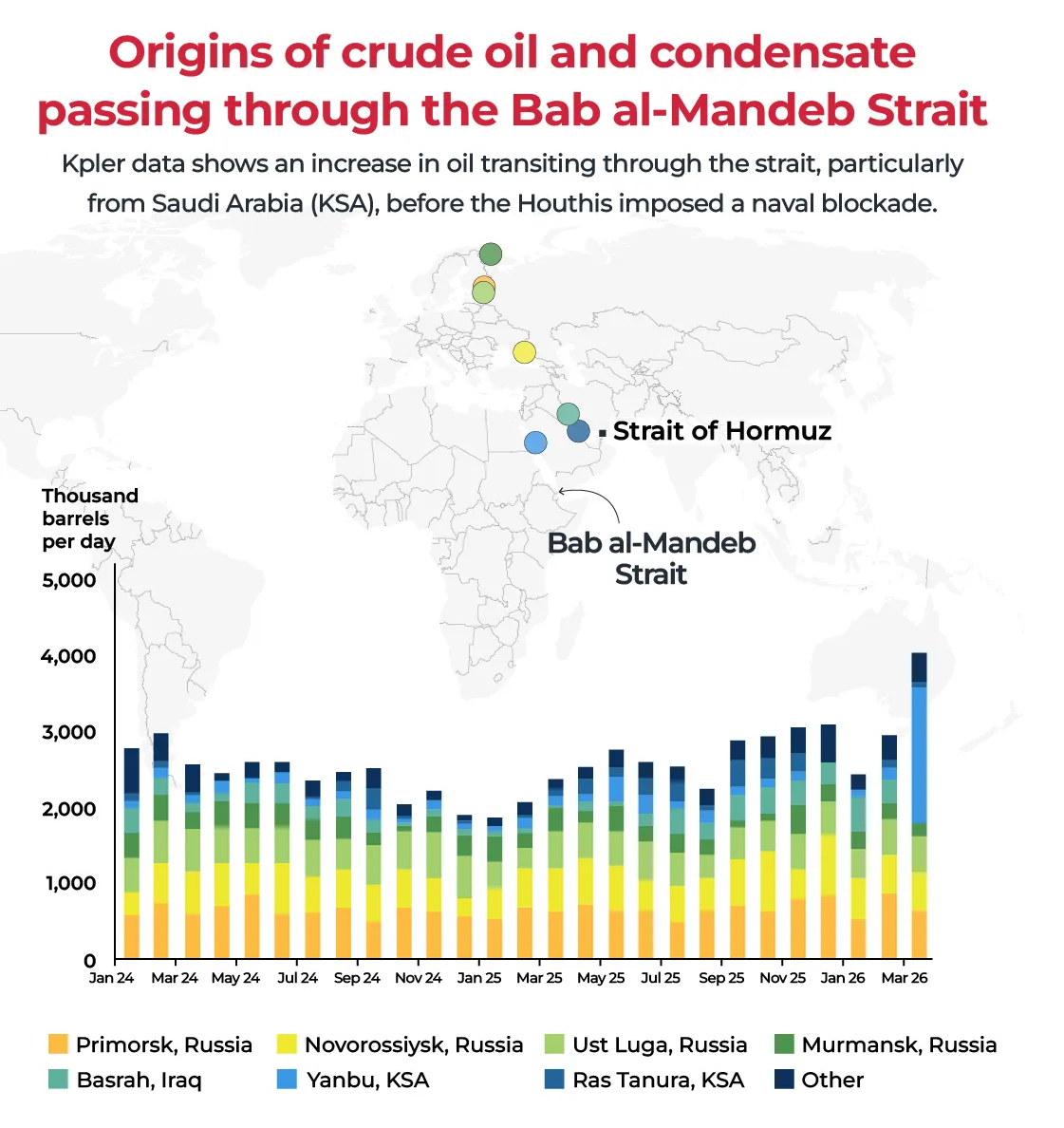
The Houthis control northern Yemen, including the coast of the Bab al-Mandeb, the strait at the mouth of the Red Sea. Saudi Arabia’s Yanbu port on the Red Sea has been the main bypass route for millions of barrels per day of Middle East oil to avoid the blockaded Strait of Hormuz at the mouth of the Gulf.
|
|
|
Email shows Houthis’ warning to shipping companies to avoid Saudi ports
Shipping companies should not load or discharge cargo at Saudi Arabian ports, as such activity may result in being targeted “in any location” by Yemen’s Houthi movement, according to an email sent to companies by the Houthis.
“Vessels are banned from loading or discharging cargo at or from any Saudi ports,” the July 20 email said, which was received by multiple shipping companies.
“We strongly recommend that your company exercise due diligence and the utmost care in all its dealings,” according to the email, which was sent to multiple companies in the industry and seen by Reuters.
“Any such activity would expose the violating vessels to sanctions. Furthermore, they may be subject to targeting in any location within the operational reach of the Yemeni Armed Forces,” according to the email, which was sent by the Houthis’ Sanaa-based Humanitarian Operations Coordination Center.
The Iranian-backed Houthis announced on Sunday they began implementing a “naval blockade” against Saudi Arabia.
The Riyadh government condemned the Houthis’ decision to impose a naval blockade and announced it would take all necessary measures to protect its ships within the framework of international law.
In Yemen, the Houthis have controlled the capital Sanaa and some other areas of the country since September 2014.
|
|
|
Saudi condemns Houthi blockade: How will the rest of the world be impacted?
Saudi Arabia yesterday condemned allegations by Yemen’s Iran-aligned Houthis that Riyadh was imposing a siege on the Yemeni people, after the group announced it would impose a maritime blockade on Saudi Arabia.
Amid the disruption in shipping through the Strait of Hormuz during the US-Israel war on Iran, Saudi Arabia was attempting to facilitate oil flow through alternative routes through the Red Sea and the Bab al-Mandeb Strait. Now that route is under threat from the Houthis.
The Saudi Foreign Ministry said in a statement that it would take “all necessary measures” to protect its ships.
The Houthis have a track record of disrupting shipping traffic in the Red Sea.
|
|
|
US unwilling to cede influence to Iran in the Middle East
Cyrus Schayegh from the Geneva Graduate Institute says the Houthi threat to attack Saudi oil exports in the Red Sea is an “alignment” with Iran’s strikes on the Strait of Hormuz.
“This is an escalation in the sense that we now have a new space, the Red Sea, that is part of the war. But at the same point in time it is a very particular non-military escalation – that is it is non-kinetic right now at this particular moment,” he said.
“What’s the conclusion here? I’d say that the Iranians want to signal they can get the Houthis to basically move on and escalate, but they’re careful in the way in which they do so.”
Schayegh said the “fundamental problem” is the US has been heavily involved in the Middle East since 1980 and wants to continue its influence.
“This region is key for United States and for Iran to play somewhat of a bigger role is, I think, extremely problematic and difficult for the Americans practically speaking.”
|
|
 |
| |
|
|