| Highlights from yesterday |
|
Comments |
- The US bombs Iran for an eighth consecutive night, with CENTCOM saying the strikes are partly in response to the killing of two American soldiers in an Iranian attack in Jordan.
- US President Donald Trump says the deaths were “a very sad thing”, adding that “we’re never allowing Iran to have a nuclear weapon”.
- Iran’s Supreme Leader Mojtaba Khamenei says Trump’s signature is “worthless and invalid”, accusing the US of repeatedly breaching the memorandum of understanding (MoU) signed last month.
- Kuwait says an Iranian air strike hit a facility of its state-owned oil company after earlier accusing Tehran of hitting a second power and water desalination plant this week.
|
|
|
US bombs Iran for an eighth consecutive night
It’s turning into yet another night of escalation as American air strikes continue to target Iran’s southern coast.
At this point, the strikes are less intense compared to the past two to three nights there where attacks targeting civilian infrastructure, military sites and other places across Iran’s southern coast.
According to the latest reports, roars of fighter jets have been heard over the skies of Kish Island, and there are reports of sounds of explosions in the city of Sirik, which is an important geostrategic location because it oversees the Strait of Hormuz. And there are reports about explosions in Bandar Abbas. This is the most important port city of the country, and over the past two to three nights, it has witnessed some of the heaviest bombardment by the Americans.
At this time, the situation seems to be quite fragile, and we are closely following to see whether there are going to be sustained attacks or it’s going to be less intense.
|
|
|
US says latest strikes on Iran are punishment for soldiers' deaths
According to the US Central Command (CENTCOM), this is a new wave of air strikes that began as “swift punishment” for the killing of those two US servicemen in Jordan, which happened on Friday.
President Trump said he authorised the strikes.
As to what they’re targeting, CENTCOM said it’s to “further degrade Iran’s ability to threaten commercial shipping in the Strait of Hormuz”, but the president days earlier had also threatened to bomb all of Iran’s bridges and all of its power plants.
CENTCOM has taken credit for striking logistics, weapons storage, and other military targets, but it has not said that it bombed bridges or desalination plants as some reports have indicated.
We’re still seeking clarity on that, and of course this is now the eighth consecutive day that the US is bombing Iran in this dramatic escalation, which has now taken the lives of two additional US service members, bringing the total US military death toll of this conflict to 16.
|
|
What does international law say when a war belligerent resorts to what it calls "swift punishment"?
Under international law, revenge or retaliation is strictly prohibited in armed conflict. While a belligerent may resort to a specific "belligerent reprisal" (an otherwise illegal act in response to an adversary's violation), this is only legal if the sole aim is to force the enemy to comply with the law.
"..in response to an adversary's violation"
This is not the issue because Jordan is a co-belligerent as it assist in the US preparedness in the war on Iran. It has US E-2D Hawkeye's, Boeing E-3 Sentry "flying radars" and Boeing fuel tankers stationed.
So, what does international law say when Iran attacked neighboring countries, the United States is using to attack Iran?
Under international law, the United Nations Charter prohibits the use of military force across borders. That is the issue here because Trump attacks Iran from another continent, not those of the Americas. Lawful military action is only permitted ..in this case .. if authorized by the UN Security Council.
|
US forces target location near Qeshm
The Mehr news agency is reporting that a location near Iran’s Qeshm Island was targeted in a US military attack.
It said there were no civilian casualties or damage to residential or commercial infrastructure.
|
|
|
Iran names two girls killed in US strikes on southern Iran
Two Iranian girls – Sogand Dardmand and Fatemeh Zahra Akbari – were among seven civilians killed in a US air strike on a bridge in Bandar Khamir in southern Iran, the Iranian embassy in India says via a post on X.
The bridge was hit late on Thursday when US forces launched attacks across southern Iran.
Iranian authorities say at least 50 people have been killed and more than 500 have been wounded in the US air attacks.
|
|
We replied to the Iranian embassy in India:
Any embassy of Iran should not distribute such message because the geographic location of the embassy doesn't make the content in the post credible.
Such posts are supposed to be published by any but relevant institution from inside the country of Iran, not any country abroad.
|
Explosions heard in Iran’s Bandar Abbas and Qeshm Island
Several explosions have been heard in the southern Iranian port city of Bandar Abbas and on nearby Qeshm Island, according to Iranian media.
The official IRNA news agency reported that several explosions were heard in parts of Bandar Abbas, and that authorities were investigating on the ground. The semi-official Tasnim news agency cited provincial officials as saying that audible blasts had been heard in Bandar Abbas, but that they had yet to receive any reports of missile impacts or attacks by US fighter jets.
Tasnim also reported that explosions were heard at around 3:38am local time (00:08 GMT) in multiple locations across Qeshm Island. Residents said several locations on the island had been hit, with some putting the number of impacts between three and five, the agency reported.
Both Bandar Abbas and Qeshm Island have been subjected to repeated US air attacks in recent days.
|
|
|
Former Trump allies slam ‘senseless war’ on Iran
Former US Congresswoman Marjorie Taylor Greene and former director of the US National Counterterrorism Center Joe Kent have criticized Trump’s war on Iran, with the latter calling for American forces to be withdrawn from the Middle East.
Greene accused the Trump administration of using the deaths of two American service members in Jordan to justify further escalation. She was responding to Defense Secretary Pete Hegseth, who described the soldiers as “heroes” whose “sacrifice only stiffens our resolve”.
In a post on X, Greene said the soldiers had not willingly sacrificed themselves but had been killed in a war being waged “on behalf of a foreign country, Israel”.
“You mean their deaths fuel your bloodlust for a senseless war,” she wrote on X.
Kent separately argued that US air attacks were failing and warned that a ground campaign would cause heavy American casualties and further destabilize the region.
He said the killing of Iran’s former Supreme Leader Ali Khamenei had “backfired” by rallying Iranians behind the government and the Islamic Revolutionary Guard Corps (IRGC).
Kent called for US troops, bases and naval forces to be removed from the region, describing them as liabilities. He said Washington should instead offer sanctions relief in exchange for guarantees protecting navigation through the Strait of Hormuz.
|
|
|
At least six missiles hit outskirts of Qeshm
The Tasnim news agency is reporting that at least six missiles have struck areas on the outskirts of Qeshm Island.
Citing its correspondent on the island, Tasnim said security officials and relevant authorities have not yet made any statements on the incident. It added that no information has been released about the extent of potential damage or casualties.
|
|
|
US public likely to hold Trump responsible for soldiers’ deaths ‘in equal measure to Iran’
David Des Roches, a professor at the Thayer Marshall Institute, about how the Pentagon determines an appropriate response when US soldiers are killed:
“It sounds like a cop-out, but it really is situationally dependent,” Des Roches said. “The situation depends on what means we have, how close we think we are to resolving an issue, whether it could be dealt with through negotiations and, quite frankly, what the domestic political mood is.”
Des Roches, a former Pentagon director of Arabian Peninsula affairs, said the American public was likely to hold Trump responsible for Iran’s killing of the two US soldiers in Jordan.
“Because President Trump didn’t really lay the groundwork domestically or make a case for this war before it started, I think that people will hold Trump responsible for this in equal measure to Iran,” he said.
“The president’s supporters certainly will want to see something taken against Iran,” he added, saying there remains a military argument to “establish deterrence so that this doesn’t happen again”.
|
|
"... or make a case for this war before it started, ..."
Trump was promised by Netanyahu that the war on Iran, which is the resumption of his preemptive 12-day war on Iran from June 2025, would bring the Iranian regime to a collapse. That was before Trump declared war on Iran, as Netanyahu couldn't issue a declaration because the Israelis never lifted their declaration of war since the six-day war of 1967. So, Trump was lured in that resumption by Netanyahu. That's where the narrative "regime change" has its roots.
The war, the way as it unfolded on February 28th until April, known as the 40-day war, is NOT Trump's war but solely those of Netanyahu.
Consecutive developments as emerged after April have made the war look like as taken over by Trump as we see the Israelis no longer participating in the war on Iran.
So, the war pretends to look like as if it is Trump's war. It never was.
|
Gulf nations denounce Iran’s attacks
There have been various statements from countries in the region as well as the Gulf Cooperation Council (GCC). Some of those statements were strongly worded. The head of the GCC, Jasem Mohamed Albudaiwi, even went so far as to accuse Iran of carrying out war crimes following the strikes on Kuwait’s power and desalination plants.
In Saudi Arabia, the Foreign Ministry condemned the strikes and demanded an immediate end to the military escalation in the region. And here in Qatar, the Foreign Ministry called those strikes “dangerous escalations” and said they complicate efforts to contain tensions.
But throughout the conflict, Iran has been saying its air strikes and drone attacks do not target civilian infrastructure. They say the only targets they have hit are US personnel and military infrastructure in the region.
Separately, the GCC and EU have issued a joint statement calling Iran’s closure of the Strait of Hormuz unlawful and rejecting claims of sovereignty or control of the strait by any state.
Why do they say that? The GCC countries depend on the strait for the export of oil and gas, while for the EU, about 10 percent of its oil supply comes from the region, most of it passing through that waterway.
For Iran, the strait has been a sticking point in the negotiations with the US. They want ships transiting the strait to get pre-approval and also to pay fees. They say those charges will pay for the damage done by the US and Israel’s strikes.
|
|
|
With Trump’s decision-making, ‘presidential psychology is more important than political costs’
Ross Harrison, an analyst with the Middle East Institute in Washington, DC, says Trump ran on ending “forever wars” and “stupid wars” in the Middle East, yet is now engaged in a war that “seems to lack any real strategic logic”.
“One of the questions we struggle with here in the United States is whether political logic actually weighs upon this administration,” he said.
During Trump’s first term, “we did see that they were watching the poll numbers, they were watching the stock market”, he said. “But the question here is: Do more casualties actually impact the decisional calculus on the part of the president? That’s unclear at this point.”
Harrison suggested Trump may now be driven more by how he sees himself in historical terms than by conventional political pressures like midterms or economic fallout.
“What’s concerning is that presidential psychology is more important than the political costs,” he said. “Some of the questions we would ask of a regular president – how midterms or the economy would weigh on decision-making – may be detached at this point. And that’s what makes this conflict particularly dangerous.”
|
|
“What’s concerning is that presidential psychology is more important ...”
In plain words?
Egocentric as found in the two books written by his niece Mary L. Trump, which reveal her uncle's characters of personality.
All authoritarian rulers, dictators and tyrants have the habit to put themselves at the center.
|
What to expect after the US reimposes naval blockade on Iran’s ports
The United States has reinforced its naval blockade on Iran’s southern ports, amid the escalating military confrontation between them.
The US blockade on Iran was first imposed in mid-April and remained for over nine weeks. It was only lifted after the two sides signed a memorandum of understanding (MoU) in June to end four months of fighting and reopen the Strait of Hormuz.
Iran immediately began exporting tens of millions of barrels of crude oil, much of it stored on supertankers anchored close to its oil terminals. However, after the recent resurgence in military strikes over control of the Strait of Hormuz, Washington rescinded oil and banking waivers issued as part of the MoU and prevented vessels linked to Iran from returning to port to load more Iranian oil.
Since the MoU effectively fell apart due to recent strikes, US Central Command (CENTCOM) has redirected several ships operating in the Strait of Hormuz. It also launched a strike to disable the Curacao-flagged supertanker Belma, which had allegedly been transporting Iranian crude during the war.
|
|
"Curacao-flagged supertanker Belma"
The Caribbean island Curacao, which is part of the Netherlands, does not have an commercial fleet nor has it foreign merchant vessels registered.
We believe that the US attacked a shadow fleet ship.
|
Iran claims drone attacks on two ‘US bases’ in Kuwait
Iran’s army says it has launched a large-scale drone attack on two “US military facilities” in Kuwait.
In a statement carried by the IRIB state broadcaster, the army said its “destructive drones” hit an ammunition depot at Camp Al Adiri as well as Patriot and air-defense radars at Ali Al Salem airbase.
|
|
|
US forces hits location near Shadegan in southwestern Iran
US fighter jets have struck a location near the city of Shadegan in Iran’s southwestern Khuzestan province, the Tasnim news agency reported, citing the province’s deputy governor for security.
The official said emergency teams were at the scene and would provide further information about the situation and the extent of any damage later.
|
|
|
US urges Americans abroad to exercise caution
The US State Department is urging Americans travelling anywhere in the world to exercise increased caution because of heightened tensions in the Middle East and the possibility of what it described as “unforeseen escalation”.
That warning was issued before the latest US air strikes against Iran, and the feared escalation has since materialized.
The developments are also showing how a war that may appear distant to many Americans at home is directly affecting them. The economic impact is already being felt through higher fuel prices, while American service members have also been killed in the conflict.
Those latest military deaths have further increased the number of US personnel killed since the fighting began.
|
|
".. travelling anywhere in the world .."
The US State Department resorts to the same politics the Israelis practicing, when they caught themselves in paranoia over a threat they have created themselves.
The warning also hallmarks the character of fear mongering, and fuels the suggestion as if Iran wants to spread the once Netanyahu's war globally.
Americans traveling wherever in the world should not fear, as the world only feels the now Trump-led war economically.
|
New US strikes reported on Qeshm Island
US fighter jets have carried out another round of attacks on Iran’s Qeshm Island, according to the Tasnim news agency.
It said at least two explosions were heard on the island, and that emergency, security and operational teams have been deployed to identify the locations hit and assess any casualties or damage.
|
|
|
Top Iranian commander warns US of ‘devastating response’ to aggression
Major-General Ali Abdullahi, the commander of Iran’s Khatam al-Anbiya Central Headquarters, has warned the US, saying “any aggression or barbarism will be met with a decisive and devastating response” from the country’s armed forces.
In a statement carried by Iranian state media, Abdullahi described the US as “the Great Satan” as well as “the criminal, treacherous and deceitful enemy”.
He pledged to strengthen unity between the armed forces, the Iranian public and officials and pledged to “impose heavier costs” on the US than in the previous wars.
“The enemy, following successive defeats in the military conflict, has taken comfort in creating division and discord between the people and their leaders,” Abdullahi said.
“Our dear country’s defensive power is a solid foundation for the peace and security of the proud and courageous nation from south to north and from east to west of the glorious and vast Iranian land,” he added.
|
|
|
Earthquake strikes Iran’s Khuzestan province
A magnitude 5.0 earthquake has struck the Saland area of the southwestern Khuzestan province at a depth of about 12 kilometres (7.5 miles), the IRIB state broadcaster reported, citing the Iranian Red Crescent Society.
It said two rescue teams have been sent to villages near the epicentre to assess possible damage.
|
|
|
Iran’s Khuzestan puts emergency services on alert after earthquake
Khuzestan Governor Seyed Mohammad Reza Mowlaizadeh says he has issued the “necessary instructions for the full mobilization of rescue and operational forces” after a magnitude 5 earthquake struck the southwestern province this morning.
The IRIB state broadcaster reported earlier that the earthquake struck at a depth of about 12km (7.5 miles).
Mowlaizadeh said assessment teams have been rapidly deployed, and a field assessment of the situation in earthquake-affected regions is ongoing. He added: “No casualties or significant financial damage have been reported so far, and all relevant executive bodies are on full alert.”
|
|
|
US extending attacks inland ‘to try and isolate Iran’s coast’
David Des Roches on the US military strategy in the war on Iran:
The former Pentagon official said the US offensive had evolved since the first phase of the war, when strikes were “designed to decapitate the leadership and degrade Iran’s ability to launch volleys of ballistic missiles”.
Those strikes meant Iran “hasn’t been able to launch volleys of missiles and overwhelm defenses”, he said, though noting that it has “been able to launch individual or maybe two or three missiles at once, which are generally intercepted”.
The renewed US bombardment – following Iranian attacks on tankers in the Strait of Hormuz – have been “directed against maritime observation, and launching facilities”, he said, such as the towers in Chabahar, “which Iran had been using civilian navigation systems to locate targets”.
In recent days, however, the campaign has pushed further inland. “We saw the targets extend inland to try to isolate the coast, so that Iran would be unable to reinforce it with missiles, troops, drones,” Des Roches said, adding that he expected the next phase to focus on “national leadership, national military facilities and dual-use infrastructure within the Iranian interior”.
He warned, though, that air power alone has clear limits as a tool for achieving strategic objectives.
“What we find is that it never performs as advertised, or very rarely,” he said.
|
|
|
US military says eighth night of strikes against Iran now over
The Central Command says it has completed the eighth consecutive night of strikes against Iran, at the commander-in-chief’s direction.
|
|
|
US military claims attacks on IRGC forces involved in deadly Jordan strikes
It said that during the latest round of attacks, its forces “successfully hit Iranian military coastal surveillance and air defense facilities, maritime capabilities, and missile and drone storage sites”.
It added that “American military assets also targeted Islamic Revolutionary Guard Corps forces that launched attacks against US service members in Jordan on July 17”.
As we’ve been reporting, at least two US service members were killed in the attacks on Jordan, while another remains missing.
|
|
".. attacks on IRGC forces involved in deadly Jordan strikes."
The justification as given by CENTCOM is exactly the way the Israelis defend their retaliation, which are also war crimes.
Whatever CENTCOM is claiming to defend itself, their "swift punishment" remains the following:
Under international law, revenge or retaliation is strictly prohibited in armed conflict.
|
Plumes of smoke rise over Kuwait after repeated Iranian attacks
Towering plumes of smoke rose over Kuwait after Iranian strikes hit multiple locations in Mangaf on Saturday.
Kuwaiti authorities said the attacks targeted a power generation and water desalination plant and have asked citizens to conserve power when possible.
|
|
|
Resident says demand for water has increased in Kuwait
Kuwait has accused Iran of attacking a power and water plant in the country for the second time on Saturday.
One Kuwaiti resident told AFP there were fears that basic goods might become unavailable if the escalation continues.
“The demand for water and canned goods has increased since this morning amid fears that services or supply chains will be affected,” Hassan Rayan, 61, told AFP.
Resident Ali Mahmoud, 46, told the agency that “the streets and beaches were almost empty, even though it is a holiday”.
|
|
Kuwait should finger point at its main ally the US first, as Iran responded likewise after US bombardments on Iran's desalination plants and water storages.
|
Retaliatory Iranian attacks limited to one country overnight
In the past three days, this was the least intense night in Iran, so the list of targets, compared to the previous days, is shorter.
So Qeshm Island has been hit, and then several cities in Hormozgan and Khuzestan provinces were also hit, but we do not know what was targeted. These include Hajiabad, Shadegan and Sirik.
The sounds of fighter jets were heard in Kish Island, but no explosions were reported. And this is perhaps why Iranian retaliation was relatively limited to only one country, Kuwait.
Iranians say their attacks are an answer, a reaction to American aggression, and that they are keeping it proportionate. However, military officials here are still warning of attacks.
Just a little while ago, the commander of the Khatam al-Anbiya Central Headquarters, Ali Abdollahi, released a statement, saying they are going to follow the orders of the supreme leader and will impose costs on the enemy that are heavier than the past.
|
|
Iran responded likewise but it remains also a war violation
|
Kuwait says it is intercepting Iranian missiles, drones
The General Staff of the Kuwaiti military says its air defenses are “confronting hostile missile and drone attacks” after “sinful Iranian aggression”.
It said on X that “any explosions heard are a result of air defense systems intercepting hostile attacks”.
The alert comes hours after Iran’s army claimed a large-scale drone attack on an ammunition depot at Camp Buehring, formerly known as Camp Udairi, and air defense radar systems at Ali Al Salem Air Base.
|
|
|
US ‘trying to isolate’ southern Iran from rest of the country
The US attacks have been tremendously affecting the ordinary lives of Iranians living in the south of the country in particular.
Several bridges have been hit, in addition to railways, tunnels, airports and roads.
We have also seen some hospitals being evacuated and exams at schools being postponed.
The destruction of civilian infrastructure is significantly limiting the movement of people, goods and logistical supplies.
The US is trying to degrade the IRGC’s capacity, but these infrastructures are also used by civilians. Americans are trying to isolate the south of the country from the rest of Iran.
On the other hand, the IRGC says it will not give up the Strait of Hormuz. They believe the reason the US is focusing on these provinces along the waterway is to ensure that the IRGC does not control it.
|
|
|
Attacks on desalination plants could disrupt water supplies in the Gulf
Kuwait has accused Iranian forces of targeting a water plant in the country for the second time. Such strikes are a concern in the Gulf as water in the region is scarce due to the arid climate and irregular rainfall.
Countries in the Gulf also have very limited natural freshwater resources.
Groundwater, together with desalinated water, accounts for about 90 percent of the region’s main water resources, according to a 2020 report by the Gulf Research Center. In recent years, as groundwater has begun to deteriorate as a result of climate change, Gulf countries have begun relying heavily on energy-intensive seawater desalination to meet their water needs.
More than 400 desalination plants are located on the Gulf’s shores from the United Arab Emirates to Kuwait, providing water to one of the most water-scarce regions in the world. According to a 2023 research paper published by the Arab Center Washington DC, the six member states of the Gulf Cooperation Council account for about 60 percent of global water desalination capacity, producing almost 40 percent of the total desalinated water in the world.
About 42 percent of the UAE’s drinking water comes from desalination plants while that figure is 90 percent in Kuwait, 86 percent in Oman and 70 percent in Saudi Arabia. Saudi Arabia produces more desalinated water than any other country.
Iran also uses desalination plants, which have been installed in coastal areas, such as Qeshm Island in the Gulf. But Iran also has many rivers and dams and is not as reliant on desalination plants as other countries in the Gulf region.
|
|
If the US didn't start attacking Iran's water supply, the Gulf states as co-belligerent of the US, wouldn't have to face likewise response from Iran.
|
Trump ‘caught in escalation trap’ in Iran
Ross Harrison, senior fellow at the Middle East Institute, said the US president is caught in an “escalation trap” in which he appears to be intent on inflicting increasing pain on Iran but without achieving his broader aims.
“You have a president who entered a war on a sort of faulty strategic logic, [and] he is caught in some ways in what we call an escalation trap, where he can escalate tonight, tomorrow night – as he has for the last seven nights – and inflict pain and retribution, payback for the Iranians,” Harrison said.
“But military means should only be used to achieve some kind of political outcome. And if the political outcome desired is to get the Iranians to capitulate and give up the leverage they have tried to build or rebuild since the beginning of this war, it’s not going to work,” he said.
He argued that Trump faces a bind either way. “If he escalates further in retribution against these deaths [the killings of US soldiers in Jordan], it’ll inflict pain, but it’s not going to change [Iran’s position]. In fact, it may even harden the Iranians’ fortitude. And if he de-escalates, he is seen as being weak and succumbing to pressure from the Iranians.”
Trump, Harrison added, “seems not to have the kind of strategic capacity that would normally be used to get out of this situation”.
|
|
|
Gulf condemnation of Iran as civilian targets attacked in Kuwait
It’s an active and fluid situation at the moment. There has been a statement from the Kuwaiti army saying if the population hears any loud explosions, these are going to be interceptions above.
This, in a sense, is a reassurance to the general population that they are getting it under control, that they do have their layers of defense.
There has been a flurry of condemnation against Iran, specifically over the past two days, with Kuwait’s electricity, desalination plants, and oil facilities having been hit, causing large fires.
There’ve been a number of injuries, including firefighters and civilians, specifically in one oil depot. Qatar has said if you’re going to hit civilian infrastructure, this has crossed all red lines.
Iran, meanwhile, has continued to say it is only aiming at US assets and bases across the region.
|
|
|
IRGC claims interception of MQ9 drone
Iran’s Revolutionary Guard says it intercepted and destroyed a US MQ9 drone in Ahvaz, a city in the eastern Khuzestan region that borders Iraq.
An MQ-9 is a large, remotely piloted unmanned aerial vehicle designed primarily for intelligence, surveillance, reconnaissance, and air strikes, according to a description by the US Air Force.
The US said it completed an eighth straight night of attacks against Iran after earlier announcing two American soldiers were killed in Jordan and another is missing following an Iranian attack.
|
|
|
Sirens ring out throughout Bahrain
Warning sirens are sounding in Bahrain as Iran continues to strike its Gulf neighbors with missiles and drones.
“The siren has been sounded. Citizens and residents are urged to remain calm and head to the nearest safe place,” the Interior Ministry said in a statement.
The US and Iran have intensified attacks since an interim agreement signed a month ago fell apart last week, raising the possibility of a return to all-out war.
|
|
|
Iran leaders ‘fighting for their lives’; US fighting ‘over policy choices’
When it comes to commitment to winning the war, Iran has the “upper hand” as the US isn’t facing a threat to its survival, an analyst says.
“Right now you’re looking at an unpopular and increasingly costly war, and this historically has meant pressure for the United States to get out of that war,” said Paul Musgrave from Georgetown University in Qatar.
He said “severe criticism” is mounting not only from the Democratic Party but also from the right of the political spectrum.
“Since February, the asymmetry on how interests have been conducted has been clear: the regime in Tehran is fighting an existential war. The United States and Israel are fighting a war over policy choices,” said Musgrave.
“That means that the Iranians are always going to have the upper hand when it comes to who is more credibly committed to the fight. They’re not going to back off because the price of oil goes up $10 a barrel. They’re in this for their lives, literally their lives.”
|
|
|
Trump says he ‘couldn’t care less’ about Iran’s interim deal withdrawal
The US president has given a brief phone interview to the US cable network NewsNation.
Asked about Tehran’s announcement that it’s no longer abiding by the US-Iran memorandum of understanding (MoU) signed last month, Trump said, “I couldn’t care less.”
He repeated the war’s primary objective is “never allowing Iran to have a nuclear weapon”.
The MoU was signed between Washington and Tehran in mid-June with the aim of ending the war launched by the US and Israel in February.
The latest exchange of deadly attacks kicked off because of disagreements over the management of the Strait of Hormuz.
|
|
".. the war’s primary objective is “never allowing Iran to have a nuclear weapon”
This is a admission of having a nuclear political motive, not a military one. Trump's motive violates the UN Charter as it infringes Iran's sovereignty and is there one of the two explanations stating that the war on Iran is illegal. The other one is having no approval or mandate from the UN Security Council.
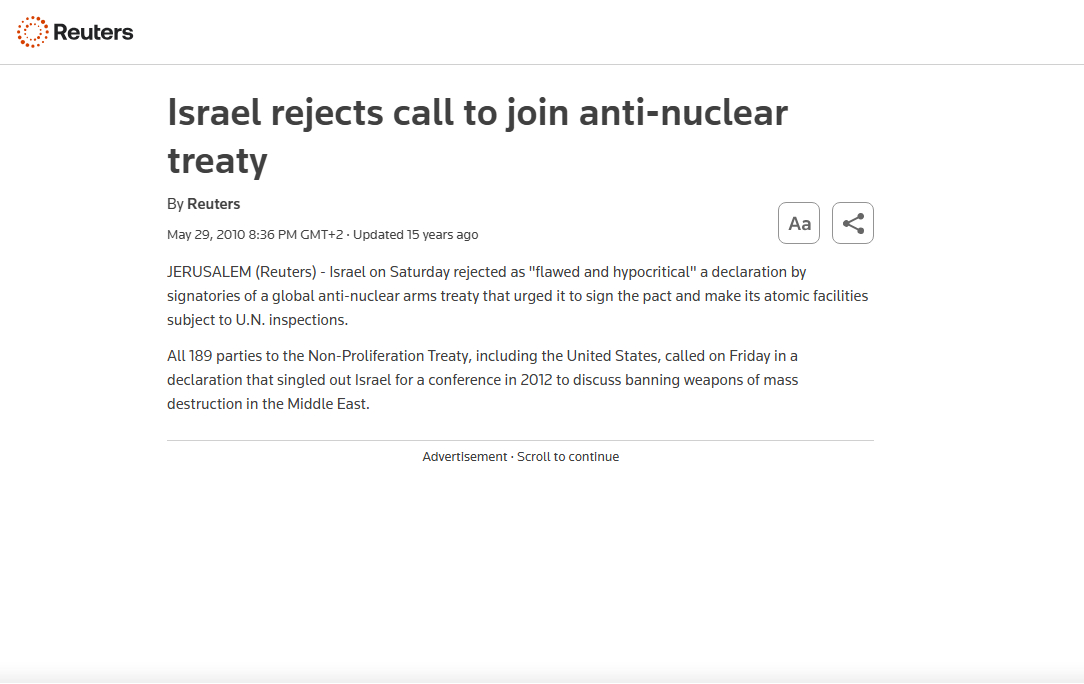
But, the US invented the nuclear militarization in 1942 and caused with this development the rise of nuclear powers in the world, including those who stole it from them to become a nuclear power in 1967.
The US has been backing the thieves as the only nuclear power in the Middle East at least since 2010 when the thieves began to target Iran with sabotage, assassinations, and cyber attacks.
The world refuses to be aware that the war on Iran has to do with scapegoating despite all the evidence which began to emerge thanks to Netanyahu's own doing when he jeopardized the peace talks with the Palestinians in April 2014.
The world now pays the price by facing the economical consequences of this war, which is just part of a nuclear rivalry against Iran since 2010, inflicted by the thieves themselves.
|
More on the MQ-9 drone after Iran announces shootdown
Iran’s Revolutionary Guard is saying it shot down a MQ-9 drone.
Over the past eight days the Iranians claimed they downed four MQ-9 Reaper drones. These aircraft are used both for surveillance and attacks. Throughout the US-Israeli war Iran said it downed more than 150 different types of drones, and roughly 30 were MQ-9s.
Qassem Soleimani, the slain commander of the Guard’s Quds Force, was assassinated by MQ-9 near Baghdad airport in January 2020.
The MQ-9 has become one of the most recognizable military unmanned aerial vehicles because it allows operators to monitor targets for many hours, conduct surveillance over large areas, and strike targets with precision without risking a pilot in the aircraft.
|
|
|
Trump to face many questions from Americans over war on Iran
Whenever Americans die, it raises the stakes politically, but this is an unpopular war here in this country.
What this administration has been able to benefit from is, because it is so distant, it isn’t top of mind for Americans as they battle so many issues, primarily the cost of living right now.
But when Americans die, it really brings it close to home and highlights the many reasons why many Americans do not want this level of involvement in the Middle East.
President Trump, when he ran in 2024, pledged to end “the endless wars”, and so this is in direct opposition to what he campaigned on.
So that is why we see such widespread frustration, even among some of his supporters. No doubt President Trump and his administration will have to answer many questions in the coming weeks.
|
|
|
‘Treacherous’ Iran attacks blunted by air defense systems: Bahrain
Bahrain’s military says it thwarted missile-and-drone attacks launched from Iran.
“With unwavering resolve and high combat readiness, the Bahrain Defense Force’s air defense systems intercepted and destroyed several treacherous Iranian aerial attacks on Sunday,” it said in a statement.
“The General Command urges everyone to exercise caution and avoid approaching any unidentified or suspicious objects resulting from the remnants of the brutal Iranian aggression and to report them immediately.”
It added, “The deliberate use of missiles and drones to target civilians and private property constitutes a flagrant violation of international humanitarian law.”
|
|
|
US embassy in Jordan ‘strongly advises’ citizens not to go to airport or seaport
A statement released on social media says Jordanian authorities evacuated the international airport and seaport in Aqaba because of “a specific and credible threat”.
“We strongly advise all Americans to refrain traveling to either the airport or seaport. Continue to follow all Jordanian authorities’ security directives,” it said.
“US Embassy Amman continues to advise all Americans to avoid travel to military bases in Jordan.”
The US said earlier it completed an eighth straight night of attacks against Iran after announcing two military personnel were killed in Jordan and another is missing following an Iranian attack.
|
|
|
Jordan says no evacuation orders for Aqaba airport or seaport
Jordan says no threats have been reported after the US embassy warned Americans not to go to the airport or seaport in the coastal city of Aqaba.
State media quoted government spokesperson Mohammad al-Momani as saying the airport and the seaport in Aqaba are operating normally. Jordanian authorities “have not issued any evacuation orders” at those two sites, he said.
“No potential threats have been recorded by the relevant Jordanian authorities in the past few hours,” said al-Momani.
The US embassy in Amman earlier released a statement warning US citizens to stay away from the airport and seaport because of “a specific and credible threat”.
|
|
|
Iran says vessels involved ‘accident’ in Hormuz as it blocks the strait
Iran’s Revolutionary Guard navy says two ships attempting to leave the Strait of Hormuz via what it described an “unsafe route” were involved in “accidents” and stopped, while two others refused to continue along the route.
It did not specify what the accidents involved.
The IRGC claimed the vessels disabled their navigation systems and ignored warnings. Ships carrying oil, gas, or fertilizer must obtain permission and use its designated passage, it added, warning vessels entering other routes risk “accidents”.
Since the signing of a memorandum of understanding with Washington in mid-June, Tehran has maintained it has authority over the narrow waterway, a vital chokepoint for global energy exports.
Iran says vessels should use a shipping lane closer to the Iranian coast, rather than one nearer Oman, and has attacked ships it says failed to comply.
|
|
|
Kuwait PM visits wounded citizens amid Iran’s attacks
Prime Minister Sheikh Ahmad Abdullah Al-Ahmad Al-Sabah has visited the injured at Al-Adan Hospital as Iranian attacks on Kuwait continue.
Sheikh Ahmad “checked on their health” and assessed the level of medical care being provided, a statement said. Health Minister Ahmad Abdulwahab al-Awadhi accompanied him.
The prime minister affirmed the government’s commitment to monitoring the condition of the wounded. His visit comes as Kuwait has been heavily targeted by Iranian missiles and drones for days.
|
|
|
Iran nuclear agency says US attacked Darkhovin nuclear site
The Atomic Energy Organization of Iran has said multiple projectiles hit the under-construction Darkhovin nuclear power plant site in Khuzestan province, according to local media.
The agency condemned the US attack that took place at 3:39am local time.
Construction of the plant began in 2022.
|
|
|
Iran says 30 MQ-9 drones shot down since US-Israel war started
Iran’s Revolutionary Guard says it shot down an MQ-9 Reaper drone of the US over the city of Ahvaz.
This is the fourth American MQ-9 drone shot down by Iran in the last eight days, according to the authorities. These are expensive and sophisticated drones used for both surveillance and attack.
Iranians say they have downed more than 150 US drones since the beginning of the war with about 30 of them being MQ-9s.
In the first week of March, US Secretary of State Hesgeth said his country is in full control of Iranian airspace. MQ-9s are known for not being easily detected by air defence systems.
Iranians say they have new and advanced air defence systems, and if they have downed 30 Reapers this is in contradiction with what the secretary is claiming.
The average estimated cost of MQ-9s is $34m in 2024. If 30 were really shot down in four months that is a cost of more than $1bn for the US military.
|
|
|
Trump doesn’t have ‘political capital or will’ to deploy troops in Iran
Despite a surge in fighting between the US and Iran, Washington has no appetite for a ground invasion, an analyst says.
“I think it’s unlikely in part because the United States has demonstrated it is casualty-averse to the point it doesn’t want to launch a ground campaign,” Paul Musgrave from Georgetown University Qatar said.
“A ground campaign would be tremendously bloody. People have talked about maybe a raid with special forces to go in and come out. [But] this is not Venezuela, not something where the United States can move its weapons, troops and materiel into Iran,” he added.
“That would be a major generation of forces. It would present a lot of opportunities for Iran to pre-empt, and it would just be bloody to be blunt about it.”
Musgrave said there may be some kind of campaign to seize Iran’s southern islands, but “this would be something where they’re in range of artillery. It might look something like the fighting in Ukraine.”
“It has been a meat grinder, and President Trump doesn’t want to commit ground troops. Instead you see the Americans … intensifying the air campaign in a very deliberate way,” he said.
“I don’t think President Trump has the political capital, the will or the intensity to go after his objectives with the use of ground troops.”
|
|
|
Arab League chief warns of escalating regional violence, economic decline
Nabil Fahmy, the secretary-general of the Arab League, has warned that escalating tensions between the US and Iran risk plunging the Middle East into further violence, destruction and economic decline.
In a statement, Fahmy condemned Iranian attacks on Arab countries and said these states should not bear the cost of the conflict.
He also called on the US and Iran to de-escalate, uphold their memorandum of understanding, respect freedom of navigation in the Strait of Hormuz and return to negotiations.
|
|
|
Kuwait says power and water desalination plant attacked for second time in two days
Authorities in Kuwait say a power generation and water desalination plant in the country has been attacked for a second time in two days, resulting in a fire in some of its facilities.
Teams are working to extinguish the blaze, which affected a large number of electricity generation units, Kuwait’s Ministry of Electricity, Water, and Renewable Energy said in a statement.
|
|
|
Iran nuclear agency decries US ‘terrorist’ strike on plant
The Atomic Energy Organization of Iran has denounced the United States for bombing the under-construction Darkhovin Nuclear Power Plant.
“The terrorist and criminal US regime, whose nature is nothing but bullying and lawlessness, carried out an aggressive and barbaric act in violation of international law,” it said in a statement.
It called the nuclear facility “one of the symbols of the Iranian nation’s dignity and scientific self-reliance”.
|
|
|
Kuwait condemns ‘heinous’ US attack on water facility
Iran continues to retaliate against US bombardment with attacks across the Gulf region.
“As a result of the heinous Iranian aggression on Kuwait, a power and water distillation plant – for the second time in two days – has been subjected to an attack that caused a fire in some facilities of the station,” the Kuwaiti ministry of electricity, water and renewable energy said in a statement on X.
Firefighters are working to extinguish the blaze, it said. International law explicitly bans making civilian sites the “object of attack or of reprisals”.
Last week the US bombed a water facility in southern Iran leaving 10,000 people without drinking water.
Iran, which is less dependent on desalination plants for drinking water than some of its Gulf neighbors, has threatened civilian infrastructure across the region if its own facilities are targeted by the US.
|
|
|
Leaders of Qatar and Iraq stress importance of dialogue to ensure Hormuz navigation freedom
Qatari Emir Sheikh Tamim bin Hamad Al Thani has met Iraqi Prime Minister Ali al-Zaidi in Doha.
The two leaders during the meeting discussed bilateral relations as well as regional developments, including the latest escalation between the US and Iran, according to an official statement.
Sheikh Tamim and al-Zaidi stressed the importance of all parties involved in the war in adhering to “dialogue and diplomacy, and implementing what has been agreed upon within the framework of the memorandum of understanding … including ensuring freedom of navigation in the Strait of Hormuz and promoting regional stability”.
|
|
|
Trump says Republicans should add Iran to Russian bill
US President Donald Trump says Republicans should add Iran to the Russian sanctions bill.
In January, Trump backed a bill to impose sanctions on countries that buy Russian oil, including China and India.
Late US Senator Lindsey Graham’s Sanctioning Russia Act would give Trump the authority to impose a tariff of up to 500 percent on imports from countries doing business with Russia’s energy sector.
“That’s what Lindsey wanted to do, and it was going to happen. Important,” said Trump on social media platform Truth Social.
|
|
|
Iran’s cohesion key for ‘national resistance’ during US strikes: Speaker
Parliament Speaker Mohammad Bagher Ghalibaf has told the Iranian people it is crucial to maintain unity during American attacks on the country.
“Insisting on sacred unity is not just a moral or social recommendation, it is rather a necessary condition for victory in the field of struggle against the enemy,” Ghalibaf said in a social media post.
“We should consider obedience to this religious and national command of the supreme leader of the revolution as an important part of our historical role in this national resistance and in the administration of the country.”
|
|
|
Sirens sound in the Jordanian capital Amman
Warning sirens are sounding in Jordan’s capital.
The alarms come after the US embassy earlier warned citizens of attack threats.
|
|
|
Israel detects Iranian missile fire towards Jordan’s Aqaba city
Missiles launched from Iran towards the city of Aqaba in Jordan have been detected, according to an Israeli military spokesperson.
Some projectiles may fall within Israel’s controlled territories, and sirens may be activated in southern Israel, the army spokesperson said.
“Accordingly, air raid sirens may be activated in the south of the country, and in the event of a siren sounding, it is required to enter protected spaces and remain there until further notice,” he said in a statement.
|
|
|
Jordan says it intercepted three out of four Iranian missiles, one fell in remote area
The Jordanian Armed Forces intercepted and shot down three out of four Iranian missiles, the country’s state news agency has reported.
The fourth missile fell in a remote area in the south, it said.
No casualties or damaged were reported.
|
|
|
Iran’s civilian infrastructure not targeted in latest US attacks
There are conflicting messages on the war from President Trump. He has made it clear he wants the war to be over, yet he relaunched attacks.
The most telling thing is what the US military says it attacked in the latest round of strikes overnight. In a post on social media, the Central Command said it hit coastal surveillance and air defense facilities, maritime capabilities and missile and drone storage sites.
This is telling because the president previously said he was going to go after Iranian infrastructure and power plants. After he did that, we saw Iran retaliate in the Gulf at similar facilities.
None of those were on the target list this time around, according to the Central Command. Obviously, the president is under increasing pressure from his allies in the Gulf.
This is because if the US attacks those critical facilities in Iran, Tehran will retaliate in the same manner in the Gulf.
|
|
|
UN nuclear watchdog investigates reported attack on Iran’s Darkhovin site
The International Atomic Energy Agency (IAEA) says it is looking into reports of an overnight attack on the construction site of a planned nuclear power plant in Darkhovin, in Iran’s southwestern Khuzestan province.
“The facility is in the very early stages of construction and contained no nuclear material when last visited by the IAEA,” the UN agency said in a statement.
The reported attack is not believed to pose any radiological risk, the IAEA said, but Director General Rafael Grossi reiterated a call for “military restraint in the vicinity of all nuclear-related sites”.
|
|
|
Climbing down escalatory ladder possible, but does either side want this?
The US is unlikely to win a war with Iran, but Tehran is walking a fine line and risks overplaying its hand, according to Mehran Kamrava, a professor at Georgetown University in Qatar.
“The US did not succeed in Vietnam, the Soviets in Afghanistan, the Russians in Ukraine, or the US in Iraq, and they are unlikely to succeed in Iran,” Kamrava said. “In each of these cases, the dominant power inflicted immense damage, death and destruction, but it never won the war. Just like the others, Iran is not going to beg for mercy.”
Still, the political scientist said that “diplomacy is the art of the possible” and argued that a win-win outcome remained achievable. One possible scenario, he said, would see the US obtain security guarantees for commercial shipping through the Strait of Hormuz and for Gulf countries, while Iran would receive assurances from the US and Israel that it would not be attacked again.
“There is a way to climb down the escalatory ladder,” Kamrava said. “The question is whether either side is willing to take it.”
|
|
|
IRGC says US ‘trying to compensate for military defeat’ with attacks
Iran’s Islamic Revolutionary Guard Corps (IRGC) says it has delivered “heavy blows to American bases in Jordan, Kuwait, Oman, and other nations, and this seriousness will continue”.
“The Americans are trying to compensate for their defeat in this war through military actions and return the Strait of Hormuz to its pre-war conditions, but they will certainly not succeed,” said Brigadier-General Yadollah Javani, an IRGC commander, in a post on Telegram.
He also vowed “revenge and retribution” for those who killed Supreme Leader Ali Khamenei, “and these individuals must bid farewell to peaceful sleep and comfort”.
|
|
|
Iran’s ‘escalation of intent’ puts pressure on Trump
The latest US strikes appear aimed at “paving the way for using force in Strait of Hormuz by cutting off transportation”, an analyst says.
Muhanad Seloom, an assistant professor of international politics and security at the Doha Institute for Graduate Studies, says that Iran is using the strategic waterway “to pressure” the US because it lacks the capabilities to defeat it militarily.
The current confrontation, he said, represents an “escalation of intent from Iran” adding Tehran hopes higher oil prices resulting from disruption around Hormuz will put pressure on the US “domestically” and, ultimately, “put pressure on Trump” to make concessions at the negotiating table.
His comments come after Iranian officials said a railway station, bridges, water facilities, food silos and other civilian infrastructure have under attack, while US President Donald Trump has also said energy infrastructure could be targeted in future strikes.
|
|
|
Iran in ‘real danger of overplaying its hand’
Mehran Kamrava, a professor at Georgetown University in Qatar, says Iranian forces appear to be adhering to a principle of proportionality by targeting facilities similar to those struck by the US inside Iran.
Even so, he warned, that approach carries significant risks.
“Tehran has repeatedly overplayed its hand throughout history, and these repeated attacks across the Gulf Cooperation Council could end up making the Strait of Hormuz redundant,” Kamrava told Al Jazeera.
He noted some Gulf countries have already invested in alternative routes to export oil and gas.
“Tehran is running a real danger of overplaying its hand,” Kamrava reiterated.
|
|
|
Lebanon’s PM condemns Iranian attacks on Kuwait and Jordan
Lebanon’s prime minister has spoken with his Kuwaiti and Jordanian counterparts.
Nawaf Salam told Ahmad Abdullah Al-Ahmad Al-Sabah and Jaafar Hassan that he strongly condemned the ongoing Iranian strikes on their countries, saying they “constitute a blatant violation of the security and territorial integrity of Kuwait and Jordan and a direct threat to the security of the Arab region”.
Salam communicated Lebanon’s “steadfast stance by their side in confronting everything that threatens their sovereignty”, the Presidency of the Council of Ministers said in a statement.
|
|
|
Iran’s military says it destroyed US drone
The Iranian military says navy air defense systems intercepted and shot down an American LUCAS drone in southern Iran.
Iran’s IRNA news agency showed a photo of what appears to be a damaged drone.
US forces started using the LUCAS – Low-cost Uncrewed Combat Attack System – drones in Iran earlier this year.
|
|
|
IRGC threatens more attacks on vessels linked to US
This is the first time since the war started on February 28 that we have seen a nuclear power plant in Iran hit by American projectiles.
Iran also said it shot down drones used for surveillance and strike missions.
The IRGC said two ships attempting to pass through the area had been involved in an accident. The statement was brief and vague.
The end of the statement used more threatening language, saying that vessels influenced by America that enter what it described as unsafe waters would certainly have an accident.
|
|
|
Death toll rises as US-Iran trade intensified attacks
The Iran-US war continues to escalate after an attack on a base in Jordan killed two American soldiers, left one missing, and four requiring hospital treatment.
Since the war began on February 28, 16 US soldiers have been killed and more than 430 wounded.
Iranian authorities said on Sunday that at least 50 people have been killed and 517 wounded in the latest US strikes that began this month.
Iran has provided no overall information on its material losses in the US campaign, which is now in its eighth day as the nations vie over control of the Strait of Hormuz, the narrow mouth of the Gulf through which one-fifth of all oil and natural gas traded passes in peacetime.
|
|
|
Israel launches interceptors after Iranian strikes on Jordan
Following Iranian attacks on Jordan, Israel’s army says “several interceptors were launched toward interception fragments in order to rule out the possibility of shrapnel falls in Israeli territory”.
“Fragments of an interceptor were identified that fell in an open area near the city of Eilat” and there were no casualties or damage, it added.
Earlier, alerts were activated in southern Israel in response to Iranian attacks towards Aqaba in neighboring Jordan.
|
|
|
Trump yet to appear publicly after deaths of two US service members
We haven’t seen President Trump since the news about the two US service members who were killed in an Iranian attack in Jordan on Friday.
He is currently at his golf club in New Jersey and is later due to attend the FIFA World Cup final.
He did have a phone call with one news outlet, saying that it was “a very sad thing” before adding that he believes they died in service to their country.
The last time we saw US military casualties at the very beginning of the war, that appeared to shift public opinion against the conflict.
Usually, the Pentagon releases the names of service members after next of kin have been notified. It had previously said one service member was also missing, but there have been no further updates.
|
|
|
Jordan summons Iranian envoy to protest attacks on the country
Jordan’s Foreign Ministry has summoned the charge d’affaires of Iran’s embassy in Amman to deliver “a strongly worded protest message” about Iranian attacks.
Jordan’s state media agency reported that the ministry also took issue with “provocative and inflammatory statements” made by official Iranian entities.
|
|
|
‘Missiles can’t resolve this conflict’
Although we are seeing a more intensive military campaign from the the US, and Iran is responding differently this time, we are not yet an all-out conflict, Muhammad Salim, assistant professor at the Doha Institute for Graduate Studies, says.
“The type and nature of targets are different, but for Iran, this is an existential war,” he said. “For the US, this is a policy, or, if you like, a choice war.”
Iran wants assurances from the US that the regime is safe, Salim said. They want to ensure that “the Americans and the Israelis are not coming after the head of the regime” and “this explains why the new supreme leader is not out there”.
Iran wants to keep its nuclear enrichment capabilities, but would exchange this for not only economic benefits, but also the survival of the regime, Salim explained, adding that “the Iranian economy needs trillions of dollars because of the damage, and also because of more than three decades of sanctions”.
Both sides, along with the international community, have lost trust, and the US and Iran “need to take a step back if they want to walk away from an all-out war and talk sensibly”, he said, adding that “this is what the region is trying to do.”
“Missiles can’t resolve this conflict,” Salim said.
|
|
|
Iran says it has shot down more US drones
The Islamic Revolutionary Guard Corps (IRGC) says it shot down a spy drone in southern Iran, saying it was “conducting reconnaissance and surveillance of the operational areas of the south”.
It also said that its aerospace force shot down a MQ-9 drone in the sky over Ahvaz in the southwest of the country.
The army also successfully intercepted a US cruise missile in the west of Iran, the IRNA news agency reports.
|
|
|
Kuwait condemns Iranian attacks on Bahrain, Jordan
Kuwait has condemned Iran’s attacks on Bahrain and Jordan, calling them a “flagrant violation” of their sovereignty.
In a statement, Kuwait’s Foreign Ministry expressed “full solidarity” with Bahrain and Jordan and said it supported “all measures” taken by them to protect their security, sovereignty and stability.
|
|
|
Gulf attacks continue with Middle East on high alert
Iran said earlier that it carried out “large-scale attacks with kamikaze drones” against the US military’s ammunition depot at Camp Udairi and a Patriot radar system and air surveillance radar at Ali Al Salem airbase in Kuwait, according to a statement on state media.
Both Kuwait and Bahrain, which host US military installations, have borne the brunt of attacks by Iran on its Gulf neighbors since hostilities resumed this month despite a ceasefire and memorandum of understanding between Washington and Tehran.
Kuwait said Iran struck a power and water plant as well as an oil facility before the US announced bombardments to “punish” Iran over the first US military deaths since the renewed hostilities.
US Central Command said two service members were killed on Friday as they “defended against Iranian ballistic missile and drone attacks”. It said another service member is missing in action.
|
|
|
UAE condemns Iranian attacks on Bahrain, Jordan and Kuwait
The United Arab Emirates has condemned Iran’s “renewed hostile attacks” targeting Bahrain, Jordan and Kuwait with missiles and drones.
The attacks are a “flagrant violation” of the three countries’ sovereignty, said a foreign ministry statement.
The emirate also reiterated its “full solidarity” with them, saying it supported “all measures aimed at safeguarding their security and stability”.
|
|
|
CENTCOM says US service member killed in Iraq
The US CENTCOM says a “US service member in northern Iraq was killed in action July 18 during a controlled detonation of unexploded ordnance from a downed Iranian one-way attack drone”.
This comes after two US soldiers were killed and one missing by an Iranian attack on Jordan.
“After a thorough search, US military personnel found unidentified remains at the location earlier today. An examination process to verify the remains is ongoing.”
|
|
|
Qatar PM condemns Iranian attacks
Qatar’s Foreign Minister has held separate phone calls with his counterparts in Saudi Arabia, Jordan and Oman, condemning Iran’s latest attacks and urging all parties to pursue dialogue and diplomacy.
|
|
|
Iran’s supreme leader calls for calm amid political divides
A message attributed to Iran’s Supreme Leader Mojtaba Khamenei has promised “unforgettable lessons” to Washington during their escalating conflict. But it also homed in on another theme that tempered some of the fire of his warnings against the US, amid eight nights of renewed fighting between the two countries.
Khamenei, who has not been seen or heard from since being made supreme leader in March, said Iranians must uphold “sacred unity” as a fundamental imperative, particularly against the United States.
The call for national unity comes against the backdrop of events in June, when another Khamenei statement stirred debate and controversy among some of the most hard-line supporters of Iran regarding the recently signed MoU with the US.
|
|
|
Rising US deaths don’t bode well for a negotiated end to the conflict
The US military death toll now stands at 17, including those two US service members who were killed on Friday in Jordan.
The US death toll is very likely to go higher as the escalating violence continues to spiral.
US Central Command was saying today that it attacked the IRGC forces responsible for those Jordan attacks, as well as targeting communication and air defense facilities in Iran. The US embassy in Jordan issued another warning of imminent and credible threats, leading to the evacuation of the international airport there as the situation continues to spiral towards more and more danger.
As these numbers tick up, this is not boding well for Americans’ belief that this conflict may end with a negotiated conclusion. There are few that believe that Trump has the ability to negotiate a deal that is better than that of Obama.
The president’s approval ratings reflect this pessimism at below 40 percent. President Trump today, though, hasn’t said anything about these US deaths at this point. He is watching the World Cup final as his military continues to seek retribution.
|
|
".. US military death toll now stands at 17.."
The US CENTCOM says a “US service member in northern Iraq was killed "in action" July 18 during a controlled detonation of unexploded ordnance from a downed Iranian one-way attack drone”.
With this so-called "killed in action," the death toll stands at 18.
We dismiss the qualification "killing in action" because there is no battlefield nor in Iraq (and Jordan; see below) where troops from both sides are supposed to engage each other. What happened is being killed while on duty.
---
"..it attacked the IRGC forces responsible for those Jordan attacks.."
Again, this is a war crime because it is about attacking Iran over the death of two US servicemen:
Under international law, revenge or retaliation is strictly prohibited in armed conflict.
|
Bahrain sounds siren, urges residents to shelter
Bahrain’s Interior Ministry says it has sounded warning sirens and urged residents to remain calm and head to the nearest shelter, according to a statement posted on X.
|
|
|
CENTCOM says seven commercial vessels stopped under Iran blockade
US CENTCOM says its forces have redirected six commercial vessels and disabled another amid its naval blockade on Iran.
|
|
|
Former US ambassador urges ‘businesslike deal’ to ease US-Iran tensions
Henry Ensher, a former US ambassador, says diplomacy is the only viable route out of the current confrontation.
“There’s only space for diplomacy,” Ensher said.
He said the most important step was for both countries to “look at reality as it is” and recognize that Iran was “not giving back control of the strait”, while also accepting that it would “never have total control of the strait”.
“Rational adults should sit down and make a businesslike deal,” he said. Ensher added that both sides needed to demonstrate that they were prepared to “go to the maximum”, but noted that they could be doing “worse things” and were instead “choosing to hold back”.
“They’re leaving some escalatory space,” he added, saying he was optimistic that they would return to diplomacy once they had “made their point”.
|
|
|
Kuwait says air defenses confronting Iranian drone attacks
Kuwait’s air defenses are responding to a hostile drone attacks launched by Iran, the General Staff of the Kuwaiti Armed Forces says.
In a post on X, it said any explosions heard were caused by air defense systems intercepting the incoming threats and urged the public to follow safety and security instructions issued by the relevant authorities.
|
|
|
Iran says US responsible for consequences of Darkhovin power plant strike
Iran’s deputy foreign minister has said the US attack on the under-construction Darkhovin nuclear power plant is “a dangerous assault on Iran’s peaceful infrastructure”.
Kazem Gharibabadi said he “fully implicates the US government in the consequences stemming from heightened insecurity and instability”.
We reported earlier that Iran’s Atomic Energy Organization said multiple projectiles hit the site in Khuzestan province.
He added that Iran “will take appropriate measures to defend its national interests and security”.
|
|
|
Diplomacy continues and likely to involve Iraq PM as mediator
Iraq’s PM has an opening to mediate between the US and Iran, says Henry Ensher, a former Deputy Assistant Secretary of State.
“Of course there’s diplomacy going on and intermediaries talking to each other and to the parties.” he said.
It is “inconceivable” that Iraq’s PM, fresh off a Washington visit, would travel to Tehran “and not say a word about the current situation”, Ensher said, particularly given regular Iranian fire on Iraq and the recent killing of an American there.
He argued the Iraqi PM has an opening to mediate. “He too is a businessman, like the US president, something different than the usual diplomat. So a real possibility there, in addition to all the other efforts.”
Iraq’s PM got into the office having built his career as chairman of the National Holding Company and other private-sector ventures.
|
|
|
CENTCOM launches ninth consecutive night of strikes on Iran
US Central Command says it has begun a new wave of strikes against Iran, marking the ninth consecutive night of attacks.
In a post on X, CENTCOM said the operation started and would continue targeting Iranian military capabilities that it says have been used to attack commercial vessels and civilian mariners travelling through the Strait of Hormuz.
|
|
|
Several explosions reported in Iran’s Khuzestan province
Several explosions have been reported in the port cities of Mahshahr and Bandar Imam Khomeini in Iran’s southwestern Khuzestan province, according to the Tasnim news agency, citing local residents.
|
|
|
Explosions heard in five Iranian cities
Explosions have been heard in five Iranian cities, including the major northwestern hub of Tabriz and two key ports, shortly after US Central Command announced a new wave of attacks on the Islamic Republic, Tasnim news agency is reporting
Witnesses and local reporters told Tasnim explosions were heard in Tabriz, the southeastern coastal cities of Chabahar and Konarak and the southwestern energy hubs of Bandar Mahshahr and Bandar Imam Khomeini.
The reports came minutes after CENTCOM said it had initiated a fresh round of strikes against Iranian targets, part of an ongoing campaign that US officials say is aimed at neutralizing threats to commercial shipping in the Strait of Hormuz.
|
|
|
Iranian air defenses said to have shot down drone in south: Mehr
Iranian air defense systems are said to have shot down a drone over southern Iran, according to Mehr News Agency.
|
|
|