| Highlights from yesterday |
|
Comments |
- The US and Iran wrap up indirect technical talks in Doha, with Qatari authorities reporting “positive progress” on issues related to the memorandum of understanding signed on June 17.
- US President Donald Trump also said earlier that the talks were going “very well”.
- Iran’s Deputy Foreign Minister Kazem Gharibabadi says a communication channel will be established between Tehran and Washington to report and discuss breaches of the MoU.
- A foreign container ship has run aground in the Strait of Hormuz after entering shallow waters outside Iran’s designated shipping route, according to Iranian media.
|
|
|
Trump says denuclearization of Iran is going well
US President Donald Trump hails the progress of indirect talks with Iran, saying there had been “very good meetings” in Doha, despite US strikes on Iran in recent days.
|
|
|
US-Iran talks in Qatar show ‘both sides do want the ceasefire to hold’
Gordon Gray, a former US diplomat, says the fact that the US and Iran held talks in Qatar, even if indirectly, “is a step in the right direction”.
“There were indications that one side or the other wasn’t going to join, and I think it demonstrates that both sides do want the ceasefire to hold and that both sides do want to come to an agreement,” Gray said.
The former deputy assistant secretary of state for Near Eastern affairs says there are “several difficult issues” ahead for Washington and Tehran.
“For the United States, I think the paramount immediate interest is getting the Strait of Hormuz reopened. I think for the Iranian side, their most pressing need is sanctions relief, because their economy is in such terrible shape due to the war, due to sanctions, and due to their gross economic mismanagement.”
|
|
|
Ghalibaf denies reports that IAEA has access to Iran’s nuclear sites
Iran’s Parliament Speaker Mohammad Bagher Ghalibaf’s has reacted to reports, that the International Atomic Energy Agency’s has access to the bombed nuclear sites at Fordow, Natanz and Isfahan.
He said reports that Iran has granted access are “false” and that “IAEA inspectors do not have the right to inspect nuclear sites bombed by the US”.
According to the IRIB broadcaster, he said: “Currently, inspectors only have access to two locations: Bushehr power plant and Tehran reactor.”
Ghalibaf added that Parliament had passed a law prohibiting such access.
“Parliament itself passed the law, and the Supreme National Security Council has also adopted a corresponding resolution,” he said.
Ghalibaf’s comments came after IAEA chief Rafael Grossi said the agency’s inspectors will “have to have access and inspect” Iran’s nuclear sites under the Iran-US MoU. “We hope to be there soon,” Grossi said.
|
|
|
Iran raises ‘US violations of obligations’ at Doha talks
Iran’s Deputy Foreign Minister Kazem Gharibabadi told state media the Iranian delegation held two rounds of meetings with mediators Qatar and Pakistan.
The first was a session of the Monitoring and Implementation Working Group, one of four bodies established under the US-Iran MoU. According to the IRIB broadcaster, Iran’s delegation used the meeting to raise the “US’s violation of its obligations under Article 1 of the MoU”, which calls for an end to war across all fronts. They also discussed “news reports about US actions to strengthen equipment and forces in the region, and threatening and interventionist statements by US officials”.
The meeting decided to establish an immediate communication channel within a day, and to formally document the MoU’s shortcomings so the issues could be reviewed and resolved.
The second meeting, with Qatari officials and the country’s central bank, addressed the release of some $6bn in frozen Iranian funds. According to Gharibabadi, the talks covered issues related to the cost of part of the initial $6bn, with an agreement that Iran would use the funds to buy goods according to its “declared needs”.
|
|
|
Traffic in Strait of Hormuz ‘holds steady’
MaritimeTraffic, a data and analytics monitor, says traffic in the Strait of Hormuz held “steady” on Tuesday, July 1, “with 34 verified crossings recorded and traffic evenly split by direction”.
The report followed data from another maritime tracker, WindWard AI, which recorded 42 transits in the waterway on Monday.
Both figures mark a drop from last week, particularly on June 24, when 70 transits were recorded, the highest since the US-Israel war on Iran began. Traffic fell after the US and Iran exchanged tit-for-tat attacks over the weekend over a dispute on the waterway’s management.
Before the conflict, roughly 130 to 140 ships passed through the strait daily.
|
|
|
About the US-Iran talks in Qatar
Qatari and Pakistani mediators have wrapped up separate meetings with the US and Iran in Doha.
- The indirect talks followed days of tit-for-tat military strikes by the US and Iran amid a dispute over shipping routes in the Strait of Hormuz.
- US Middle East envoy Steve Witkoff and Trump’s son-in-law, Jared Kushner, attended, but Iran’s top negotiators – Foreign Minister Abbas Araghchi and Speaker Mohammad Bagher Ghalibaf – did not.
- Iran’s Deputy Foreign Minister Kazem Gharibabadi, who heads the country’s technical team, attended instead.
- US Vice President JD Vance said discussions were held on the Strait of Hormuz, while informed sources said Tehran’s nuclear program, its frozen funds and the conflict in Lebanon were also on the table.
- Gharibabadi told Iranian media that two meetings were held, one addressing the US’s “violations of its obligations”. The sides decided to establish a communication channel to resolve disputes. The second meeting addressed the release of $6bn in frozen Iranian funds.
- Qatar hailed “positive progress” and said the next meeting will follow funeral processions for former Iranian Supreme Leader Ali Khamenei, who was killed in a US-Israeli strike on the first day of the war.
|
|
|
TankerTrackers says grounded Hormuz tanker tied to Iranian oil magnate
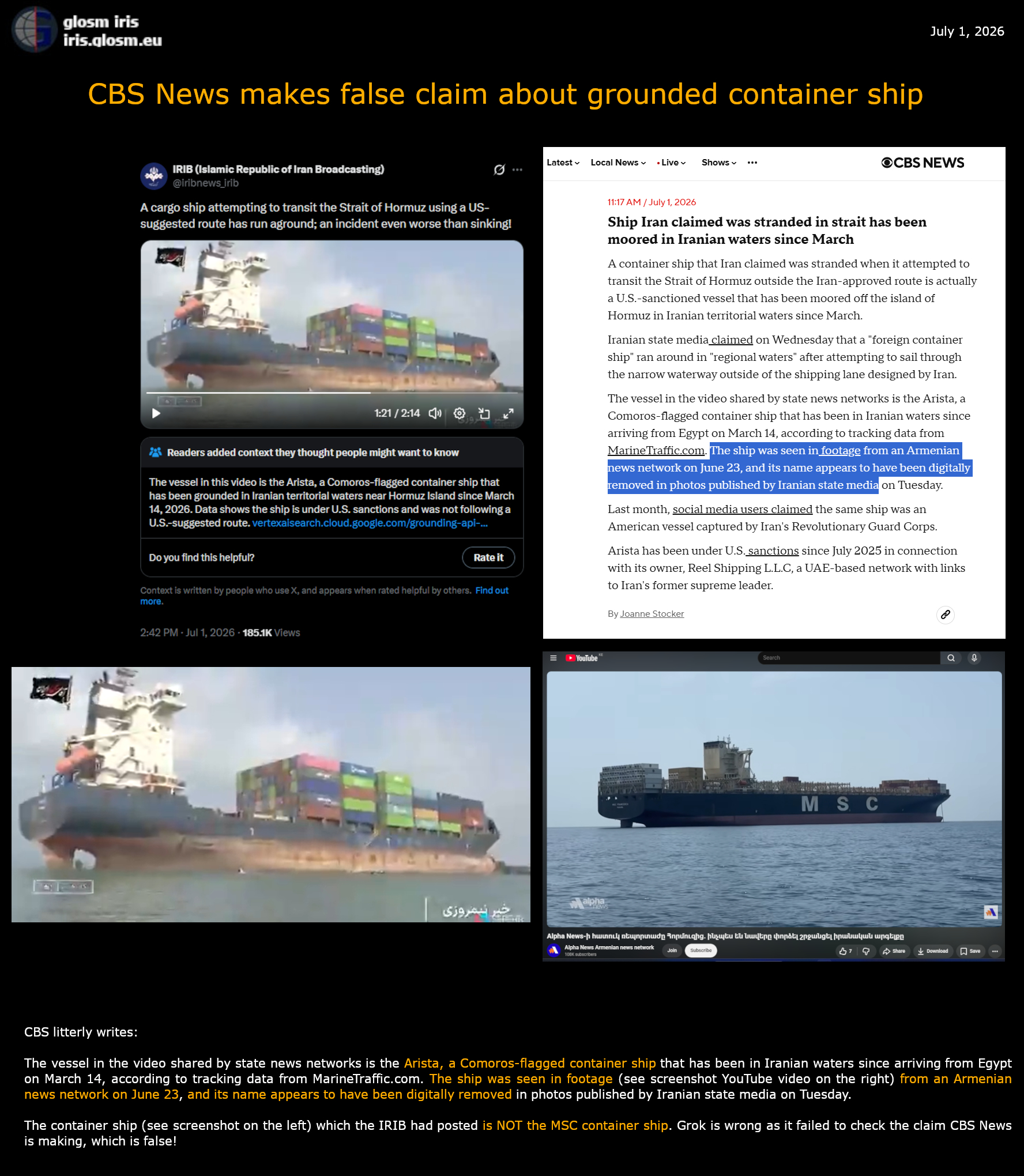
Yesterday, Iranian state media reported that a foreign cargo ship using a “US-suggested route has run aground” in the Strait of Hormuz.
Now, TankerTrackers.com, a maritime traffic monitor, says the ship had “actually been stuck in this same spot since March”.
It identified the vessel as Arista, and said that while the ship is Comoros-flagged, it is part of an operation managed by Iranian oil magnate Mohammad Hossein Shamkhani, the son of the late senior Iranian security official Ali Shamkhani.
|
|
CBS News reported that the vessel was seen in a YouTube footage from an Armenian news network on June 23, and its name appears to have been digitally removed in photos published by Iranian state media on Tuesday.
|
Iranian official slams US-led regional security dialogue
Gharibabadi, Iran’s deputy foreign minister, has dismissed a US-led regional security dialogue held in Bahrain, where participants from 12 nations discussed the Strait of Hormuz.
“Hormuz is defined under Iran’s command, not CENTCOM,” he wrote, adding that “a military summit in Bahrain cannot establish legal order and security for the Persian Gulf”.
“The region’s security will be ensured through the end of interventions and the US withdrawal from the area, respect for countries’ sovereignty, and acceptance of new geopolitical realities – not under the military umbrella of America,” he said.
His comments came after the US announced that senior military officials from 12 countries – including Saudi Arabia, the United Arab Emirates, Qatar, Lebanon and Syria – had met in Bahrain and affirmed their “commitment to the free flow of commerce” through the strait.
|
|
On June 28, 2026, Iran called for ‘security framework’ with Gulf countries.
On July 1, 2026, CENTCOM leads security meeting with reps from 12 countries in Bahrain.
|
Shipping workers, employers say Hormuz still a war zone
The International Transport Workers’ Federation and the Joint Negotiating Group have agreed to keep the Strait of Hormuz designated a “Warlike Operations Area” until July 9.
The move follows attacks on two cargo ships in late June that prompted a pause on an evacuation plan by the UN’s maritime agency.
In a joint statement, the ITWF, a workers union, and the JNB, which represents maritime industry employers, said double pay will be maintained for seafarers in the area, who are on board ships covered by the International Bargaining Forum’s labour agreements.
“This decision recognizes the continuing and significant risk to life and the rapidly evolving situation in the area,” they said.
The UN’s International Maritime Organization said in late June that some 11,000 seafarers were stranded on board some 600 commercial vessels in the Strait of Hormuz. About 2,500 seafarers and some 115 vessels were evacuated over three days before attacks on ships in the area halted the operation.
|
|
|
Iran prepares for Ali Khamenei’s funeral
Iran is preparing the largest state funeral in its history for former Supreme Leader Ayatollah Ali Khamenei, who was killed in a US-Israeli strike on February 28.
The six-day ceremonies will span five cities, including in neighboring Iraq.
They will begin on Saturday, with Khamenei’s body lying in state at Tehran’s Grand Mosalla prayer complex. The ceremonies will continue through Monday, with a funeral procession through the streets of Tehran on Monday. The procession will move to the holy city of Qom on July 7, and then to the cities of Najaf and Karbala in Iraq.
Khamenei’s body will be returned to Iran for burial in his home city, Mashhad, on July 9.
Mourners from across the country and abroad are expected to attend the ceremonies.
Authorities say they expect some 15 to 20 million mourners to participate, and police have declared a state of high alert for the event. Senior officials and representatives from more than 30 countries, including Russia, China, Pakistan, India, Georgia and Cuba, are expected to attend, while religious leaders from 90 countries will also take part.
Pakistani Prime Minister Shehbaz Sharif, whose country has spearheaded efforts to end the US-Israel war, confirmed in an address to parliament earlier this month that he would attend.
|
|
On June 16, 2025, during an interview with ABC News, Netanyahu called on the US for help in the assassination of the Iranian Supreme Leader knowing that Hezbollah would respond. That how he spilled over the resumption of his preemptive 12-day war on Iran into Lebanon.
|
Iran ramps up security ahead of Khamenei’s funeral
Brigadier General Mohammad Akraminia says Iran’s military is on high alert ahead of the multi-day funeral for Khamenei.
He said Iranian forces had stepped up their deployment for the arrival of senior officials and religious and political figures from various countries.
“The army’s ground, naval and air forces have expanded their active presence across the country’s borders to help ensure security,” he told the IRNA news agency.
He added that Iran’s air defense force is maintaining continuous surveillance of the country’s airspace.
|
|
|
Iran’s Ghalibaf calls for huge gathering for Ali Khamenei’s funeral
Mohammad Bagher Ghalibaf, Iran’s parliament speaker, has called for a massive turnout for Ayatollah Ali Khamenei’s funeral that starts this weekend.
“I invite all the Iranian people … to write a glorious page in the history of Islamic Iran through your presence” at funeral ceremonies starting on Saturday, Ghalibaf said in a statement.
“The nation’s call for vengeance must ring in the ears of the whole world,” he added.
Ali Khamenei, 86, the then supreme leader of Iran, was assassinated in Tehran on February 28 – the first day of the US-Israeli war on Iran.
Khamenei led Iran from 1989 following the death of Ayatollah Ruhollah Khomeini, who spearheaded the Islamic revolution a decade earlier.
|
|
|
Iran tells UN that Israeli threat to kill its supreme leader is ‘state terrorism’
Amir-Saeid Iravani, Iran’s ambassador to the UN, has lodged a protest with the global body over Israel’s latest threat to assassinate the country’s Supreme Leader Mojtaba Khamenei.
In a letter to Secretary-General Antonio Guterres, the Security Council and the General Assembly, Iravani described the threat by Israeli defense minister Israel Katz as “part of a deliberate and systematic policy of state terrorism” targeting Iranian government officials.
He tied it to the “Israeli regime’s illegal acts of aggression against Iran, including the assassination of the late Iranian leader, Ayatollah Seyyed Ali Khamenei, and other senior political and military officials, carried out with the participation, coordination, and support of the United States”.
Iravani added that the UN Security Council has allowed Israel to act with impunity and warned that Tehran would respond to any hostile actions.
“Unfortunately, the failure of the Security Council to fulfill its responsibilities under the UN Charter has reinforced the climate of impunity and has made the Israeli regime more brazen in normalizing state terrorism, which sets a very dangerous precedent and poses a serious threat to international peace and security.”
|
|
Yesterday, Iran’s Foreign Minister Abbas Araghchi has reacted strongly to remarks by Israeli Defense Minister Israel Katz who said Iran’s Supreme Leader Mojtaba Khamenei is “marked for death”.
What does international law say when the Israeli war belligerent, which it is since 1967, declares the leader of Iran as “marked for death”?
Under international law, declaring a foreign head of state "marked for death" violates the sovereignty of that nation and disrupts international relations. When two nations are not legally in a state of declared war, or even during armed conflicts, international law governs these actions through specific frameworks. For instance:
Customary international law grants sitting heads of state, heads of government, and foreign ministers absolute personal immunity from the jurisdiction of foreign states. Threatening, attempting, or executing the assassination of a recognized foreign leader is considered an unlawful breach of this inviolability.
|
Iran changed the global energy sector: 'will never be the same'
Since the United States and Israel launched a war on Iran in late February, the global energy sector has undergone major upheaval.
Oil prices have swung from levels not seen since the onset of Russia’s full-scale invasion of Ukraine in 2022 to close to where they were before the conflict more than four months ago.
Energy suppliers have scrambled to find alternative trade routes amid Iran’s stranglehold over the Strait of Hormuz, through which about one-fifth of global oil and liquefied natural gas (LNG) supplies pass in peacetime.
But while ongoing US-Iran negotiations to reach a lasting peace have raised hopes for a return to stability in oil and gas markets, the war has already transformed the global energy landscape in ways that are likely to be long-lasting and even permanent, according to energy experts.
|
|
|
Iran talks expose the collapse of US diplomacy
The purpose of a professional diplomatic corps is to ensure that a nation has negotiators acting on its behalf whose only stake in the outcome of their work is the welfare of their nation.
As the US continues what may be the most critical negotiations of the second Trump administration – those with Iran – its negotiating team is led by the vice president and two real estate investors with a side hustle in crypto currency.
Jared Kushner and Steven Witkoff are not the natural fit for a high-stakes matter of international diplomacy.
The former’s association with foreign policy came only as a function of his familial association with Donald Trump through marriage to his daughter Ivanka.
It is an association that has expanded in consequence for his family with Jared’s father, Charles Kushner, going from a felony conviction in 2005 to a presidential pardon in 2020 to appointment as US ambassador to France in 2025.
Witkoff’s involvement in international affairs is even more recent, with his greatest achievement in Trump’s statement announcing his 2025 appointment as Middle East envoy being his leadership in “financing, repositioning and construction of over 70 properties”.
|
|
|
‘Parties agreed to continue discussions’ after US-Iran indirect talks: Qatar spokesperson
“Positive progress” was made during indirect talks between Iranian and US negotiators in Doha, with the next round expected after the late Iranian Supreme Leader’s funeral, Qatar’s foreign ministry spokesman said.
“Qatar & Pakistan mediators concluded separate meetings with the US & Iranian negotiators in Doha today, with positive progress made on issues related to the Islamabad Memorandum of Understanding, building on the outcomes of the Lake Lucerne Summit,” spokesman Majed al-Ansari said on Wednesday on X.
“The parties agreed to continue discussions over the coming period, with the next meeting to be scheduled at the earliest possible time following the funeral processions of the former Iranian Supreme Leader,” he said.
“The parties agreed to continue discussions in the upcoming period, with the next meeting to be scheduled as soon as possible after the conclusion of the funeral processions for the former Iranian Supreme Leader,” he added.
|
|
|
US, Iran ‘agree to continue discussions’ after indirect talks in Doha: Pakistan
The Pakistani Foreign Ministry has announced that indirect talks with Iranian and US delegations in Doha have been concluded “with positive progress made on issues related to the aspects of the Islamabad MoU”.
“Parties have agreed to continue discussions over the coming period, with the next meeting to be set at the earliest possible time following the funeral processions of the former Iranian Supreme Leader,” the ministry said.
|
|
|
‘Hormuz is not the playground of aggressor America’: Iranian military
All commercial vessels are obliged to take the Iranian-designated maritime route for safe passage through the Strait of Hormuz or face the consequences, Iran’s military headquarters warns.
“Any US interference in the Strait of Hormuz will be met with a decisive and swift response from the armed forces,” the Khatam al-Anbiya Central Headquarters said in a statement.
“The Strait of Hormuz is not the playground of the aggressor America, but rather the territory of the undisputed sovereignty of the Islamic Republic of Iran.”
The Fars News Agency quoted the statement as saying: “The security and maintenance of the stability of this vital waterway are the red line of the powerful armed forces of Islamic Iran.”
After the US and Israel began their war on Iran on February 28, Tehran essentially blockaded the Strait of Hormuz, and ships passing through the region risked becoming military targets.
|
|
|
No ‘actual remedy’: Iranians wary of US negotiation outcome
Many people in Iran hold a sceptical view about the ongoing talks with the United States and the impact they’ll have, according to Elham Kadkhodaei of the University of Tehran.
“I think in Iran people are more inclined to rely on what actually happens rather than what is stated,” Kadkhodaei says.
“Whether, for example, the Iranian assets that were supposed to be unfrozen – whether that happens or not, and what’s going to happen in the Strait of Hormuz practically speaking.”
She added “because of the experiences that we have had throughout the years, we know that a deal with the Americans is not going to guarantee the lifting of sanctions and guarantee a better economic situation”.
“Some people believe that we should not rely that much on talks with the Americans, that it’s not going to be an actual remedy to the problems that we have,” Kadkhodaei said.
|
|
|
‘Think twice’: Iran’s army warns against any ‘miscalculation’ by US, Israel
The Khatam al-Anbiya has warned the United States and Israel against any “miscalculation”, saying it will be met with a “harsh” response.
The statement comes days after tit-for-tat attacks with the US put the ongoing peace negotiations in jeopardy.
“We warn the enemies of a strong Iran – especially the United States, the Zionist regime, and their regional accomplices – to avoid any miscalculation… They should think twice about any threat or aggression against our beloved country,” the military headquarters said.
“We declare our full readiness to safeguard the independence, security, and territorial integrity of the Islamic Republic of Iran.”
|
|
|
European gas prices steady as US-Iran talks progress
Dutch and British wholesale gas prices have been steady after Qatar said Iran and the US “made progress” in indirect talks on the Strait of Hormuz as low gas storage levels continue to support the market.
“Price action is likely to be driven more by fundamentals today with no Doha talks scheduled. However, the market remains sensitive to headlines, and any statements from US or Iranian officials could quickly influence sentiment,” said Wayne Bryan, head of gas research at LSEG.
Oil prices have fallen to levels not seen since the start of the US-Israel war on Iran amid rising hopes for a breakthrough in negotiations aimed at sealing a permanent peace deal.
Shipping in the Strait of Hormuz, a conduit in peacetime for one-fifth of the global trade in oil and liquefied natural gas, has shown tentative signs of recovery in recent days after a sharp decline following attacks on two commercial vessels in the waterway on Thursday and Saturday.
|
|
 |
Trump says record number of vessels leaving Strait of Hormuz
Trump has spoken to crowds in the US state of North Dakota for the Theodore Roosevelt Presidential Library dedication.
Standing in front of Spanish-American War re-enactors, he said record numbers of ships are leaving the Strait of Hormuz and called communism the “greatest threat”.
|
|
|
Iran ‘won’t torch sanctions relief and regime recovery’ over Lebanon
Israel’s refusal to pull out troops from southern Lebanon puts the United States “in breach by proxy” of the interim deal with Iran, an analyst says.
Tehran in response has postponed Switzerland talks and is “throttling Hormuz in protest”, Muhanad Seloom, assistant professor at the Doha Institute for Graduate Studies, said.
“Still neither side walks: Iran needs sanctions relief … Trump needs the strait open. This is managed brinkmanship not collapse,” he added.
“Iran forced Lebanon into the MoU to prove it still speaks for the axis [of resistance], but Hezbollah has been gutted so its deterrent value collapsed at the exact moment Tehran needs it as a symbol,” said Seloom.
“That’s the sovereignty trap: Iran must be seen defending Lebanon while the capacity to do so is gone. Lebanon is leverage – and leverage you trade not die on. Tehran will push hard and rattle Hormuz but won’t torch sanctions relief and regime recovery over the pace of an [Israeli] pullout.”
|
|
“Iran forced Lebanon into the MoU ..."
With the assassination of the Iranian Supreme Leader, while knowing that Hezbollah would respond, Netanyahu spilled over his resumption of the preemptive 12-day war on Iran into Lebanon.
On April 8, 2026, Lebanon has been agreed even by the US as part of the ceasefire agreement. The agreement included "war must stop on all fronts, including Lebanon." He made Lebanon part of the war on Iran.
|
| |
|
|
| |
|
|
| |
|
|
| |
|
|
| |
|
|
| |
|
|
| |
|
|
| |
|
|
| |
|
|
| |
|
|