| Highlights from yesterday |
|
Comments |
- Israel and Lebanon have signed a “framework agreement”, which US Secretary of State Marco Rubio described as a “first step” in negotiations, after talks in Washington, DC.
- Israeli forces have killed several people in attacks on the Gaza Strip and southern Lebanon.
|
|
|
Lebanon-Israel deal prompts protests by Hezbollah supporters
Lebanon and Israel have signed a US-sponsored framework agreement in Washington. Supporters of the Lebanese group Hezbollah took to the streets protesting the deal.
|
|
|
US releases 14-point framework deal between Israel, Lebanon
The US State Department has shared the text of the framework deal that was reached earlier in Washington, DC.
The second point in the framework states that the governments of both Israel and Lebanon “commit to a reciprocal, sequences process” under which the Lebanese military “will restore effective sovereign authority over all Lebanese territory”.
That, the text states, is predicated on “the verified disarmament of non-state armed groups and dismantlement of associated infrastructure, enabling the [Israeli army] to progressively redeploy out of the Lebanese territory”.
Some of the articles in the 14-point “trilateral framework” agreements:
- The Lebanese army will “gradually assume full and effective security responsibility” over so-called pilot zones in Lebanon; Israel and Lebanon have agreed to two initial pilot zones – which are not identified – but more may be added by mutual agreement.
- The Lebanese government “will rebuild the State’s monopoly on the use of force [and] achieve the complete and verified disarmament of all non-state armed groups” – a reference to Lebanese group Hezbollah.
- The Israeli government says “the termination” of “the threat” posed by non-state armed groups, such as Hezbollah, “will eliminate any future need for [Israeli] military action or presence in Lebanon”. Israel also affirms it has no “territorial ambitions” in Lebanon.
- The US will “rally international partners” to help rebuild Lebanon.
Israel and Lebanon “will work to establish working groups to draft the full comprehensive peace and security agreement”.
In a separate statement, the US State Department said it will commit “significant resources” to helping “break the cycle of violence”, including an immediate $100m in humanitarian assistance in coordination with the UN.
The US Department of Defense also will reimburse the Lebanese army with more than $30m “under existing authorities and appropriations”, the statement said.
|
|
|
About the Israel-Lebanon framework agreement
Netanyahu has framed the war on Lebanon as being about protecting northern Israel from attack, insisting the current deal will not see Israeli forces withdraw from Lebanon “as long as Hezbollah is not disarmed and as long as there is a threat” to Israel.
For his part, Lebanese President Joseph Aoun said that the framework agreement was the “first step on the path towards Lebanon restoring its sovereignty over all its territory”.
Hezbollah has insisted that Israel must leave Lebanon unconditionally, and Secretary-General Naim Qassem has said that there should be “no normalisation” with Israel.
The group’s position is that Israel cannot be trusted and that it has to keep its weapons to fight Israel if the Lebanese army is unable to. The outline presented in the framework, where disarmament of armed groups precedes any Israeli withdrawal, will be bitterly opposed by Hezbollah.
|
|
|
Residents return to destruction in southern Lebanon
Lebanese families are beginning to return to their villages after months of displacement, only to find widespread destruction following Israeli attacks.
Hussein Damash is among those confronting the ruins of his home amid fears over Israel’s continued attacks and military presence in the area.
“Israel might strike right now,” Damash said. “They cannot be trusted. They do not comply with international laws. The whole world knows this.”
|
|
|
Critics of Israel-Lebanon framework say it won’t end Israeli occupation
Protesters against the Israel-Lebanon framework agreement are saying it will not end the Israeli occupation of southern Lebanon.
The word withdrawal is not in the text.
Instead, the framework stipulates that Israeli forces will “redeploy out of the Lebanese territory” once non-state actors – such as Hezbollah – are disarmed.
Israeli leaders, including Prime Minister Benjamin Netanyahu, have stated that the military will not withdraw from Lebanon until Hezbollah is disarmed and there is no longer a threat of attack in northern Israel.
Hezbollah has rejected disarmament, saying that it must retain weapons in order to defend Lebanese territory from Israel’s attacks.
|
|
|
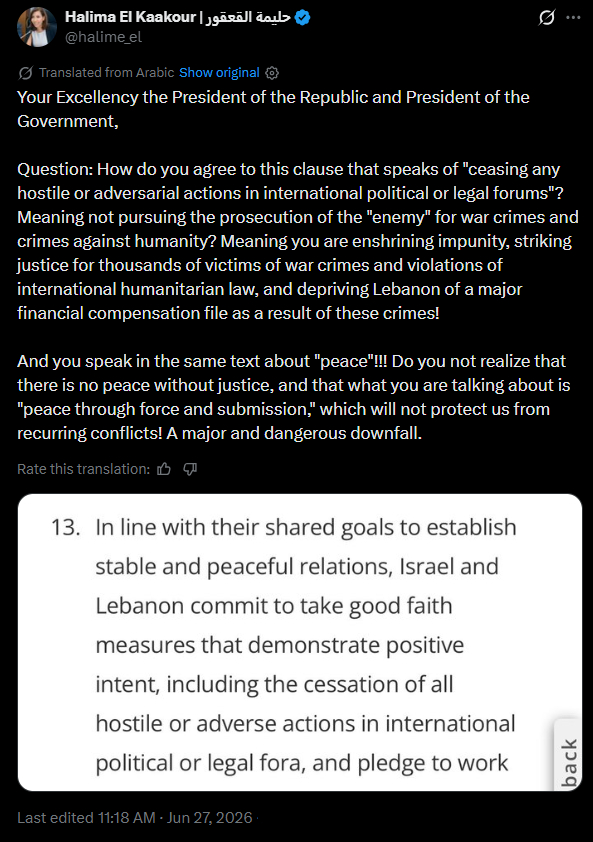
X-user confronts Lebanese president with harsh but true question
|
|
|
Israeli bombing reported near Lebanon-Israel border
Lebanon’s National News Agency is reporting that Israeli forces overnight bombed the vicinity of the town of Markaba, located 1.5km (1 mile) from the Israel-Lebanon border.
The report comes after Israel and Lebanon signed a “framework agreement” in Washington that US Secretary of State Marco Rubio described as a “first step” in the negotiations.
|
|
|
Lebanese MP says Lebanon ‘acting like a state’ after deal with Israel
Lebanese Member of Parliament Ashraf Rifi, a former justice minister, has praised the signature of a “framework agreement” with Israel, saying Lebanon was finally “acting like a state”.
“The notion that a state within a state protects Lebanon has fallen, and with it the illusion that illegal weapons create security or restore rights,” he said – a reference to Hezbollah’s military dominance over the country.
“This is a historic moment for Lebanon,” he continued, according to state-run NNA news agency. “It is no longer acceptable for Lebanese decision-making to remain hostage to the Iranian project, or for Hezbollah to continue its dominance over the state and its institutions.”
|
|
|
Israel-Lebanon framework a repeat of past agreements
Alon Pinkas, an Israeli former ambassador and consul general in New York, says the framework agreement signed by Israel and Lebanon is not unlike Security Council Resolution 1701 in 2006, which mandated the full cessation of hostilities and the withdrawal of Israeli forces from southern Lebanon.
“Now, 20 years later, we’re facing the same reality,” Pinkas said. “I’m very doubtful and skeptical that this will work out because the deal is between Israel and Lebanon with the US, and Israel and Lebanon do not really have territorial issues or any kind of issues; the issue here is Hezbollah.”
The group has announced that it would not accept the framework deal, which means Israel will not withdraw from southern Lebanon, the former ambassador said. For the deal to work, it would need a full “reassertion of sovereignty from Lebanon, which is unlikely”.
“The bigger picture is that while in 2006 it was all about Lebanon, now Iran is linking what is happening in Lebanon to the maturation of an agreement with the US,” Pinkas said. “That complicates things [because] Netanyahu said that [Israel] would not yield to any linkage to Iran and that Israel would defend itself in Lebanon.”
|
|
|
Lebanon MP calls to avoid internal strife after framework deal
Lebanese MP Gebran Bassil, the leader of the Free Patriotic Movement, has said the framework agreement between Israel and Lebanon “requires responsible engagement”.
“It is beneficial if we regain all our rights, and dangerous if it is a recipe for strife,” he said on X.
“Everyone must avoid slipping into it, and not reject outright any path that liberates the land, strengthens the state, and establishes peace.”
|
|
|
Lebanon orders measures to prevent riots after deal with Israel
Public Prosecutor Judge Ahmad Rami al-Hajj has issued a judicial order, tasking the Lebanese security forces to take measures to prevent riots, Lebanon’s NNA news agency reports.
The order came after Hezbollah supporters blocked roads to protest the Israel-Lebanon framework agreement.
The judge also requested that security agencies work to identify the rioters in order to take legal action against them, the state-run news agency said.
Hezbollah supporters took to the streets of the capital, Beirut, on Friday evening after Israel and Lebanon signed the deal in Washington, burning tyres and blocking a road leading to the airport.
|
|
|
Israeli drone strike hits southern Lebanon day after deal
An Israeli drone has struck the Nabatiyeh area in southern Lebanon, Lebanon’s state news agency says.
The NNA agency said the Farah amusement park intersection in Nabatieh al-Fawqa area was targeted by the Israeli drone strike.
The reported strike came a day after Israel and Lebanon signed a US-brokered security arrangement aimed at reducing tensions along their border following months of cross-border hostilities with Hezbollah.
|
|
(Also?) an Israeli drone strike targeted a motorcycle in upper Nabatieh. One man was taken to hospital, seriously injured.
|
Netanyahu’s political career under threat over his war in Lebanon
Upcoming elections in Israel will likely decide the legacy of Prime Minister Benjamin Netanyahu, who faces mounting pressure over his handling of wars in the region and corruption charges.
Netanyahu, Israel’s longest-serving prime minister, is regarded as the ultimate survivor in Israeli politics. But with the upcoming general election, slated for October, he is now confronted with his biggest challenge yet that could see his nearly four-decade political career come to an acrimonious end.
Netanyahu started a war in Lebanon by dragging Hezbollah in his war on Iran. This has seen Netanyahu trapped between US pressure to halt the military offensive in Lebanon and an Israeli public eager to continue the fight against Iran and its regional proxies.
Meanwhile, Netanyahu also faces widespread public anger over his failure to hold an independent public inquiry into his government’s failings before and after the Hamas-led attacks into southern Israel on October 7, 2023.
|
|
"... into his government’s failings before and after the Hamas-led attacks into southern Israel on October 7, 2023."
No Western media, except the New York Times, did an in-depth research, to discover that Netanyahu knew for at least a year that Hamas was planning something. He kept this knowledge for himself to inflict serious security issues to allow October 7, 2023 to happen, to use the resistive event as an excuse to start a war on Gaza. He would use the war, which turned genocidal over the years, to delay the prosecution and trial which runs since 2019.
|
Hezbollah chief says group ‘will not abandon’ armed resistance
Hezbollah Secretary-General Naim Qassem has said the group will continue its armed struggle despite the latest agreement between Lebanon and Israel.
“We will continue as a resistance in the field to defeat the occupation,” Qassem said.
“We did not abandon the field in the most difficult circumstances, and we will not abandon it,” he added.
|
|
|
Qassem calls framework agreement between Israel and Lebanon ‘null and void’
Qassem says Hezbollah rejects the framework agreement reached between Israel and Lebanon in Washington, DC, saying it should be replaced by the Iran-US memorandum of understanding.
“The framework agreement in Washington is humiliating, shameful, and a surrender of sovereignty,” the Hezbollah leader said.
“This agreement is null and void, and the provisions of the Iranian-American Memorandum of Understanding must be implemented.”
The Hezbollah leader condemned proposals to tie an Israeli withdrawal from southern Lebanon to the group’s disarmament.
“Linking the Israeli withdrawal to the disarmament of the resistance throughout Lebanon is a very dangerous proposition that crosses all red lines,” he said.
|
|
International law permits sovereign states like Lebanon to negotiate and sign binding frameworks without involving non-state armed groups. However, because Hezbollah controls territory and is a primary combatant, not the Lebanese army, any ceasefire agreement that excludes Hezbollah faces significant practical and legal enforcement challenges.
International Humanitarian Law (IHL) or the laws of war generally apply to all parties engaged in combat, regardless of who is deemed the aggressor. While states can make peace, armed groups not party to the agreement are not legally bound by its terms.
The framework has basically no value because it serves the party who is the invader of Lebanon.
|
Hezbollah hails Iran’s support for Lebanon
The Hezbollah leader praised Iran’s role in securing the ceasefire in Lebanon, calling it “a gift of honor, dignity and strength”.
Qassem’s statement said the Iran-US memorandum of understanding had given Lebanon “a powerful card” by guaranteeing “the territorial integrity and sovereignty of Lebanon”.
|
|
|
Qassem accuses Lebanese government of legitimizing Israeli occupation
The Hezbollah leader has accused Lebanon’s leaders of giving legitimacy to Israeli occupation for many years to come by signing the framework agreement with Israel.
“This could even lead to the annexation of these lands to the Zionist entity,” Qassem said.
“We say to the Lebanese authorities: It is time for you to retract your sins that are destroying Lebanon”.
Hezbollah remained “ready to cooperate and stand together for the sovereignty of Lebanon, the liberation of its land, the expulsion of the Israeli occupier”, Qassem added.
|
|
Under international law, the framework agreement between Israel and Lebanon does not grant legitimacy to occupation of Southern Lebanon by the Israelis. Under the framework, the Israeli presence is described as temporary, performance-based "security measure" tied to the disarmament of Hezbollah.
Hezbollah has repeatedly said that it will not let itself disarmed, and that it is not part of the talks therefore not binded.
The Israelis insist that the group must be disarmed, while also saying that they will not leave regularly without saying that their refusal is tied to the disarmament. They're simply saying that they are not leaving.
This makes the used term "phased ... redeployment" in paragraph 3 of the 14-point framework ambiguous as no time frame is included, This fuels the suspicion of an occupation with an time span exceeding "temporary" as defined in the Law of Belligerent Occupation.
Gaza was first colonized from 1967 to 2005, and under occupation since 2007. The West Bank became occupied in 1967 but is under annexation in a slow pace since then, while Southern Lebanon was occupied from 1981 to 2000.
During the establishing of the Islamabad Memorandum of Understanding, the Trump administration had warned Iran not to use the language of ambiguity. But the framework is full of such language.
|
Italy says ready to support Israel-Lebanon deal diplomatically
Rome is ready to provide diplomatic support to the newly signed Israel-Lebanon agreement and could contribute to a future international mission following the mandate of the UN peacekeeping force, Foreign Minister Antonio Tajani says.
Speaking at a news conference in Dubrovnik, Croatia, where he is attending an international forum and the MED-9 summit, Tajani described the agreement as “certainly a step forward”, while cautioning that it will take time for the situation to stabilise.
“It is important that the goal of signing has already been achieved,” he said, adding that Italy is prepared to “provide diplomatic support” and “play a role with our armed forces, with an international mission after UNIFIL”.
The minister added that Italy, together with France, can play “a significant role” in rebuilding Lebanon, including strengthening its institutions to better guarantee the country’s sovereignty.
Regarding the possibility of a post-UNIFIL mission, Tajani stressed that any international deployment would have to be based on a multilateral agreement and said participation by Arab and Gulf countries should not be ruled out.
|
|
|
Hezbollah leader on Israel-Lebanon framework agreement:
- Qassem called the framework agreement signed in Washington, DC, “humiliating, shameful, and a surrender of sovereignty”.
- The Hezbollah chief said Hezbollah would “continue as a resistance in the field” and “will not abandon” armed struggle.
- He rejected linking an Israeli withdrawal from Lebanon to Hezbollah’s disarmament, saying it “crosses all red lines”.
- Qassem also accused Lebanon’s government of legitimizing Israel’s occupation “for many years to come”.
|
|
"Israel’s occupation “for many years to come”
Reminder:
This makes the used term "phased ... redeployment" in paragraph 3 of the 14-point framework ambiguous as no time frame is included, This fuels the suspicion of an occupation with an time span exceeding "temporary" as defined in the Law of Belligerent Occupation.
|
Jordan congratulates Lebanon for framework deal with Israel
Lebanon’s Foreign Minister Youssef Raggi says he received a call from his Jordanian counterpart, Ayman Safadi, who congratulated him for Lebanon’s signing of the US-mediated framework agreement with Israel.
Safadi “expressed his hope that the agreement would advance the interests of Lebanon,” including reasserting its sovereignty and restore stability,” Raggi said on X.
“In turn, I thanked him for Jordan’s steadfast support for Lebanon and reaffirmed that this agreement marks a victory for diplomacy and for the authority of the State and its institutions above all else.”
|
|
|
Netanyahu celebrating Lebanon framework deal as victory
The Israeli government is hailing the framework agreement with Lebanon as a victory because it is giving Israel all it was demanding: no withdrawal from the so-called security zone in Lebanon, a fifth of that country’s territory; freedom of movement and freedom to attack if necessary; and a phased withdrawal without deadlines or a timeframe.
All in all, Netanyahu is quite happy and he is not alone in the government to celebrate. Opposition figures have yet to comment but overall it will be hard for them to market this as a bad deal.
The fact that the deal pits the Lebanese government and Hezbollah against each other is a win-win scenario. If the Lebanese government has to confront Hezbollah by force, then Israel is relieved from having to do so itself. Civil war in Lebanon is OK for Israel as long as it gets the job done.
|
|
|
EU chief welcomes Israel-Lebanon agreement
European Commission chief Ursula von der Leyen has welcomed the framework agreement between Israel and Lebanon, calling it a “critical step away from escalation”.
“Because there can be no peace in the Middle East with Lebanon in flames. My thanks to the US for the mediation,” von der Leyen said in a statement posted on social media.
“Key next steps are the disarmament of non-state groups and preserving Lebanese sovereignty and territorial integrity. The EU stands ready to support this path to lasting regional stability, also with the continued delivery of much needed humanitarian aid with 100 million euros ($114 million) mobilized for the displaced,” she added.
|
|
|
‘Fragile’ ceasefire as Israeli attacks continue in southern Lebanon
In a reminder of just how tenuous and fragile this ceasefire is, incidents are being reported in the south, again on the outskirts of the city of Nabatieh, in Nabatieh al-Fawqa.
This was a drone strike at an intersection with an amusement park.
Also, to the east of there in the Hasbaiyya district, there are reports from the National News Agency of Israeli forces pushing further north, supported by machine-gun fire.
So there are still these incidents. And this comes at the end of a week where – although the ceasefire has largely held, there has definitely been a lull in fighting – there where specific incidents carrying on throughout the week, with several people being killed.
|
|
|
Lebanese army commander meets UK defense chiefs
Lebanon’s army says its commander, Major General Rodolphe Haykal, has visited Britain for talks with defense chiefs.
Both sides discussed “ways to support the army and enhance cooperation between the two sides”, the army statement said.
The meetings addressed “the challenges facing the army in the context of peacekeeping and stability missions and border protection” and “how to achieve a sustainable ceasefire in Lebanon”.
Haykal met Chief of the Defense Staff, Rich Knighton, National Security Adviser, Jonathan Powell, Minister of State for Defense, Vernon Coaker, and Parliamentary Under-Secretary of State for the Middle East and North Africa, Hamish Falconer.
|
|
|
Former US diplomat says Israel–Lebanon agreement ‘advantageous’ for Tel Aviv
The Israel-Lebanon framework agreement is “advantageous” for the Israelis, but it’s a “very dangerous” agreement for Lebanon, the former US diplomat Nabeel Khoury says.
“In the end, I don’t think it will achieve peace. It’s a formula for an open-ended struggle. In the long run, it’s not even really good for Israel, although right now they feel like they have the upper hand.”
But the agreement “lessens the burden” on Israeli troops and allows them to go home.
“Essentially, these demands that the Lebanese armed forces do the work that the Israelis couldn’t do, or it proved too costly for the Israelis to do. They want the Lebanese army to do their bidding,” Khoury said.
“If the Lebanese army can go after Hezbollah, all over Lebanon, is what is being demanded of them, and the Israelis simply lend air support, then this is advantageous for Israel,” he added.
|
|
Reminder:
The framework has basically no value because it serves the party who is the invader of Lebanon.
|
Israeli air strike reported on Nabatieh al-Fawqa, southern Lebanon
Israeli warplanes carried out an air strike on the town of Nabatieh al-Fawqa in southern Lebanon at about 15:30GMT (6:30pm local time), according to our colleagues on the ground.
Lebanon’s state-run National News Agency (NNA) also reported the attack. It follows an earlier Israeli strike near the town.
The reported attack came a day after Israel and Lebanon signed a US-brokered security arrangement.
|
|
|
Israel orders military to prepare for ‘extended stay’ in southern Lebanon
Israel’s defense minister says Israeli forces have been instructed to prepare for an “extended stay” in the so-called security zone the Israeli army occupies in southern Lebanon.
“The prime minister and I have instructed the [Israeli military] to prepare for an extended stay in the security zone”, Israel Katz said in a video statement, after Israel and Lebanon agreed to a US-brokered framework aimed at ending hostilities and handing over territory to the Lebanese army.
He added that “there will be no redeployment by Israel in southern Lebanon, no withdrawal, as long as the terrorist organization Hezbollah is not disarmed throughout Lebanon”, describing it as “the important principle established in the agreement”.
|
|
|
Israel-Lebanon deal ties ceasefire to Hezbollah disarmament
After the trilateral signing in Washington, the US Department of State released the text of the agreement, which talks of a “sequenced process” that will see the Lebanese army restore “effective sovereign authority over all Lebanese territory, pending the verified disarmament of non-state armed groups” – a clear reference to Hezbollah.
The deal does not mandate Israeli withdrawal from the fifth of Lebanese land it occupies. Instead, the framework notes that Israel shall “progressively redeploy” out of Lebanon, offering two “pilot zones” where the Lebanese military “will gradually assume full and effective security responsibility”.
|
|
The framework has nothing to do with genuine definition of ceasefire, as it is full of details, the Israelis and the US knew that Hezbollah would not accept, while the group was sidelined in that process.
It is an diktat written in ambiguous language, and is only advantageous for Netanyahu who have dragged Hezbollah in the resumption of his preemptive 12-day war on Iran. It really has nothing to do with ceasefire.
It hallmarks the tactic of making Lebanon defenseless like Netanyahu has done against the new army in Syria by destroying many army bases with weapon storage and the navy base in Tartous during the fall of Assad. It says a lot about why Syria's new leader refuses to fight Hezbollah for Trump.
|
Lebanon divided over framework agreement signed in Washington
Residents in southern Lebanon’s Tyre and the capital Beirut expressed sharply different reactions on Saturday after an initial framework agreement was signed between Israel and Lebanon following US-mediated talks in Washington, DC.
|
|
|
Lebanese army command calls on citizens to act responsibly amid protests
The Lebanese army has reiterated its respect for the freedom to express opinions following “exceptional challenges facing Lebanon”.
“We call on citizens to act responsibly in light of calls for demonstrations in Beirut and other areas. We will not allow any breach of security or infringement on civil peace through actions with unforeseen consequences,” the army command said.
The call comes after Israel and Lebanon signed a framework agreement on Friday that has sparked protests in the country.
|
|
|
France backs Lebanon-Israel agreement
France says it is “ready to contribute” to implementing the framework agreement signed by Lebanon and Israel, describing it as a step towards restoring Lebanese sovereignty.
In a statement, France’s Foreign Ministry said it supports the Lebanese government’s “full monopoly on weapons” and called for the withdrawal of the Israeli military from Lebanese territory.
The agreement, signed in Washington on Friday after five rounds of talks, includes a process aimed at disarming Hezbollah – a move that has been rejected by the group.
|
|
|
Death toll from Israeli attacks on Lebanon rises
The Lebanese Health Ministry reports that at least 4,246 people have been killed and 12,190 wounded by Israeli attacks on Lebanon since March 2, when hostilities between Israel and Hezbollah erupted into all-out war.
|
|
|
Netanyahu hails Israel-Lebanon agreement
Netanyahu has hailed the Israel-Lebanon framework agreement as “a historic achievement for Israel”, which moves towards ending the conflict and allows for the prospect of “an eventual peace agreement between Israel and Lebanon”.
During a media conference, Netanyahu said the deal was a “major blow” to Iran and Hezbollah and said that the so-called security zone in southern Lebanon will be held until there is “no longer a threat to Israel from Lebanon.”
He explained that with the agreement, the US, Israel and Lebanon were telling Iran: “You have no status here, no involvement and no role”.
Netanyahu acknowledged that Israel will be withdrawing from two small areas it currently occupies, in a pilot project towards disarming Hezbollah and transferring territory to the Lebanese army.
He added that one of the areas was outside the security zone, while the other was on the zone’s edge.
|
|
The 14-point framework is written in a ambiguous language. For example: we have not found a time frame for what is written as "phased ... redeployment"
The used term in that framework, prompts the question to where "redeployment", as that is not defined in the document. Then, how to achieve when there is a stalemate between the invaders and Hezbollah, who was dragged in the war on Iran.
The Israelis were constantly saying that they are not going to leave often without adding why they refuse to leave or by saying "until there is no threat." Hezbollah is constantly saying that it will not let itself disarmed, and that the Israelis must leave.
So, if you have these stances as a stalemate then what is the framework for? It is at least not for a "ceasefire" as Israeli attacks in Lebanon have not stopped.
Then, the framework is written in a ambiguous language. This means that it was written in a way that very clear serves Netanyahu not Lebanon. His statement reveals that the Lebanese government was put under pressure. This resembles the "ceasefire agreement" in Lebanon from 2006, which Beirut was also forced to sign under pressure.
Netanyahu's statement reveals that the Lebanese delegation accepted the legalization of of a renewed occupation of the country. That occupation will certainly last for years to come as long as the Israelis uphold the stalemate because it was Netanyahu who dragged Hezbollah in the resumption of his preemptive 12-day war on #Iran from June 2025.
By assassinating Khamenei while knowing that Hezbollah would respond, Netanyahu spilled over his war on Iran into Lebanon.
The framework is entirely obsolete and a falsification of how the region is dragged into a turmoil
|
Far-right Israeli minister calls Israel-Lebanon agreement a ‘mistake’
National Security Minister Itamar Ben-Gvir has slammed the framework agreement with Lebanon, calling it a “big mistake”.
“I already approached the Prime Minister this evening with a request to hold a vote in the cabinet, and I’ve been fighting against the agreement for weeks,” Ben-Gvir wrote on X.
“Indeed, we are remaining in most of the territory for now, but the state of Lebanon will not disarm Hezbollah of its weapons, ministers in the Lebanese government are Hezbollah members, and we cannot rely on Lebanon to take the weapons away from Hezbollah – I will demand a vote in the cabinet,” he said, adding that only the Israeli army could “destroy” Hezbollah.
|
|
|
Israeli minister says military ‘deepening the destruction of infrastructure’ in Lebanon
Israeli Finance Minister Bezalel Smotrich has defended the government’s agreement with Lebanon, saying the Israeli military “controls a security strip in Lebanon” and is “deepening the destruction of infrastructure along its length and breadth above and below ground”.
Smotrich said Hezbollah “hasn’t been eliminated yet, but it has been severely struck”, adding there was “an international commitment to its elimination” and to maintaining “Israeli freedom of action to thwart threats and prevent buildup”, while remaining in the security zone until then.
He also said Iran was “much weaker than it was on the eve of the war – militarily, governmentally, and economically”.
|
|
|
Israel orders troops to prepare for ‘extended stay’ in Lebanon
Israeli Defense Minister Israel Katz says the military has been ordered to prepare for an ‘extended stay’ in southern Lebanon, insisting that forces will not withdraw unless Hezbollah is disarmed throughout Lebanon under the terms of the new US-brokered agreement.
|
|
|
Israeli opposition leader criticizes Lebanon agreement
Israeli opposition leader Yair Lapid has criticised the framework agreement with Lebanon, saying it “allows for the continuation of money transfers from Iran to Hezbollah” and “does not set a timetable for Hezbollah’s disarmament”.
In a post on X, Lapid also accused Prime Minister Benjamin Netanyahu of agreeing “to a withdrawal from Lebanese territory without receiving anything in return and without achieving a separation between the Iranian and Lebanese fronts”.
|
|
|
The framework agreement with Lebanon
The announcement of a framework agreement between Israel and Lebanon after negotiations in the United States has been met with guarded optimism in Israel.
Friday’s agreement describes a “sequenced process” that will see the Lebanese army restore “effective sovereign authority over all Lebanese territory, pending the verified disarmament of non-state armed groups” – a clear reference to Hezbollah, which has been fighting with Israel since October 2023, with varying levels of intensity.
Only once that process is completed will Israeli forces be able to “progressively redeploy” out of the large area of southern Lebanon they have occupied since early March, when they launched a renewed offensive that has killed more than 4,000 people.
The Washington framework does not specify what measures will be used to verify disarmament but outlines two “pilot zones” for an initial Israeli withdrawal, where the Lebanese military “will gradually assume full and effective security responsibility”.
|
|
|
Lebanon’s President Aoun receives call from Trump on Israel deal
The Lebanese presidency says on X that Joseph Aoun received a call from Trump last night, during which the US president “congratulated him on signing the framework agreement between Lebanon and Israel under the auspices of the United States of America”.
Trump further said that the US will support Lebanon’s economy and armed forces, in the name of Lebanese “sovereignty”, according to the statement.
Aoun said that he hoped “the United States would contribute to preventing any breach of this agreement and ensuring compliance with all the commitments agreed upon, especially by pressuring Israel to withdraw from the lands it occupies in the south to facilitate the army’s deployment to the international borders”.
The framework agreement, signed yesterday in Washington by Israel, Lebanon and the US, concerns the withdrawal of occupying Israeli troops from two areas, deemed “pilot zones”. Since the deal was announced, Israeli politicians have said the departure of Israeli troops from Lebanon will not be widespread, and that the army should prepare to occupy territory for a long time.
|
|
|