| Highlights from yesterday |
|
Comments |
- Israeli forces continue attacks on Gaza as Israeli colonists attack Palestinian homes near Bethlehem in the occupied West Bank.
|
|
|
| |
|
|
| |
|
|
Netanyahu, Katz have approved reconstruction work in Gaza’s Rafah, Israeli media say
Israeli Army Radio reports that Netanyahu and Defence Minister Israel Katz have approved the start of reconstruction work in Rafah in southern Gaza.
It said they had authorized the work without a public announcement, nearly three years into the genocidal war and amid international pressure for the deployment of a multinational stabilization force in the enclave.
The Prime Minister’s Office rejected the report, saying it “distorts the facts and recycles old information”. It described the effort as a known UAE pilot project deep inside the “Yellow Line” launched several months ago to build a tent complex outside Hamas’s control.
The office said the Israeli military had cleared the area of “militant infrastructure”, including tunnels. Work on electricity, sewage and water would be supervised by the army rather than carried out by contractors in Gaza, it said.
The Jerusalem Post had reported last month that the Israeli security cabinet had approved a plan by Trump’s Board of Peace to allow the entry of the International Stabilization Force and to launch a pilot humanitarian zone for Palestinians in Gaza.
|
|
The UAE's dubious background
The UAE was the first to sign the Abraham Accords, making itself as the most closest ally of the Israelis.
It was involved in Netanyahu's war strategy of creating chaos in Gaza by facilitating the Popular Forces at the time of Netanyahu's campaign led by Yasser Abu Shabab. We've found videos showing Toyota pickup trucks with UAE license plates delivered to the group.
Prior to the talks for a memorandum of understanding, the UAE was against the ceasefire with Iran. And it even attacked Iran by its own by bombing Iran's Siri Island located some 100 km off the Emirati coast.
|
| |
|
Behind UAE's plan
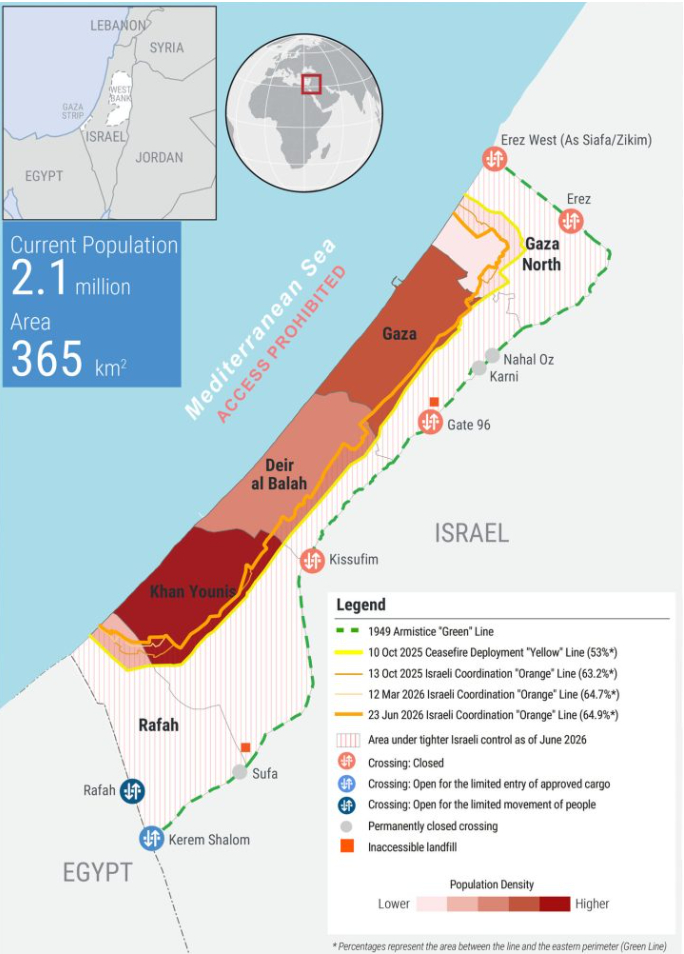 On February 5, 2026, the United Arab Emirates presented a plan to build a compound "to house thousands of displaced Palestinians" in a part of south Gaza under Israeli military control. However, the "compound" is planned to be located in the east of Rafah. On February 5, 2026, the United Arab Emirates presented a plan to build a compound "to house thousands of displaced Palestinians" in a part of south Gaza under Israeli military control. However, the "compound" is planned to be located in the east of Rafah.
[click on the map to enlarge]
On July 7, 2026, Israel’s "defense" minister had lay out a plan to force all Palestinians in Gaza into a camp on the ruins of Rafah, in a scheme that legal experts and academics described as a blueprint for crimes against humanity.
Israel Katz said he has ordered Israel’s military to prepare for establishing a camp, which he called a “humanitarian city”, on the ruins of the city of Rafah, Haaretz newspaper reported.
Palestinians would go through “security screening” before entering, and once inside would not be allowed to leave, Katz said at a briefing for Israeli journalists.
Israeli forces would control the perimeter of the site and initially “move” 600,000 Palestinians into the area – mostly people currently displaced in the al-Mawasi area.
Eventually the entire population of Gaza would be housed there, and Israel aims to implement “the emigration plan, which will happen”, Haaretz quoted him saying.
That is why Netanyahu and "Defence" Minister Israel Katz had authorized the work without a public announcement.
|
Israel’s Rafah reconstruction plan aims to take control away from Hamas
Israeli Army Radio reports that reconstruction work in southern Gaza, approved by Netanyahu and Defence Minister Israel Katz, will take place east of Rafah, inside the “Yellow Line”.
It says the directive was issued two weeks ago.
The report said the aim of the work was to establish a housing project for Palestinians outside the control of Hamas and under the control of the multinational force envisaged by Trump’s Board of Peace.
However, caravans and mobile buildings would not be allowed in any sooner than November, which is after Israel’s scheduled elections.
Israeli Transport Minister Miri Regev said reconstruction of Gaza can begin in any area where disarmament has taken place, the report added.
“If you want Gaza to be rehabilitated, in any area cleared of weapons it is possible to start the process,” she said.
|
|
|
Egypt warns Palestinian displacement from Gaza remains a ‘red line’
Egyptian Foreign Minister Badr Abdelatty warns that plans to displace Palestinians from the Gaza Strip remain on the table and says Cairo would resist them with full force, describing such a move as a “red line” for Arab and Muslim countries.
In an interview with the Palestinian Wafa news agency, Abdelatty said “voluntary displacement” could not be considered voluntary if conditions are created that make life in Gaza impossible. Pushing residents to leave under such circumstances amounts to coercion that violates international law and the rights of people under occupation, he said.
Egypt “will not accept and will not allow” displacement to take place, he said, reaffirming its commitment to Palestinians remaining on their land.
Regarding the occupied West Bank, Abdelatty expressed concern over escalating violations against Palestinians, describing the situation as “silent annexation” and “de facto annexation” that undermines prospects for a Palestinian state and a two-state solution.
He said the use of force, however great, would not achieve sustainable security for Israel or the region as long as Palestinian rights go unrecognized.
|
|
|
‘This is not the kind of ceasefire we want to see’ in Gaza, UN official says
A ceasefire exists on paper in Gaza but not in reality, says Ajith Sunghay, head of the Office of the UN High Commissioner for Human Rights in occupied Palestinian territory.
“While a ceasefire was declared, there have been numerous violations of international humanitarian law and human rights law throughout this period since October 2023,” Sunghay said.
His office’s figures show 1,150 people killed since the ceasefire announcement, the majority of them civilians, through bombardment, naval strikes and gunfire across the 30 percent of Gaza still accessible to Palestinians.
Sunghay said the UN high commissioner for human rights has raised the issue repeatedly. “This is not the kind of ceasefire we want to see,” he said.
On whether reporting to the UN Security Council or the International Criminal Court (ICC) is making any difference, Sunghay said: “There have been small steps taken, minor changes, but they are not enough for people in Gaza to feel that anything has really changed.”
The humanitarian situation, he said, remains extremely difficult after nearly 1,000 days of war. Palestinians are confined to 30 percent of the Strip with the Israeli military’s control line shifting constantly. “The bigger problem has not stopped. Urgent action is needed,” he concluded.
|
|
|
Gaza death toll rises
Israel has killed at least one person and injured eight in the Gaza Strip over the past 24 hours, according to the enclave’s Health Ministry.
One body was also recovered from the rubble of a previous Israeli attack, the ministry said in a statement on Telegram.
Israel has killed 1,258 people and injured 4,139 others since last year’s “ceasefire”, it said.
Since October 2023, when Israel’s genocidal war on Gaza began, at least 73,386 Palestinians have been killed and 174,250 have been injured, the statement said.
|
|
|
Netanyahu rejects Trump’s plan for Gaza
Netanyahu says Israel has rejected US President Donald Trump’s Board of Peace 15-point plan for Gaza and would not withdraw its forces until Hamas was disarmed, according to Israeli media.
“Israel denies the 15-point document,” Netanyahu was quoted as saying. “The [army] will not carry out any withdrawal until Hamas is genuinely disarmed.”
He said Israel was seeking the group’s real dismantlement, “not fictitious decomposition”, and was discussing the matter with Washington.
“Now, we are talking to the Americans about this issue. They have ideas, some of them are acceptable to us and some are not,” he said.
|
|
|
Netanyahu hit reset button on Gaza due to approaching polls
Netanyahu was speaking to the Israeli public because all the discussions around the 15-point document presented by the Board of Peace, talking about Hamas’s disarmament and Israel’s withdrawal, are extremely controversial for the right-wing government.
His cabinet approved the entry of some international forces without full knowledge of the details.
This time around, the prime minister said loud and clear that Israel rejects the 15-point document. He said the Israeli army would not withdraw from Gaza until Hamas is disarmed.
The conditions the Israeli prime minister is talking about include the total disarmament of heavy weapons, light weapons and, in addition, plans for any tunnels that might remain.
This is extremely problematic for the Board of Peace and the mediators who have been working for months now to try to find a way to carry out the disarmament of Hamas and have Israel commit to a phased withdrawal from Gaza.
Now, it seems that Netanyahu, so close to elections, has hit the reset button, saying that none of that will happen under his watch.
|
|
The media is reporting about "Israel rejects Trump's Gaza peace plan."
But Netanyahu rejects the 15-points Roadmap for Completing the Implementation of President Trump’s Comprehensive Peace Plan in Gaza, as that includes Israeli troops must withdraw from Gaza, while he and his "defense" minister repeatedly have said that they will not withdraw.
So yes, it is purely a stunt for the upcoming elections.
|
Israeli security demands, Palestinian needs ‘not at loggerheads’
Netanyahu’s move against Trump’s Gaza deal is “misaligned with what the people in Israel would generally want, if they understood correctly what’s going on”, according to Israeli analyst Dan Perry.
“I have no naiveté about Hamas. But even if there is an idea that there is a declarative agreement to disarm, it is something that should be welcomed so clearly,” said the former chief of The Associated Press news agency in Europe, Africa and the Middle East.
“I keep hearing about a trade-off between Israeli security demands and the obvious needs of the Palestinian people, the need to alleviate and fix the humanitarian disaster in Gaza, but these are not at loggerheads. If Gazans live better, the chances that Israel will face a popular attack by armed elements in Gaza or elsewhere are diminished,” he said.
|
|
|
Gaza people expected Netanyahu to reject 15-point plan
This was expected. The fact that the Israeli prime minister took all this time to just come up with this decision and it’s coming in the form of a full rejection of the 15-point plan did not surprise anyone here. It was expected by many of the people here.
The only concern that people have right now is that this is translating into greater uncertainty. The plan was meant to provide more structure and a framework.
There are important elements that were part of the plan in terms of security – Israeli withdrawal from the area that it has been occupying over the past years across Gaza known as the “Yellow Line”, the disarmament of Hamas, as well as the entry of international stabilization forces.
Now, the full rejection here puts the sequencing and the steps to complete that into serious question. It translates into no clear end to hostilities and wars.
Over the past five days, we haven’t reported on strikes, assassinations or aerial activities apart from the ongoing shooting in areas adjacent to the “Yellow Line”, but this could come back at any time. This rejection is seen as a license for the Israeli military to come out of this five-day break into more of an escalation on the ground.
|
|
|
Netanyahu believes he can ‘continue to act with impunity’
Xavier Abu Eid, a political analyst and former adviser to the Palestinian negotiations team, says the Board of Peace and Resolution 2803 of the UN Security Council were accepted late last year because it was argued at that time that they were the only way to end the Israeli genocide in Gaza.
“But it was very clear from the very beginning that the 20-point plan of President Trump and the 15-point disarmament and implementation plan that followed were more about meeting Israeli interests than the Palestinian right to self-determination,” he said.
“Justice for Palestinians is something that nobody talks about. So, certainly, this remains a position,” the analyst added. He also said Trump is unlikely to be happy with Netanyahu’s statement.
“But at the same time, Trump has never even pretended to push any sort of accountability measures for Netanyahu violating even their own agreements,” the analyst said.
Abu Eid concluded: “Therefore, Netanyahu believes so far that even if President Trump is not going to like this statement, he will still continue to act with impunity.”
|
|
|
Netanyahu thinks defying Trump on Gaza plan is ‘risk-free’
Alon Pinkas, former Israeli diplomat, says Netanyahu “absolutely” needs “a forever war”.
“This Israeli rejection of the Gaza plan … should be viewed entirely in the context of the upcoming Israeli election on October 27,” he said.
Pinkas said Netanyahu made a “calculation that this is risk-free”, “that he can supposedly defy President Trump because Trump doesn’t care enough, because of the sequence, because Hamas hasn’t disarmed yet, because he can get away with it”.
“And this is all about the forever war and the election,” he concluded.
|
|
|
EU sees Trump’s Gaza plan as ‘the only plan in town’
The European Union is caught between recognizing the Gaza Board of Peace as a threat to the international order and treating it as the only diplomatic game in town, according to Muhammad Shehada, writer, political analyst and a visiting fellow at the European Council on Foreign Relations.
“On the one hand, they understand that it exists to replace the multilateral system, the rules-based international order,” Shehada said, describing the body as “a family-owned business enterprise that substitutes international law with deal-making”.
He said European capitals feared the model would be replicated in places like Venezuela, Iran, Ukraine and Greenland, and were alarmed to see figures they consider war criminals, including Netanyahu and Vladimir Putin, added to it.
Yet, the EU has continued to insist that Trump’s plan is “the only plan in town”, Shehada said, and must therefore be engaged with rather than resisted.
However, paradoxically “with this particular roadmap in Gaza, it is creating a rare opening now for Europe to use it as a hook to pass measures that were previously being resisted by member states like Germany, Italy, and others”.
Those measures include partially suspending the EU-Israel trade agreement, banning products from illegal Israeli settlement in the occupied West Bank, or sanctioning Israeli ministers.
|
|
|
Netanyahu playing ‘very dangerous game’ with Trump
Netanyahu’s rejection of the Gaza deal completely scuttles US efforts. The original announcement was made just days ago on July 31 and the White House made a very big deal about this.
Trump and Netanyahu’s relationship has been getting worse and worse. [Earlier this year], they had what we were told was an expletives-laden call, with President Trump calling the Israeli Prime Minister something crazy.
[Trump] is a president who doesn’t like to be disrespected, especially on the world stage. So, this could be a very dangerous game for the Israeli PM.
We’ve seen in the primary elections in the Democratic Party that even though AIPAC, the pro-Israeli government lobbying firm, has been spending tens of millions of dollars on races, some of the candidates they’ve targeted the most because they want to withdraw aid to Israel, those candidates still won their primaries. The Democrats are very much sliding towards the Palestinian cause.
The president has full control over his Republican Party – so if he chooses to make this an issue and say it is time to split with Israel, it is likely that many – not all, but many Republicans will go along. So, Netanyahu is betting that the president isn’t going to use his considerable power within the Republican Party, the last staunchest ally of Israel in the US, to turn against them.
|
|
|
Hamas remains committed to agreed Gaza roadmap, senior official says
Basem Naim, a senior Hamas official, has told the Reuters news agency that the group remained committed to the roadmap agreed with mediators in Cairo 10 days ago.
“We expect the mediators and the US guarantor to press Netanyahu and his government to adhere to the roadmap and not obstruct the process for internal political and electoral reasons, while continuing to jeopardize the region’s security and stability,” Naim said.
|
|
|
Netanyahu’s Gaza plan rejection no surprise, Palestinian politician says
Mustafa Barghouti, secretary-general of the Palestinian National Initiative, says Netanyahu’s rejection of the 15-point plan is not surprising, since Israel never implemented any of the agreements it signed.
He said Israel has broken the ceasefire’s core obligation to halt bombing Gaza, violating it “3,000 times”, killing “more than 1,200 people” and injuring “more than 4,000”, and “the United States did nothing about it”.
He added that Israel also violated commitments on humanitarian aid, free passage to Rafah, transferring governance to an independent committee, and admitting a peacekeeping force.
Barghouti said the real question is “who should pressure Netanyahu”, not Hamas, since Hamas “agreed to the plan” while Israel blocked its implementation. “There is an aggressor … and another side, which is the victim,” he said.
He called this a test for Trump and the international community: “Will they initiate sanctions in Israel, as they should do, if it was about any other country in the world?”
Barghouti described the Israeli government’s goal as “ethnic cleansing”, but insisted: “Palestinians will not leave.”
|
|
|
Hamas calls for full implementation of Trump’s 15-point plan
The Palestinian armed group says in a statement published on Telegram that it remains committed to the 15-point plan for the second phase of the Gaza ceasefire.
Hamas said the priority now is full implementation of the agreement – a complete halt to attacks on Palestinians, an Israeli troop withdrawal, the opening of crossings, and the entry of aid, shelter supplies, and reconstruction materials.
The group called on mediators and guarantor countries to “assume their responsibilities” and prevent any “violations or breaches” that could derail the process.
Hamas said it will continue engaging “positively and responsibly” to see the agreement through, “thereby ensuring an end to the suffering of our people”.
|
|
|
Netanyahu’s rejection of Gaza plan linked to October election
The Israeli prime minister’s public rejection of the Gaza plan is largely tied to upcoming elections, says former Netanyahu aide, Mitchell Barak.
Calling it Netanyahu’s “opening position” rather than a final stance, Barak said the PM announced the rejection during a cabinet meeting within “his very right wing government, which … doesn’t have a long shelf life left”, suggesting the move is aimed at his political base rather than Washington.
Barak said he still expects “Israel will accept the Trump plan, sooner or later”, framing the rejection as a matter of “sequence and timing” tied to Hamas’s disarmament, not a permanent break with the US.
He argued that Netanyahu’s real leverage heading into the election is his relationship with Trump – “the best relationship of any world leader” – and that Netanyahu “does not want to lose that”.
|
|
|
Netanyahu ‘never’ planned to withdraw from Gaza
Gideon Levy, a prominent Israeli journalist and columnist at Haaretz newspaper.
He said Netanyahu’s rejection of Trump’s deal with Hamas is going just as the Israeli prime minister planned.
“I don’t think that Netanyahu for a moment had in mind to withdraw from Gaza,” he said.
Netanyahu’s initial agreement to enter into the US-brokered talks was just to please the Americans, Levy said. That’s why he had put in “very vague conditions” regarding the disarmament of Hamas, he argued.
Levy pointed out that it was never clear how the disarmament would happen nor who would control the process.
“It was a way for him to postpone any withdrawal. And now with the elections in Israel getting closer, he wants to show that he didn’t give up Gaza and he has all the intentions in the world to stay there, which was the truth from the very beginning,” he said.
Away from disarmament and withdrawals, Netanyahu would likely have found other reasons to reject the plan at a later stage, Levy believes. Currently, the peace plan does not even touch on the opening up of Gaza, which is likely to be sensitive for the Israeli government, he said.
The bottom line is that everything now depends on Donald Trump, he added. If Trump would like Israel to withdraw from Gaza, Netanyahu would have no other choice but to do so – but Trump would have to put extraordinary pressure on Israel to comply, Levy concluded.
|
|
|
Egypt FM calls for Israel’s complete withdrawal from Gaza
Egypt’s Foreign Minister, Badr Abdelatty, has stressed the importance of a complete Israeli withdrawal from Gaza and the opening of the strip to allow sustained humanitarian aid in line with President Trump’s peace plan for Gaza.
The foreign minister made the statements in a phone call with Nikolay Mladenov, the director-general of Trump’s Board of Peace, according to a statement by the Egyptian foreign ministry.
Both sides also discussed the deployment of the International Stabilization Force expected to take over security in Gaza, the statement said.
Israel’s PM Netanyahu formally rejected the 15-point peace plan on Sunday.
|
|
|
Netanyahu’s comments likely to upset Trump’s plans
It seems fairly likely that Netanyahu’s comments will upset President Trump’s peace plan completely.
PM Netanyahu was very unequivocal, saying: ‘We reject the 15-point plan.’
That has been the key issue for the Trump administration. This is an administration that is looking desperately for a foreign policy win. The war in Iran is incredibly unpopular, it seems like it’s a bit of a quagmire for the president. He came out just days ago and heralded what he called a historic success – that Hamas was going to disarm. So if Israel says they reject the plan, it would seem there isn’t a plan [at all].
If you know anything about Donald Trump, you’d know he really doesn’t like it when people say no to his demands. But we’ve been here before. The Israeli PM has refused Trump’s request to pull out of Lebanon for example, putting the Memorandum of Understanding with Iran at risk and obviously it eventually collapsed. So far, we haven’t seen the president use any of his leverage, but he’s made it very public that he thinks that Israel will do his bidding.
The president could do a lot to Israel. Support for Israel used to be a bipartisan issue, but it’s become very partisan, with Democratic lawmakers and voters speaking out against Israel.
Republicans have held steady. But think about this: Who controls the Republican Party? Donald Trump. He has full control over his base. If he chose to speak out against Israel he could start to change that narrative. Again, he’s been ignored by Netanyahu in the past, and he hasn’t been able to use that leverage. Not sure he’s going to do it now.
|
|
|
‘A long way to go’ before Gaza conflict is resolved, says former US general
Retired US general and former diplomat Mark Kimmitt has said there’s “a long way to go” before there is any resolution to the various problems in the region and that Trump now faces a choice between “show patience or find some off ramps”.
Kimmitt said Netanyahu’s demand that Israeli forces stay until Hamas disarms makes “a lot more sense” than Hamas’s competing demand for a full Israeli withdrawal first, arguing that “neither side is going to accept a unilateral” move – withdrawal and disarmament instead need to be “milestone-based on both sides”.
|
|
|
Trump shares Hillary Clinton’s June op-ed defending his Gaza plan
US President Donald Trump has posted an opinion piece by former US Secretary of State Hillary Clinton, defending his Gaza plan, on Truth Social – in his first public response since Israeli Prime Minister Benjamin Netanyahu dismissed it on Sunday, though he has yet to address the rejection directly.
In the Financial Times piece, published in June, before Trump’s more recent claims of a finalized deal, Clinton writes that “the world may not like Trump’s Gaza plan – but there is no alternative,” adding: “If even I, an implacable opponent of the president, can accept this as the best option, then surely others can too?”
Trump’s choice to highlight Clinton’s piece stands out, given that during their 2016 presidential contest, Trump told Clinton she “would be in jail” if he were elected president.
|
|
|
What’s the 15-point plan Netanyahu has rejected?
After much speculation about his stance, Israeli PM Netanyahu has finally said Israel rejects Trump’s 15-point Gaza peace plan.
It’s a rare public break from Trump – and the US, Israel’s strongest ally.
Both men face upcoming elections and while Trump is seeking a foreign policy win in the form of a peace deal in Gaza, the same could sink Netanyahu domestically.
Trump’s Board of Peace initially announced the 15-point plan on July 30, saying Hamas had agreed to it.
It mandates that Hamas disarm and that Israel fully withdraw from the Gaza Strip in phases.
It also states that there will be a transfer of power to Palestinian technocrats of the independent Palestinian National Committee, which has been stuck in Egypt, as Israel has not allowed its members in.
The White House hailed the agreement as “monumental” – it was the first time in history Hamas would agree to disarm.
Netanyahu did not publicly agree to the plan, nor did he disagree.
In contrast, Israel had officially agreed to the initial October 2025 US-brokered “ceasefire” and Gaza peace roadmap on which the 15-point plan was built.
Israel’s National Security Minister, Itamar Ben Gvir, immediately dismissed Trump’s plan.
On August 3, Finance Minister Bezalel Smotrich and Settlement Minister Orit Strock also condemned the plan as a “betrayal” and an “existential threat” to Israel.
At the same time, Israel stepped up attacks on Gaza.
Now, Netanyahu has unequivocally rejected the plan, saying the military will not withdraw until Hamas is fully disarmed.
Hamas, meanwhile, has maintained that handing over its heavier weapons is contingent on Israel ending “all forms of aggression” and withdrawing its forces from Gaza.
|
|
|
Gaza Board of Peace envoy says Israel not required to withdraw without ‘verification’
The Board of Peace lead envoy for Gaza says Israel is not expected to withdraw from the strip until Hamas’s disarmament is “verified”.
Nickolay Mladenov was speaking in an interview with Israeli broadcaster Channel 12 after Netanyahu’s rejection of Trump’s 15-point plan.
Decommissioning and weapons certification will happen gradually and Israel will only be required to progressively withdraw after each phase, he said.
The envoy stressed that what is required of Israel now is that it doesn’t move further inside Gaza, beyond the so-called ‘Yellow Line’ – and that it stops killing civilians.
“So we would like them to stay at those positions and to make sure that they do not shoot across at people unless they are a real threat to Israeli soldiers…,” he said.
|
|
|
Netanyahu’s dismissal of Trump’s Gaza plan unlikely a ‘fundamental rejection,’ says analyst
Kenneth Katzman, a senior fellow at The Soufan Center, says Benjamin Netanyahu’s rejection of President Donald Trump’s 15-point plan for Gaza is likely to be linked to upcoming elections in Israel.
“I doubt it is a fundamental rejection. It could be that Netanyahu might shift after the Israeli election. It’s popular in Israel to reject this; it’s popular in Israel to delay a withdrawal until Hamas disarms,” Katzman said.
He also said the Israelis are willing to stand up to the US on issues that directly impact them in the Middle East.
“It’s the same process that we are seeing in the south of Lebanon, where Mr Trump wanted Netanyahu to stand down and not advance but de-escalate, and Netanyahu said no, because Hezbollah is an existential threat… they [Israel] are able to and willing to resist Mr Trump’s pressure on some of these issues.”
|
|
|
| |
|
|
| |
|
|
Child injured in Israeli shooting in Gaza
Israeli army gunfire has injured a child in the Al-Najjar neighbourhood of Khan Younis, the Wafa news agency is reporting.
Areas east of the city have also been shelled.
|
|
|
Gaza detainee confirmed dead in Israeli custody
A detainee from Gaza imprisoned in Israel since December 2023 has been confirmed dead, according to reporting by Wafa news agency.
The Israeli Prison Service confirmed the death of Mohammad Abdul Qader Diab, 36, Wafa reported, quoting a statement by the Palestinian Commission of Detainees and Ex-Detainees Affairs.
Diab suffered a health condition, the Israeli authorities said, although his family rejects the claim, saying he was healthy when he was detained.
The Palestinian commission speculates Diab died around September 18, 2024. His death brings the toll of Palestinian deaths in Israeli custody since October 7, 2023 to 91, the commission said.
Thousands of Palestinian detainees are being held in Israeli custody, many of them without trial.
|
|
|
Israeli forces committed 108 attacks on Palestinian journalists in July, syndicate says
The Palestinian Journalists’ Syndicate documented 108 attacks by Israeli occupation forces on journalists and media workers in July, according to its Liberties Committee, the Palestinian news agency Wafa has reported.
Violations included arrests, beatings, detentions and prevention from covering events, alongside settler attacks, raids on homes and press institutions, and seized or destroyed equipment.
Detention and obstruction of coverage topped the list with 58 cases, followed by 12 cases of sound and gas bomb exposure, 11 settler attacks, and six beatings. Four journalists suffered bloody injuries, including shrapnel wounds, while covering events in Gaza, the syndicate found.
It called for journalists to be protected and for those responsible to be held accountable.
|
|
|
Injuries reported from Israeli fire in Gaza’s Tuffah neighborhood
Israeli forces injured several citizens on Sunday evening in the Al-Mahatta area of Tuffah neighborhood, northeast of Gaza City, the Palestinian news agency Wafa reports.
Local sources said Israeli military vehicles also entered the Beit Lahiya project in the northern Gaza Strip, amid heavy gunfire towards homes.
|
|
|
| |
|
|
| |
|
|
Israeli military raids, colonist attacks continue in occupied West Bank
The Israeli military has raided several homes in the town of Beit Furik, east of the city of Nablus in the occupied West Bank, according to the Palestinian Information Center.
The raids came as Israeli colonists also continued attacks on Palestinian property, including the village of Jaba, near the city of Jenin, and the town of Taybeh, east of Ramallah.
Earlier, Israeli colonists attacked Palestinian properties near Bethlehem and cut down olive trees and damaged water tanks in Deir Sharaf, west of Nablus.
The latest violence comes less than three months before Israel’s general elections. Land grabs and the expansion of illegal colonies are important issues for Prime Minister Benjamin Netanyahu’s far-right support base.
|
|
|
Israeli colonist attacks rise as West Bank residents lose land
Palestinians near Bethlehem describe daily colonist attacks as violence rises across the West Bank.
With elections looming, Israel’s right-wing government has an incentive to keep colonists happy, with their votes crucial to its re-election.
|
|
|
Hamas slams demolitions, forced displacements near Bethlehem
Mahmoud Mardawi, a Hamas official, says Israel has issued “dozens of demolition and displacement orders against more than 100 Palestinian families in al-Walaja” northwest of Bethlehem in the occupied West Bank.
In a statement on Hamas’s Telegram channel, Mardawi condemned the Israeli move as “war crimes and crimes against humanity”, calling it “part of a systematic plan to encircle the area, as is the case in all West Bank governorates”.
He added: “The occupation government’s criminal confiscation of land, Judaisation of holy sites, and destruction of the foundations of life will not alter the identity of the Palestinian land, nor will it grant the occupation any legitimacy.” On the contrary, “it will only strengthen our people’s resolve to remain steadfast on their land and protect it,” he said.
|
|
|
Happened in the occupied West Bank
Attacks by Israeli soldiers and colonists have become a daily reality across the occupied West Bank with an election-bound Israeli government courting the colonist vote.
- This morning, Israeli forces stormed the villages of Awarta, Beita, Einabus, Beit Furik and Salem in Nablus governorate, where they broke into and ransacked multiple homes, according to the Wafa news agency.
- Israeli colonists and soldiers carried out attacks and incursions and caused injuries in the areas of Tubas, al-Mughayyir, Masafer Yatta and Wadi al-Rakhim while also levelling farmland, according to our colleagues on the ground.
- The Israel Land Authority published a new colony tender for the construction of 627 residential units in the Kokhav Ya’akov colony, which is built on Palestinian land in the Ramallah and el-Bireh governorate.
- A group of Israeli colonists protected by military forces stormed the town of Beit Ur al-Tahta, west of Ramallah, while firing live ammunition as another group of colonists simultaneously stormed the al-Batin area on the outskirts of the village of Jaljulia, north of Ramallah, Wafa reported.
- On Saturday evening, Israeli forces stormed the Dheisheh refugee camp, south of Bethlehem.
- Israeli forces also stormed the towns of Zaatara, Shuwawra, Dar Salah and al-Ubaydiyya, east of Bethlehem, as part of a wider series of raids, Wafa reported.
|
|
".. Israeli colonists protected by military forces .."
What does international law say when the Israeli occupying belligerent protect its colonists attacking Palestinians?
- Under Article 43 of the Hague Regulations of 1907, the occupier must ensure public safety and order. The belligerent is creating Israeli colonist disorder while not protecting the people it is occupying.
- Article 27 of the Fourth Geneva Convention requires that protected people under occupation be protected from all acts of violence. The Israeli belligerent is not protecting the people it is occupying.
- An occupier cannot apply selective law enforcement that favors its own transferred civilians over the local population.
- Article 49(6) of the Fourth Geneva Convention bans an occupying state from moving its own people into occupied land.
- The International Court of Justice affirmed that Israel's presence and settlement policies in Palestinian territories breach international law and involve a failure to prevent or punish settler violence.
"... stormed the Dheisheh refugee camp ..."
What does international law say when the Israeli occupying belligerent continues to carry out attacks on refugee camps in the West Bank?
- Law of Belligerent Occupation governs the West Bank as hostile territory under foreign military control. The occupying power must ensure public order and safety while strictly protecting the local civilian population. The belligerent is creating Israeli colonist disorder while not protecting the people it is occupying.
- Attacks using heavy weaponry, air strikes, or helicopter gunfire inside densely populated civilian areas like refugee camps violate the fundamental IHL principles of distinction between combatants and civilians, and proportionality.
- Mass displacement of camp residents resulting from extensive military destruction violates the prohibition against individual or mass forcible transfers under Article 49 of the Fourth Geneva Convention.
- Harming civilian infrastructure—such as severing water, sanitation, and electrical grids in camps like Jenin or Tulkarm—constitutes unlawful destruction of property not justified by absolute military necessity.
- In its advisory opinions, the International Court of Justice (ICJ) found Israel's occupation to be illegal under international law, obligating Israel to end its unlawful presence and cease actions that alter the demographic or physical character of the territories.
|
Israeli settlers carry out raids in occupied West Bank
- Israeli settlers conduct raids in multiple locations across the Ramallah and el-Bireh governorate. Affected areas include Deir Jarir village in Ramallah’s east, Beitillu town in the northwest and areas near the illegal settlement of Kramilo in the east.
- Israeli settlers cut down dozens of fruit trees on a Palestinian farmer’s fields in the village of Khirbet Farasin, in western Jenin.
- Israeli worshippers stormed Al-Aqsa Mosque compound escorted by the Israeli police. About 133 Israelis entered the holy site to perform rituals in the site’s courtyards.
- Israeli ministers and parliament members were present at an event to establish a new illegal Israeli settlement in Arrabeh, southwestern Jenin. The new illegal settlement is to be named Emek Dotan.
|
|
|
Happened in the occupied West Bank
- Israeli settlers under military protection attacked Palestinian farmers in Al-Mughayyir, northeast of Ramallah; residents confronted them, no injuries were reported.
- Israeli occupation forces raided Al-Mughayyir, detained two young men and fired tear gas.
- Israeli forces also carried out incursions elsewhere in the occupied West Bank, entering Qalqilya’s Al-Naqqar neighborhood and raiding Solomon’s Pools south of Bethlehem, where attacks and closures have recently escalated.
- Israeli forces stormed the town of Turmus Ayya, northeast of Ramallah, local sources reported, driving their military vehicles through the streets.
|
|
|