| Highlights from yesterday |
|
Comments |
| None. |
|
|
| |
|
|
|
|
|
|
Israel will not interfere in Hamas’ disarmament: Hamas
Ghazi Hammad, a member of the Palestinian group Hamas, says that the issue of disarmament is contingent upon the Israeli withdrawal from Gaza and the progress of reconstruction.
“Israel will not interfere in the disarmament issue, and the national committee is the one that will carry out this task”, he said.
He said negotiations to reach a final agreement, “were tough and harsh” and that Hamas tried to reach the best possible formula that could be achieved.
“Hamas remains steadfast in its national goals, represented by preserving the rights of the Palestinian people,” he said.
|
|
|
Hamas will not abide by deal in case of Israeli delays
Ghazi Hamad, a member of Hamas’s negotiating delegation, has said: “Hamas will not implement any step of the Gaza peace deal if the Israeli occupation forces do not fulfill their obligations under the agreement.”
|
|
|
Egypt to host multi-nation meeting on Gaza ceasefire roadmap
A meeting will be held soon in Cairo, bringing together mediators from Egypt, the US, Qatar and Turkiye to ensure that all parties commit to the second phase of the Gaza ceasefire agreement, Al-Qahira News reports.
An informed Egyptian source said the upcoming talks aimed to reaffirm the commitments made by all concerned sides to the roadmap, according to Al-Qahira News.
It added that Hamas and other Palestinian factions had officially approved the proposal, which sets out terms for the deployment of international forces and the entry of a National Committee to carry out its duties.
The agreement, according to the report, would pave the way for early recovery operations and reconstruction efforts across the Gaza Strip.
Earlier, Trump announced that an agreement had been reached by the Gaza Board of Peace for the complete disarmament of Hamas.
|
|
|
Hamas signs onto deal promising ‘fresh start for Gaza’
Hamas spoke to the mediators, including the Qataris, the Turks and the Egyptians.
They were dealing with Hamas directly, and Hamas agreed to sign onto this agreement, and it means that there will be a disarmament in Gaza; that was seen to be one of the big sticking points, but Hamas has agreed to that.
That means handing over their weapons to the International Stabilization Force, it means that zones will be identified and they will be demilitarized, and then they move on to the next phase once that has been verified by an independent body.
The International Stabilization Force will perform three roles. First, it will support the training of a new Palestinian police force. It will then also position itself between the Israelis and the people of Gaza, as the Israelis begin to move out, and they will oversee the process of decommissioning, which includes decommissioning the extensive tunnel network that is in Gaza.
The US and Board of Peace officials believe that this is a fresh start for Gaza, that this can create something new and something different.
They understand that the whole process is going to take some time … the demilitarization part, they said, could take between 200 and 300 days.
The International Stabilization Force will be overseen by an American general, but they say they already have commitments from a number of nations for a force totaling somewhere in the region of 5,000.
|
|
|
Gaza Board of Peace’s Mladenov warns ‘what happens next matters even more’
Nikolay Mladenov, high representative of the Gaza Board of Peace, says the agreement on disarmament and civilian transition in Gaza took “months of very difficult negotiations”.
Mladenov stressed, in a post on X, that “implementation and verification have to be real” and that “withdrawal must move in lockstep with decommissioning”.
He also stated that the National Committee for the Administration of Gaza and the Palestinian people need “the political and practical backing to take charge of their own future”.
He expressed gratitude to Trump and the US, Egypt, Qatar, Turkiye and the UAE.
He also thanked the UN Security Council for “staying focused on our work and consistently messaging how important it is to fully implement resolution 2803”.
“Ahead of us is a Gaza rebuilt, governed by Palestinians and at peace with Israel”, as well as a “political horizon to a meaningful resolution the Israeli Palestinian conflict”.
“That is the work now,” he added.
|
|
|
Too early to say if Gaza deal a significant milestone
The deal reached between Hamas and Israel could be significant, but, given Trump’s history of not keeping up with his promises, caution is important, says Rami Khouri, American University of Beirut distinguished fellow and non-resident senior fellow at the Arab Center Washington, DC.
Khouri cautioned against “accepting the deal as a great breakthrough”, adding: “It is impossible to predict anything Trump says on social media, because his track record of keeping his actions in line with his words is very poor.
“Trump is basically desperate for a political win, anywhere in the world, and this deal is something he thinks will help him,” he said.
|
|
|
About the plan for Hamas disarmament in Gaza
US President Donald Trump says the Gaza Board of Peace has reached an agreement to disarm Hamas and all armed groups in Gaza in phases, framing it as a critical step towards a new Palestinian government and long-term security.
- A schedule for inventorying weapons must be prepared within 14 days, with extensions permitted only if agreed by an international verification commission and all parties involved.
- A Palestinian National Committee will oversee and execute the inventory and storage process and will be the sole entity to hold, store, or control weapons in Gaza, with participation from Palestinian factions.
- No weapons will be transferred or handed over to Israel or any other non-Palestinian parties.
- An international verification commission, an International Stabilization Force, and a new Palestinian police force will oversee disarmament as Israeli troops incrementally withdraw to designated lines in step with verification progress.
- The inventory and storage will initially target heavy weaponry, military production sites, weapons depots, and the extensive tunnel network.
- The process is contingent on several steps, including the entry of the National Committee and the deployment of the international force.
- Disarmament phases are directly tied to Israel’s gradual withdrawal from areas it controls and to a broader implementation of the peace plan.
|
|
|
Some groups involved in the Gaza roadmap
- Gaza Board of Peace: A US-led international body – chaired for life by US President Donald Trump – to manage high-level strategy, post-war stabilisation and funding for reconstruction.
- Founding Executive Board: A seven-person group led by former UK Prime Minister Tony Blair that sets agendas and implements the Board of Peace’s mission in Gaza. Other likely members include, Trump’s son-in-law, Jared Kushner, US Secretary of State Marco Rubio, US Middle East envoy Steve Witkoff, and World Bank President Ajay Banga.
- Gaza Executive Board: A secondary operational layer to direct reconstruction and coordinate with regional diplomats.
- National Committee for the Administration of Gaza: An apolitical, technocratic Palestinian committee to handle day-to-day civil administration inside the territory, with no Hamas participation.
- International Stabilization Force: A multinational force backed by partner countries (potentially including Indonesia and countries like Morocco, which has pledged training support) to maintain security alongside a new police force.
- New Gaza Police Force: A new local police force that will take over areas vacated by Hamas as part of the roadmap, but questions remain over recruitment and selection criteria of Gaza’s new police units.
|
|
|
‘Historic’: Board of Peace lauds Hamas agreement to disarm
The Board of Peace, established to oversee Gaza’s post-war transition, has announced that Hamas officially agreed to a detailed roadmap for implementing the next phases of the “ceasefire”.
“For the first time, Hamas officially has committed to an actionable plan for relinquishing all its weapons, which will be followed by Israeli withdrawal from Gaza,” The Board of Peace said in a post on X.
“The agreement concludes months of intensive, good faith negotiations to advance President Donald J. Trump’s vision for establishing new governance, security, humanitarian relief, reconstruction, and economic recovery in Gaza as set out in the Comprehensive Peace Plan and UN Security Council Resolution 2803,” it added.
|
|
|
Board of Peace says roadmap will ‘deliver significant benefits’ to people of Gaza
In a post on X, the Gaza Board of Peace says the “actionable plan” to disarm Hamas and lay the groundwork for Israeli withdrawal from Gaza.
It also “holds the promise of delivering significant benefits to the people of Gaza, who have waited for too long for a better future” the post continued.
The Board of Peace stressed that implementation is the next important focus, and that it is working with the National Committee for the Administration of Gaza (NCAG), phasing it towards “full authority, backed by the International Stabilization Force (ISF)” in order to achieve “rule of law, security, and humanitarian improvement in Gaza”.
|
|
|
Gaza deal jubilation not felt by Palestinians in the Strip
There is a very significant gap in what is being announced politically and diplomatically and what Palestinians are actually experiencing on the ground in Gaza.
The reality is, last October’s ceasefire hasn’t translated to any progress on the ground in Gaza, where Palestinians continue to live under the threat of Israeli attacks.
Multiple casualties are reported from across different parts of the Strip on a daily basis.
For ordinary Palestinians, the question is more urgent: When will they feel the impact of these announcements by Trump and others?
Palestinians want to see an end to the violence.
They want to be able to move freely and to return to their homes, most of which have been destroyed.
They want to have a sense that this war is genuinely coming to an end.
|
|
|
Serious concern international law being side-stepped on Gaza deal
The Trump administration has presented a business model for reconstruction, not a political model, certainly not one anchored in international law.
In fact, the Palestinian civil society has called for a Palestinian-centered approach to reconstruction and for ending the genocide, and for bringing back Gaza to the Palestinian political system.
This is something that might not be in discussion with the Board of Peace.
Implementation of the Gaza peace deal will be very complex, because the Board of Peace was not the first choice for all involved except, of course, US President Trump.
Moving forward, talking about disarmament, talking about recovery and reconstruction, and having that Palestinian Technical Committee enter would create a different dynamic. That is at least the hope at this stage.
All of this will depend on whether implementation will truly go ahead, because what we’ve seen in phase 1 is that the Israeli captives held by Hamas were released, some Palestinian captives held by Israel were released, some unidentified bodies of Palestinians held by Israel were also released, but then not much else moved forward.
It was not sustainable… and the mediators are hoping things will be different this time.
There is also concern that the US has too much control over this process. The main concern at the onset was that the Board of Peace would replace the United Nations; this is something not only Palestinians, but much of the international community object to.
There is serious concern that international law is being side-stepped, given the nature of this situation – that Israel remains the occupying power, and that Palestinians are being occupied in contravention of international law.
This context is being ignored by the Trump administration.
|
|
"..business model for reconstruction," which reminds us of the following:
- Tony Blair, the initial source of the commercial development plan of Gaza
- Jared Kushner, who was caught on video in May 2024 talking about "Gaza Waterfront project.
- Donald Trump, who took over Kushner's idea in February 2025 and renamed it into Gaza Riviera plan.
|
Gaza deal gives Hamas a face-saving opportunity
Hamas has few options left but to accept the Gaza Board of Peace deal, says Stephen Zunes, chair of Middle Eastern Studies at the University of San Francisco.
“Hamas’s policies have been a disaster for the Palestinian people, particularly the people in Gaza. Hamas doesn’t have the support of the majority of people in the Strip,” he said.
“If this deal leads to a full Israeli withdrawal, Hamas will get the face-saving it wants, and can possibly declare victory.”
|
|
|
Gaza peace deal a breakthrough?
There are groups on all sides of the Gaza peace deal who would want to sabotage the agreement, says Adam Weinstein, deputy director of the Middle East program at the Quincy Institute for Responsible Statecraft.
Weinstein said that while the agreement is “very significant”, it is unclear if it is a breakthrough.
“I think there will be a lot of skepticism that Hamas is not handing over all of its weapons, or that it is keeping some of its small arms,” said Weinstein.
“There’s going to be various groups, armed militias operating in Gaza that are not part of Hamas, and they may wish to be spoilers to this agreement, and of course there are going to be Israeli politicians, who are hardliners and don’t want to see a withdrawal from Gaza, and they’ll be making these claims that Hamas is holding onto weapons that may or may not be true,” he added.
“Verification is going to be important”.
|
|
|
‘It’s unclear who would run Gaza’: Antony Loewenstein
While a cessation of hostilities is necessary, it is unclear who would run Gaza, says Sydney-based independent journalist Antony Loewenstein, the author of The Palestine Laboratory.
“Scepticism isn’t just necessary, it is essential when it comes to this deal,” Loewenstein said.
“The Board of Peace wasn’t just a creation of Trump, but also Jared Kushner, Trump’s son-in-law.
“And Kushner’s vision, if you can call it that, for Gaza was basically disaster capitalism, tied to a reality where there are high-rises; the Palestinians are probably working in sweatshops for outside companies,” he said.
|
|
|
Employees who lose jobs during Gaza transition to receive legal benefits: Hamas
A senior source within the group told Al Jazeera that the agreement includes protections for employees who lose their jobs or are retired during the transitional period.
Those affected will receive the benefits to which they are entitled under Palestinian law, the source said.
The source added that the National Committee for the Administration of Gaza will carry out a full audit of the territory’s financial and administrative status and evaluate legitimate debts to suppliers and contractors.
The committee will seek to address those liabilities – up to a total of $400m – over three years, the source said.
|
|
|
Palestinian factions say Gaza agreement tied to ‘nitty-gritty details’
There is no official written statement issued by Hamas, but senior officials have been giving us clearer pictures of their position.
Sources who are familiar with negotiations are stating that Hamas and the Palestinian factions accepted the broad framework of the agreement.
However, they’re saying, when it comes to the issue of disarmament, this should be part of a broader political process rather than a bargaining chip or a precondition imposed while the war is still going on.
Ghazi Hamad, a senior Hamas official and a negotiator, said that the issue of weapons and disarmament is tied to key issues here: full Israeli withdrawal from areas occupied over the past months and the yellow line that it established.
He also added that Israel will not have any role in the disarmament and the whole process will be implemented and overseen by a Palestinian National Committee.
There are also indications that not all Palestinian factions are on the same page.
The Islamic Jihad official stated that reports suggesting that there is a final agreement about the disarmament and moving forward are largely inaccurate and there are details that need to be finalized before suggesting that there is an agreement.
So, whether the milestone described by President Donald Trump is true or not – anything in Gaza that can help change people’s livelihood and move forward will be looked at as an achievement and as a milestone, but things on the ground are still tied to the nitty-gritty details that need to be addressed before moving forward.
Judging from these reactions from senior officials and commentators so far, they don’t want to fall back to the past.
|
|
|
Will Israel live up to the agreement?’
Israel can shift the goalposts on any deals it agrees to on Gaza, because it knows the US has its back, says Stephen Zunes, Middle East Studies chair at the University of San Francisco.
While “Israel might agree in theory to the terms of this agreement”, Zunes said, it will likely start “reinterpreting it, or even violating it, with the understanding that the US is not going to push them, or that Washington will suddenly agree with their reinterpretation, or even blame the Palestinian side, as they have done so many times before”.
“I think that is really the weakest part of this agreement, that is: Will Israel live up to the agreement, and will the US enforce this deal?”
|
|
|
Netanyahu unlikely to oppose Trump on Gaza deal but likely to try to avoid withdrawal
Israel has been clear in wanting a full disarmament and not just storing weapons with the Palestinian Authority or with a Palestinian unit under an international committee.
But at the same time, it would be very difficult for Netanyahu to stand against President Trump, who wants to push ahead on a deal that he has wanted to make progress on and push for.
It will be interesting to see how Israel will try to avoid responsibility for withdrawing its troops, because it has always been saying a full withdrawal will only happen after Hamas fully dismantles and takes weapons out of Gaza.
That’s seen as a way for Israel to ensure that it can always strike inside Gaza under the ceasefire framework, while not having Hamas hit them back.
Israel will try to put its security needs and concerns forward as a way to maintain its occupation.
|
|
|
Trump expects Israel to sign up to Gaza roadmap, end military operations
It’s taken them eight months to get to this point and there have been a lot of discussions, but now they believe they have a comprehensive peace plan for Gaza, which will essentially kick in 14 days after all sides agree.
There’s no confirmation that the Israelis have signed up yet, but we are told that Donald Trump would be very disappointed if Israel backs out of the deal.
This will mean a complete end to military operations in Gaza.
There will be disarmament and dismantlement of the tunnels and weapons-making facilities.
Each area will be disarmed and there may also be independent corroboration that that has happened before the Israelis move out.
There will also be the creation of an International Stabilization Force under the control of an American general, but it will have about 5,000 personnel from several different countries and they will effectively act as a buffer in each zone.
Officials are saying people shouldn’t get tied up on timetables, and which part of which deal is being done. It is a case of moving this through and they think it could take somewhere between 200 and 300 days.
That International Stabilization Force will also work closely with a new Palestinian government, it will be a technocratic government of experts that are appointed by the Board of Peace.
The intention is to create a new Gaza which will be governed by capitalism and the entrepreneurial spirit of the Palestinian people.
|
|
|
Hamas will hand over weapons to Palestinian National Committee, official tells Reuters
Ghazi Hamad, a Hamas official involved in the negotiations, told Reuters that the Palestinian group will hand its weapons over to the Palestinian National Committee, a body proposed within the Board of Peace framework.
Once both sides approve the agreement text, Israel must begin implementing the agreement’s first phase, Hamad said.
He added that the Palestinian National Committee and the international force must enter Gaza and ensure the dismantling of Israeli-backed armed groups.
In the interview with Reuters, Hamad also reiterated comments made earlier to Al Jazeera, stressing that the group’s disarmament will be contingent on the withdrawal of Israeli troops.
|
|
|
Mood among Palestinians in Gaza remains cautious
In a different world, the achievement of a milestone as described by Donald Trump would have sent people into a celebratory mode, but that's on the ground in Gaza.
After nearly three years of repeated political announcements and statements about a political breakthrough, there is skepticism and cautiousness among Palestinians.
In Gaza, it is about whether they would not see any more drone attacks happen and whether it would be fine to walk with kids down to their summer camp. That’s what people really worry about; that’s their immediate concern – they are less concerned about the political details of all of this.
|
|
|
Israeli drone strike on the Karama area north of Gaza City
An Israeli drone strike was carried out on Karama area, north of Gaza City.
A drone strike is also reported to have targeted a group of people in northern Gaza City as they were standing next to the Khadija Mosque.
|
|
|
Two injuries reported in Israeli drone strike near Khadija mosque, in northern Gaza City
Two injuries have now been reported at Al Shifa Hospital, following the Israeli drone attack on a group of people standing next to the Khadija mosque in northern Gaza City.
|
|
|
NCAG says it’s ready to ‘assume its responsibilities’ in Gaza
The National Committee for the Administration of Gaza (NCAG), a body tasked with overseeing the future administration of Gaza under a US-backed plan to end Israel’s genocidal war on the Palestinian territory, has issued a statement welcoming the implementation of a roadmap to disarm Hamas.
“After years of conflict, destruction, and uncertainty, the priority today is to translate this progress into practical steps that have a tangible impact on citizens’ daily lives,” it said on X, affirming its “full readiness to assume its responsibilities”.
It said that over the past months, it completed preparations “to take over the administration of the Strip”.
|
|
|
Gaza’s National Committee says committed to ‘principle of one authority’
Below are more details on what the National Committee for the Administration of Gaza (NCAG) said in its statement:
- Its mission is to serve the people of Gaza through an efficient and transparent Palestinian administration, “guided by the principle of one authority, one law, and one security apparatus”.
- The committee worked over the past months to restore essential public services, strengthen the rule of law, and facilitate the delivery of humanitarian aid.
- As the implementation process advances, it will focus on restoring the functioning of public administration institutions, improving humanitarian conditions, enhancing public security, laying the foundations for reconstruction and generating economic opportunities.
- The success of this phase depends first and foremost on Palestinian national partnership.
- It will coordinate with the Board of Peace, the Office of the High Representative, the International Stabilization Force and regional and international partners to create the necessary conditions on the ground.
- Rebuilding Gaza will require sustained international commitment, substantial financial resources, and close cooperation among all partners.
|
|
|
Netanyahu election rival says Gaza agreement raises questions over Israel’s role
Gadi Eizenkot, the leader of the newly formed Yashar party that appears best placed to challenge the ruling Likud party at the next election, has reacted to the news of Hamas agreeing to a roadmap that includes its disarmament.
“Any agreement will be judged by one test only: whether it achieves the war’s objectives – destroying or dismantling Hamas’s military and governing capabilities,” Eizenkot wrote on X. “Anything short of that would constitute an absolute failure.”
The former Israeli Chief of Staff said Netanyahu’s failure to present the agreement to the Israeli public raised “serious questions” about whether it was imposed on Israel without its participation.
Eizenkot also criticized the outcome of Israel’s war in Gaza, which he said had failed to achieve any of its objectives aside from the release of Israeli captives.
|
|
|
Palestinian rights group says Israeli attacks aim to destroy ‘essentials of life’ in Gaza
The Palestinian Centre for Human Rights (PCHR) has said continued Israeli attacks in Gaza targeting homes, displacement tents, shelters, civilian gatherings, and civilian vehicles are “widespread and systematic”.
“These attacks form part of a comprehensive policy aimed at destroying the essentials of life in the Gaza Strip through mass killings, widespread destruction, starvation, and forced displacement as part of the ongoing genocide against more than two million Palestinians,” the centre said in a statement.
“PCHR calls on the international community to fulfill its legal and moral obligations by taking urgent action to stop the crime of genocide and other international crimes being committed in the Gaza Strip.”
|
|
|
Hamas ‘made concessions for the sake of our Palestinian people’, official says
Hamas official Ghazi Hamad says that the group “made concessions for the sake of our Palestinian people”.
“Our primary objective is to protect our people in the Gaza Strip from the ongoing hostile measures and criminal plans pursued by the Israeli occupation,” he said.
|
|
|
Gaza agreement a ‘comprehensive package,’ not just about weapons: Hamas official
Hamas official Ghazi Hamad has said the Gaza agreement is a “comprehensive package” that goes beyond disarmament.
It includes an end to the Israel’s military offensive, the full withdrawal of troops from the Gaza Strip, the deployment of the National Committee and international forces and reconstruction, he said.
On the issue of heavy weapons, Hamad said the group spoke “clearly and unequivocally” about its intention to store its arsenal under the responsibility and supervision of the National Committee.
“This is conditional upon Israel fulfilling a number of commitments, particularly the full implementation of the first phase, the beginning of the gradual withdrawal from the Gaza Strip, the entry of the National Committee, the deployment of international forces, and the dismantling of armed gangs,” he added.
|
|
|
Hamas to remain ‘part of Palestinian national fabric’: Official
Hamas will not withdraw from the political arena but “remain an integral part of the Palestinian national fabric,” Ghazi Hamad has said, adding that the agreement was reached “under exceptional, difficult and harsh circumstances.”
The group will “continue to shoulder its national responsibilities and duties in pursuit of the legitimate rights of the Palestinian people,” the Hamas official added.
|
|
|
Gaza Board of Peace says Israel, Hamas to fully cease military operations under latest roadmap
The Board of Peace and International Stabilization Force has released more details on its announced roadmap for Gaza.
Posting on X, it says Israel “shall fully complete, without delay” all commitments it made as part of the Gaza ceasefire deal last year, “particularly the cessation of military operations”.
“Hamas and the Palestinian factions shall complete the cessation of all military operations in accordance with Sharm Sheikh Protocol and the Peace Plan.”
|
|
|
Hamas says disarmament hinges on Israel’s withdrawal
The Palestinian group has issued an official statement saying the implementation of the second phase of the Gaza ceasefire deal is dependent on Israel’s full implementation of its first phase, including the withdrawal of troops and the cessation of attacks.
“The occupation’s commitment to halting the killing is the fundamental prerequisite for proceeding with implementing and establishing a timeline for what has been agreed upon,” Hamas said.
The group also named as necessary conditions the entry of an administrative committee – the National Committee for the Administration of Gaza – the deployment of an international stabilization force, and the disbanding of Israeli-backed militias.
|
|
|
Israeli official says the country will not withdraw from ‘Yellow Line’ in Gaza unless Hamas disarms: Report
An Israeli official has told the Reuters news agency that Israel will not withdraw behind the so-called Yellow Line in Gaza before Hamas is disarmed.
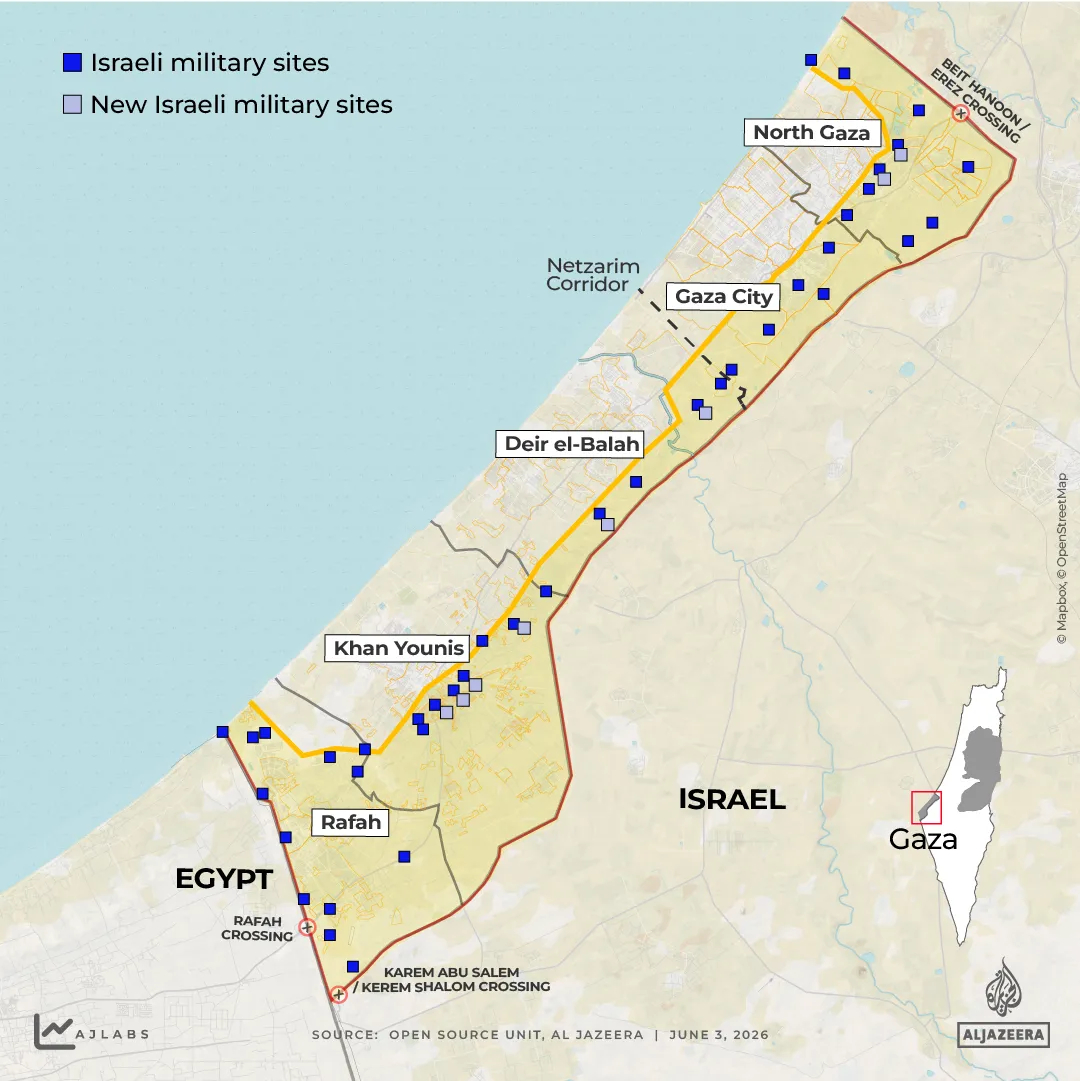
The Yellow Line is the demarcation line where the Israeli army withdrew to under the first phase of the Gaza ceasefire that came into effect last October. Israeli military maps indicate the line extends 1.5km and 6.5km (0.9 miles to four miles) inside Gaza from its eastern boundary with Israel and covers roughly 58 percent of the enclave.
The line divides Gaza into two zones: an eastern area under Israeli military control, and a western area where Palestinians face fewer movement restrictions but are under constant threat of air strikes and forced displacement.
|
|
 |
Technocratic Palestinian committee to have ‘full independence’
Under its new announced roadmap, the Gaza Board of Peace says Hamas and other Palestinian factions “agree that all civilian governance and security functions in Gaza shall be handed over” to the National Committee for the Administration of Gaza (NCAG) – an apolitical, technocratic Palestinian committee tasked with handling day-to-day civil administration inside the territory.
“They also assert that NCAG shall enjoy full independence in carrying out its responsibilities and that the factions shall not interfere in NCAG affairs during the transitional period,” said the board.
“Upon fully assuming its responsibilities in Gaza, NCAG shall maintain the continuity of civilian institutions and public services,” it said.
|
|
|
Hamas’ agreement to Trump’s disarmament plan ‘calls Israel’s bluff’
Julie Norman, an analyst with the Middle East and North Africa Program at Chatham House, has said, “Hamas’ reported agreement to Trump’s disarmament plan essentially calls Israel’s bluff.”
“For the past nine months, Hamas’s refusal to disarm has been held up as the primary obstacle to unlocking other elements of the ceasefire plan, including the entry of the technocratic National Committee for the Administration of Gaza (NCAG) and the International Security Force,” the analyst told Al Jazeera via email.
The announcement that Hamas has agreed to a roadmap for its disarmament can now shift that dynamic, yet it is unlikely things will change on the ground anytime soon.
“The last thing Israeli Prime Minister Benjamin Netanyahu wants going into October’s elections is US pressure to withdraw from Gaza, and it’s likely he will foot-drag any further negotiations as much as possible,” Norman said.
“Slow-walking the process also suits Hamas. It’s a pragmatic move by new Hamas leader Khalil al-Hayya that keeps the group in the conversation and improves their positioning with the Board of Peace. But they know that actual decommissioning will not be immediate.”
|
|
|
How will the Board of Peace demilitarize Gaza?
First, there has to be acceptance by all the parties. That is one of the things noted in the statement put out by the Board of Peace, which US President Donald Trump established at the end of 2025. Basically, it is an organization that is running parallel to the work that is done by the United Nations.
Once there is this joint acceptance by Hamas and other Palestinian groups, as well as by Israel, then they get to the process of trying to demilitarize Gaza — where the very lengthy and detailed process of Hamas giving up its weapons, as well as the Israeli military pulling out of those sections of Gaza which it has occupied since the ceasefire took effect several months ago, begins.
Then they are going to bring in this new government as the National Committee for the Administration of Gaza, which will basically replace Hamas as the governing entity in Gaza responsible for all civic and state services for the people who live in Gaza.
Then at some point, they will try to figure out how to organize and pay for the reconstruction of all of the damaged buildings and reconstruction of Gaza during the war which started after the October 7, 2023 attacks.
Then, eventually, according to the Board of Peace, they will get to a point where not only do you have a situation where Israel’s security is guaranteed, but you also have a separate government in Gaza, which is part of a greater Palestine. Then the talk about possibly establishing a long-favored two-state solution begins. Two states, Israeli and Palestinian, dependently coexisting side by side.
But what’s missing is an actual timeline. US officials have been telling reporters that they don’t want to be tied too strictly to deadlines because they know at any given moment, on any given day, there can be some sort of complication that arises, that needs to be mitigated before the Board of Peace says the next step of this political transition can take place.
|
|
|
People in Gaza are cautious about the draft peace deal
In Gaza, people are cautious [of the draft peace deal] and it has to do with past experiences.
Over the past months, there have been many statements, many announcements and political breakthroughs over progress [of the deal] which then ended in collapse and failure to bring any meaningful change in their lives.
So this time, they’re being careful. They’re not interested in the politics behind all this. They’re interested in the political aspect of the governance.
So the immediate concern revolves around the bombing, whether it is going to stop or not, whether they can go outside running their daily errands without constantly being attacked by unexpected, unpredictable drone strikes that have been going on.
People want to feel safe on the streets and see more of the humanitarian aid coming in … as well as the withdrawal of the Israeli military, so that they can go back to their homes. The vast majority of Palestinians are displaced in displacement camps here, and their living conditions are difficult to experience. So these are the things they are concerned about.
|
|
|
‘Will be difficult’ for Netanyahu to oppose Trump on latest Gaza agreement
Israel has long demanded the full disarmament of Hamas, saying that all weapons need to be put outside of Gaza, not stored with a Palestinian entity overlooked by international bodies.
And Israel has long used security as a way to derail potential agreements, as a way to point out that Hamas has not respected its end of the bargain, even as we see how Israeli forces continue their bombardment in Gaza.
It will be interesting to see how Israel will try to spin this latest agreement [for Hamas to disarm in phases that would be matched by Israeli withdrawal from Gaza] and if it finds ways not to go through with the latest agreement.
It would be very difficult for Netanyahu to stand against US President Trump, who wants to push ahead on a deal that he has wanted to make progress on and push for.
|
|
|
Trump says Israel has been ‘very good’ about Hamas disarmament plan
Trump says there is an “understanding” with Israel when it comes to the Hamas disarmament plan and said that they have been “very good about it”.
“Most people said that would be a deal that would be undoable. Now, will it go through its ups and downs? It’s a very complex situation over there,” he said.
“It’s a great breakthrough; nobody thought that would be possible to disarm Hamas. That shows you how much success we’re having with Iran, because if you go [back] four months ago, five months ago, a deal like that would have been impossible. So, it’s a big step for the Middle East and people are impressed by it and surprised by it,” he added.
|
|
|
About Hamas’s disarmament agreement
“Today, the Board of Peace reached a HISTORIC agreement for the COMPLETE DISARMAMENT of Hamas and all other armed groups in Gaza. This is a monumental step toward lasting PEACE and SECURITY,” Trump wrote on Truth Social late on Thursday.
“This agreement is a critical step towards Gaza finally being governed by a new Palestinian government that will work closely with the Board of Peace to help the Palestinian people. At the same time, Israel will have the security it deserves, with Gaza no longer used as a base for terror attacks.”
Trump said the agreement would be implemented in stages, with Israeli forces withdrawing as the disarmament process advances. “Agreement will be carried out in carefully structured phases. As disarmament is completed, Israeli forces will withdraw, and the International Stabilization Force will work with a new Palestinian police force to take responsibility for Gaza being safe for its residents and its neighbors,” he wrote.
|
|
|
| |
|
|
Ben-Gvir says draft peace plan for Gaza ‘unacceptable to Israel’
Far-right Israeli National Security Minister Itamar Ben-Gvir says the draft peace deal “is unacceptable to Israel”.
An agreement “to stop the assassinations” of Hamas members is “tantamount to agreeing to Hamas organizing for the next massacre”, he posted on X.
“The assassinations in Gaza must continue, the encouragement of immigration must happen, Israel must win,” he said.
As we reported earlier, Israel’s former chief of staff and one of the contenders to replace Netanyahu, Gadi Eisenkot, wrote on X that any agreement that does not see “the destruction of Hamas’ military-governmental power or its dissolution … is a complete failure”.
“The fact that the prime minister chooses not to present the agreement to the Israeli public raises major question marks as to whether Israel is a partner in it or whether an agreement was once again forced upon Israel without its involvement,” he said.
|
|
|
Former Israeli chief of staff says Netanyahu ‘capitulated’ on draft peace deal
Gadi Eisenkot says the draft peace plan has shown the “outrageous gap” between what Netanyahu promised and the reality of the situation.
“After the heavy prices, the fallen and the wounded, he has capitulated in his political weakness without achieving the war’s objectives, instead of ending it from a position of strength,” Eisenkot posted on X.
“Leaving Hamas in power in Gaza is the Netanyahu-Smotrich concept of preferring Hamas rule, which led to the disaster of October 7. The State of Israel must not accept a reality in which Hamas survives, rearms and waits for the opportunity to carry out the next massacre!”
Eisenkot added that Israelis deserved a leadership that “wins, tells the truth and stands by its goals. Israel must win, and it will win”.
|
|
|
Global reactions
|
Belgian FM welcomes Gaza draft peace deal, urges swift implementation
Maxime Prevot has welcomed the draft agreement, calling it a potential step toward ending the conflict and “towards lasting peace and security for Israelis and Palestinians alike”.
Posting on X, Prevot said, “This must open the way to greater humanitarian access, the return of Palestinian governance in Gaza, and renewed momentum towards a negotiated two-state solution. Diplomacy deserves a real chance.”
|
|
|
EU foreign policy chief welcomes Gaza peace draft deal
The European Union’s foreign policy chief Kaja Kallas has welcomed the draft peace deal which aims to fully end Israel’s war on Gaza.
In a statement on X on Friday she noted that for the deal to be successful, all parties should be fully committed to the deal.
“Verifying Hamas’ compliance will be a significant challenge. Israel would need to eventually withdraw from Gaza,” she said.
|
|
|
UK foreign secretary welcomes Hamas’s disarmament
British Foreign Secretary Ed Miliband has welcomed the announcement that Hamas will disarm.
In a statement on X, Miliband said the focus must now be to “implement the 20-Point Plan in full” which he said “includes the withdrawal of the [Israeli army] from Gaza and respect for the ceasefire by all parties.”
He noted that conditions for people in Gaza remain appalling and stressed that Israel “must immediately end the unacceptable restrictions on aid so that more food, medicine and support can reach those who need it.”
|
|
|
UN Guterres hails Hamas deal as ‘good news’
UN Secretary-General Antonio Guterres hailed the Hamas deal, calling it the “only good news in recent days”.
“Let me be clear: the fighting must stop on all fronts in the region,” he said.
“We are now six months into the military escalation in the Gulf. What began as a regional conflict is increasingly becoming a driver of global instability,” he added.
|
|
|
Qatar welcomes Hamas’s acceptance of draft peace deal
Qatari Prime Minister and Foreign Minister Sheikh Mohammed bin Abdulrahman bin Jassim Al Thani spoke to the head of Hamas political bureau, Khalil al-Hayya, and welcomed the decision to accept a roadmap for implementing the second stage of the ceasefire.
According to the Qatari foreign ministry, Sheikh Mohammed said in a phone call to al-Hayya that he hopes that by accepting the roadmap, it will put an end to the “suffering of the brotherly Palestinian people in the Strip”.
“Achieving their aspirations for security and stability, and emphasizing in this context the necessity for the international community to fulfill its responsibilities, press Israel to comply with its obligations under the agreement, and stop its ongoing violations of the rights of the Palestinian people,” he said.
“Thereby ensuring the completion of the implementation of the roadmap, leading to the achievement of peace and stability in the Gaza Strip,” he added.
|
|
|
Pakistan’s Sharif hopes Gaza draft peace deal leads to establishment of an independent Palestine
Pakistan’s Prime Minister Shehbaz Sharif has welcomed the Gaza Board of Peace’s draft peace deal.
In a statement on X, Sharif said that Pakistan hopes that “these efforts will lead to the realization of the right to self-determination of the people of Palestine” and “the establishment of an independent, sovereign, and contiguous State of Palestine, based on the pre-1967 borders with Al-Quds Al-Sharif as its capital.”
|
|
|
Canada’s Carney says Gaza draft peace plan could be a step towards ‘peace and security’
Canada’s Prime Minister Mark Carney has said the draft peace deal for Gaza, “if accepted and implemented, could be an important step towards peace and security.”
“We remain committed to a just and lasting resolution to the Israel-Palestine conflict, based on a negotiated two-state solution in which Israeli and Palestinian people can live in peace, security and dignity,” Carney added.
|
|
|
| end global reactions |
|
|
| |
Israeli attacks despite Gaza road map to peace
|
|
| |
|
|
Israeli army claims killing of Mujahideen Brigades commander
The Israeli military has issued a statement claiming it killed Mujahideen Brigades commander Ahmed Hussein Mohammed Kafina in a strike on an unspecified location in the southern part of the Gaza Strip.
The army claimed Kafina had taken part in the attacks of October 7, 2023, carried out the abduction of Noa Argamani and Avinatan Or, and directed the abduction of Sudthisak Rinthalak.
|
|
|
Israel claims killing of Hamas deputy commander
The Israeli army and the country’s security agency Shin Bet have announced the killing of Abd al-Rahim Abd al-Hay Youssef Kardi, whom they claim was a Hamas deputy commander.
“Kardi infiltrated Israeli territory during the October 7 massacre,” the Israeli army said in a statement on X.
|
|
|
Palestinian killed in an Israeli air strike in central Gaza
An Israeli air strike on Salah al-Din Street in central Gaza has killed at least one Palestinian, according to medics at the Al-Aqsa Martyrs Hospital.
The strike occurred hours after the Gaza Board of Peace announced the Hamas disarmament agreement.
|
|
|
Israeli drone strike injures several people in Deir el-Balah
Several people have been injured, some with serious wounds, following an Israeli drone strike on Deir el-Balah in the central Gaza Strip.
Attacks have continued on the enclave today, with one person killed and others wounded in an Israeli air strike targeting Palestinians on Salah al-Din Street also in central Gaza.
A number of people, including a woman and a child, were wounded in an Israeli drone strike on the Intelligence headquarters area northwest of Gaza City.
|
|
|
Israel destroys home in Gaza’s Nuseirat refugee camp
An Israeli air strike has destroyed a house in the Nuseirat refugee camp in central Gaza.
Medics at the Al-Awda Hospital reported that at least 10 people were injured in the Israeli attack.
The attack comes as the world continues to celebrate the newly announced peace deal for Gaza, which, if implemented, would see Hamas disarm and Israel gradually withdraw from the Strip.
|
|
|
Israeli drone strike kills Palestinian in Gaza City’s Sabra neighborhood
An Israeli drone strike on Gaza City’s Sabra neighborhood has killed at least one Palestinian, a source working in the enclave’s ambulance and emergency services has told Al Jazeera.
Earlier, an Israeli air strike on Salah al-Din Street in central Gaza, killed one Palestinian, according to medics at the Al-Aqsa Martyrs Hospital.
The Israeli strikes come hours after US President Donald Trump’s Board of Peace announced a draft peace plan for Gaza.
|
|
|
| |
|
|
Israeli pogrom in the West Bank
|
| |
|
|
Israeli colonists, protected by Israeli forces, storm town of Tal near Nablus (again)
Dozens of Israeli colonists have stormed the town of Tal, south of Nablus in the occupied West Bank, under the protection of Israeli forces.
Last week, Israeli colonists launched a deadly raid on the town, which left four Palestinians and two Israelis dead.
|
|
|
Israeli forces arrest 7 Palestinians amid raids in Nablus governorate
The Israeli army has arrested seven Palestinians from the Nablus governorate, amid raids in several neighborhoods in Nablus city as well as in the towns of Tal and Salem, the Wafa news agency has reported.
At least three of the arrested were from Tal, where Israeli colonists were conducting attacks again after two Israelis were killed there last Friday, the Palestinian news agency said.
Israeli forces began raiding the town of Tal on Thursday, seizing four homes and converting them into military barracks, locals are saying.
|
|
|
Israeli colonists storm Nablus city under army protection
Dozens of Israeli colonists are storming the western part of Nablus city under the protection of the Israeli army.
|
|
|
At least 10 Palestinians, including 4 children, injured in Israeli raid on Nablus
At least 10 Palestinians, including four children, have been injured during a raid by Israeli colonists and military forces in the Junaid neighborhood west of Nablus, according to the Palestinian Red Crescent.
|
|
|
Palestinian youth injured by Israeli gunfire in Junaid raid
The Palestinian Red Crescent is now saying that a Palestinian youth was injured by live ammunition fired by Israeli forces.
|
|
|
At least 11 Palestinians injured by Israeli forces and colonist in Nablus and nearby villages
Medical sources in Nablus are saying that at least 11 Palestinians have been injured during attacks by Israeli forces and colonist in the city and several surrounding villages.
Israeli forces also raided Khallat al-Hummus in Masafer Yatta, south of Hebron, while colonist attacked the village of Atara, north of Ramallah, in the occupied West Bank.
|
|
|
Israeli army says colonist have left Nablus area
The Israeli military says “Israeli civilians” had entered Area A of the occupied West Bank which is prohibited under Israeli law.
All have since left the Nablus area, the statement added.
The army also said it received reports of a cemetery being vandalized.
There were 3,033 Israeli colonist attacks between January 1, 2025 and the end of last month, according to data from the United Nations Office for the Coordination of Humanitarian Affairs (OCHA).
Earlier, we reported injuries to at least 11 Palestinians by Israeli forces and colonist in Nablus and nearby villages.
|
|
Earlier today:
Israeli colonists, protected by Israeli forces, storm town of Tal near Nablus (again)
|
Israeli colonists set fire to agricultural land south of Nablus
Israeli colonists have set fire to agricultural lands in Burin, south of Nablus, the Wafa news agency has reported.
Local sources said a number of colonists attacked Palestinian-owned farmland and set it ablaze, burning several olive trees.
They added that Israeli colonists obstructed Palestinian Civil Defense crews from reaching the area to extinguish the fire.
|
|
|
Israel’s military says 200 detained in West Bank in past week
Israel’s military has detained more than 200 people and confiscated cash in the occupied West Bank over the past week.
They were wanted on suspicion of crimes including “inciting terrorism,” smuggling and weapons dealing. Others were accused of unspecified links with Hamas, according to a military statement.
Dozens of items “used to manufacture weapons” were seized, in addition to tens of thousands of shekels “intended for terrorist activity”.
Israel’s military regularly carries out raids and arrests, many held without charge under its controversial system of “administrative detention”.
|
|
|
Happened in the Occupied West Bank
- Israeli forces have arrested a number of Palestinians who confronted a colonist attack on the outskirts of the village of Tal, southwest of Nablus.
- Israeli colonists set fire to guard rooms in the quarries southwest of Deir Abu Mash’a in the Ramallah district.
- Dozens of colonists stormed an archaeological site in the town of Sinjil, northeast of Ramallah.
- A colonist set fire to olive groves in the village of al-Maniya, southeast of Bethlehem, before fleeing the scene.
- Ten Palestinians, including four children, were injured during an attack by colonists and Israeli forces on the Junaid neighborhood west of Nablus.
- A Palestinian man was shot by colonists east of Hebron after attempting to defend a farmer who was being attacked by colonists near the Asfar settlement, east of the town of ash-Shuyukh.
- Israeli forces stormed the Solomon’s Pools tourist area south of Bethlehem.
- The Israeli military also launched a widespread campaign of raids and arrests targeting towns and villages around Nablus, Tulkarem, Bethlehem, Hebron, Jerusalem, Salfit and Ramallah.
|
|
|
What is happening in Tal?
Israeli forces have shot and wounded at least one Palestinian, arrested at least three, and closed entrances to the village of Tal in the occupied West Bank as more than 100 Israeli colonists marched towards the village.
A colonist attack last weekend had left four Palestinians and two Israelis dead.
The Israeli military has carried out near-daily raids and arrests in Tal, which is near Nablus in the northern West Bank.
Munther Shtayya, vice president of the local council, said at least 24 people from Tal were still in Israeli custody.
“All those arrested had no involvement in what happened last week. It was simply an expression of the resentment felt by the Israelis, and part of it was a form of punishment,” said Shtayya.
|
|
|
Israeli colonists injure child by gunfire during attack northwest of Ramallah
A 10-year-old child was injured by shots fired by Israeli colonists during an attack on the village of al-Mughayyir, northeast of Ramallah in the occupied West Bank, Wafa reports.
According to local sources, a group of colonists attacked a sheep farm west of al-Mughayyir and fired live ammunition, leading to a 10-year-old Palestinian being shot in the back.
|
|
|
Israeli forces assault Palestinian man near Awarta checkpoint, Nablus
Israeli forces have assaulted a Palestinian man near the Awarta checkpoint, south of Nablus in the occupied West Bank, Wafa reports.
According to the director of the Red Crescent’s ambulance and emergency centre in Nablus, Amjad Ahmed, ambulance crews treated a 22-year-old man who was injured after being assaulted.
The Palestinian man was also one of the detainees from the town of Tal, southwest of Nablus.
|
|
|
Israeli forces injure Palestinian teen south of Bethlehem
At least one person has been injured by live ammunition during an incursion by Israeli forces into the town of Beit Fajjar, south of Bethlehem, Wafa reports.
According to a local source, Israeli forces stormed Beit Fajjar and positioned themselves in the “Triangle” area, firing live ammunition, which led to a 15-year-old being shot in the foot.
|
|
|
| |
|
|