| Highlights from yesterday |
|
Comments |
- Diplomatic efforts to reopen the Strait of Hormuz ramp up, with Iran saying talks with Oman are proceeding “positively”.
- US Secretary of State Marco Rubio also reports “progress” in talks on the strait, while Treasury Secretary Scott Bessent suggests an agreement could be possible as early as “today or tomorrow”.
- Qatari Emir Sheikh Tamim bin Hamad Al Thani speaks with US President Donald Trump as Doha says mediators are working with all parties to find a diplomatic resolution to the war.
- The US military says it has redirected 45 commercial vessels since mid-July under its “blockade against Iran”.
|
|
|
|
|
|
|
| |
|
|
Rubio says progress made to reopen Strait of Hormuz
The US secretary of state says there has been progress in negotiations with Iran to reopen the Strait of Hormuz.
Marco Rubio made the remarks during a meeting with Paraguayan Foreign Minister Rubén Ramírez Lezcano to sign a memorandum of understanding on nuclear cooperation.
|
|
The US is portraying itself as taking part in the Hormuz talks between Iran and Oman. But we don't have find any indication that this is the case.
|
Brent falls below $80 on prospects of Hormuz deal
Brent crude, a key global benchmark, has fallen below $80 a barrel – a considerable drop from over $100 at the height of the war.
This is something that consumers – not just here in the US but worldwide – see almost immediately.
The price of crude has a direct impact on how much people pay to put fuel in their vehicles, to provide electricity to their homes, and how much they pay for consumer goods, because everything that is transported to the market is usually done through a petroleum-fuelled vehicle.
The prospects of a deal to normalize shipping traffic through the Strait of Hormuz are also giving investors some confidence. On Tuesday, as Brent fell, the Dow Jones hit a new record, closing above 54,000.
That’s not just due to the ongoing negotiations between Iran and Oman on the reopening of the Strait of Hormuz, but also comes down to the fact that the US economy is still robust despite all of the energy shocks in the past five and a half months. So, the record profits that are being reported by US companies are helping to fuel a rise in the stock market.
Of course, if there’s no deal, this could all change.
|
|
|
US has used up nearly all its long-range precision missiles: Media reports
Reuters and CBS News report that the US has used nearly all of its global stockpile of long-range precision missiles during the war on Iran.
Reuters, citing three sources, said the US has used “virtually all” of its Army Tactical Missile Systems (ATACMS) and Precision Strike Missiles. CBS News also reported that the US has used nearly all of its global stockpile of these weapons.
The Pentagon, meanwhile, pushed back against the claims.
“America’s military is the most powerful in the world and has everything it needs to execute at the time and place of the president’s choosing,” Sean Parnell, the chief Pentagon spokesman, told CBS News.
US Defense Secretary Pete Hegseth has previously also dismissed concerns about munitions deficits.
|
|
"..the US has used “virtually all” of its Army Tactical Missile Systems (ATACMS).."
Videos were found and documented, showing that missiles of this system where fired on Iran from Kuwait.
|
US’s THAAD interceptors depleted by up to 80%: Media
Earlier, we brought you reporting from Reuters and CBS that said the US has used nearly all of its global stockpile of long-range precision missiles during the war on Iran.
Now, CNN reports that the US has exhausted nearly 80 percent of its interceptors for the key THAAD missile defence system. The outlet, citing two sources familiar with the matter, reported that “the US military has burned through nearly four-fifths of its THAAD missile inventory compared to pre-war numbers and roughly half of its Patriot interceptors since the start of the war”.
The dwindling munition reserves, along with concerns from Middle East allies about potential Iranian retaliation, reportedly convinced Trump to call off planned large-scale strikes against Iranian infrastructure, CNN said.
Pentagon and White House officials pushed back against concerns over inventory shortages.
Chief Pentagon spokesman Sean Parnell told CNN that “America’s military is the most powerful in the world and has everything it needs to execute at the time and place of the President’s choosing”.
White House spokesperson Anna Kelly added that the military “has more than enough munitions, ammo, and stockpiles to serve all of President Trump’s strategic goals and beyond”.
|
|
“the US military has burned through nearly four-fifths of its THAAD missile inventory .."
THAAD missile systems where deployed to what is called "Israel", Jordan and Saudi Arabia
|
Iran-Oman talks on Hormuz progressing, no final agreement yet
Discussions are progressing between Iran and Oman on arranging the passage of vessels through the Strait of Hormuz, especially at the technical and political levels, although there is no final agreement in place yet.
A technical framework is reportedly under discussion that would give Iran full control over inbound shipping, while Oman would give clearance to outbound vessels after notifying Iran.
But Iranian officials are reiterating that these are only bilateral discussions between Oman and Iran, without any direct negotiations with the United States. Esmaeil Baghaei, Iran’s Foreign Ministry spokesperson, also blamed the United States for the crisis in the Strait of Hormuz.
Despite that, Washington has also acknowledged progress in the talks. US Secretary of State Marco Rubio said there had been progress, although no final agreement had been reached. Likewise, the US Treasury Department said there was an opportunity to reopen the Strait of Hormuz, but maritime risks remained high as vessels continued to be attacked by projectiles.
Despite the hardened rhetoric from both sides, talks appear to be progressing. At the same time, the Strait of Hormuz remains the centre of gravity and Iran’s main source of strategic leverage.
|
|
|
Any deal must lead to Iran ‘formally announcing’ it will cease attacks on ‘neutral civilian shipping’
David Des Roches, a former Pentagon director of Arabian Peninsula affairs, said any credible agreement would need Iran to formally commit to ending attacks on shipping in the Strait of Hormuz.
“Geography gives Iran the ability to disrupt the sea lanes when they want to do it,” he said. “So Iran has that ability if they choose to exercise it.”
The immediate priority, he argued, is restoring the “ancient rights” of neutral civilian vessels to transit another country’s sovereign waters without fear of Iranian attack. “That’s the baseline for an agreement,” he said.
“What’s really needed here is some sort of agreement that leads to Iran formally announcing that it will cease to attack neutral civilian shipping, whether in Omani waters or in international waters.”
Des Roches said such a commitment was a condition for the resumption of normal trade.
“This is not a military problem. This is a commercial problem of insurance,” he said. “The insurance market needs to have confidence that Iran will cease attacking civilian shipping, and then normal trade will presumably resume to the benefit of all the Gulf littoral partners, including Iran, as well as their trading partners.”
|
|
|
New Zealand foreign minister links rising unemployment to Hormuz closure
New Zealand Foreign Minister Winston Peters has blamed the country’s rising unemployment on the closure of the Strait of Hormuz.
“The rise in unemployment is directly attributable to the recent conflict in the Strait of Hormuz and the resulting massive increase in fuel costs, which directly affects business costs,” he wrote on X.
“We said at the start of this conflict that this would severely impact both inflation and unemployment.”
Peters said the crisis strengthened the case for New Zealand to develop its own oil reserves. “Our policy to find the reserves we have and extract it, will give us fuel security and true resilience, and will stop our country being at the whim of international decisions and geopolitical influences,” he added.
New Zealand’s unemployment rate rose to 5.6 percent in the second quarter, its highest level in a decade, while inflation reached 4.1 percent amid higher fuel costs, according to Statistics New Zealand data cited by Reuters.
|
|
|
Oil stabilizes following two-day drop
Oil prices are stabilizing after sharp declines over the previous two trading sessions, with Brent crude futures gaining 26 cents, or about 0.33 percent, to $79.62 a barrel as of 01:10 GMT.
US West Texas Intermediate (WTI) crude went up 12 cents, or 0.16 percent, to $75.90 a barrel.
The stabilization came as investors waited to see whether diplomatic efforts to end the US war on Iran and restore shipping traffic through the blockaded Strait of Hormuz were making progress, according to Reuters.
|
|
|
How much profit are Big Oil companies making?
The closure of the Strait of Hormuz has sent oil prices spiralling and driven up the cost of food and other goods.
Yet even as the war on Iran has upended markets, so-called Big Oil companies have reaped extraordinary profits from the fallout.
- ExxonMobil: The US’s biggest oil company reported second-quarter earnings of $14.5bn, with adjusted earnings of $14.7bn, and marked its highest quarterly profits in four years.
- Chevron: The US’s second-biggest company reported second-quarter earnings of $12bn, its highest quarterly profit in six years, beating analysts’ estimates.
- Shell: The British-Dutch group, which is Europe’s biggest oil company, more than doubled its second-quarter earnings, reporting nearly $10bn in earnings and exceeding analysts’ expectations,
- TotalEnergies: The French oil giant’s earnings rose 67 percent in the second quarter, its best quarter in nearly three years.
- BP: Another UK oil major reported second-quarter profit of $5.73bn, more than double the $2.35bn it earned a year earlier and above analysts’ forecasts.
- Saudi Aramco: The world’s largest state-owned oil producer also reported sharply higher quarterly earnings – rising 44 percent year-on-year to $32.69bn.
|
|
|
Iraq shipped 30 million barrels of oil via Hormuz in past month
Iraq exported more than 30 million barrels of crude oil through the Strait of Hormuz between July 4 and August 4, about 29 percent of its pre-war monthly average, AFP reports.
Before the war, Iraq exported an average of 105 million barrels per month through the strait, mostly from its southern terminals near Basra.
Ali Nizar, head of Iraq’s state oil marketer SOMO, estimated that between 35.5 million and 37 million barrels passed through the strait in July. He said another 7 million barrels were exported through the Iraq-Turkiye pipeline to Ceyhan.
Iraq has also transported some crude by tanker trucks through Syria, while plans for a pipeline to Syria’s Baniyas port remain under study.
|
|
|
Iran-Oman deal on Hormuz could help talks between Iran and US resume
There are now two negotiating tracks connected to the war between the US and Iran.
The first track, and perhaps the most important for the moment, is the one between Iran and Oman. These two countries are trying to figure out how to negotiate a deal so that commercial ships can transit the Strait of Hormuz and the Sea of Oman without the risk of conflict.
There is great anticipation among members of the Trump administration that such a deal could be reached in the coming days. There had been some expectation that perhaps it could have happened as soon as Tuesday, but now perhaps it may not be achieved until Wednesday.
The prospect of such an agreement helped bring the price of crude oil down to below $80 a barrel on Tuesday. And that is a good thing for consumers in the US and around the world, because the price of crude oil has a direct impact, not just on people putting fuel in their vehicles or trying to power their homes, but also on the price of consumer goods.
The larger question is how quickly, once a deal can be achieved between Iran and Oman, can negotiations resume between the US and Iran? It’s now thought that if they can settle the issue on transit in the Strait of Hormuz, they might be able to get to the larger question of ending the war.
|
|
|
Trump says US having ‘very good discussions’ with Iran
The US president says Washington and Iran are engaged in “very good discussions”, despite repeated denials from Iranian officials.
“We’re having very good discussions. They don’t like to admit that, but yeah, it’s a little bit disconcerting,” Trump said during an interview with Fox News.
“The only thing that matters is action, and they want to make a deal. We’ll see what happens. If they don’t make a deal, it’s going to be too bad,” he added.
|
|
The US is portraying itself as taking part in the Hormuz talks between Iran and Oman. But we don't have find any indication that this is the case.
|
Funeral for family killed in US strike on Iran’s Qeshm Island
A funeral has been held for the victims of last week’s US strike on Iran’s Qeshm Island, which killed a couple and their two-year-old child.
Iran’s chief negotiator and parliamentary speaker, Mohammad Bagher Ghalibaf, said the US would “pay the price” for their deaths.
|
|
|
Trump warns Iran faces ‘hard hit’ if talks fail and Hormuz remains closed
He said to Fox News.:
- “Iran will never have a nuclear weapon. They already can’t, but it’s going to be formal.”
- “The strait [of Hormuz] is going to be open very soon, or they’re going to get hit very hard, and then the strait is going to be open.”
- “We were going to have a tremendous attack, the biggest since World War II, and they called me and said, very politely, ‘Please can we talk? Can we talk?’ And I said, ‘Yes, we can talk. Let’s get it done. Finally, let’s get it done.'”
- “If they back out again, they’re going to get hit really hard; they know that; they understand that.”
- “They wouldn’t be talking if we weren’t doing what we’re doing. We hit them very, very hard, but the hard hit is yet to come, and hopefully, we won’t have to use it. I hope we won’t.”
|
|
|
Iran-Oman talks ‘aim to establish a middle corridor’ in the Strait of Hormuz
Iran’s state-owned Press TV is reporting that talks between Tehran and Muscat have entered “a new phase”, with a “bilateral understanding within reach”.
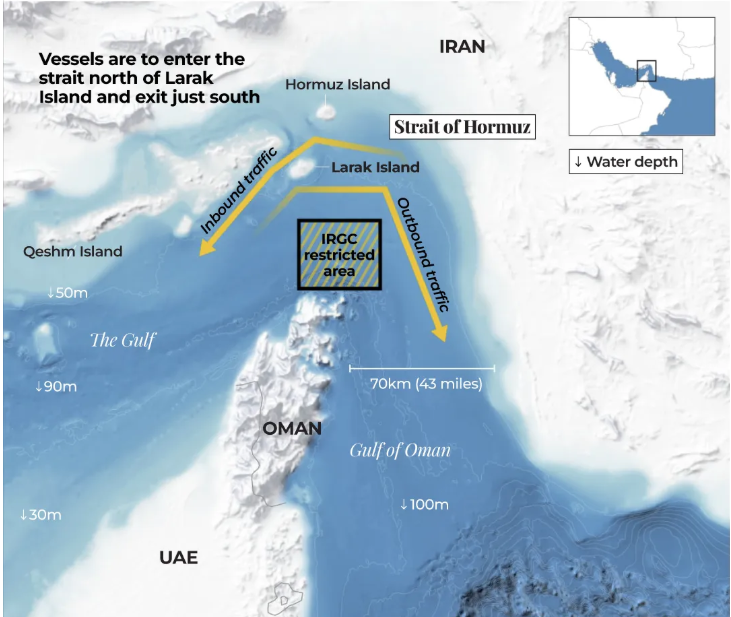
Citing a senior Iranian official, the channel said the talks “aim to establish a middle corridor through the Strait of Hormuz to ensure safe navigation while protecting Iran’s rights as a coastal state”. Once operational, the new corridor would replace both the existing northern and southern routes, according to the official.
The strait, a waterway just 34km (21 miles) wide, was an international shipping route before Iran closed it in response to US and Israeli attacks. Before the war, vessels followed a UN-adopted two-way traffic separation scheme, with sailing corridors running through both Iranian and Omani waters.
After the war began, Iran ordered all vessels transiting the strait to follow a new route through its own waters around Larak Island, or the so-called northern route. Following the signing of a ceasefire deal in June, the US pushed for an alternative route hugging the Omani coast, known as the southern route. But Iran opposed the move and launched new attacks on shipping, triggering the latest round of hostilities.
Earlier on Tuesday, Iran’s Foreign Ministry spokesman Esmaeil Baghaei said the ongoing talks between Iran and Oman were “positive” at both the technical and political levels, and were focused on designating safe routes for maritime passage through the Strait of Hormuz.
|
|
 |
Iran blames US for delay on Hormuz deal with Oman
Iran’s Sepah News, citing an informed official, is reporting that US interference and threats of military action are the primary reasons for the delay in reaching an agreement with Oman.
“The main reason for the delay in the deal with Oman regarding the Strait of Hormuz is US interference and Trump’s threats,” the official was quoted as saying.
The official added that “as long as US interference and threats of military attack against Iran exist, the agreement will be delayed”. He added that “Iran will not make any agreement under the shadow of threats”.
|
|
|
Trump signals deal with Iran could come in 48 hours
The US president has told reporters that negotiations with Iran are “moving along very nicely”.
“We’ll find out. We’ll know in 48 hours,” he added.
|
|
|
About the latest in Iran-Oman talks on Hormuz
As we’ve added in the summaries, diplomatic efforts to reopen the Strait of Hormuz are gaining momentum, with Iran and the US signaling that a deal between Tehran and Oman could come soon.
Neither side has revealed details, though Iran’s Foreign Ministry spokesman, Baghaei, said talks are “focused on establishing safe shipping routes while safeguarding the sovereign rights and security interests of Iran and Oman alike”.
Reuters, citing a senior Iranian source involved in the talks, said discussions were being held on a temporary plan and that Iran wants control over inbound shipping and visibility over outbound traffic, with the ability to intervene if necessary. The outbound lane would run between Iran and Oman, with exit clearance granted through Oman after notifying Tehran.
The source told Reuters that Iran “is unlikely to change its position” as it has already dropped its initial demand for full control over traffic in both directions.
AP, citing two regional officials, reported a similar framework, with ships entering via an Iranian-controlled route and exiting via an Omani one. It also said service fees would be charged for security and environmental protection, and added that any deal would be linked to lifting the US blockade on Iran’s ports.
Meanwhile, Iran’s Press TV also reported that the talks aim to create a “middle corridor” in the strait that would replace the existing northern and southern routes.
|
|
|
Deepening mistrust in US-Iran diplomacy brings Pakistan to its limits
Pakistan’s position has remained broadly unchanged since the US-Israel war on Iran began on February 28: advocating for restraint and calling for dialogue and a diplomatic solution.
In April, the Pakistani government hosted in Islamabad the first direct US-Iran talks in decades. They culminated in the Islamabad Memorandum of Understanding (MoU), signed in June by Pakistani Prime Minister Shehbaz Sharif, Iranian President Masoud Pezeshkian and Trump.
Yet each attempt at de-escalation has unravelled within weeks. An April ceasefire collapsed within days, prompting a US naval blockade on Iran’s southern ports, while the MoU lasted barely a month as the two sides exchanged attacks and the US reimposed its naval blockade.
Throughout successive weekly briefings in July, Pakistani Foreign Ministry spokesperson Tahir Andrabi has repeated that the MoU remains the framework for peace, even as the ceasefire it was meant to underpin has collapsed several times
|
|
|
Shipping traffic in Hormuz remains severely limited
Shipping traffic in the Strait of Hormuz and the Bab al-Mandeb did not change on Tuesday compared with the previous day, the Reuters news agency reports, citing figures from Kpler, a shipping data firm.
It said eight vessels transited the Strait of Hormuz, including five tankers and three bulk carriers, the same as the previous day. Six of the vessels, three tankers and three bulk carriers, were entering the strait, while a gas carrier and a tanker were exiting.
Roughly 130 to 140 ships would typically transit the waterway before the US-Israel war on Iran began on February 28 and Iran responded by closing the strait.
In the Bab al-Mandeb, 20 vessels crossed the strait on Tuesday, with 10 entering and 10 exiting the waterway, Kpler data showed, the same as the previous day.
The Houthis in Yemen declared a maritime blockade of Saudi Arabia in the Red Sea on July 20, launching attacks on several Saudi tankers and oil facilities, and opening a new front in the war. Crossings in Bab al-Mandeb averaged about 41 vessels a day in the week before the Houthis’ declaration.
|
|
|
‘US backs off from Iran before markets open on weekdays’
As we’ve been previously added to our summaries, Trump has claimed talks with Iran are continuing after calling off a planned “massive attack” on Iran.
Analyst Negar Mortazavi says that talks of a breakthrough often come just before financial markets open after a weekend.
|
|
|
Iranian MP says Trump approach to negotiations ‘contradictory and unreliable’
A member of the Iranian parliament’s national security committee has called Trump’s approach to negotiations with Iran “contradictory and unreliable”.
Esmail Kowsari told Iranian broadcaster IRIB that Trump claimed 75 times that the Strait of Hormuz was open, when it actually wasn’t.
Kowsari also said Trump has spoken of “Iran’s defeat” 106 times and claimed an “imminent deal” with Tehran 88 times.
Trump said late on Tuesday a deal with Iran could come within hours, but Tehran has repeatedly denied having direct negotiations with Washington.
|
|
|
Iranian state broadcaster says any deal with Oman would not immediately reopen Hormuz
Any agreement between Iran and Oman on future shipping arrangements in the Strait of Hormuz would not lead to the immediate reopening of the strategic waterway, Iran’s state broadcaster IRIB reports, citing an informed source.
The source said negotiations on future navigation arrangements are being conducted exclusively between Tehran and Muscat and “have nothing to do with the United States”.
“The possible agreement between Iran and Oman on the arrangements for vessels to pass through the Strait of Hormuz has nothing to do with the immediate opening of this strait,” the source added.
Even if Iran and Oman reach an agreement, the strait will remain closed as long as what Tehran describes as “US violations” continue, according to the report.
“The reopening of the Strait of Hormuz depends on a change in US behaviour and the correction of its violations,” the source said.
The remarks also followed reports in Iranian media that Tehran was close to reaching an understanding with Muscat on a new navigation corridor, provided the US stopped interfering in the negotiations.
Iranian officials have repeatedly accused Washington of trying to influence the talks and delay an agreement through military threats.
|
|
|
Hormuz deal could pave the way for the revival of US-Iran talks
The Iranians are talking about progress being made. But the Strait of Hormuz remains perhaps the most strategic tool in the toolbox when it comes to Iran’s foreign policy – as a means of deterrence. Also, they say the situation in the strait will not return to the situation before the war. The spokesperson for the Ministry of Foreign Affairs spoke about potential agreements, and other diplomatic sources are saying that a deal could be reached by the end of today, as they say good progress has been made.
There are still points of contention. The Iranian side is insisting on its control and the authority it plans to impose on the strait; they are saying that there might be one corridor – not the two that were initially reportedly proposed by the Omani side and that were rejected by the Iranian deputy foreign minister last week.
They are also saying, according to the foreign ministry spokesperson, that they are trying to determine a safe trajectory, including entry and exit pathways for ships and vessels. They are saying that this trajectory should fulfill the sovereign rights of Iran as well as the national interests of both sides.
But while Iranians are saying that, at this point, talks are limited to Iran and Oman, it goes without saying that the US is a key factor. We’ve got a report from state TV today citing an informed source who said that even if a deal were reached today, the breach of the Memorandum of Understanding agreement by the US means there won’t be a reopening of the strait. One of the key points of concern for the Iranians regarding the strait is the removal of the naval blockade by the Americans. They have been constantly saying that this is one of the pre-conditions.
There are other controversies between the two sides: reparations, the nuclear dossier of Iran, the security assurances, the frozen assets and others. It seems that a deal on the Strait of Hormuz between Iran and Oman could, however, pave the way for the revival of the US-Iran talks and getting back to the Memorandum of Understanding in Islamabad.
|
|
"... talks are limited to Iran and Oman.."
Paragraph 5 of the Memorandum of Understanding is clear:
The Islamic Republic of Iran will conduct dialogue with the Sultanate of Oman to define the future administration and maritime services in the Strait of Hormuz in discussion with other Persian Gulf littoral states in line with the applicable international law and the sovereign rights of coastal states of the Strait of Hormuz.
"... it goes without saying that the US is a key factor."
Like Netanyahu, who was singled out from the whole MoU, Trump has been singled out from the whole Paragraph 5. So, the US is not involved in the Hormuz talks but is interfering in these talks, as Trump is threatening Iran amid these talks.
|
‘Very weak MoU’ is fuelling renewed violence in Iran war
Wolfgang Pusztai, a security policy and defence analyst and former defense attaché for Austria, says that although an agreement on the Strait of Hormuz may be reached today or Thursday, it remains “too early to say”.
Pusztai says that the parties involved in mediation are currently “working on a clarification on some points of the very weak memorandum of understanding, which has actually contributed to the renewed outbreak of violence”.
He added that If the agreement between Iran and Oman “recognises that there is no obligation for tolls” but instead introduces some fees for maritime services, “this might very well be accepted by the Americans.”
However, if Iran were to “impose top tolls or a high amount of fees, which is clearly against the UN Convention on the Law of the Sea, the Americans would certainly reject this”.
“This is not only because of the situation in the Strait of Hormuz. It’s because this might also be used as a precedent for other maritime chokepoints,” he said.
Pusztai also explained the inconsistency in “Donald Trump’s rhetoric” as part of “American information warfare against Iran” and how Trump has three distinct narratives for “three different audiences”: his Republican voters, the Iranians and the international audience.
Pusztai concluded that whereas the “opening of the Strait of Hormuz is certainly an important step”, it would not resolve the wider conflict.
|
|
|
Only ‘one or two issues’ remain unresolved in Iran-Oman talks
A senior diplomatic source says that these issues “do not appear to be particularly complex”.
The source said: “Provided there is no malign interference by other parties, an agreement could be reached as early as today or tomorrow.”
The diplomatic source also said that the Strait of Hormuz has not been closed due to the differences between Iran and Oman.
Therefore, any closure or reopening of the strait will depend on any actions by the United States that are deemed to violate international law, the source added.
As of now, there are no plans for Iranian Foreign Minister Araghchi to travel to Islamabad, the source said, adding that, depending on how the diplomatic process develops, such a visit may be scheduled at a later stage.
|
|
|
Italian FM stresses to Iran the need for continued dialogue on Hormuz
Foreign Minister Antonio Tajani has had a phone call with his Iranian counterpart, Abbas Araghchi, amid ongoing negotiations between Tehran and Muscat over shipping in the strategic waterway.
Tajani said on X that Araghchi had briefed him on negotiations between Iran and Oman aimed at reopening the Strait of Hormuz to commercial traffic.
“I reiterated the importance of continuing the dialogue to swiftly reach a political solution to the crisis, including with the United States, and to avoid further escalations,” said Tajani.
“It is essential to ensure full freedom of navigation in the Strait of Hormuz, without tolls or restrictions, in the interest of regional stability and the global economy.”
Tajani said the two men had also discussed Lebanon.
“I hope that the ongoing negotiations in Rome will yield concrete results to consolidate the ceasefire and reach a general agreement,” he added.
|
|
Italy is in no position to tell Iran what to do, as Rome is a co-belligerent of the United States. Rome has allowed the US to carry out preparatory activities for attacks on Iran, while it fails to prove that the US isn't using Italy's territory for attacks on Iran.
|
John Bolton says Washington likely involved ‘behind the scenes’ in Iran-Oman discussions
Former US National Security Advisor John Bolton says he believes the administration of US President Donald Trump has been working “behind the scenes” in US-Oman discussions over the Strait of Hormuz, with Trump’s primary objective being to lower petrol or gas prices for US consumers.
“What Trump wants here has nothing to do with the geostrategic environment in the Middle East,” Bolton said. “He wants the price of gasoline for American consumers to come down.”
Bolton said the US may agree to a reported deal in the works to fully reopen the strait toll free for 60 days. While such an agreement will “not settle any outstanding differences” between the US and Iran, it “could result in a lot of oil and gas coming out during that period”, he said.
“That I’m sure was the interest that the US was following, and if this deal comes through and it lasts for 60 days, that will be a boost for Trump and his efforts to get gas prices to consumers in the US down,” Bolton added.
|
|
|
Iran trying to exert ‘hegemony over Hormuz’
Former US national security adviser John Bolton says Iran is “trying to assert hegemony over the Strait of Hormuz”, threatening international maritime law and posing a serious risk to Gulf Arab states.
“The Strait of Hormuz is an international waterway, which should be open to the innocent passage of all commercial vessels,” Bolton said.
“What they’re [Iran] trying to do is assert hegemony over the Strait of Hormuz,” he added. That violates a fundamental principle of freedom of the seas for the US. And for the Gulf Arab states, I would think it would be totally unacceptable to put their fate in the hands of Tehran.”
|
|
|
Iran and Oman deal ‘doesn’t necessarily mean Strait of Hormuz will open’
Iran’s strategic objective is to ensure the Strait of Hormuz cannot again be used to support military operations against it, Ali Akbar Dareini, a researcher at the Center for Strategic Studies, said.
Dareini says negotiations between Iran and Oman have made significant progress towards a long-term framework for administering the waterway. The proposal under discussion would give Iran control over inbound shipping, while outbound traffic would be jointly managed by Iran and Oman.
He argues that Iran views the strait as having facilitated US military operations by allowing weapons and military supplies to reach American bases in the Gulf. As a result, he says Tehran intends to ban shipments of US weapons through the waterway and suggested vessels suspected of carrying military cargo could face restrictions or inspections under a future arrangement.
Dareini insists the talks are solely between Iran and Oman, despite Muscat’s role in communicating with Washington. Even if an agreement were reached, he says it would not automatically reopen the Strait of Hormuz, arguing that shipping will not fully resume while Iran considers itself under US military pressure and subject to what it describes as an American naval blockade.
|
|
The content is somewhat premature because Iran’s state broadcaster IRIB cited earlier today an informed source who has said that a agreement between Iran and Oman on future shipping arrangements in the Strait of Hormuz would not lead to the immediate reopening of the strategic waterway.
|
Qatar and Egypt discuss regional tensions and Strait of Hormuz during Amman meeting
Qatar’s Prime Minister and Foreign Minister Sheikh Mohammed bin Abdulrahman bin Jassim Al Thani has spoken with Egypt’s Foreign Minister Badr Abdelatty in Amman, according to a post by Qatar’s Ministry of Foreign Affairs on X.
The ministers discussed bilateral relations, regional developments and Arab diplomatic efforts to respond to escalating tensions in the region.
The two men met on the sidelines of a gathering of foreign ministers of Jordan, Qatar, Egypt, Saudi Arabia, Algeria, Tunisia, Pakistan and Iraq in the Jordanian capital.
Sheikh Mohammed stressed the importance of dialogue and diplomacy, calling for the implementation of the US-Iran memorandum of understanding, including ensuring freedom of navigation in the Strait of Hormuz.
Qatar’s prime minister also reiterated Doha’s support for efforts to reduce tensions and reach a comprehensive agreement aimed at strengthening regional security and stability.
|
|
|
Iran, Oman agree on geographic characteristics of Hormuz route: Iran’s foreign ministry
Iran’s Foreign Ministry spokesman Esmaeil Baghaei has said Iran and Oman have come to an agreement on the geographic characteristics of a shipping route in the Strait of Hormuz.
Baghaei says Iran and Oman are in the final stage of preparing a joint announcement on the agreement, provided “certain third parties” do not interfere in the process.
|
|
Geographic characteristics of a shipping route refer to the physical, natural, and structural features of the Earth along a vessel's path that dictate how, where, and safely a ship can travel between ports. These features shape transit times, fuel consumption, and vessel size limits.
|
US action could still undermine Hormuz security despite Iran-Oman understanding, says Iran’s Foreign Ministry
Iran’s Foreign Ministry spokesperson Esmaeil Baghaei has said an agreement between Iran and Oman on a shipping route through the Strait of Hormuz does not automatically guarantee safe passage, warning that US military action in the region could still undermine security.
In comments shared on the Iranian Foreign Ministry’s Telegram page, Baghaei said many factors contributing to insecurity in the strait are still in place. He cited the US’s declared naval blockade on Iran and other “aggressive and threatening actions against Iran and its interests”.
|
|
|
Iran continuing to exchange views with Pakistan, Qatar: Iran’s Foreign Ministry
Iran’s Foreign Ministry spokesman Esmaeil Baghaei has said Iranian officials are continuing to exchange views with their counterparts in Pakistan and Qatar, but that neither Foreign Minister Abbas Araghchi nor Parliament Speaker Mohammad Bagher Ghalibaf currently plans to visit either country.
|
|
|
Iran’s control over Hormuz is its ‘biggest achievement of war’
Ali Akbar Dareini, a Tehran-based researcher at the Center for Strategic Studies, has said Iran is aiming to “stabilise” its control over the Strait of Hormuz, which is its “biggest military achievement of the war”.
“Negotiations are aimed at stabilising those achievements,” Dareini told Al Jazeera. “You do not negotiate to give away your achievements but stabilise them.”
Once Iran opens up the strait, Dareini said Iran is still likely to put in place a mechanism to “ensure that peace will prevail”.
“Iran wants to make sure that there will be innocent passage … But there will not be hazardous passage, there will not be war,” he said, arguing that Tehran needs to ensure the US and its allies do not transport military equipment that could be used for attacks against it.
|
|
|
Iran-Oman understanding on Hormuz ‘on verge of being finalized’: Iran’s deputy foreign minister
There is an update on the status of talks between Iran and Oman on the Strait of Hormuz.
Iran’s Deputy Foreign Minister Kazem Gharibabadi has said that an understanding has been reached between the two countries on almost all issues, including the location of entry and exit routes for maritime traffic.
In comments shared by Iran’s IRNA news agency, Gharibabadi said a final understanding between the two countries is “on the verge of being finalized”.
|
|
|
Significant part of new Hormuz route would go through Iran’s territorial waters: Iran’s deputy FM
Kazem Gharibabadi, Iran’s deputy foreign minister for legal and international affairs, has said his country is working on a “new model” for managing traffic through the Strait of Hormuz as part of an understanding with Oman.
Under the planned arrangement, he says:
- Large parts of the designated shipping route will go through Iran’s territorial waters, while some parts will also pass through Omani territorial waters
- Existing temporary routes – including a northern route near Iran’s Larak Island and a southern route in Omani waters – would be closed
- The new route in Hormuz will be used for a period of two to four months or potentially longer.
|
|
|
US, UK top diplomats meet on Iran
US State Department spokesman Tommy Pigott says that Secretary of State Marco Rubio met today with UK Foreign Secretary Ed Miliband.
The two discussed “their shared commitment to safe transit in the Strait of Hormuz and ensuring Iran never develops or obtains a nuclear weapon”, according to Pigott.
|
|
|
US ‘breach of promises’ must be resolved, says Iran’s deputy FM
Kazem Gharibabadi, Iran’s deputy foreign minister for legal and international affairs, has said that Iran continues to distrust the US, which he accuses of repeatedly violating its commitments.
A return by the US to its obligations under a memorandum of understanding signed with Iran in mid-June would be a necessary condition for reopening the Strait of Hormuz, but not a sufficient one, Gharibabadi said in comments carried by Iran’s IRNA news agency.
He said the US’s “breach of promises and commitments” would ultimately need to be “resolved”.
|
|
|
US military says redirected total of 48 vessels as part of ‘blockade against Iran’
US Central Command has said US forces have now redirected a total of 48 commercial vessels to enforce a US naval blockade of Iran.
That is three more than the 45 total vessels CENTCOM reported having redirected in the region yesterday.
|
|
|
‘Iran-Oman deal will not reopen Hormuz unless US blockade ends’
MENA researcher at the University of Tehran, Mohammad Eslami, says vessels entering the Gulf would need approval from Iranian authorities, while outbound traffic would be coordinated with Oman. He stressed that Iran would continue monitoring commercial shipping.
He said the talks remain between Iran and Oman, although the US is believed to be coordinating with Oman. According to Eslami, Tehran has rejected Washington’s involvement in the negotiations.
Eslami said the agreement does not mean Hormuz will immediately reopen, as Iran considers the continuation of a US naval blockade an act of war. He said Tehran’s position is that the strait will only reopen if Washington ends the blockade.
He added that the US is using mediators, including Qatar and Pakistan, to encourage Iran to return to negotiations, but Tehran has yet to decide.
|
|
|
Saudi and Egyptian FMs discuss regional developments
The two officials reviewed bilateral cooperation and discussed the latest regional developments and diplomatic efforts.
|
|
|
Iran’s president says country has overcome ‘difficult conditions’ thanks to its people
Iran’s President Masoud Pezeshkian has delivered remarks thanking the Iranian people, who he says have resisted “pressure” from Iran’s enemies and helped the country overcome the “most difficult conditions” in its modern history.
“If the country [Iran] has remained standing until now, it is indebted to the people,” said Pezeshkian in comments carried by Iranian media.
He said while “the enemy” is trying to provoke Iranian people to protest, Iran’s government is resolved not to “let the people down”.
“If we stand with the people, no power can bring us to our knees,” said Pezeshkian.
|
|
|
Trump, Republicans must contend with ‘lasting economic pain’ caused by war on Iran
US Democratic strategist Malbert Smith says Democrats are planning to “hammer home” two key messages heading into mid-term elections in November: that Trump failed to keep his promises to end inflation and to avoid new foreign wars.
Even if Trump is able to secure a deal with Iran that effectively ends the conflict by November, the economic damage will continue to be felt, Smith added.
“This is lasting economic pain,” he said. “Gas prices are not going to go down to where they were before, before election day, and that doesn’t even factor in the fact that we have higher food costs, we have higher diesel that makes transportation and goods more expensive, so it’s going to be lasting pain.”
|
|
|
‘Hormuz unlikely to return to pre-war status’
Sina Azodi, assistant professor of Middle East Politics at George Washington University, says the understanding Iran and Oman are working towards regarding the Strait of Hormuz represents both a diplomatic compromise and a recognition of Iran’s strategic influence in the Gulf.
Azodi said he doubts the status of the Strait of Hormuz will ever return to how it was before the US-Israeli war on Iran began.
“The Iranians have learned that by blockading the Strait of Hormuz, they can make the global economy scream,” he said. “This is a strategic asset, and I don’t think they will let go of it easily.”
However, he said Oman has been a “very helpful, trustworthy mediator” between Iran and the US, helping to move towards the eventual reopening of the waterway.
“Oman’s role has always been very positive,” said Azodi. “The Iranians trust Oman; the Americans trust Oman.”
|
|
|
Iran-Oman Hormuz shipping route deal nears final stage
Iran says It has reached an understanding with Oman on the geographical coordinates of a new shipping route at the Strait of Hormuz is bringing weeks of negotiations closer to a formal agreement.
Now, these discussions are at the final drafting stage, pending a joint final statement. But Iranian officials argue that these discussions are exclusively with Oman, without any foreign or outside interference.
They also say that any agreement does not mean that the situation will be brought back to the pre-war conditions, arguing that the military actions and the naval blockade imposed by the United States on Iran are the cause of the disruption of navigation at the Strait of Hormuz.
But on the other hand, Washington rejects reports suggesting that Iran would have control over traffic at the Strait of Hormuz, and says that any temporary route should not require any permits, approvals or fees.
In Iran, President Masoud Pezeshkian, during the second anniversary of his inauguration, said that Iran’s enemies have targeted military commanders, scientists and the country’s strategic capabilities to undermine the country’s resilience and technological progress.
So now, a final agreement on a temporary route at the Strait of Hormuz is in the making, but the dispute remains unresolved.
That means that any agreement on a shipping route at the Strait of Hormuz does not necessarily mean the end of the crisis.
|
|
|
Trump: ‘I’d rather make a deal with Iran – I don’t want to kill people’
US President Donald Trump says Washington is holding talks with Tehran and would prefer an agreement to further military action.
Speaking in Las Vegas, Nevada, Trump claimed the US had been preparing to launch what he described as “the biggest attack since World War II” before Iranian officials asked for negotiations.
“We were all set for the biggest attack since World War II, and they [the Iranians] called me and said, ‘Please don’t do it. Let’s talk,’” he said.
“I would rather make a deal with Iran because I don’t want to kill people,” Trump added, while reiterating that Tehran could not be allowed to obtain a nuclear weapon.
|
|
"..Donald Trump says Washington is holding talks with Tehran.."
Trump is interfering in the second part of MoU's Art. 5 by coordinating with Oman over the administration of the Strait of Hormuz. In return, Oman is contributing in Trump's violation of Article 5.
|