| Highlights from yesterday |
|
Comments |
- Israeli Prime Minister Benjamin Netanyahu says the military will not withdraw from areas it occupies in southern Lebanon, stressing that “we will maintain these dominating territories for as long as required”.
- Hezbollah has accused Israel of targeting civilians seeking to return to their homes in southern Lebanon, killing at least two people, despite the US-Iran deal stipulating an end to the war on all fronts.
- US Secretary of State Marco Rubio has said Washington wants the deal with Tehran to work, but will not settle for “a deal at any price”.
- After a meeting with Gulf Cooperation Council (GCC) countries in Bahrain, Rubio also said the US and its Gulf allies are opposed to any Iranian fees or restrictions in the Strait of Hormuz.
- Iran’s Islamic Revolutionary Guard Corps (IRGC) warns against any unauthorized crossings of the strait, saying that vessels not complying “will be dealt with”.
|
|
|
Israel’s war backfires as Gulf countries back US-Iran deal
Gulf states have welcomed the breakthrough agreement between the US and Iran to end a war they never wanted.
Six countries – Saudi Arabia, the United Arab Emirates (UAE), Qatar, Kuwait, Bahrain and Oman – form the Gulf Cooperation Council (GCC), which was created in 1981 following fears of the perceived expansionist ambitions of a new Iranian government.
Since the 1979 Islamic revolution, Israel has attempted to isolate Iran and its wide network of regional proxy groups. But in a twist of irony, Israeli aggression in this pursuit has pushed some Gulf states closer to Tehran.
“The ongoing conflict … compelled the Gulf states to pursue a more pragmatic relationship with Tehran, one that will include enhanced dialogue to deter conflict,” Farah al-Qawasmi, a researcher at the Gulf Studies Center at Qatar University, said.
|
|
|
What did Rubio, GCC ministers say after meeting in Bahrain?
- Rubio stressed the “enduring US commitment to GCC security”.
- The GCC nations welcomed the US-Iran deal, while stressing “the need to maintain momentum and unity as negotiations proceed toward a more permanent end to hostilities”.
- The ministers “rejected any tolls, fees, or attempts to assert control” over the Strait of Hormuz.
- They expressed a “full commitment to Lebanon’s sovereignty, security, stability, and territorial integrity”, as well as support for US-brokered talks between Israeli and Lebanese government officials.
- “The Ministers condemned attacks by Iranian proxies in Iraq against GCC countries, including drone attacks damaging civilian facilities, critical infrastructure, and energy security.”
|
|
|
State Department official says Israel-Lebanon talks to continue on today
A US State Department official has said that Israeli and Lebanese delegations will resume their meetings today.
Officials from the two countries have been meeting for US-brokered talks in Washington, DC, aimed at reaching a deal to end fighting in Lebanon.
The discussions were set to conclude on Thursday.
|
|
|
Trump says he’ll use unfrozen Iranian assets to buy US agricultural products
The US president was speaking a short time ago at an event for US farmers.
“We’re going to be taking some of their money,” Trump said, referring to unfrozen Iranian assets.
“And we’ll spend it, and we’re going to be buying wheat, soy beans and corn – a lot of it. And that process is going to be starting pretty soon,” he said. “It’s going to be pretty big, too.”
The Trump administration has said Iran’s unfrozen money will be used to buy US agricultural products, which will then be provided to Iran.
|
|
|
Iran reacts on Trump’s push to use Iranian assets to buy US crops
Mohammed Bagher Ghalibaf, Iran’s parliamentary speaker and a key figure in the Iranian negotiating team, has rejected the idea.
“America falsely claims our unfrozen assets will buy their agriculture. Interesting. The only crop we’re harvesting is what you planted: decades of mistrust,” Ghalibaf recently wrote on X.
|
|
|
US president knows ‘he has to get an agreement’ with Iran
Doug Bandow, a senior fellow at the Cato Institute think tank, says that’s in part because Trump “wants to ensure that oil continues to flow” around the world.
“He doesn’t want continuing violence. He knows that Gulf countries are desperate as well to have stability … and return to economic growth and energy production,” Bandow siad.
“So there’s a lot of pressure on the president, and he’s going to be applying a certain amount of pressure on Israel” to rein in its military assault on Lebanon, Bandow said.
As we’ve been reporting, the memorandum of understanding between Washington and Tehran stipulates an end to the war on all fronts, including Lebanon. Despite that, Israel has continued to carry out deadly attacks on the country.
|
|
|
Rubio optimistic Israel, Lebanon can reach ‘commitment of intent’
Day three of diplomatic talks between Israel and Lebanon has come to an end here at the State Department. The delegations did not reach any sort of meaningful or final conclusion, and have decided to resume talks on today.
Earlier, US Secretary of State Rubio had seemed to express optimism that both sides were moving very close to reaching a commitment of intent and an outline that he described as offering a promising future for both countries.
Throughout the course of this latest round of negotiations – we are now at the fifth round – there have been several contradictory bits of rhetoric. On Tuesday, there was a statement by the Israeli ambassador to the US, who described this round as a “train wreck”, seeming to contradict the more optimistic tone here at the State Department.
These talks are taking place against the backdrop of the wider efforts by Washington to find a way to calm tensions across the Middle East.
One of the main objectives of US officials is to keep these talks going, to continue to host a space for good-faith negotiations for Israel and Lebanon … [while] moving, ultimately, towards the goal of stabilizing that relationship, and building the infrastructure necessary for a more lasting, durable and sustainable peace between the two countries.
|
|
|
South Korea says 3 more ships to depart Strait of Hormuz at weekend
South Korean President Lee Jae-myung made the announcement in a post on X.
He said the departures were facilitated by several state agencies, including the Foreign Ministry, which “worked tirelessly through sleepless nights on communication and cooperation”
|
|
|
Grossi says IAEA hopes to inspect Iran’s nuclear sites ‘as soon as possible’
Rafael Grossi, head of the UN’s International Atomic Energy Agency (IAEA), says the agency has been tasked with inspecting Iran’s nuclear sites as part of the US-Iran deal.
“This MoU specifically indicates that the nuclear part of the memorandum will be supervised … by the IAEA. In order to supervise, we need to inspect, there is no other way,” Grossi told reporters in Tokyo, Japan.
“The technical work has started and we hope to be there soon.”
Grossi added: “The IAEA will have to have access and inspect. I am prepared to continue the technical work and be there as soon as possible.”
|
|
|
Israeli withdrawal from Lebanon key issue in US-brokered talks
Tracy Chamoun, a former Lebanese diplomat and ex-ambassador to Jordan, says the Lebanon-Israel talks are “not going very well” as the ceasefire and withdrawal terms remain vague and unresolved.
“I don’t think we can call it any more a ceasefire – and that’s one of the things that the Lebanese delegation is really seeking, a comprehensive ceasefire,” Chamoun said.
“The other point is the question of Israeli withdrawal from Lebanese territory, and the Israelis have been very clear … [that] they will remain in Lebanon.”
|
|
|
Saudi Aramco resumes oil loading after 4-month halt
Saudi Aramco, the world’s largest oil company, has resumed oil loading at its Ras Tanura terminal in the Gulf after a near four-month halt, shipping data showed.
Reuters has reported that this is a sign that Middle Eastern producers are pushing forward with plans to boost exports despite a ship being reportedly attacked in the Strait of Hormuz on Thursday by an unknown projectile.
Two Very Large Crude Carriers controlled by Saudi’s shipping arm Bahri were seen loading crude at Ras Tanura, the world’s biggest oil port, while another waited nearby, the data showed. Each VLCC is capable of loading 2 million barrels of oil.
As we reported earlier, Iran has said that any vessel transiting the Strait of Hormuz must be in coordination with the Revolutionary Guard Corps.
|
|
|
Two killed in Israeli raid in southern Lebanon town of Mayfadoun
Two people were killed and one person was wounded in an Israeli raid on the town of Mayfadoun, in southern Lebanon’s Nabatieh district, the National News Agency reported, citing the country’s Health Ministry.
The ministry said it was a revised toll from earlier.
An Israeli air raid also hit the town of Nabatieh al-Fawqa this morning.
|
|
|
Taiwanese company says ship was hit by ‘unknown object’ off Oman
Evergreen Marine’s ship was hit by an unknown object off Oman but has now safely departed the Strait of Hormuz, the Taiwanese company said on Friday.
In a statement to the Taiwan stock exchange, the company has said the starboard side of the bridge of the Ever Lovely, owned by its Singapore subsidiary, was hit a day earlier by an unknown object 3.6 nautical miles off Oman’s Khawr Naiwah.
After an initial inspection by the crew, damage was found around the bridge windows. But the crew, vessel and cargo are all safe, it said.
It added that the ship was following the recommended route of the British navy agency UKMTO while passing through the strait.
|
|
|
One killed, another injured after war remnant explodes in southern Lebanese town
An explosion caused by an unexploded remnant in the town of al-Mansouri in southern Lebanon’s Tyre district has killed one person and critically injured another, NNA is reporting.
|
|
|
Israeli military bulldozes, burns homes in Lebanon’s Nabatieh
The Israeli army has been bulldozing and burning houses in the municipality of Markaba, in southern Lebanon’s Nabatieh district, during military operations, the country’s National News Agency has reported.
|
|
|
Hard-headed pragmatism: Israel’s war backfires as Gulf states back US-Iran deal
Gulf states, which never wanted this war, have welcomed a breakthrough agreement between the United States and Iran to end it.
Six countries – Saudi Arabia, the United Arab Emirates (UAE), Qatar, Kuwait, Bahrain and Oman – form the Gulf Cooperation Council (GCC), which was created in 1981 following fears of the perceived expansionist ambitions of the new Iranian government.
Since the 1979 Islamic revolution, Israel has attempted to isolate Iran and its wide network of regional proxy groups. But in a twist of irony, Israeli aggression in this pursuit has pushed several Gulf states closer to Tehran.
Gulf relations with Iran, at present, appear more shaped by realism than reconciliation, but this approach could help them navigate the uncertain road ahead.
“The ongoing conflict … compelled the Gulf states to pursue a more pragmatic relationship with Tehran, one that will include enhanced dialogue to deter conflict,” Farah Al Qawasmi, a researcher at the Gulf Studies Center at Qatar University, said.
|
|
|
Israel-Lebanon talks to continue in Washington later today
US-mediated talks between Israel and Lebanon that were slated to end last night will go on for another day, resuming in Washington later today.
The talks are a fifth round of discussions that began earlier this week to discuss a US-backed proposal for the fighting between Israel and Iran-backed Hezbollah.
The negotiations have been focused on Israeli forces handing over some of the territory they have occupied to Lebanon’s military.
A US State Department official yesterday told the Reuters news agency that Israel had taken a “concrete step” towards the proposal, by pulling back from a part of a buffer zone in southern Lebanon. However, Lebanon’s military told Al Jazeera no such action had taken place.
Israeli officials have rejected withdrawing “as long as Hezbollah remains a threat, is not disarmed and demilitarized,” said Israeli government spokesman David Mencer.
Despite this, US Secretary of State Marco Rubio said yesterday that Israel and Lebanon were making good progress towards a “commitment of intent”.
The talks come despite Israel continuing to violate a fragile “ceasefire,” largely attacking southern Lebanon on a near-daily basis.
|
|
|
Iran threatens response ‘if US is unable to contain’ Israeli aircraft
Khatam al-Anbiya Central Headquarters, the unified command of Iran’s armed forces, has said in a statement that Tehran considers the “movements and presence of military aircraft in the skies of some neighbouring countries towards Iran as a dangerous act and a threat against the Islamic Republic of Iran”.
In the statement, quoted by Iran’s Fars news agency, the headquarters further noted that if the US “is unable to contain and control the Zionist [Israeli] regime, the Islamic Republic of Iran will not tolerate any threat against it and considers it its right to respond to these dangerous actions”.
|
|
|
Israel must leave Lebanon ‘unconditionally’, says Hezbollah chief
Israel must leave Lebanon unconditionally, says Hezbollah Secretary-General Naim Qassem, in a broadcast aired live now.
Israel is in Lebanon not because of the missiles [from Hezbollah], but because it wants to swallow up and occupy the country, Qassem added.
|
|
|
MoU an official declaration of US-Israel defeat, says Hezbollah chief
“Iran was able to stand firm and reach the memorandum of understanding, which is an official declaration of the defeat of America and Israel,” says Qassem.
|
|
|
Lebanese authorities cannot ‘antagonize half of the Lebanese people’: Qassem
“We broke the Israeli-American project and entered a new phase,” Qassem also says.
Lebanese authorities cannot afford to antagonize half of Lebanon’s population, he added, saying the “resistance” will stand with the government if it proceeds on the path of Lebanese sovereignty.
|
|
|
‘Stop implementing dictates of America, Israel,’ says Qassem
Hezbollah Secretary General Naim Qassem also called on the Lebanese authorities to “unite the ranks against the enemy, stop implementing the dictates of the mandate, and the interests of America and Israel,” in his broadcast speech.
|
|
|
Iran calls US-GCC joint statement ‘interventionist, provocative’
Iran’s Foreign Ministry has called the joint statement from the US and GCC countries “interventionist, irresponsible, and provocative,” and warned against “the continuation of hostile and interventionist behaviors in the region”.
|
|
|
US military a burden for GCC countries, says Iran’s Foreign Ministry
Iran’s Foreign Ministry further said in its statement, carried by the semiofficial Tasnim news agency, that the US claims of commitment to the security of the GCC member states “is nothing more than rhetoric and a distortion of reality”.
The statement added that the US military presence is rather a burden for regional countries.
|
|
We put it this way:
If a GCC country engages in agreements with a alien military power from another continent, knowing that the alien power wants to be on its soil merely for own interest, for instance Iran, the engaging country contributes to instability in the region. So, it is not just about being themselves binded to military agreement:
If the alien military power declares war on a third party country in the region, and the agreement includes the allowance of the use of the host country's soil for attacks on the third party country, the host country is then contributing to aggression and violence in the act of war by the alien military power even when it is about logistical assistance.
The host country remains international legally responsible under state responsibility laws.
|
US places no value on security of Gulf countries, says Iran’s Foreign Ministry
A ministry statement said that “the use by the US of military bases and facilities” in regional countries to attack Iran “clearly demonstrated that the US places no value on the security of the countries in the region or their mutual relations”.
|
|
In April and early May 2026, Gulf states, in particular Kuwait, were complaining about the lack of protection from the United States
|
Palestinian, Lebanese struggles are legitimate under international law, says Iran
Iran also criticized the GCC countries’ “alignment with the United States and the Israeli regime in describing the Palestinian and Lebanese resistance movements as ‘Iranian proxies'”.
The Foreign Ministry noted in its statement that “the struggles of the Palestinian and Lebanese peoples against occupation are legitimate under international law”.
|
|
About Hamas
The United Nations has designated Hamas as a political movement while its armed wings are within the Law of Belligerent Occupation, which states that occupied people have the right to form armed groups to resist occupation. But Hamas is branded a "terrorist organization" on religionized and ideological grounds.
Members of Hamas have the full right to resist the Israeli occupation of Gaza and the annexation of the West Bank. If they take and use that right, they must distinguish themselves from the civilian population, or based on articles 43 & 44 of the Additional Protocol I of the Geneva Conventions, at least carry their weapons openly during attacks and deployments.
We do not have any international legal information about Hezbollah.
|
Iran urges GCC to support ‘nuclear-weapon-free zone’ in Middle East
Iran also dismissed the United States’ and the Israeli government’s position on “Iran’s peaceful nuclear program” as false allegations.
The Iranian Foreign Ministry urged GCC countries to support the initiative for a nuclear-weapon-free zone in the Middle East, “instead of aligning with policies of portraying Iran as a threat”.
It further emphasized that lasting peace and security can only be achieved through regional cooperation without foreign interference, and condemned efforts to portray Iran’s defensive, missile, and drone capabilities as a threat.
|
|
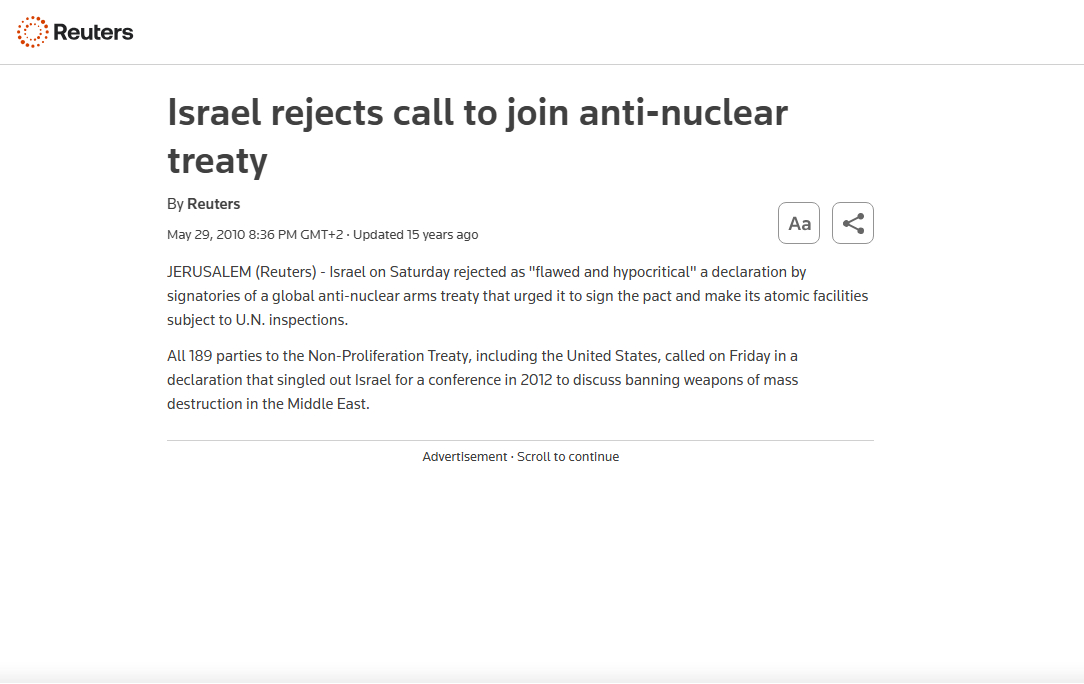
"... United States’ and the Israeli government’s position on “Iran’s peaceful nuclear program” as false allegations."
With its secret 1942 Manhattan Project (atom bomb), the US is the inventor and introducer of nuclear militarization and inflamed in 1947 the rise of nuclear powers in the world, including the Israelis in 1956.
The invention wasn't helping peace. It contributed to the first nuclear genocide to end the Second World War in Asia.
The outcome have led to the possession of weapons of nuclear mass destruction across the world, only helping to deter each other: China, US, North Korea, India, Pakistan and yes, even the Israelis are potential users. The latter particular against those who don't have these nuclear WMDs. The Israelis have proved it during their six-day war in 1967.
|
IAEA demands verification of Iran nuclear ambitions amid ‘statement war’
The head of the International Atomic Energy Agency (IAEA) has asserted that a “very strong system of verification” must be put in place to monitor Iran’s nuclear program.
Director General Rafael Grossi called on Friday for the nuclear watchdog to be given full access, noting that ensuring Iran is not able to develop nuclear weapons is the key objective of the preliminary ceasefire agreement with the United States.
The United States and its Western allies have for years warned that Tehran’s nuclear program may be aimed at developing the capacity to build a weapon. Iran has always firmly denied it has any such intention, insisting its ambitions are strictly civilian.
“The government of Iran has affirmed quite clearly that [developing nuclear weapons] is not their intention, but of course intentions are not enough,” Grossi told reporters on Friday. “In order to have certainty, we need to have a very strong system of verification as soon as practicable.”
|
|
|
Israelis and their forever wars
An overwhelming 92 percent of Israelis felt the US has signed away their victory over a decades-old enemy, with almost half of those polled saying Israel should continue its attacks on Lebanon.
Israel has spent years fighting continuous wars across the region since the Hamas-led attack on October 7, 2023, in Israel, which killed 1,139 people.
It has committed a genocide in Gaza in response, killing more than 73,000 Palestinians and razing large swaths of the territory to the ground.
It has attacked Iran twice, killed thousands in Lebanon while fighting Iran’s ally Hezbollah, launched multiple ground incursions into Syria, and launched sporadic strikes on the Houthis in Yemen, also allies of Tehran.
|
|
|
Lebanese president welcomes French-Italian post-UNIFIL initiative
Lebanese President Joseph Aoun has welcomed a French-Italian initiative to form an international coalition to manage the post-United Nations Interim Force in Lebanon (UNIFIL) period, calling it a sign of strong international support for Lebanon’s sovereignty and stability, according to a statement on X from his office.
The president considered this initiative “a sincere expression of the international commitment to supporting Lebanon’s sovereignty and stability, and a genuine appreciation of the role played by the Lebanese Armed Forces in maintaining security and extending state authority over all its territory, particularly in the southern border regions”, the statement read.
He added that the project aligns with Lebanon’s consistent position that the Lebanese army be the sole guarantor of security in the south of the country.
|
|
|
Former Lebanese president urges withdrawal from Israel-Lebanon talks
Former Lebanese President Emile Lahoud has praised the Lebanese army commander for what he described as the “honourable stance” of the country’s military delegation, which declined being photographed alongside the Israeli delegation at talks in Washington, Lebanon’s National News Agency (NNA) reported.
He also expressed hope that the entire Lebanese delegation would withdraw from the negotiations.
Lahoud argued that Israel is not seeking a truce or peace, but is instead attempting to weaken Lebanon’s resistance through negotiations and create internal divisions, NNA said.
He also claimed that Iran had achieved a “strategic victory” that forced the US and Israel to accept a new reality, concluding that steadfast confrontation remains the only effective approach in dealing with Israel, the agency reported.
|
|
|
Iran’s Foreign Ministry on US, GCC and the Strait of Hormuz
- The US-GCC joint statement is “interventionist, irresponsible and provocative”, as it warned against the “continuation [of] confrontational conduct” in the region.
- The Strait of Hormuz will be managed, and the security of the territorial waters and coasts of Iran and Oman, in accordance with the MoU.
- The US claim of committing to GCC countries’ security is “a distortion of reality”, and the US military presence is “merely a burden [imposed] on the peoples of the region and has been a source of insecurity and division”.
- Iran called on Gulf countries to prevent any use of their territories and facilities for planning, supporting or carrying out unlawful acts against Iran.
- Iran urged GCC countries not to align with the US’s portrayal of “the threat of its peaceful nuclear program”, and instead pursue a “nuclear-weapon-free Middle East”.
- Tehran also stressed that the security of the region must be ensured by the countries of the region themselves … rather than through dependence on foreign powers whose interventions have “repeatedly undermined” regional stability.
|
|
|
Attack on ship in Hormuz Strait ‘unprovoked, unjustifiable’, says Singapore port authority
The Maritime and Port Authority of Singapore has reacted on the attack with an unknown projectile, that hit the Singapore-flagged Ever Lovely in the Strait of Hormuz on Thursday.
“The vessel has since completed its transit through the Strait of Hormuz and is proceeding on its voyage,” the statement noted, adding that all 21 crew members are safe.
The authority expressed deep concern over the incident, “which was unprovoked, unjustifiable, and a breach of international law”.
“All actions affecting international shipping must fully comply with international law, in particular the United Nations Convention on the Law of the Sea, and not endanger the safety of seafarers and ships at sea,” the statement concluded.
|
|
|
Safe passage through Hormuz by ‘parallel routes’ cannot be guaranteed: Iran’s deputy FM
Kazem Gharibabadi, Iran’s deputy foreign minister, has said safe passage through the Strait of Hormuz cannot be guaranteed for vessels transiting “with ambiguous arrangements, parallel routes, or decision-making outside of Iran’s considerations as the coastal state”.
“Any credible framework must be based on coordination with Iran and the provisions of paragraph five of the Islamabad Memorandum of Understanding,” he said in a statement on X. “Otherwise, the outcome will be the suspension of the designated parallel route.”
The 14-point MoU between the US and Iran mandates that Iran “will conduct dialogue with the Sultanate of Oman to define the future administration and maritime services in the Strait of Hormuz in discussion with other Persian Gulf littoral states in line with the applicable international law and the sovereign rights of coastal states of the Strait of Hormuz”.
|
|
|
Strait of Hormuz management to be main sticking point in US-Iran talks
Yesterday, Oman announced new routes for the passage of the ships. But then the IRGC released a statement, saying that whether the ships go through the Iranian or Omani territorial waters, they need to be in full coordination with Iranian authorities.
And if they violate that, then Iran is going to act accordingly. So the question was whether Iran is going to really act or not?
The answer is yes. Now, we have seen that a tanker has been attacked by projectiles in the Strait of Hormuz. The IRGC did not claim responsibility but did not deny it, either.
Kazem Gharibabadi, Iran’s deputy foreign minister, also said any parallel routes or decision-making outside Iran’s considerations as a coastal state are unacceptable, and Iran is going to act.
Perhaps, in the coming days and weeks, we will see that the Strait of Hormuz is one of the main sticking points.
|
|
|
‘West has brought nothing but plunder and violence,’ says adviser to Iran’s supreme leader
Ali Akbar Velayati said that the stability of Gulf Arab states “is indebted to Iran’s century-long management of the Strait of Hormuz,” adding that “the West has brought nothing to the region but plunder and violence”.
In a post on X, Velayati wrote: “These political minors of the periphery should not be comforted by commissioned statements; know this, your survival feeds off the scraps of this table.
“In the great realignment, peripheral minor players have no seat at the table,” he added, “They are eliminated, and their strategic survival is at the mercy of Tehran’s tolerance.”
|
|
|
IRGC Navy warning forces three oil tankers to turn back in Strait of Hormuz
At least three foreign oil tankers that attempted to cross the Strait of Hormuz “without authorization” turned back after a warning from the IRGC, Iranian state TV has reported.
Yesterday, a Singapore-flagged vessel came under attack from an unknown projectile, prompting the UN to call off its mission to rescue 11,000 sailors in the Strait of Hormuz.
Tehran has not claimed the attack, but has issued multiple warnings against transiting the waterway without Iran’s authorization.
|
|
|
IRGC warns Hormuz transit only possible via routes approved by Tehran
Iran’s Revolutionary Guards has warned that passage through the world’s energy chokepoint, the Strait of Hormuz, “is only possible via routes announced by Iran,” the state broadcaster IRIB has reported.
“The only law that governs this region is still the law of the Islamic Republic of Iran and the Revolutionary Guards Navy,” a reporter from the state broadcaster said.
|
|
|
Israel must recalibrate Lebanon objectives to end fighting with Hezbollah
Hezbollah is not seeking to be a part of Israel-Lebanon negotiations, says Sultan Barakat, a professor in public policy at Qatar’s Hamad Bin Khalifa University.
“What they seek is for Israel to withdraw fully from south Lebanon,” Barakat said.
“As long as Israel does not recalibrate its objectives in Lebanon, it’s very difficult to see how we’re going to get out of this.”
Barakat said Israel believes “what they have attempted in Gaza can be applied to Lebanon” but that’s “a very wrong assumption”.
“Lebanon is not Gaza,” he said, noting that it is “not under the same isolation Gaza is subjected to.”
Hezbollah is “a general part of the Lebanese society,” not only within the Shia community, but also politically, said Barakat.
Barakat also said Israel’s military goals have shifted.
“They started by saying we don’t want Hezbollah to threaten the north of Israel. Now Hezbollah is not threatening the north of Israel, they are now well into the Litani River, and they’re saying we don’t want Hezbollah to threaten our soldiers inside Lebanon,” he said.
“This is impossible to guarantee by anyone.”
|
|
|
Israel drops leaflets over Lebanese town ordering people to leave
The Israeli military has dropped leaflets over a town in southern Lebanon, ordering residents to leave, Lebanese state media reported, in a first such order issued since the ceasefire between Israel and Hezbollah took effect.
The town lies near the boundary of the area occupied by Israeli troops inside southern Lebanon.
Israeli attacks in southern Lebanon have continued despite a ceasefire in place, and negotiations under way in Washington.
|
|
|
If Iran attacks Israel, it will ‘commit its biggest mistake’: Katz
If Iran attacks Israel, it will “commit its biggest mistake”, says Israel’s Defence Minister Israel Katz.
The IRGC’s commander has “been constantly threatening Israel these days”, he said in a post on X.
“Neither Hormuz nor attacks on civilians will help them; nothing will stop us. Our forces are ready to finish the job.”
|
|
Since February 28, 2026, Iran has attacked the Israeli territory many times.
|
Israel says kills 7 in southern Lebanon, alleging Hezbollah membership
The Israeli army has claimed to have killed seven Hezbollah members who had transferred weapons near soldiers in southern Lebanon.
In a statement on Telegram, the army said it had struck the alleged members near the so-called “security zone” in the al-Manzala area that was used as a “combat and observation post”.
The “security zone” is an area of southern Lebanon that Israeli forces are occupying north of the Israeli border.
|
|
|
Iran has an ‘inherent right to legitimate self-defense’: Foreign Ministry
Esmaeil Baghaei, spokesman for Iran’s foreign ministry, has issued a scathing statement, calling out Iran’s neighbors in the Gulf, Israel and the US, saying Iran has the right to defend itself.
“The southern neighbors [Gulf countries] must be held accountable,” Baghaei posted on X, for their role in US attacks on Iran.
“It should be clear to all that Iran’s military capabilities ensure the Iranian people’s inherent right to legitimate self-defense in the face of aggression and crimes, while at the same time guaranteeing peace and stability in the region”, he said.
Throughout the joint US-Israeli war on Iran, the Iranian military carried out continuous attacks on its Gulf neighbors, including on their energy production and transportation facilities.
|
|
|
Iranians are taking a hard line on passage through the Strait of Hormuz
The Iranian officials are using quite a strong language. The deputy foreign minister is saying the safe passage through the Strait of Hormuz cannot be guaranteed by vague arrangements or parallel routes.
Any credible framework must be based on coordination with Iran, otherwise the result will be suspension of the designated routes. So clearly, they are no warning that the routes will be suspended.
So now, the Strait of Hormuz, the Iranians are saying that they’re not opening it.
|
|
|
UAE, Iranian FM’s discuss regional developments during call
Emirati Foreign Minister Abdullah bin Zayed Al Nahyan spoke to his Iranian counterpart Abbas Araghchi during a phone call, in which they discussed the latest regional developments, the UAE state news agency WAM reports.
During the call, Al Nahyan stressed the importance of full commitment to the MOU’s terms, including the cessation of hostilities in the region.
“Respect for the sovereignty of states and the principles of good neighbourliness, strict adherence to international law, and the protection of maritime routes and freedom of international navigation, including ensuring the smooth flow of traffic in the Strait of Hormuz,” WAM cited him as saying.
Al Nayhan also expressed his hope that the ongoing US-Iran negotiations would yield positive results, achieving “sustainable security and stability in the region.”
He also pointed out that “serious diplomacy and responsible dialogue are the best way to address all regional and international crises”.
|
|
|
Pakistan says Iranian crew members seized by US have been released
Pakistan’s Deputy Prime Minister and Foreign Minister Ishaq Dar has said 22 Iranian crew members from the vessel Lenore/Davina, which was seized by US authorities amid a blockade on Iran’s sea trade, have arrived in the Pakistani city of Karachi.
“Arrangements are now being finalized in close collaboration with the Iranian Missions in Pakistan to facilitate their earliest and safe return to their homeland,” Dar said.
“This marks the fourth group of Iranian crew members in the last two months whose repatriation has been facilitated by Pakistan.”
|
|
|
Iran deal in ‘serious danger of collapsing’
The memorandum of understanding between Iran and the US is “in serious danger of collapsing”, Rob Geist Pinfold, lecturer in defense studies at King’s College London, says.
According to Geist Pinfold, the deal was intended as a “stepping stone” that served two purposes.
“To stop the escalating violence in and around the Strait of Hormuz and in Lebanon, and to get the Strait of Hormuz open to deal with the more substantive issue, which is Iran’s nuclear program and its support for proxies,” he said.
“But we’re now more or less back to square one, seeing no end to conflict in Lebanon and no end to escalation in the Strait of Hormuz.
“We thought we’d be out of this quagmire of no war, no peace to somewhere better, but we’re now back once again to square one,” Geist Pinfold added.
|
|
|
More than 100 vessels evacuated from Strait of Hormuz since Tuesday, UN’s IMO says
Since Tuesday, 115 vessels and 2,500 seafarers have been evacuated from the Strait of Hormuz, says Arsenio Dominguez, the secretary-general of the UN’s International Maritime Organization.
Separately, Pakistani officials said Friday that 22 Iranian crew members from the vessel Lenore/Davina, which was seized by US authorities amid a blockade on Iran’s sea trade, have arrived in the Pakistani city of Karachi.
|
|
|
UAE says technical glitch caused false alarm
The UAE’s National Emergency Crisis and Disaster Management Authority says earlier messages warning residents about a missile threat were a technical malfunction.
It said the issue was resolved by specialized teams and apologized for the disruption.
The UAE has been the Gulf country hardest hit by Iranian missiles during Tehran’s war with the US, with significant disruption to daily life amid missile alarms and loud explosions from interceptions.
|
|
|
Lebanese FM welcomes GCC-US statement on the situation in the country
Lebanese Foreign Minister Youssef Raji says he spoke with the secretary-general of the GCC, Jasem Albudaiwi, conveying his “appreciation for the support expressed in the joint ministerial statement” for the Lebanese-Israeli negotiations mediated by the US.
In a statement posted on X, Raji said the ministry had “highly appreciated” the references to Lebanon in the GCC-US statement.
“Particularly its welcome of the ongoing US-mediated negotiations between Lebanon and Israel, its emphasis on preserving the negotiation process and keeping it separate from any other track, and its affirmation that Lebanon cannot achieve full sovereignty as long as non-state armed groups retain military capabilities,” the statement read.
“The ministry also welcomes its call for the complete disarmament of all such groups and for the Lebanese state alone to have the exclusive authority to use force,” it added.
|
|
|
Iran slams the GCC and the US for ‘interventionist’ statement
The US-GCC statement followed talks in Manama co-chaired by US Secretary of State Marco Rubio and Bahraini Foreign Minister Abdullatif bin Rashid Al Zayani, in which foreign ministers from other Gulf nations, including Kuwait, Oman, Qatar, Saudi Arabia and the United Arab Emirates, also participated.
The ministers welcomed the June 17 memorandum of understanding between Washington and Tehran, but tied any future economic engagement with Iran to strict conditions.
The ministers said “any trade and investment with Iran is conditional and reversible”, and reaffirmed “the shared objective of preventing Iran from ever developing or otherwise acquiring a nuclear weapon”.
The statement also said, “lasting regional peace and security requires addressing the full spectrum of Iran’s threats, including its ballistic missiles, drones, and support of proxies in the region”.
|
|
|
‘Iran will keep leveraging Strait of Hormuz until MoU fully implemented’
Iran is aiming to retain control of the Strait of Hormuz to ensure it has the ability to shut the shipping channel again if parts of the deal with the US are not upheld, Hamid Reza Gholamzadeh, director of Diplo House in Tehran, says.
The waterway is the “most important and maybe the only leverage to contain the Americans and have some practical results on the MoU,” the analyst said.
He added that Iran would want to see all issues in the MoU resolved before allowing free passage of all vessels.
One issue Iran wants to see progress on is Lebanon, where Israeli troops are still stationed and waging war.
“The Americans do not seem to be serious in following [up on that commitment],” which is why Tehran must retain its ability to put pressure on the US, he added.
|
|
|
Trump calls Iranian drone attack a ‘foolish violation’ of ceasefire agreement
The US president says the US shot down at least “four one-way attack drones at ships transversing the Strait of Hormuz” launched by Iran.
“One of the Drones solidly hit the upper deck of a large and very expensive Cargo Carrying Ship. Damage was done, but the Ship was able to proceed on its way,” Trump wrote on TruthSocial.
“We knocked down three other Drones. Obviously, this is a foolish violation of our Ceasefire Agreement,” he added.
It is unclear which incident the US president is referring to or when it took place.
A vessel was attacked yesterday in the waters off the coast of Oman, for which the US blamed Iran.
|
|
|
What do Israel and Lebanon want to gain from US talks?
Throughout the course of these talks, there’s been a lot of contradictory rhetoric. It’s been very difficult to read the room in terms of how these different delegations have been feeling.
On the one hand, there has been this sense of optimism, especially from US officials, that forward momentum has been made. Just the simple fact that these talks continue to happen is largely seen as a success in and of itself.
But it doesn’t take an expert in diplomatic policy to see that some of the rhetoric that we’ve heard since the very beginning of these talks has been very concerning.
On the political track, it’s about stabilizing the relationship between two countries that, outside of this building, don’t have a formal diplomatic relationship. And on the military track, it’s about lessening tensions to prevent a spillover and a scenario that could … drag the US into a wider, broader regional conflict.
For Lebanon, they want a full withdrawal of Israeli forces from Lebanese territory. For Israel, the sticking point is that any sort of withdrawal has to be contingent on the full disarmament of Hezbollah and an assurance that Hezbollah would not be able to re-establish a military presence along the Israeli-Lebanese border.
|
|
|
Lebanon death toll from Israeli attacks rises
The Lebanese Ministry of Health has said the overall toll from Israeli attacks since March 2 has risen to 4,243 dead and 12,186 wounded.
Israeli officials insist they will stay in Lebanon, despite Iran saying Israel is obliged to withdraw under the terms of the interim US-Iran ceasefire agreement that also covers Lebanon.
|
|
|
| |
|
|
| |
|
|
| |
|
|
| |
|
|
| |
|
|