| Highlights from yesterday |
|
Comments |
- US President Donald Trump says Washington is only “semi-negotiating” with Tehran and will wait for economic pressure on Iran to mount.
- His comments came after Iran’s Foreign Minister Abbas Araghchi said there are no direct talks with the US, but that “intermediaries are still trying to create the grounds for negotiation”.
- Araghchi says Iran-Oman talks on the Strait of Hormuz are in “the final stages”, but the waterway will not open until the US meets Iran’s demands, including lifting a naval blockade.
- Iran’s Supreme Leader Mojtaba Khamenei has appointed Mohsen Rezaei, a former commander of the Islamic Revolutionary Guard Corps (IRGC), as his representative to the Supreme National Security Council.
|
|
|
| |
|
|
| |
|
|
Does Trump’s remarks mean US is giving up its military options?
No US president ever gives up on the military option when trying to resolve a global crisis.
But what appears to be happening here is that this time a week ago, the US president was telling anyone who would listen that regional partners had urged him to hold off on a major military operation against Iranian targets. They were asking him to give diplomacy a chance.
He said he was willing to allow Qatari and Pakistani mediators to try to work with Iranian officials to try and reach a deal, particularly on the Strait of Hormuz.
That [posture] has not changed. In fact, on Saturday, we heard the US vice president, JD Vance, using similar language, echoing what Trump said in his interview with Axios. Vance said the US is willing to bide its time to allow ongoing sanctions on the Iranian economy to continue to do their work and hopefully compel the Iranian government to give into US demands – to not take unilateral control of the Strait of Hormuz, to stop supporting groups such as the Ansar Allah (Houthis) in Yemen, Hamas and Hezbollah, and to give up its nuclear weapon ambitions.
Whether or not this strategy will work depends on several factors: whether the US continues with it for more than a day or two, whether outside events disrupt the US’s posture, whether the Iranians decide they want to do something else altogether, either to try to break this apparent stalemate or go back to open warfare.
|
|
"...to allow ongoing sanctions on the Iranian economy to continue to do their work and hopefully compel the Iranian government to give into US demands – to not take unilateral control of the Strait of Hormuz, to stop supporting groups such as the Ansar Allah (Houthis) in Yemen, Hamas and Hezbollah, and to give up its nuclear weapon ambitions."
The United States is a attacking belligerent since Trump declared war on Iran on February 28th. The continuation of economic pressure, as Vance stated, prompts us to put his statement in the context of international law.
What does international law say when the US, as a attacking belligerent, uses economy as a weapon in its war on Iran?
When a belligerent state like the United States uses economic pressure, trade restrictions, and financial embargoes as weapons during its war, public international law analyzes the action through separate legal regimes governing the resort to force, the conduct of hostilities, and economic sovereignty. These legal regimes are stipulated in the UN Charter.
The broader military offensive against Iran conducted by the U.S. and its allies is widely evaluated by international legal scholars as a violation of Article 2(4) of the United Nations Charter, which prohibits the threat or use of force against the territorial integrity or political independence of any state.
International law recognizes exceptions for UN Security Council authorization or self-defense under Article 51 of the United Nations Charter, criteria that critics and international bodies argue are unmet in this conflict.
Trump is waging war from countries on other continents, not from his country. He has no authorization from the UNSC. Then, Iran is not attacking the country but US presence in its region. Trump's claim of self-defense looks like derived from by the Israeli claim of self-defense.
|
US envoy says economic pressure will force Iran to make concessions
Mike Waltz, US ambassador to the UN, says Treasury Secretary Scott Bessent’s economic operation “is devastating the Iranian economy”, claiming that the Iranian side keeps coming to the negotiating table asking for cash.
“When Iran is coming to the table with our negotiators, they are talking about cash, cash, cash. Because they’ll absorb the bombings,” Waltz said in an interview with Fox News. “I say this jokingly but seriously as well – the Iranians are more afraid of Secretary Bessent than they are of [Defense] Secretary Hegseth right now.”
The US envoy claimed that Iranian leaders “don’t care about” their military or the Iranian people. Instead, they mainly care that “their currency is tanking” and that “inflation is the highest [it has been] in 80 years”, he said.
“They are constantly asking for access to cash, access to their assets that we have frozen … that’s the squeeze. That, coupled with the blockade, that’s what’s going to eventually get the Iranians to move.”
|
|
See previous comment.
|
Iran defiant even as US economic pressure, threats weigh on citizens
For Iranians, it’s just like dancing with the same old tune, as they have been witnessing these pressures taking place for the past days, weeks, and I would say decades even, prior even to these statements coming from the US President Donald Trump.
But certainly that does not mean that there is no impact, economically speaking. We know that the country is facing a deteriorated situation, seeing the high inflation, devaluation of the local currency, and other economic issues out there, caused by years of sanctions, domestic mismanagement, and obviously the impact of war is out there to put another layer of impact into this intricate situation.
But speaking of the response from the Iranian side, the spokesperson for the Ministry of Foreign Affairs, on his weekly news conference, came out to respond to Trump’s statement saying that negotiations at this point look like chess.
And the spokesperson responded to that, saying that even with lights on or off, Iranians are known as professional, skilled chess players.
We know that this is not only the economic pressure, also the military posturing and rhetoric that we have been hearing about the potentiality of another round of confrontation is putting another psychological impact on the ordinary citizens in Iran.
|
|
See previous comment.
|
Iran: US sanctions reflect a ‘compulsive addiction,’ not a policy
Iran’s foreign ministry spokesman has responded to the US treasury secretary’s boast of “suffocating” Iran through sanctions, calling it proof of “America’s compulsive addiction to sanctions”.
“Whenever Washington proves itself incapable of pursuing diplomacy, it retreats into sanctions; and whenever those sanctions fail to produce results, it simply increases the dose,” Esmaeil Baqaei posted on X, adding that this is “no longer ‘policy’… it is ‘habit’.”
He said Iran has shown for decades that it won’t be “strangled by these exhausted refrains,” warning that US politicians clinging to sanctions risk losing their own “chance of a less humiliating exit from a crisis of their own making”.
|
|
See previous comment.
|
Iranian negotiators believe ‘they have more time on their side’
Trita Parsi, executive vice president of The Quincy Institute for Responsible Statecraft, says Iran’s recently released conditions for opening the Strait of Hormuz, as well as Trump’s wait-and-see position, are both common negotiation tactics and do not preclude the possibility of a deal.
“It is not unusual, particularly in negotiations between the US and Iran – which ultimately this is – that at certain moments, particularly close towards reaching a deal, there is some sort of an escalation by either side, or both sides, [including] putting forward some very hawkish demands,” he said.
“Trump’s comments should also be seen in this context, in which he’s saying, I’ve got time on my side, your economy is really suffering,” he said.
Parsi said both Iran and US are under pressure to make a deal, though Washington likely faces more pressure.
“Iran is under a tremendous amount of pressure because of, essentially, the blockade of the blockade, and because of all kinds of other difficulties that are emerging with this war. But they are not facing the same political limitations as Trump is,” he said.
“Trump is facing midterm election coming up in just a month and a half or so. So, there are a lot of other challenges that Trump faces that I think leaves the Iranians with the impression, right or wrong, that they have more time on their side. And right now, it does appear that it is the Iranians that are playing for time, prolonging the negotiations, not Trump.”
|
|
|
US Senator Murphy says Trump has ‘lost’ war on Iran
Democratic Senator Chris Murphy says the US president has “lost this war” with Iran, arguing that continued fighting is weakening Washington while strengthening Tehran.
Murphy told NBC News he would support even a “bad deal” to end the war and reopen the Strait of Hormuz, saying the cost of reopening the strategic waterway was rising as negotiations remained stalled.
“The war needs to end because every day that the war continues, America gets weaker, Iran gets stronger, and people here in the United States get s****** as prices go up and up and up,” Murphy said.
The lawmaker said he would oppose funding to continue the war but would support replenishing US munitions after the conflict ends.
Iran’s Foreign Minister Abbas Araghchi said on Sunday there were no direct talks with the US and insisted the Strait of Hormuz would not reopen until Washington met Tehran’s demands, including lifting the naval blockade.
|
|
|
Neither US nor Iran ‘willing to take first step and extend an arm’
Mehran Kamrava, professor at Georgetown University in Qatar, says negotiations between Iran and the US are progressing very slowly and cast doubt on whether Washington’s economic pressure campaign would succeed.
“What we have seen is that the Iranians are trying to put economic pressure on the regional neighbors, particularly on countries like Qatar, UAE, Saudi Arabia and Kuwait, so that they would in turn put pressure on the US to negotiate with Iran,” he noted.
“Meanwhile, the US is putting economic pressure on Iran … So neither side is willing to take that first step and extend an arm and say let’s sit down and negotiate,” he said.
Kamrava said he was skeptical that US economic pressure would prove effective.
“Tehran is under tremendous economic pressure. But we need to bear in mind that Iran’s political system is ultimately a very repressive one. It’s not that people making decisions directly care about the plight of the middle classes. They want to stay in power,” he said.
“The US had put pressure on Iran for decades now and it hasn’t dislodged the stage, nor has it really changed the behaviour of the Iranian state. So I’m not sure if this tactic is going to work at this point,” he added.
|
|
|
What’s delaying the Iran-Oman Strait of Hormuz deal?
Trita Parsi at the Quincy Institute for Responsible Statecraft, said the delay in the Iran-Oman talks on the Strait of Hormuz stemmed, from Tehran’s perspective, from last-minute demands introduced by the US.
The US is “de facto at the table” because “the Omanis are negotiating not just on behalf of themselves, but on behalf of other GCC states” and Washington, he said, using the acronym for the Gulf Cooperation Council.
“At the last minute, the US [has tried] to either move the goalposts or add new demands, and the Iranian reaction to that was exactly what we saw – putting forward these very hawkish demands for what needs to be done and for there to be a resumption of US-Iran talks.”
However, he said this is unlikely to be a major hurdle in finalising a deal to secure a shipping route through the waterway.
“These are some of the theatrics that happen at specific stages of the negotiation, and may not necessarily be as big of an impediment to a deal than first meets the eye.”
|
|
|
The latest in the Iran-Oman talks on the Strait of Hormuz
Iran has said for days now that it is nearing a final pact with Oman defining new shipping lanes in the Strait of Hormuz. But Tehran has said the waterway will only reopen when the US meets its conditions.
- On Sunday, Iran’s Foreign Minister Abbas Araghchi said there are no direct talks with the US, but said negotiations with Oman are continuing on the Strait of Hormuz.
- “Our negotiations with Oman are regarding the determination of a new maritime route in the Strait of Hormuz. These negotiations have progressed well; I can say we are in the final stages, and the old existing routes will be replaced with new ones. Specialists are currently working on the maps,” he said.
- Iran’s National Security Council meanwhile laid out six conditions for Hormuz to reopen. They are: the US ending its threats to Iran; halting military action against Iran and its regional allies; withdrawing naval and air forces involved in blockading Iran; compensating Iran for damage caused in the conflict; lifting sanctions and unfreezing Iranian assets.
- For his part, Trump said Washington is only “semi-negotiating” with Tehran and is prepared to allow economic pressure on Iran to mount. He told media outlet Axios that the US naval blockade has put Iran “in very bad shape”.
|
|
|
US cause of insecurity in Middle East, Iran’s Foreign Ministry spokesman says
Iran’s foreign ministry spokesman, Esmaeil Baghaei, said “this region doesn’t need players from outside and this development in itself must attract attention”.
“The region must not be left under the illusion of achieving security through America, America is part of the lack of security in the region,” Baghaei added.
He also said that US creates the conditions for Israel to wage war with impunity.
“The Americans are supporting the Zionist entity politically and on the security level, without the Americans, the Zionist entity will never be able to do what they did and continue their crimes.”
He added that no one can hold them accountable “or take them to court”.
|
|
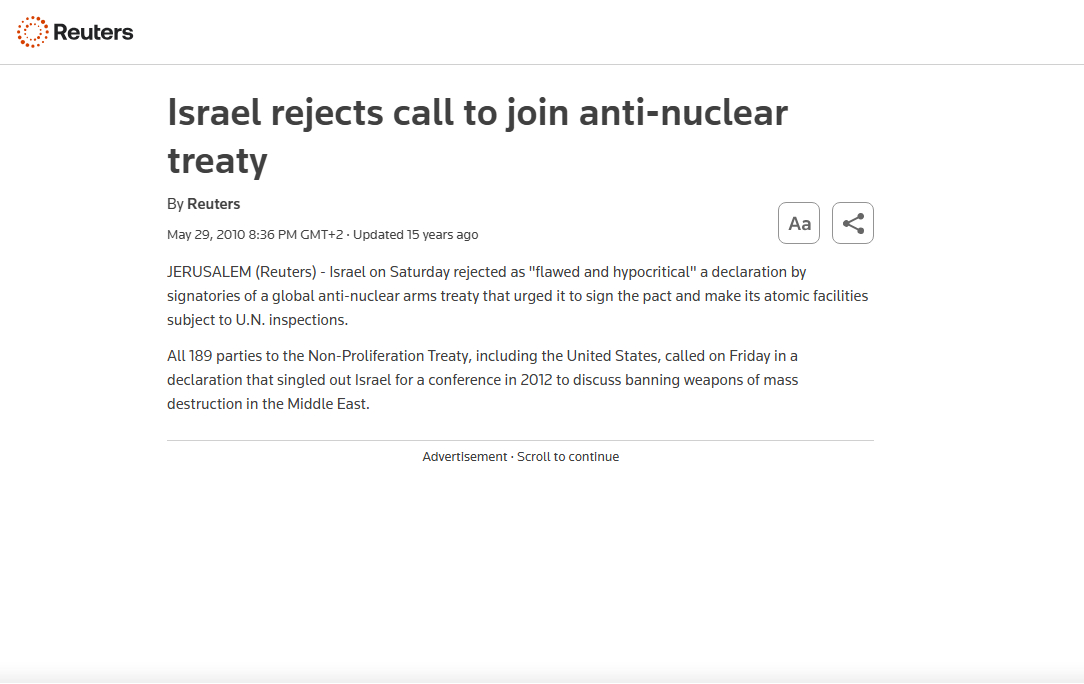
The issue is not insecurity but nuclear rivalry inflicted by the Israelis, in this case, against Iran in 2010, as the rivalry but against any Arab country that starts its own nuclear program, began in 1968.
The war in June 2025 and since 2026 are both initiated by Netanyahu because of Iran's nuclear program.
However, the start of current war was claimed as to achieve regime change in Iran. Netanyahu and Trump saw their goal as impossible to achieve. So, they turned on Iran's nuclear program.
|
Appointment of Mohsen Rezaei important for Iran’s security apparatus
The replacement [of the secretary of Iran’s Supreme National Security Council] is critically important for several reasons.
First, the position itself is at the intersection of political and military affairs, where matters of political and national security of the country are coordinated.
Also, in terms of timing, the country faces a moment of decision when it comes to talks with Oman and when it comes to diplomatic engagement with the US. These are critical moments for the Iranians to make significant decisions on whether there is going to be a continuity of policy or a little bit of change.
In terms of domestic politics, we know that it [the replacement] is important. Previously, we know that Mohammad Bagher Zolghadr was appointed by the president as the secretary of the Supreme National Security Council of the country [before], but we don’t have any public confirmation that he was also the Supreme Leader’s representative.
Right now, the new appointment [of Mohsen Rezaei] could be indicative of a stronger alignment in terms of the supreme leader of the country and the presidency.
Last but not least, it could be interpreted as a major, or at least a sign of more militarization when it comes to Iran’s important security apparatus.
|
|
|
‘Tremendous amount of opacity’ in Iran's system
Trita Parsi at the Quincy Institute for Responsible Statecraft on the appointment of Mohsen Rezaei to Iran’s Supreme National Security Council.
“The importance” of this appointment “is very difficult to tell”, Parsi said.
“There is a tremendous amount of opacity about what actually is going on inside the Iranian system at this point,” he added, with Iran “keeping a certain level of discipline to ensure” that the country’s political processes in this new situation “are not known to the outside world”.
Parsi also said hard line elements within the IRGC have grown significantly stronger since the war, with a “tug of war” taking place between the generals and the diplomats.
“But they’re not necessarily working against each other all the time either. I think, for instance, there is probably a greater degree of consensus amongst the decision-makers within the Iranian system of what their ultimate goal is now,” he said. “Tactical differences are probably quite profound, but on strategic objectives I don’t think there is a significant difference between the different sides.”
|
|
|
IRGC attacks, harassment persist in Strait of Hormuz, UKMTO says
The UK’s Maritime Trade Operations (UKMTO) agency says the threat level in the Middle East remains “severe” amid continued attacks on commercial shipping in the Strait of Hormuz.
It noted that a UAE tanker was hit in the waterway on Saturday and that commercial traffic through the Strait of Hormuz remains at “reduced levels,” with transits in the single digits.
“IRGC attacks and harassment activity persisted, including hailing, UAV over flight and targeted surveillance of commercial ships,” it said, using the acronym for unmanned aerial vehicles – drones.
“These actions continue to demonstrate Iran’s intent to assert presence along key transit lanes and maintain pressure on transiting vessels. Kinetic activity (projectile strikes and near-miss explosions) continued on the southern Omani approaches (Limah-Khasab-Kumzar),” it said.
UKMTO also warned of the continued risk of drifting and uncharted mines in the waterway.
|
|
The UKMTO is part of the navy of Britain, which allows the US to carry out attacks on Iran from its soil.
Messages from the UKMTO often contain assumptions and or assertions.
The entity often reveals a position of partiality.
|
Iran’s crude export pipeline at ‘complete halt’ under US blockade, tracking firm says
Windward says Iran’s crude export pipeline on Kharg Island remains at a “complete halt” amid the US military’s blockade of Iranian ports.
In a post on X, the maritime intelligence firm said all three of the island’s terminals are currently empty, and that 17 “dark” tankers, which have their transponders turned off, have remained stationary around it.
“The pattern is consistent with a blockade-driven export halt: no loadings, no departures, and a dark queue that isn’t moving,” it said.
Located 15 nautical miles (about 28km) from the Iranian mainland, Kharg Island is the economic backbone of Iran and typically processes about 90 percent of Iran’s crude exports.
|
|
|
Oil rises as Strait of Hormuz reopening remains uncertain
Oil prices have climbed as markets reopened in Asia after the weekend amid continued uncertainty over the reopening of the Strait of Hormuz, according to Reuters.
Brent crude futures rose 91 cents or 1.09 percent, to $84.46 a barrel by 00:56 GMT, while US West Texas Intermediate crude futures rose 61 cents, or 0.78 percent, to $78.79 a barrel.
Both benchmarks had fallen more than 7 percent last week on hopes that Iran and Oman were close to reaching a deal that would result in a reopening of the Strait of Hormuz, through which a fifth of the world’s oil transited before the war.
Tehran says a deal with Oman is in its final stages, but insisted the US must still meet several conditions.
|
|
|
Hormuz ‘not going to return to its pre-war condition’: Iranian official
Ali Nikzad, Iran’s deputy speaker of the Islamic Consultative Assembly, has said the Strait of Hormuz is not going to return to its pre-war condition, according to a report by the country’s Mehr news agency.
Addressing the assembly to the current conditions in the region, he said: “The Islamic Republic of Iran tried to inform the aggressor and deluded enemy of the fact that the Strait of Hormuz is not going to return to the pre-war conditions during the days of the war.”
“Unfortunately, they tried to pretend not to know, but the passage of time is the greatest teacher for deluded people, and today the American-Zionist enemy, with a strong fist of armed forces, has practically realised that the opening of the Strait of Hormuz has no military solution and must submit to the new order in the region,” Nikzad said.
He added that Iran’s most important priority currently, however, is to reduce the country’s economic problems.
|
|
|
Japan PM calls for free, safe passage through Strait of Hormuz
Sanae Takaichi has urged the resumption of free and safe passage through the Strait of Hormuz during a phone conversation with Oman’s Sultan Haitham bin Tariq Al Said.
Haitham bin Tariq responded that Oman would consult with and respect the views of countries that use the waterway, Takaichi told reporters at her office in Tokyo, according to Kyodo News.
Oman and Iran are negotiating transit through Hormuz.
According to Muscat Daily, the two leaders exchanged views on regional developments, during which the Japanese PM expressed appreciation for Oman’s ongoing efforts to support dialogue, de-escalation, and international peace and security.
They also discussed ways to strengthen cooperation across various fields in pursuit of their mutual interests, as well as regional developments, the newspaper said.
The phone call comes as negotiations over the future of navigation through the strait remain at an impasse, as talks between the US and Iran remain at a stalemate.
|
|
|
| |
|
|
Iran hopes its neighbors will ‘work hard to strengthen the collective security’: Baghaei
When asked by a journalist if the defense agreement between Turkiye, Saudi Arabia and Pakistan was “an Islamic NATO”, Baghaei said, “We do not need any outside powers to intervene in our region.”
“The tension [in the region] is still there … but in cooperation with the countries of the region, we hope all countries learn the lesson to study the developments of the recent years well and to work hard to strengthen the collective security of our region.”
|
|
|
Iran stance on Saudi-Pakistan-Turkiye defense pact
The reaction has largely been subdued in Tehran, with officials mostly focusing on aspects of regional and Muslim cooperation, and what they perceive as a declining role for the US.
Iran’s Foreign Minister Abbas Araghchi said on Friday that when Muslims stand together, “we can face every challenge by malicious outsiders head-on”.
“Time to rely only on ourselves and embrace true brotherhood,” he wrote on X, without directly mentioning the trilateral agreement signed hours earlier.
But Iran certainly sees some reasons to be concerned in the long run, according to Hamidreza Azizi, a researcher and analyst on Iran and Middle Eastern geopolitical dynamics.
The associate at Clingendael Institute in The Hague, Netherlands, said that the timing is important, since the agreement comes after months of a war in which Saudi Arabia has faced attacks from the Iran-aligned Houthis in Yemen and armed groups in neighboring Iraq.
“From Tehran’s perspective, the concern is therefore not only that the pact could strengthen Saudi deterrence, but that it could eventually facilitate coordinated pressure on Iran in Yemen, Iraq, and even economically through Turkiye and Pakistan,” he said.
|
|
|
Kuwait congratulates Pakistan on defense pact with Turkiye, Saudi Arabia
According to a statement by Pakistan’s Foreign Ministry, Kuwaiti Foreign Minister Jarrah Jaber Al-Ahmad Al-Sabah and his Pakistani counterpart, Ishaq Dar, had a late-night phone call on the recent signing of the Mecca Joint Defense Agreement.
The statement said Kuwait’s top diplomat “felicitated” his Pakistani counterpart during the phone call.
The two exchanged views on the regional situation, including in occupied East Jerusalem, the statement said.
They discussed Pakistan-Kuwait relations and matters of mutual interest, including a follow-up to Jarrah’s recent visit to Pakistan and ways to further enhance cooperation and investment in key sectors.
Turkish President Recep Tayyip Erdogan, Saudi Crown Prince Mohammed bin Salman and Pakistani Prime Minister Shehbaz Sharif signed the Mecca agreement on Friday in the holy city in Saudi Arabia.
The pact considers an armed attack against any of the three countries an attack against all of them and aims to strengthen collective deterrence and expand defense cooperation.
|
|
|
Mecca agreement is ‘just ink on paper’
Wolfgang Pusztai, a security policy and defense analyst, says the defense agreement between Turkiye, Saudi Arabia and Pakistan is currently “just ink on paper”.
“We have not seen Pakistani or Turkish troops in Saudi Arabia because of the recent attacks by the Houthis,” he said.
“We did not see a Turkish reaction to the Iranian missile attacks on the Gulf states, including Saudi Arabia,” the analyst added.
Pusztai stressed that if there are no boots on the ground in the three different countries, or if Pakistani and Turkish soldiers are not affected by an attack on Saudi Arabia, such a mutual defense agreement would not work.
|
|
|
Iran says Pakistan invited foreign minister, parliament speaker for talks
Iranian Foreign Minister Abbas Araghchi and Parliament Speaker Mohammad Bagher Ghalibaf have been invited by Pakistan to visit Islamabad for talks, according to Foreign Ministry spokesman Esmaeil Baghaei.
Araghchi and Ghalibaf will make the visit “at an appropriate time”, he said in remarks carried out by state media, without providing any details on the time of the visit.
“Reciprocal visits and exchanges are a natural part of the growing ties between the two neighboring countries,” he added.
Pakistan played a mediatory role between Washington and Tehran in an effort to de-escalate tensions, including helping broker a ceasefire in April and a framework agreement in June.
The agreement, however, collapsed last month, with the two sides exchanging attacks for nearly two weeks before US President Donald Trump abruptly halted the bombardment amid reports of talks to resolve the conflict.
|
|
|
Top Pakistani, Iranian diplomats discussed Mecca defense pact
Pakistani Foreign Minister Ishaq Dar and his Iranian counterpart Abbas Araghchi have discussed the Mecca security pact recently signed by Pakistan, Saudi Arabia and Turkey in Mecca.
Iran’s Tasnim news agency reported that the discussion occurred during a phone conversation today, and the two ministers “exchanged views on regional and international developments”, with a focus on “efforts to promote peace and stability”.
It also reported that Dar shared key points of the pact with Araghchi.
|
|
|
Trump choosing patience over escalation in war on Iran
President Trump says he is prepared to wait it out. His administration officials say that he has backed away or toned down from his threats to go into an imminent escalation in the war.
He has described it himself as a low-key approach. He is waiting and seeing, he says, what the economic harm is to Iranians and that continuing economic harm that, he insists, is being done because of the US blockade of the Strait of Hormuz, prohibiting or forbidding the export of Iranian oil, which is a massive drain on its economy.
All of that being said, several observers point out that there is a shortage of ammunition, that President Trump reportedly has been warned that [the US] may not be able to continue another sustained escalation of violence.
There are a number of other potential reasons. But administration officials are painting a picture of divisions within Iranian ranks. They believe that just by waiting it out there will be economic pain, there will be some kind of resolution in that split in the Iranian leadership.
And one administration official claims that when the US is waging a war on Iran, then the Iranian people are able to forget about the economic woes. So, there is a lot of justification for what basically is sitting on your hands for a while.
|
|
|
Oil spill from tanker off Oman spreads over huge area
An oil slick is covering an area of about 390 square kilometers (150 square miles) off the coast of Oman, according to the country’s government, after a vessel under sanctions and carrying Russian crude sustained damage.
A statement from Oman’s Environment Authority, carried by the state news agency, said the country was seeking to tackle the oil leak from Caroline Bezengi in its waters near the Hallaniyat Islands off the southern governorate of Dhofar.
It said the slick extends northeast of the islands towards the mainland and, at its nearest point, comes within an estimated 7km (4.3 miles) of the shore.
The vessel’s crew first reported difficulties on June 8 off the southern Yemeni port of Mukalla, two maritime security sources told the Reuters news agency, adding that initial assessments indicated that a blast occurred onboard.
The cause of the damage to the vessel is unclear, and Oman did not offer any explanation.
Shipping data showed the ship was loaded with Russian crude prior to the voyage, and it last transmitted a signal on public AIS tracking on June 11 off the coast of Yemen, according to Reuters.
|
|
|
Rezaei’s appointment as Iran’s security chief
Mohsen Rezaei, the former commander-in-chief of the Islamic Revolutionary Guard Corps (IRGC), has been appointed as the head of Iran’s top security body, which plays a crucial role in the country’s security and foreign policy.
Rezaei takes over as secretary of the Supreme National Security Council amid ongoing talks over the Strait of Hormuz, which Tehran has used as leverage during the months-long conflict with the US and Israel.
He replaces Mohammad Bagher Zolghadr, who has been appointed as a political adviser to Supreme Leader Mojtaba Khamenei. The position was formerly held by Ali Larijani, who was assassinated in a US-Israeli strike in March.
|
|
|
Rezaei’s appointment signifies ‘coordination’ between military, religious, political leaders
Wolfgang Pusztai, a security policy and defence analyst, has said that the appointment of Mohsen Rezaei who was the former commander-in-chief of the Islamic Revolutionary Guard Corps (IRGC), as Iran’s new security chief, certainly signifies that the influence of the hardliners is increasing in Tehran.
“It signifies coordination between the Revolutionary Guards, the religious leaders of the state and the president of the state is even closer,” he said.
“There are some hardliners and moderates, seeking a solution of the conflict through negotiations,” he noted.
Pusztai, however, stressed that the appointment of hardliner Rezaei, certainly makes it clear that Iran wants to go through the war according to its own intensions and its own vision for the future of the Strait of Hormuz and its nuclear program.
|
|
|
Iran’s president says supreme leader stressed ‘national unity’ in meeting
Iran’s President Masoud Pezeshkian says in his seven-hour meeting with Mojtaba Khamenei, the supreme leader emphasised “maintaining national unity and cohesion and paying attention to the people’s livelihood”.
His remarks have been reported by Iran’s Fars news agency.
Pezeshkian met Khamenei around the start of the president’s third year in office late last month, state media said on Sunday.
|
|
|
Pezeshkian says US, Israel attacked Iran using AI data
Iranian President Masoud Pezeshkian has said the US and Israel’s attacks were based on artificial intelligence data, according to reporting by the semi-official Mehr news agency.
Pezeshkian made the comments while speaking at a University of Tehran conference. He said the attacking sides had attempted to cause insecurity and push Iran toward famine, looting and social collapse.
“Yet, their calculations, which were based on artificial intelligence data, espionage networks, hired elements and their domestic representatives, were thwarted one after another,” he added.
|
|
|
Traffic slows in Strait of Hormuz
Traffic through the Strait of Hormuz dropped sharply over the weekend, according to vessel tracker MaritimeTraffic.
Crossings went from 15 on Friday to 11 on Saturday, and 6 on Sunday, the tracker said.
The data showed 17 vessels passed through the Iranian Unilateral Scheme route, while 10 others took a route classified as “undetermined”.
In the Bab al-Mandeb Strait that connects the Red Sea to the Indian Ocean, much busier traffic saw 116 crossings over the same period.
|
|
|
Trump says US Navy has ‘mine-swept the entire Strait of Hormuz’
US President Donald Trump says the US military has cleared the Strait of Hormuz of mines.
“Look, the only one that has control of the Strait of Hormuz right now is the United States Navy,” he told reporters in the Oval Office. “We have a blockade that’s been infallible. It’s a steel wall. And we let people in that we want to let in.”
“Now, a little bit complex, because they will, on occasion drop a mine,” he added. “We find the mines. You know, we’ve mine-swept the entire strait.”
|
|
Trump's claim doesn't reflect the events in the Strait of Hormuz.
|
Iran’s demands ‘testing a potentiality’ for negotiations with US
The Iranian side has been saying over the past few days that there are no direct negotiations with the United States. Meanwhile, the spokesperson for the Ministry of Foreign Affairs is not denying the mediated messaging between the two countries, of course, by the Pakistani side. And that is something that the US president prefers to call semi-talks or semi-negotiations.
However, speaking of any prospect for the talks, we know that the Iranian side, and the spokesperson in particular, is saying that it’s going to be dependent upon the circumstances and the extent to which the United States can, according to the former [Iranian] Supreme National Security Council secretary, “correct its behaviour”.
And they are coming with clear demands, six demands, the other day. And that’s quite in line with the Memorandum of Understanding that was signed between the two countries.
Iranians are testing a potentiality for the talks. Let’s keep in mind they are in talks with the Omani side, which, if a deal is reached at the end of the day, could pave the way for further negotiated settlement with the United States. But let’s bear in mind, the entirety of any prospect for talks is engulfed by mistrust. The situation remains quite uncertain and brittle, and there are too many points of contention.
Whether the two sides can sit down to talk about all these controversies is something that remains to see.
|
|
|
Gulf states’ bypass routes cannot fully compensate for Hormuz closure
The Strait of Hormuz closure is hitting Gulf states hard – especially Kuwait, Bahrain and Qatar – which have no bypass routes, says Frederic Schneider, an economist and a non-resident senior fellow at the Middle East Council on Global Affairs.
Even Saudi Arabia and the United Arab Emirates, which do have alternatives, cannot fully make up for the losses, made worse by a partial blockade of the Red Sea by Yemen’s Houthi rebels.
He said reserves have helped Gulf states cope “up until now”, but a “huge burden” is building, pointing to Saudi Arabia’s widening fiscal deficit despite high oil prices.
Bypass routes will “never be able to fully compensate”, Schneider said, noting that a container ship can carry up to 24,000 containers compared to about 400 by train – and that Gulf coast oil exports remain exposed to the same missile and drone strikes that are driving the crisis.
On global prices, he said oil was expected to hit $150-200 a barrel by now, but has not, thanks to released reserves and increasing Russian oil exports to India and China – measures he called “time limited.” He warned that other costs, such as higher fertilizer prices, will hit later around harvest time.
|
|
|
Talks with Oman going ‘smoothly’, says Iran FM spokesperson
Iran’s Foreign Ministry Spokesperson Esmail Baghaei has said negotiations with Oman are proceeding smoothly, but that there are those seeking to obstruct an arrangement. He did not mention any names.
Baghaei was speaking in a broadcast on the official state IRIB channel.
He added that an understanding with Oman was likely and that it would mark an important stage in the negotiations.
Meanwhile, Baghaei said the US’s continued “hostile” actions in the Strait of Hormuz has made the passageway unsafe.
Iran considers the US’s naval blockade “an act of aggression” against Tehran, he added.
|
|
|
Iran’s supreme leader appoints six top military commanders
Iran’s supreme leader and commander-in-chief of the armed forces, Mojtaba Hosseini Khamenei, has announced on Telegram that he has issued decrees appointing six senior commanders across the General Staff, IRGC and Basij.
Major General Ali Abdollahi was named Chief of Staff of the Armed Forces, with Brigadier General Kioumars Heydari as his deputy. Ahmad Vahidi, promoted to Major General, was appointed Commander-in-Chief of the IRGC, with Mostafa Izadi as his deputy.
Rear Admiral Ali Ozmaei was named commander of the IRGC Navy, and Hossein Taeb was appointed head of the Basij.
|
|
|
Rezaee may replace Ghalibaf as Iran’s lead negotiator
The appointment of Mohsen Rezaee as Iran’s security chief may mean a change in Iranian strategy and he will likely play a key role in any future negotiations, says Muhanad Seloom, assistant professor of international politics and security at the Doha Institute for Graduate Studies.
“Rezaee was the commander of the IRGC, but also he is a figure who has been chosen by the Supreme Leader Mojtaba Khamenei,” he said.
Seloom said reports from Iran suggest that his appointment has been made to “counterbalance the growing influence of [Parliament Speaker and chief negotiator Mohammad Bagher] Ghalibaf”, who himself was a leading figure inside the IRGC and has been leading the negotiations in Pakistan, Oman and beyond.
“So, Rezaee might be the one who is going to lead the next phase of negotiations,” he said, adding that a broader leadership shift appears to be under way in Iran, extending beyond Rezaee to several other key appointments across the government’s security network. “The US is in a waiting game trying to see where Iran will land.”
|
|
|
Iran’s military reshuffle signals more offensive strategy
Mostafa Khoshcheshm, a professor at the University of Applied Sciences in Tehran, says Supreme Leader Mojtaba Khamenei’s decree appointing six senior commanders in the General Staff, IRGC and Basij marks a shift towards a more offensive military strategy in Iran’s war against the United States.
“All these appointments are pointing in one direction, that Iran is going on the offensive,” he said.
He says Iran believes the US is “not serious about negotiations” after repeatedly attacking Iran amid talks and violating the terms of the memorandum of understanding reached in June.
“So Tehran’s calculations apparently show that Donald Trump is thinking of full-fledged war, maybe in the coming weeks or months,” he says. “So Iran is preparing itself.”
He says the six commanders appointed “are actually known to favour offensive strategies” and identifies Mohsen Rezaee as the most important appointee.
Khoshcheshm says Rezaee carries significant weight in Iran’s political and military circles, having previously commanded several of the other appointees, and has long advocated for “a more active strategy”.
“He has the weight and power and he knows everything about Iran’s military and politics and economy in order to start a new strategy for the country,” he says.
Khoshcheshm says the appointments could also herald a major restructuring of Iran’s security and military apparatus, with a greater focus on preemptive strikes and more powerful responses to any US attack.
While Khoshcheshm does not believe Iran would attack the US “offhand with no reason”, he says the new leadership is preparing Iran to develop its capabilities for preemptive strikes and stronger attacks on US military forces and positions in the region.
He describes the appointments as creating a “more offensive-minded leadership for Iran’s security establishment across the board”.
|
|
|
Iran’s FM congratulates six newly appointed military commanders
Iranian Foreign Minister Abbas Araghchi has congratulated six senior commanders appointed to leadership positions in the armed forces, the Islamic Revolutionary Guard Corps (IRGC) and the Basij, a domestic security and social control force.
Araghchi named the appointees: Ali Abdollahi, chief of staff of the armed forces; Kioumars Heydari, deputy chief of staff; Ahmad Vahidi, IRGC commander-in-chief; Mostafa Izadi, deputy IRGC commander; Ali Azmaei, commander of the IRGC Navy; and Hossein Taeb, head of the Basij.
The foreign minister said the supreme leader’s decision to entrust them with the positions reflected their years of experience and service in defending Iran’s security, independence and territorial integrity.
He said their record had also been demonstrated during the country’s “two recent imposed wars”, praising their role in “standing firm and defending Iran”.
Araghchi wished the commanders success in safeguarding Iran’s “security, dignity and power” under the supreme leader’s command.
|
|
|
Trump says US to seek compensation from Iran
Trump has said the US will seek compensation in retaliation for Iran asking to be reimbursed for damages inflicted by the US and Israel during the months-long war.
In a statement on his Truth Social site, Trump said Iran was asking for compensation now, but that Tehran “never mentioned” that in any of the earlier negotiations or meetings.
“I am likewise demanding compensation from Iran, for all of the people that they have killed and gravely wounded with their roadside bombs and many conflicts… including the families of those killed on the USS Cole, and thousands of others killed in combat,” he said.
Trump said Iran should also pay compensation to the families of protestors killed in Iran in the last 50 years, and the “52,000 that have been killed in the last five months”.
He added that he has instructed his representatives to put in the request for further negotiations.
|
|
Trump cannot claim any form of compensation because he had chosen to decide to join Netanyahu's war on Iran, and waged his part of that war from countries on other continent.
Then, his participation was driven on his believe that the war would bring the Iranian regime to a collapse, as Netanyahu promised him. The war was purely political, not military motivated.
Then, the US is the party that brought insecurity and instability into the Gulf region by luring countries in the region to engage in military agreements with the US as a military power from another continent. It is the US that wanted to be in the territory of the engaging countries for its own interest.
If countries in the region feel the need to have damages compensated, it is Netanyahu and Trump who must compensate.
|
Trump says Iran should be held ‘responsible for damages and death’ across Middle East
Trump has said Iran should be held responsible for the “damages and death” caused to the people of Lebanon, Syria, Yemen and Gaza.
He was adding to earlier comments where he said the US will seek damages from Iran for conflicts he said Tehran had been involved in, in response to Iran asking for compensation over the weekend for the current months-long war.
|
|
See previous comment.
|
Trump’s compensation request could derail negotiations
There are enough problems with these talks at present. If this is not all an extended joke by President Trump, then throwing this issue into negotiations now could very well bedevil an already troubled process.
There’s a public war and a private war going on within this administration.
President Trump is publicly absolutely insistent that he has no problems, that he is in a good position and that he is prepared to wait and see.
He argues that Iran has lost this war and that the economic blockade is throttling Iran. But he’s also had his advisers go out and push the message that this decision to do ‘half-negotiations’, as Trump puts it, or to take a ‘low-key’ approach, is a good one because it will continue to throttle Iran economically.
In addition, Trump’s advisers are saying there are divisions within the Iranian leadership and that a pause may intensify them.
But critics of Trump are absolutely insistent that he is looking for an off-ramp because of the political damage this war is causing. They argue that this is why he does not want to escalate the conflict because that could push back any chance of getting that off-ramp.
|
|
|
Trump’s demand for Iran compensation is just ‘banter’
Charles Kupchan, a former special assistant to ex-US President Barack Obama, has dismissed Trump’s latest comments regarding compensation from Iran as “banter”.
“Unfortunately, we are just looking at some back-and-forth banter here where neither the Iranians nor the Trump administration is being serious,” he said.
Neither side will get what they’re pushing for in the end: the Iranians won’t get the reparations they’ve asked for, and neither will Trump, he said.
Both sides, he added, are merely posturing.
But what’s important, Kupchan pointed out, is that Trump appears to be moving away from threats and escalations to a more patient posture, seemingly more willing to allow the naval blockade and the closure of the Strait of Hormuz to continue hurting Iran’s economy.
Kupchan said it’s likely both sides will eventually agree to a deal because they both need one.
Iran won’t be able to survive without exporting oil, he said, and Trump doesn’t want to go into the US midterms with high gas prices. There’s also pressure on the Pentagon now in light of reports that US munitions stockpiles are low, he added.
With Iran’s Supreme Leader appearing to appoint hardliners to top military positions, though, a deal might be harder to reach, and their stance could cause Iran to “overreach” in any retaliatory action against the US, he concluded.
|
|
|
Iran’s Araghchi holds talks with German foreign minister
Iran’s FM Abbas Araghchi has held a phone call with his German counterpart Johann Wadephul.
The two discussed regional and international developments, according to a statement from Araghchi.
The call comes after Germany appeared to back Trump’s 15-point peace plan for Gaza on Monday, with a Foreign Ministry spokesperson saying the proposal could pave the way for Hamas’s disarmament.
Netanyahu formally rejected the plan on Sunday.
Araghchi also spoke by phone with Pakistan’s Foreign Minister Ishaq Dar, discussing the state of negotiations between Iran and Oman and a new Pakistan-Saudi Arabia-Turkiye defence pact.
|
|
|
Pakistan PM Sharif: Mecca Defence Agreement is defensive, not aggressive
Prime Minister Muhammad Shehbaz Sharif told a federal cabinet meeting that the Mecca Defence Agreement “has absolutely no aggressive intent” and is “solely and exclusively for defensive purposes,” according to a statement on X from the government of Pakistan.
He said the agreement is meant to promote peace, development and prosperity in the region, calling it “a source of strength for the Muslim Ummah,” and noted efforts towards it had been underway for years.
|
|
|
Iran needs to be part of any regional security initiative: Ex-Pakistan army commander
Any regional security framework or architecture that doesn’t include Iran will only serve a cosmetic purpose, says the former commander of the Pakistan Army’s Frontier Corps, retired Lieutenant General Tariq Khan.
“Iran’s exclusion appears to be a serious flaw,” Khan says about the Mecca Joint Defence Agreement, signed last week between Saudi Arabia, Turkiye and Pakistan.
“It appears, at least on the surface, to be an attempt to fill a security vacuum created by the changing role of the United States in the region. The US has obviously given its nod, approving this. Is it looking for an autonomous entity in the region, replacing its own presence due to an imminent withdrawal from it?” asked Khan.
“Excluding Iran, one of the region’s principal military powers, creates an obvious strategic contradiction. This raises questions on the agreement’s viability,” he said.
|
|
|
Khan: Practical implications of Mecca defence pact
The former commander of the Pakistan Army’s Frontier Corps, retired Lieutenant General Tariq Khan raises concerns over the practical implications of the Mecca Joint Defence Agreement, signed last week between Saudi Arabia, Turkiye and Pakistan.
Khan said: “What is the strategic purpose of this agreement, and how is it actually meant to work? What threat – which enemy?”
Khan said there were important questions over how such a trilateral deal would work on “common military planning, force commitments, intelligence architecture, logistics, basing arrangements, or rules of engagement flow” between the three signatories.
“A defence pact becomes meaningful only when there is a credible mechanism for translating political commitment into military capability,” Khan said.
|
|
|
Pakistan rushed to join defense pact
The former Pakistani Lieutenant General Tariq Khan says Pakistan has rushed into the trilateral defense pact with Turkey and Saudi Arabia “without a clearly articulated national security strategy”.
“Pakistan appears increasingly willing to enter major defence and strategic understandings without meaningful parliamentary debate or public articulation of their long-term implications,” said Khan.
“The issue is whether Pakistan is shaping a regional security architecture or is compelled to sign up to one being shaped by others.”
|
|
|
US Strategic Petroleum Reserve falls below 300m barrels for first time in more than 40 years
The stock of crude oil at the US Strategic Petroleum Reserve (SPR) has fallen below 300 million barrels for the first time since 1983.
According to data from the US Department of Energy, reserves fell by 6.1 million barrels last week to 298.7 million barrels.
Though the SPR has a capacity of 713.5 million barrels it was at just 415 million barrels at the start of the Iran war, having been depleted by large releases during the COVID-19 pandemic and Russia-Ukraine war.
In the wake of Iran’s closure of the Strait of Hormuz, the US agreed to release 172 million barrels of oil from the SPR over the course of 2026, an effort coordinated with the International Energy Agency.
In June, a US Energy Department spokesman told CNBC news that the SPR’s operational minimum level was 70 million barrels, after which it could suffer structural damage from withdrawals.
|
|
|
US could take years to rebuild missile stockpiles depleted in Iran war
The US could need several years to rebuild stocks of some of its most important missiles after nearly six months of war on Iran, defence analysts says.
Mark Cancian, a senior adviser at the Center for Strategic and International Studies (CSIS), said the US has used about 60 percent of its global Patriot missile stockpile, while its supply of THAAD interceptors has fallen to roughly half of pre-war levels.
“If the war with Iran were to end today”, Cancian said, “it would take one to five years, depending on the munition, to get back to where we were pre-war”.
He said Patriot production has doubled from about 300 missiles a year before Russia’s war on Ukraine to about 600, but reaching Washington’s target of 2,000 annually will take until at least 2030.
Cancian said the most serious shortages involve long-range weapons and missile-defence munitions.
Dan Grazier, a senior fellow at the Stimson Center, said increased spending alone would not solve the problem.
“We need to design simpler weapons that can be bought at scale and produced in a relevant time span,” he said.
|
|
|
US markets fall as hopes for quick reopening of Strait of Hormuz fade
United States stock markets have closed lower as doubts grew over a deal to reopen the Strait of Hormuz.
The Nasdaq and S&P 500 both slipped on Monday as US crude oil rose about 5 percent to settle at $82.13 a barrel.
Investors had been hoping for an Iran-Oman deal that could pave the way for reopening the strait and lowering high energy prices, which have fuelled concerns about inflation and the prospect of higher interest rates, according to Reuters.
Instead, Iran issued a list of demands over the weekend as preconditions for fully reopening the strait, including compensation for damage inflicted by the US and Israel since they launched the war in February.
US President Donald Trump responded on Monday by demanding that Iran pay compensation for people he said it had killed in wars, attacks and protests.
Investors are concerned that oil prices could remain above pre-war prices for a long time, one analyst told the Reuters news agency.
“So there’s clearly no transparency of the path to get back to where we were before the conflict started, and so that premium’s just being built in,” the analyst said.
|
|
|
Trump swings between escalation and waiting Iran out
If we take a look at the actions and public statements of the US president, it is complicated, it is confusing, because on one day, Armageddon is looming; on the next day, well, we’re going to help negotiate, I’m quite content to sit on my hands and just wait for Iran to cripple itself economically.
So, there’s no real consistency of approach from President Trump. It’s either, “I’m going to hammer them” or “I’m just going to wait them out.”
His advisers have been pushing the message that it’s a good idea to take a low-key approach to this ongoing conundrum, not to escalate warfare, because Iran is suffering economically. They say that might have an impact on the war or the divisions between moderates and hardliners within Tehran.
They also say heightened conflict would detract people’s attention from the economic hardships they are suffering. Outside observers claim that’s wishful thinking.
But President Trump himself, publicly at least, says he’s quite happy in the position he is. He says he has stopped Iran from getting the bomb and doesn’t appear publicly concerned about the impact on elections looming in November.
His critics, however, are adamant that the Republican Party may pay at the polls over the ongoing inability to find an exit ramp from the conflict.
|
|
|
Iranian, German foreign ministers hold phone call on Hormuz
Iranian Foreign Minister Abbas Araghchi and his German counterpart, Johann Wadephul, have discussed the Strait of Hormuz and efforts to end the conflict in a telephone call.
Araghchi said securing the strait requires an end to US military actions, particularly its naval blockade of Iranian ports.
He also said the international community should hold Washington accountable for the security and economic consequences of the strait’s closure.
Wadephul, meanwhile, said he had stressed to Araghchi the need to constructively engage in negotiations with neighboring countries and the US to bring the conflict to an end.
The German foreign minister also said the Strait of Hormuz must be opened unconditionally to guarantee freedom and safety of navigation for all.
|
|
|