| Highlights from yesterday |
|
Comments |
- Qatari Prime Minister Sheikh Mohammed bin Abdulrahman bin Jassim Al Thani has met with US envoy to the Middle East Steve Witkoff and US President Donald Trump’s son-in-law, Jared Kushner, who are in Doha to discuss the US-Iran agreement.
- Iranian negotiators are also in Doha, but no face-to-face talks are planned between the sides.
- Qatar’s Foreign Ministry says technical talks are ongoing between the US and Iran, “whether they are direct or indirect”, and high-level meetings will take place when these discussions “produce results”.
- Iran’s Parliament Speaker Mohammad Bagher Ghalibaf insists that Tehran will not begin talks on a final agreement with the US until Washington implements provisions on ending hostilities in Lebanon, reopening the Strait of Hormuz, waiving Iran’s oil exports and releasing frozen Iranian funds.
- US Vice President JD Vance says oil traffic in the Strait of Hormuz has “reached its pre-war height” and that agreements on Lebanon say that “its territorial integrity will be respected”.
|
|
|
Ghalibaf says Strait of Hormuz is Iran’s ‘greatest instrument of power’
Iran’s top negotiator and Parliament speaker, Mohammad Bagher Ghalibaf, has been speaking to state media on the memorandum of understanding (MoU) signed with the US.
He said Iran will continue to assert sovereignty over the Strait of Hormuz, adding that the MoU only provides a temporary 60-day exemption from fees for maritime services in the waterway.
“These are our territorial waters,” Ghalibaf said, according to the Press TV website. “We will not allow the United States to create controversy or sophistry by claiming that Iran has militarized the Strait of Hormuz.”
He added that Iran “will never, under any circumstances, retreat from this position”.
Ghalibaf described the waterway as “a divine gift that God granted us during this war” and “our greatest instrument of power”.
|
|
|
Ghalibaf says Iran has exported 40 million barrels of oil in less than 2 weeks
The top Iranian negotiator has defended Tehran’s decision to hold talks with the US in his wide-ranging interview with state media.
- Ghalibaf described the lifting of the US’s naval blockade on Iran as evidence that diplomacy, backed by military action, can produce tangible results.
- He said Iran has exported more than 40 million barrels of oil in less than two weeks following the lifting of the blockade.
- But Iran’s only genuine guarantee is its military power, he said, and therefore, its missile programme and military capabilities were “absolutely non-negotiable”.
- Nor will Iran give up its nuclear rights, he said, adding: “Uranium enrichment is our legitimate and inalienable right.”
- Ghalibaf went on to note that the 60-day period in the MoU to reach a final deal can be extended, saying talks will continue until all primary and secondary sanctions imposed by the US and the UN Security Council are removed.
|
|
|
US using ‘technical talks’ in Qatar to ease Hormuz tensions
Scott Uehlinger, a US national security expert, says Washington is using indirect technical talks with Iran in Doha to manage looming tensions over the Strait of Hormuz, despite the absence of direct negotiations.
“I think that the main point of the American negotiators is to try to use the technical talks, which have already been scheduled, as a way of heading off some difficulties, which are clearly lying in the future,” Uehlinger said.
The former CIA officer said those difficulties centre on Iran’s “diplomatic gambit” to control the Strait of Hormuz. “The US is trying to… clarify what Iran’s actual role is in the strait, according to the MoU, and further details that perhaps would be included in a future agreement,” Uehlinger added.
Uehlinger said the best deal Washington can hope to get would be, as outlined in the MoU, that Qatar, along with other Gulf states, “could negotiate with Iran and form a coalition, which would then basically regulate traffic in and out” of the key waterway.
|
|
|
Iran to hold talks with Qatar on MoU deal with US, frozen assets
Iran says it will hold indirect talks on the US-Iran deal with mediator Qatar to discuss implementing its MoU with the US, as well as the release of frozen Iranian assets.
Tehran also warned it would respond to any US breach of the agreement aimed at ending the war.
|
|
|
Vance says Iran’s denial of Doha talks ‘Persian negotiating tactic’
US Vice President JD Vance says Iran’s public denials of ongoing talks amount to a deliberate “Persian negotiating tactic”, claiming that technical talks between Washington and Tehran are under way.
“There were scheduled talks, really technical talks, building on the negotiation that we’ve already had. Those are definitely happening tomorrow,” Vance said during an interview on The Michael Knowles Show published on Tuesday.
He said he found Tehran’s public statements “fascinating and frustrating”, noting that Iranian officials deny peace talks while acknowledging technical discussions.
“They’ll say, ‘No, no, there aren’t peace talks ongoing, but there are technical talks between the United States and Iran about the peace deal’,” he added. “It’s a Persian negotiating tactic and a Persian rhetorical device that I don’t understand.”
White House envoys Steve Witkoff and Jared Kushner traveled to Doha after Trump announced on Monday that Iran requested a meeting in the Qatari capital. Iran, however, has denied that any direct talks with Washington are scheduled, while saying consultations with intermediaries continue.
|
|
|
Vance says US will be in a ‘great position’ even if talks with Iran fail
The US vice president has been making several media appearances to tout the Iran MoU.
He told Fox News that the Trump administration was in a “great position” regardless of how the talks pan out.
The US “obviously” wanted the talks to succeed, Vance said, but added that his country was “still in a much stronger position” than Iran even if they fail. He insisted that Tehran’s nuclear programme and military had been “destroyed” and warned that Trump had made clear that any Iranian attacks on shipping in the Strait of Hormuz would prompt a US military response.
Vance again said Iran would be “permanently transformed” if negotiations aimed at securing a lasting settlement are successful.
Earlier, the vice president said oil traffic in the Strait of Hormuz has reached its pre-war height, and that technical talks with Iran continue, though Tehran denies holding peace talks with the US.
|
|
|
Democratic lawmaker says US ‘should not spend another cent’ on Israel’s genocide
Rashida Tlaib, a Palestinian-American member of Congress, says she will back a bill to block some $3.3bn in military aid to Israel, ahead of a vote set to take place later this week.
“We should not spend another cent arming a military that is committing genocide in Palestine, ethnically cleansing Lebanon, and committing war crimes in Iran,” she wrote on X.
“A majority of Americans and a supermajority of Democrats support ending military aid to Israel. It’s time their representatives listened.”
Other Democratic lawmakers who have said they would vote in favour of the bill include Alexandria Ocasio-Cortez, Greg Casar and Ilhan Omar.
The bill was proposed by Republican lawmaker Thomas Massie, who opposes US interventions abroad, including the war on Iran. The Kentucky lawmaker has angered Trump and lost his Republican House primary election in May to a challenger backed by the US president.
The race was the most expensive primary for the US House in history.
|
|
|
Qatar says no direct or high-level US-Iran meetings in Doha
Qatar’s Foreign Ministry spokesman, Majed al-Ansari, says US envoys Jared Kushner and Steve Witkoff are in Doha, but no meetings are currently scheduled with Iranian officials.
|
|
|
Top Iranian officials ‘reluctant to show up in Doha’ over delays in MoU implementation
Alex Vatanka, a senior fellow at the Middle East Institute, says growing scepticism within Iran’s leadership about the MoU with the US may explain why senior officials are not in Doha.
“In the last two weeks or so, we’ve seen more pushback inside the Iranian regime. People were saying, this MoU sounds impressive on paper, but where is the action?” he said.
“Where’s the frozen assets that are supposed to be released? Where is Iran’s control of the Strait of Hormuz? Why is Israel still in Lebanon?”
Some people in Tehran are saying that Iranian Foreign Minister Abbas Araghchi and parliamentary Speaker Mohammad Bagher Ghalibaf are “negotiating with a Trump administration that could easily trick you, and essentially pretend that they’re going to give Iran what Iran wants, but not do so”.
Vatanka said time was running out on implementing the roadmap outlined in the document signed on June 17.
So, “it’s not a surprise that senior officials like Araghchi or Ghalibaf are reluctant to show up in Doha and be standing in front of the cameras because, back home, that could just be a liability for them”.
|
|
|
South Korean ship damaged in attack to exit Strait of Hormuz after repairs
South Korea’s Oceans Ministry says the cargo vessel Namu, damaged in an attack in May, will leave the Strait of Hormuz once repairs are complete.
The HMM-operated bulk carrier has been stranded in the Gulf since February 28, when the US and Israel launched their war on Iran.
The ministry said the vessel, currently under repair at a port in Dubai, is expected to exit the strait in late July. Iran has denied targeting the ship, while Seoul says it cannot conclusively determine responsibility or whether the attack was intentional.
Namu is carrying 32 crew members and is one of two South Korean vessels still stranded inside the strait. Some 24 vessels have left the strait so far.
|
|
|
Iran says it couldn’t export a ‘single barrel of oil’ during US blockade
Iran was unable to export any oil during the US blockade of its ports, the country’s chief negotiator, Mohammad Bagher Ghalibaf, said, adding that exports have since surged.
|
|
|
Oil prices rise, Asian stocks fluctuate amid worries over US-Iran talks
Oil prices have climbed, and Asian stock markets have been fluctuating in early trading amid uncertainty around the negotiations on ending the US war on Iran and access to the crucial Strait of Hormuz.
Brent futures rose 33 cents, or 0.45 percent, to $73.28 a barrel as of 03:39 GMT, while US West Texas Intermediate crude climbed 34 cents, or 0.49 percent, to $69.84 a barrel.
“Hormuz continues to reopen, but it’s patchy, unpredictable, and not fully transparent… Unless there is a fresh understanding between Washington and Tehran, the market may wait and watch for sustained peace and quiet before crude resumes bearish momentum,” Vandana Hari, founder of oil market analysis provider Vanda Insights, told Reuters.
Japan’s benchmark Nikkei 225 added 0.6 percent to 70,463.72. Australia’s S&P/ASX 200 lost 0.4 percent to 8,744.50. South Korea’s Kospi dropped 1.8 percent to 8,322.39.
The Shanghai Composite edged up 0.1 percent to 4,099.41. Trading was closed in Hong Kong.
“While oil markets are currently priced for a gradual return to supply normalisation, traffic through the Strait of Hormuz has yet to recover to pre-war levels,” Tim Waterer, chief market analyst at KCM Trade, told the Associated Press.
|
|
|
Modi urges freedom of navigation in call with Pezeshkian
Indian Prime Minister Narendra Modi says he has spoken with Iranian President Masoud Pezeshkian about “recent developments” in West Asia.
In a statement on X, Modi said he welcomed the progress in negotiations with the US and “expressed hope that continued efforts will lead to lasting peace in the region”.
He added that he “reiterated the importance of freedom of navigation in the Hormuz Strait for India and the World”.
India imports about 40 percent of its oil and about half of its gas through the Strait of Hormuz, according to experts.
|
|
|
Thailand says 10 stranded vessels have exited Strait of Hormuz
Thailand’s Ministry of Foreign Affairs says 10 of 11 Thai-flagged vessels and vessels chartered by Thai operators stranded in the Strait of Hormuz since late February have safely passed through the waterway.
It said one vessel, the Hatthaya Naree, remains in the area while awaiting cargo loading and is expected to depart as soon as possible afterwards.
|
|
|
Evolution under fire: Iran’s ‘axis of resistance’ in a post-war era
The MoU between the US and Iran has halted more than three months of direct warfare.
The agreement, which includes lifting a US naval blockade and establishing a $300bn reconstruction fund for Iran, has fundamentally altered the geopolitical landscape.
The MoU represents a strategic setback for Washington’s initial war aims, effectively abandoning the goal of regime change. The framework also signals a potential end to Israeli ambitions of uncontested regional hegemony, with the US implicitly recognizing Iran as a legitimate regional power.
However, this prolonged conflict has imposed a severe stress test on Iran’s “axis of resistance” – the regional network of pro-Iranian allied forces, including the Lebanese group Hezbollah, Yemen’s Houthis and armed groups in Iraq.
|
|
|
Traffic through Hormuz remains ‘well below pre-war norms’
Recovery in the Strait of Hormuz has “stalled”, according to Windward, a maritime AI company that shares maritime updates.
It said on June 29 that Hormuz traffic remained “well below pre-war levels”, reporting low transits and “dark” activity.
“Multiple sanctioned tankers moved through including a second Iranian vessel in a week identified flying a false European flag,” Windward said in a post on X. “For now only the US-assisted southern corridor under Project Freedom is keeping limited safe passage open.”
It reported 16 cargo ships were inbound and 23 outbound.
Movement in Hormuz continued over the weekend despite security concerns, including attacks on two ships on Friday and Saturday, according to MarineTraffic, a global ship tracking website. It said 108 verified transits were recorded over three days.
|
|
|
Oman’s stance on the Strait of Hormuz
Oman has ruled out supporting any “transit fees” on ships passing through the Strait of Hormuz while signaling it is open to discussing separate charges tied to maritime, environmental and navigational services.
Foreign Minister Badr Albusaidi said Muscat and Tehran are exploring possible service-related fees for commercial vessels using the strait. Charging ships simply to pass through, he said, is different from charging for services that improve safety and protect the waterway.
He said any service charges would have to be discussed voluntarily with the countries and companies that benefit from them. Those services, he said, could include improving navigational safety, protecting waters from pollution and increasing preparedness for accidents, fires or other emergencies.
Albusaidi made the comments as Iran continues to insist on controlling security and navigational arrangements in the strait after the US-Israel war on Iran, even as regional and international players push for stronger guarantees for commercial shipping.
|
|
|
China urges US and Iran to implement interim deal as talks stall
China’s Foreign Ministry says it hopes Washington and Tehran will implement the memorandum of understanding (MoU) they signed in order to move towards the next stages of negotiations.
Foreign Minister Wang Yi said on Tuesday the priority is to safeguard and implement the interim deal, maintain the momentum of negotiations, and work towards a long-term solution agreed by both the United States and Iran that’s also accepted by Middle East nations and the international community.
A recent report by consulting firm Asia Group said China has emerged as the sole winner in Asia from the Strait of Hormuz crisis, and it also stands to gain from the economic and geopolitical trends caused by the US-Israeli war on Iran.
|
|
|
Container ship runs aground after sailing ‘non-designated’ Hormuz route
A foreign container ship has run aground in the Strait of Hormuz after entering shallow waters outside the shipping route designated by Iranian authorities, Iran’s state media says.
The news report reiterated the Revolutionary Guard’s warning that vessels should transit only through the corridor south of Iran’s Larak island, which Tehran says is the sole approved entry and exit route for ships passing through the strait.
It remains unclear the extent of damage the ship sustained.
The Revolutionary Guard’s navy “has repeatedly warned captains, ship-owners and officials of shipping companies around the world that any entry or exit through routes other than the ‘Route of Authority’ in the Persian Gulf could lead to irreparable incidents”, a state media report said.
The news report did not mention the two ships Iran attacked in recent days for heading through the strait without Tehran’s permission, including one carrying crude oil from Qatar.
Recent attacks on commercial vessels have dented hopes for a return to normal shipping in the Gulf after a resurgence in traffic following the US-Iran interim deal.
|
|
X's 'Community Notes' and its used reference CBS News have been found misinformation.
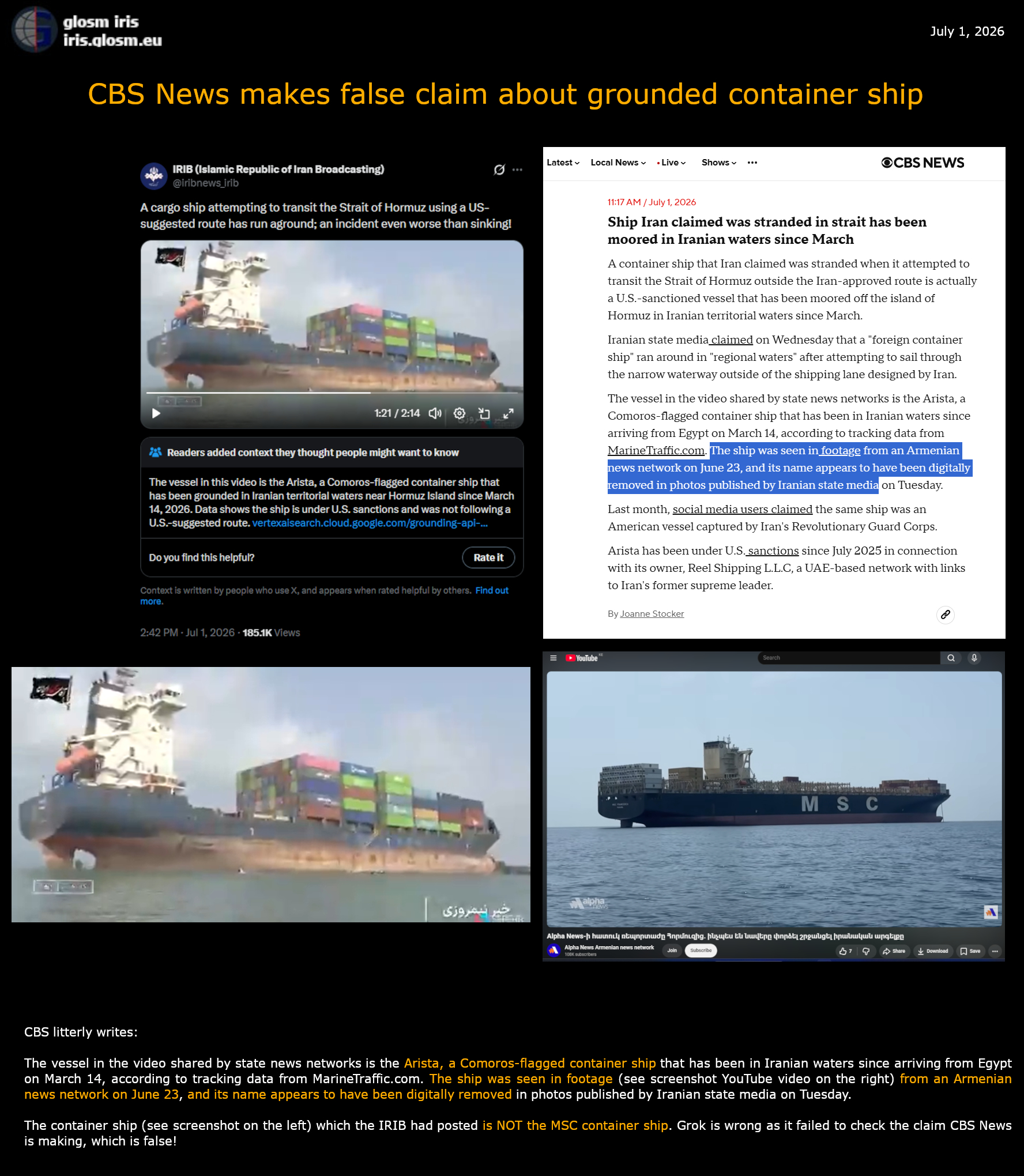
The video posted on X by the Iranian source can be watched here.
The Armenian YouTube video, which CBS News referred to can be watched here.
|
Deadly Minab school attack will not be forgotten: Iran’s UN envoy
Ambassador Ali Bahreini says Iran will not allow the world to forget the attack as he held a virtual meeting with survivors and witnesses.
The missile strike on February 28 – when the US and Israel launched their unprovoked attack on Iran – killed at least 168 children and teachers. The victims were mostly young girls and boys.
According to Iranian state media, Bahreini said: “The duty of justice demands that we ensure the victimization … and crimes against civilians are not forgotten over time. Today, there is no country that does not recognize the criminal nature of this attack or is unfamiliar with the name of Minab school.”
Neither the United States nor Israel has owned up to the school strike. “Without any doubt, responsibility for this act lies with the United States and Israel as the aggressors,” said Bahreini.
|
|
|
Freedom of navigation in Hormuz ‘most important outcome’ of US-Iran talks
The “most important outcome” of the US-Iran agreement is to get commercial vessels moving again, an analyst says.
“This is of utmost importance not only to the cities on the Arab Gulf but to the global economy,” said Wolfgang Pusztai, a security analyst and former Austrian defense attaché.
The current situation is already beneficial for Tehran “as Iran is able to export oil and this means it is able to fill up its financial reserves”, he said.
“So the longer this situation lasts, the more Iran benefits from the financial revenues,” Pusztai said.
Iran said it will hold talks on the US-Iran deal with mediator Qatar today in Doha.
|
|
|
US-Iran ‘technical talks’ now under way in Qatar
Unnamed sources are telling that negotiations at the “technical level” between Iran and the US have now started in the Qatari capital, Doha. However, no face-to-face meetings between top officials from either side are planned.
There are at least three working groups in Doha tackling the technical discussions: the nuclear issue, diplomacy, and financing and return of frozen funds, sources said.
|
|
|
Israel sanctions Revolutionary Guard-linked crypto wallets
Defense Minister Israel Katz’s office has announced sanctions against 37 digital wallets linked to the Islamic Revolutionary Guard Corps (IRGC).
The ministry in cooperation with Israel’s intelligence community exposed the crypto wallets used by the IRGC to send funds with a total value of about $6.6m to Lebanon’s Hezbollah and other armed groups, according to Israeli media.
“The campaign against Iran is not only being waged on the battlefield but also in the fight for the money that drives terrorism,” Katz was quoted as saying by The Jerusalem Post.
|
|
|
EU agency warns airlines should still avoid airspace over Iran
The European Union Aviation Safety Agency (EASA) says flight routes over Iraq and Lebanon should also not be used because of uncertainty surrounding the US-Iran ceasefire and the possibility of rapid escalation.
It advised commercial aircraft to remain cautious when flying throughout the Middle East.
The EASA said it’s extending its conflict-zone advisory for the region until July 8 after previously extending it to July 1.
|
|
|
‘The ball is in the United States’s court’
The next phase of US-Iran talks in Doha depends on Washington implementing the memorandum of understanding it signed with Tehran, an analyst says.
Zohreh Kharazmi, a professor at the University of Tehran, said she does not expect major progress on the Strait of Hormuz unless the terms of the MoU are carried out by the US.
“The articles of the MoU should be realized to have a step forward. The ball is in the United States’ court,” she said.
Iran doesn’t view the Doha meetings as high-level talks, she added, noting Tehran is sending Deputy Foreign Minister Kazem Gharibabadi and discussions are focused on technical issues including frozen Iranian assets.
|
|
|
Developments US-Iran negotiations
Iranian officials are in Doha for indirect talks with Qatari mediators a day after US negotiators Steve Witkoff and Jared Kushner met Qatar’s prime minister.
Washington says technical talks with Tehran are continuing. Iran denies holding face-to-face talks with the United States and says discussions are focused on implementing the interim deal, including the release of frozen funds.
Alex Vatanka, of the Middle East Institute, said there is growing pushback inside Iran over whether the agreement will be implemented. “This MoU sounds impressive on paper but where is the action?”
|
|
|
Lebanon seems to be sticking point in Doha US-Iran talks
At least three sets of working groups are in Doha. They’re working on a number of issues including the nuclear file, the finances vis-à-vis Iran’s frozen funds, as well as diplomacy regarding implementation of the memorandum of understanding (MoU) and the way forward.
Simultaneously, these working groups have been working on the MoU between the US and Iran with mediators Pakistan and Qatar. There are also US negotiators Steve Witkoff and Jared Kushner who’ve been in Doha for the last 24 hours.
Among other things, they’re discussing the issue of Lebanon, so it’s a complicated layer-cake of diplomacy that needs to be discussed, because the Iranians have said they won’t move forward unless the MoU is respected. Israel’s withdrawal from Lebanon seems to be a sticking point.
Iran wants its assets to be unfrozen. About $6bn worth of funds are in Qatar, and more than $150bn is reportedly held in seven different countries all over the world.
|
|
|
Israel could strike Iran ‘a third time’, defense minister says
Israeli Defense Minister Israel Katz says Israel could target Iran again “if it deems it necessary” despite ongoing US efforts to pursue diplomacy.
Speaking at a memorial ceremony for those killed in the 2006 war in Lebanon, Katz said: “We have attacked twice with proactive, preemptive strikes in Iran and, if necessary, we will strike a third time as well.”
Israeli forces will remain indefinitely in what he called “security zones” in Lebanon, Syria and Gaza to protect Israeli communities, he added.
|
|
This proofs that the Israelis are an existential threat to the region, as they already have proven by spilling over the war on Iran into Lebanon and their exploitation of the fall of the Assad regime since late 2024.
|
Iran’s Araghchi blasts Israel for comments on supreme leader
Iran’s Foreign Minister Abbas Araghchi has reacted strongly to remarks by Israeli Defense Minister Israel Katz who said Iran’s Supreme Leader Mojtaba Khamenei is “marked for death”.
“The terms of the Islamabad MoU are crystal clear and public for all to see,” Araghchi said. “[President Trump] has committed the US to muzzling its pets in Tel Aviv. If they ignore their master Iran will school them.”
In quotes shared by Israeli media on Monday, Katz described the Iranians as “good merchants” trying to extract concessions in negotiations, and said Israel would not allow Iran to produce nuclear weapons.
In response, Araghchi said “any threat against our people and leadership will receive immediate powerful response.”
|
|
What does international law say when the Israeli war belligerent, which it is since 1967, declares the leader of Iran as “marked for death”?
Under international law, declaring a foreign head of state "marked for death" violates the sovereignty of that nation and disrupts international relations. When two nations are not legally in a state of declared war, or even during armed conflicts, international law governs these actions through specific frameworks. For instance:
Customary international law grants sitting heads of state, heads of government, and foreign ministers absolute personal immunity from the jurisdiction of foreign states. Threatening, attempting, or executing the assassination of a recognized foreign leader is considered an unlawful breach of this inviolability.
Like in the assassination of the late Iranian Supreme Leader Khamenei, where the CIA assisted the Mossad, the US might be hold again responsible under state responsibility laws if Trump does not lift his declaration of war on Iran, he had issued on February 28, 2026.
|
Israeli ex-army chief accuses Netanyahu of ‘fabricating’ Iran nuclear claims
Israel’s former army chief Gadi Eisenkot has accused Benjamin Netanyahu of making up claims that Iran possessed nuclear weapons to frighten the public.
According to the Israeli daily Yedioth Ahronoth, Eisenkot made the remarks at a conference in central Israel, saying the prime minister’s statements on Iran’s nuclear capabilities were false.
“Netanyahu said repugnant things. Iran had no nuclear bombs whatsoever. He is fabricating reality to frighten the Israeli public,” Eisenkot, who is also the head of the opposition Yashar party, was quoted as saying.
Eisenkot was referring to comments Netanyahu made on Tuesday in an interview with Israel’s Channel 14, in which he said: “I entered Iran twice to save us from annihilation by atomic bombs that were already in their hands.”
Iran has long denied seeking nuclear weapons, insisting its nuclear programme is exclusively peaceful.
|
|
We don't need the Israelis to find out that Netanyahu lies, as our website provides all information about how the Israelis in 1967 became a nuclear power before they started scapegoating and attacking Iran in 2010.
On December 30, 2025, several mainstream media, which even included Fox News, have published a video containing a summary of 30 years Netanyahu's lies about Iran's nuclear program.
|
Shipping unions, firms list Hormuz as a war zone after latest strikes
Shipping unions and companies say they’ll continue to designate the Strait of Hormuz as a war zone after two ships were attacked last week despite a ceasefire between Iran and the US.
“This decision recognizes the continuing and significant risk to life and the rapidly evolving situation in the area,” said a joint statement by the International Transport Workers’ Federation union and the Joint Negotiating Group, an umbrella organization representing shipping owners.
The strait was first designated a “war-like operations area” on March 5 after ships trying to transit the vital waterway were bombed. The status will now last until at least July 9 and will be reassessed weekly.
Under the designation, mariners are paid double and receive other benefits, increasing costs for shipping companies.
At least 14 seafarers have been killed and more than 40 ships attacked since the US-Israeli war on Iran began on February 28.
|
|
|
Tehran’s message to Gulf is ‘it needs to get on board with Iran’s view of future’
Joey Hood, a retired US diplomat, says he would’ve advised the Trump administration against attacking Iran and not signing the current memorandum of understanding (MoU).
“If it had happened anyway, I wouldn’t have advised signing this MoU with the current language because it’s written in typical diplomatic language – which is a little bit vague and ambiguous – to give both sides a chance to save face and get out of the conflict,” Hood said.
“They took this MoU as a declaration of sovereignty over the strait and, therefore, a declaration of sovereignty over the Gulf economies and a say in what happens in Lebanon.”
Hood stressed Iran tried to “globalise the conflict beyond just the US and Israel”.
“When they struck ships in Omani territorial waters they did not strike any ship – they struck a ship carrying Qatari crude,” he noted.
“They are putting pressure on the mediators – Qatar and Oman. They are trying to demonstrate to the Gulf countries that they need to get on board with the Iranian view of the future and not stick with the United States.”
|
|
|
Maritime access, Lebanon truce key points in US–Iran talks
A unnamed source with direct knowledge of the ongoing Doha talks outlines Iran’s current positions in negotiations with the United States like this:
- Qatari and Pakistani mediators are providing technical support to reach preliminary agreements that can later be elevated to decision-makers from both nations.
- Iran insists five key provisions of the memorandum of understanding (MoU) must be implemented before it’s willing to move on to other key issues.
- The interim deal includes commitments linked to ending Israel’s war on Lebanon, facilitating the return of displaced people, and restoring Lebanese sovereignty across its territory.
- Iran believes Israel is undermining the agreement through continued attacks and attempts to occupy strategic areas in southern Lebanon, the source said.
- Tehran is pushing for access to its frozen assets, which it says must be made available to its central bank to facilitate international purchases.
- On maritime issues, Iran has committed to ensuring safe passage of vessels in the Strait of Hormuz but insists it remains under Iranian and Omani sovereignty.
- Tehran remains committed to the Nuclear Non-Proliferation Treaty and ongoing cooperation with the International Atomic Energy Agency.
|
|
|
Iran president says some financial restrictions eased as talks continue
President Masoud Pezeshkian says some financial and currency restrictions on Iran have been eased, according to the semi-official Fars news agency.
Pezeshkian said the continued export of oil, the easing of some financial and foreign-exchange restrictions, and new opportunities for economic cooperation are among the results of Iran’s recent agreements.
This year Iran’s currency reached an all-time low during increased tensions with the West and the unrest gripping the country. The US unilaterally abandoned the 2015 Iran nuclear deal with world powers in 2018 and imposed harsh sanctions, triggering a new currency crisis.
|
|
|
Trump hails ‘very good meetings’ with Iran
The US president tells reporters in Joint Base Andrews talks with Iran are going “very well” and hailed what he described as “very good meetings”.
|
|
|
‘Iran cannot have a nuclear weapon’: Trump
The US president says Iran has “come a long way”, speaking on the ongoing talks with Tehran.
“We hit them very hard last week,” he said.
Trump added: “The nuclearization of Iran is very simple, and Iran cannot have a nuclear weapon.”
|
|
Since February 28th, this has always been the political motive, not a military objective for Trump, to declare war on Iran without a received UNSC approval. That has been a violation of the UN Charter and illegal by international law.
|
Qatar’s emir meets US negotiators in Doha
Qatar’s Emir Sheikh Tamim bin Hamad Al Thani has met US negotiators Steve Witkoff and Jared Kushner.
The trio discussed the “progress of the negotiations” between the US and Iran, according to a statement from the emir’s office.
The situation in Lebanon and the “importance of consolidating the ceasefire” there were also addressed, it said.
|
|
|
US-Iran talks in Doha serve ‘to avoid any misinterpretation’
The ongoing Qatar negotiations between mediators and American and Iranian officials serve to “add some meat to the original agreement to avoid any misinterpretation in the future”, says analyst Rashid al-Mohanadi.
The original memorandum of understanding is “just a two-page document, so from an analytical point of view, I was certain there would be interpretation issues”, the vice president of the Center for International Policy Research said.
“We saw these translate last weekend when Iran attacked commercial shipping in the Strait [of Hormuz] after Oman worked with the International Maritime Organization to issue a safe passage through,” he said.
The Doha talks also aim to “activate other tracks” in the US-Iran deal.
“We have a regional security track, a nuclear track, a track ready through the Strait of Hormuz, but also a track related to economic development, sanction relief and assets,” he said.
|
|
|
Ships still using Oman route through Hormuz despite Iran warnings
Vessels are continuing to pass through the Strait of Hormuz using the Oman-designated route despite Iran’s rejection of the lane and warnings to ships crossing outside routes approved by Tehran.
Data from maritime monitors (Kpler, MarineTraffic) showed 21 ships, including oil tankers, have used the Omani route since the first meeting of the joint Iranian-Omani Hormuz committee on June 29. The committee was set up to continue talks on managing navigation in the strait and related services.
Oman announced the shipping transit route last week saying it coordinated it with the International Maritime Organization to help ensure freedom of navigation through the strait.
It runs near Oman’s Musandam Peninsula and offers ships a shorter, no-fee passage during rising tensions in the Gulf.
|
|
|
Principle objective of US negotiators is ‘implementation’
US President Trump has said that “the denuclearization of Iran is moving along very well”, that they’ve had very good meetings, and “we’ll see [how the situation progresses].” This is kind of a vague statement from Trump, but reading into this we can at least point to a sense of optimism and a softer tone from the US president.
If we could boil this down into a single phrase of what the Americans are hoping to achieve, it’s implementation. In principle, at least, a ceasefire agreement has already been reached.
For US negotiators, the principal objective here is transforming these political commitments into practical steps forward. One of these main points, at least for US officials, is normalizing commercial shipping. The issue of Iranian assets is another main sticking point, but so is preventing any further military escalation that could derail or undermine the broader efforts to find peace between these two countries.
|
|
|
Iran’s deputy FM says meeting in Doha attended by Qatari, Pakistani officials
Iranian Deputy Foreign Minister Kazem Gharibabadi was quoted by the semi-official Mehr news agency as saying that no meeting took place between the Iranian and American delegations in Doha.
He said that the Iranian delegation’s meetings in Doha were held only in a trilateral format with the Qatari and Pakistani delegations.
He added that the meetings of the Iranian delegation with the Qatari and Pakistani delegations were to follow up on the implementation of the provisions of the memorandum of understanding with the US, especially regarding Lebanon and the release of Iran’s frozen assets.
|
|
|
US says if Iran tries to ‘threaten its neighbors’, Trump ‘has options’ for responding
US Vice President JD Vance says that if Iran pursues various measures he says could destabilize the region, then Trump has several ways in which he could respond to the Islamic Republic.
“If Iran attempts to rebuild its nuclear program, threaten its neighbors and support terrorism, President Trump has options to deal with it,” Vance said in a statement.
Iran has consistently denied allegations that it is pursuing a nuclear weapons program.
Vance added that the US “dropped bombs on Iran because it fired on ships, and we used leverage to ensure safe passage through the Strait of Hormuz”.
The vice president also confirmed that a US delegation is holding indirect talks with Iran in the Qatari capital Doha “to discuss the details and flow of maritime traffic”.
|
|
|
Return to normal in Hormuz Strait to take months: French shipping group
French shipping company CMA CGM hopes the shipping situation in the Strait of Hormuz will improve in the coming days but expects a return to normal to take several months, its chairman and CEO Rodolphe Saade told the French business daily Les Echos.
The group has had several vessels stuck inside the Gulf since the US-Israel war on Iran began at the end of February, Saade said during the interview.
In peacetime, about 20 percent of the world’s oil passes through the strategic waterway.
|
|
|
Vance says negotiations with Iran going ‘extremely well’
Vance says that negotiations with Iran “have gone extremely well” and that the US is “working to ensure that the progress we have made continues”.
He said that Trump’s “instructions are clear: to press ahead to reach an agreement and to negotiate in good faith”, adding that “we see significant momentum amongst those within the Iranian regime who are seeking to turn a new page”.
|
|
|
Airlines resume some flights to region, but disruptions continue
Some airlines are restoring flights to parts of the Middle East as diplomatic efforts to end the conflict gather pace, but many carriers have kept suspensions in place that continue to disrupt global travel.
Air Canada
The Canadian carrier has cancelled flights to Tel Aviv and Dubai until October 24.
Air France-KLM
Air France has suspended its Tel Aviv flights until July 2, to Dubai until July 5 and to Beirut until July 9.
Its Dutch partner KLM has suspended flights to Riyadh, Dammam and Dubai until August 23.
Delta
The US carrier has suspended services on its Atlanta-Tel Aviv route through December 18.
It plans to resume flights from New York to Tel Aviv on September 6, while the launch of its Boston-Tel Aviv route, planned for late October, has been delayed until further notice.
Lufthansa Group
Lufthansa and ITA Airways resumed flights to Tel Aviv on July 1. SWISS postponed the resumption of flights until August and Brussels Airlines suspended operations until October 24.
Lufthansa and SWISS have suspended flights to Dubai until September 13.
Lufthansa, SWISS, Austrian Airlines and Brussels Airlines suspended flights to Abu Dhabi, Amman, Beirut, Dammam, Riyadh, Erbil, Muscat and Tehran until October 24.
Turkish Airlines
SunExpress, Turkish Airlines’ joint venture with Lufthansa, has cancelled flights to Dubai until June 30 and to Bahrain, Beirut and Erbil until July 14.
|
|
|
CENTCOM leads security meeting with reps from 12 countries in Bahrain
US Central Command (CENTCOM) has led a “security dialogue” alongside Bahrain’s defense forces with military officials from across the Middle East.
Representatives from Egypt, Jordan, Kuwait, Lebanon, Oman, Qatar, Saudi Arabia, Syria, the United Arab Emirates and Yemen discussed “enhancing defence collaboration across the region”, CENTCOM said in a post on X.
CENTCOM Commander Admiral Brad Cooper said the discussions “underscored our shared commitment to regional security and stability”.
|
|
|
Omani, Dutch FMs discuss Strait of Hormuz
Oman’s Foreign Minister Badr bin Hamad Albusaidi has spoken with his Dutch counterpart Tom Berendsen.
They discussed diplomatic efforts to resume “maritime navigation in the Strait of Hormuz”, as well as upping coordination in energy, transportation and supply chains, according to a readout from Oman’s foreign ministry.
|
|
|
Iran says communication channel to be established to discuss MoU breaches
Iran’s Deputy Foreign Minister Kazem Gharibabadi says a communication channel will be established to report and discuss breaches of the MoU reached between the US and Iran, reported the official IRNA news agency.
Following a meeting with Qatari mediators, Gharibabadi also said that part of the $6bn in frozen Iranian assets would be used to purchase goods that Tehran requires.
|
|
|
Israel is killing the US-Iran MoU by staying in Lebanon
During a visit to troops in southern Lebanon on June 30th, Netanyahu declared that the military “will not leave” the area as long as the Iran-backed armed group Hezbollah remains a “threat” to his nation.
A day earlier, Israeli Defense Minister Israel Katz also said Israel’s military will not withdraw “a millimeter” until Hezbollah is disarmed.
But the Israeli stance is squarely at odds with the first clause of the US-Iran MoU, which provides for an immediate, permanent halt to fighting on “all fronts”, including in Lebanon where Israeli forces have occupied approximately one-fifth of the country since early March.
That provision has since been undercut by a separate US-brokered framework agreement between Israel and the Lebanese government, which doesn’t require Israeli forces to leave southern Lebanon or halt attacks.
The result has been an entrenchment of Israel’s military presence in Lebanon.
|
|
"...as long as the Iran-backed armed group Hezbollah remains a 'threat' ..."
The Israelis have been a threat to Lebanon since they started using the country's airspace in 2013 for attacks in Syria. Then, he spilled over his resumption of the preemptive 12-day war on Iran to Lebanon by assassinating the Iranian leader Supreme Leader Khamenei, while knowing that Hezbollah would respond. So, Netanyahu brought the threat to Lebanon. This is clear the politics of always blame the victim.
|
Iran’s Pezeshkian insists supreme leader did not bar negotiations
Iranian President Masoud Pezeshkian has defended Tehran’s negotiations with the US amid criticism that Supreme Leader Mojtaba Khamenei did not sign off on the MoU.
In remarks reported by the state news agency IRNA, Pezeshkian said that if Khamenei “had ordered not to negotiate, we would have definitely obeyed”.
The supreme leader’s view on the US-Iran MoU has been a topic of much domestic debate in Iran after he said he “held a different view” on the agreement.
|
|
|
Israel threatens Iran
The June 17 signing of an MoU between Iran and the US to end the war has been followed by limited exchanges of fire and repeated threats of reignited conflict.
Israel appears most eager to resume large-scale military strikes against Iran and its infrastructure, with Defense Minister Israel Katz saying on Monday that targets are already selected and the army awaits an order to deploy fighter jets.
According to Israeli media, Katz told reporters that the war could immediately resume if US President Donald Trump decides the negotiations with Iran – which Israel vehemently opposes – will not yield results, or if Iran attacks Israel.
Iran’s Foreign Minister Abbas Araghchi responded on Wednesday, saying that “any threat against our people and leadership will receive immediate powerful response.”
|
|
|
Iran’s president defends allocation state oil
In addition to defending Tehran’s decision to negotiate with the US, Iranian President Masoud Pezeshkian has brushed aside criticisms about state oil reportedly allocated to the Islamic Revolutionary Guard Corps (IRGC) Aerospace Force.
“Defending the country’s armed forces is my duty, and I am proud of it,” Pezeshkian said in comments reported by the semi-official Tasnim news agency.
The president said last week that Iran had allocated 20 million barrels of oil to the force. Responding to critics, he pledged that if “such a situation arises again, I will provide them with not just 20 million barrels, but 100 million barrels”.
|
|
|
Inspection of Iran’s bombed nuclear sites ‘not allowed’: Parliament speaker
Inspection of nuclear sites that have been bombed and damaged “is not allowed under any circumstances”, Iran’s Parliament Speaker and negotiator Mohammad Bagher Ghalibaf has said.
Speaking with Iran’s Student News Network, Ghalibaf affirmed the International Atomic Energy Agency (IAEA) has only received access to two sites in Iran, including the Bushehr power plant.
“The access is only to this extent, and we are committed to it,” he added.
|
|
|
Qatar says ‘positive progress’ made in Doha talks
Qatar’s Foreign Ministry spokesperson says “positive progress” was made on issues related to the MoU following a separate meeting of Qatari and Pakistani mediators with the US and Iranian delegations in Doha.
“The parties agreed to continue discussions over the coming period, with the next meeting to be scheduled at the earliest possible time following the funeral processions of the former Iranian Supreme Leader,” the official said in a post on X.
|
|
|
Israeli opposition signal foreign policy change in style, but not substance
Leading figures from the Israeli opposition have used the country’s prestigious Herzliya Conference to lay out their policy agendas, but analysts and observers noted that their foreign policy positions differ little from those of Netanyahu’s governing far-right coalition.
None of the three main opposition figures – former military Chief of Staff Gadi Eisenkot, and former Prime Ministers Yair Lapid and Naftali Bennett – offered attendees at Reichman University on Wednesday much criticism of Israel’s recent wars in Gaza, Lebanon and Iran.
|
|
In other words: no change in Netanyahu's wars to be expected after the upcoming Israeli election in October.
|
Israeli resumption of its preemptive 12-day war on Iran changed the global energy sector forever
Since Israel with the United States launched a war on Iran on February 28th, the global energy sector has undergone major upheaval.
While ongoing US-Iran negotiations to reach a lasting peace have raised hopes for a return to stability in oil and gas markets, the war has already transformed the global energy landscape in ways that are likely to be long-lasting and even permanent, according to energy experts.
|
|
"Israeli resumption of its preemptive 12-day war"
Read tab 5 & 6 on this page.
|
Iran’s red lines challenge US negotiators, but not insurmountable
Gordon Gray, a former US diplomat, said that Qatar’s statement that said the US-Iran talks are making “positive progress” suggests both sides are engaging seriously.
“Well, ‘positive progress’ is a lot better than saying there were ‘frank and candid exchanges’, which is diplomatic speak for: the talks went terribly,” Gray said.
“I take that as a good sign.”
But Gray added that the indirect nature of the talks is not an “encouraging sign”.
He continues to say that some of Iran’s red lines would pose significant challenges for US negotiators, while others would likely be acceptable to Washington, or have long been established Iranian positions.
Then he said that Iran’s position on the Strait of Hormuz, where it seeks to retain control, would be a “non-starter” for the US and would violate international law.
However, he added that there could be creative workarounds on the issue, and Oman, which sits on the other side of the strait, was in a position to assist.
“It is going to be much more difficult for the United States not to agree to make progress on the Lebanon file,” he said. “That being said, for President Trump, it is of secondary importance, and so I don’t think it would hold up an agreement.”
Iran’s right to enrich uranium, another major sticking point, is not a new position. It has been a red line for Tehran dating back to the shah, Gray said.
“For the United States, it is not the right to enrich; it is the level of enrichment that is allowed – the inspection regimes.”
|
|
|
Iran’s military capabilities are non-negotiable, says defense minister
Iran’s acting defense minister has reiterated that the country’s military capabilities are a “red line” and will not be discussed during negotiations with the US.
“The Islamic Republic’s defense, missile, and drone capabilities are a red line for our national security,” Majid Ebn al-Reza said.
“They are not negotiable—now or in the future,” he added.
Al-Reza also said that Iran’s “missile and drone programs will continue to advance”.
Iran is believed to have used thousands of drones during the war, launching them at its Gulf neighbors. The unmanned aircraft are relatively cheap for Tehran to mass-produce and can overwhelm air defense systems when deployed in large numbers. Intercepting them has also proved costly, with the US using missiles worth more than $1 million dollars to shoot down a single drone.
|
|
|